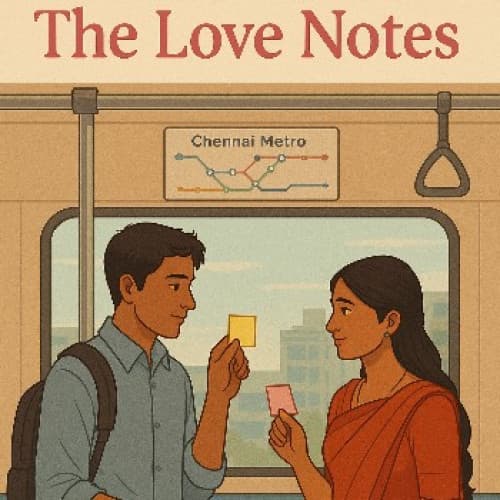

Every morning at 8:17, the Chennai Metro slid into Thirumangalam station with the same tired sigh. The platform smelled of filter coffee from the stall upstairs and damp concrete from the night’s humidity. Among the crowd that surged in, two people boarded the same coach without knowing each other’s names.
He always stood near the door, backpack slung on one shoulder, pretending to read the route map while actually watching reflections in the glass. She preferred the corner by the priority seats, hair braided neatly, fingers tapping nervously on her phone though the screen stayed dark.
They noticed each other the way strangers in cities do—accidentally, then deliberately.
It began with a sticky note.
One Monday, as the train lurched between CMBT and Koyambedu, he felt something brush against his elbow. A small yellow square had been stuck to his bag.
“Your watch is five minutes fast.”
He smiled before he could stop himself. When he glanced around, their eyes met for a fraction of a second. She looked away immediately, mortified, pretending to adjust her dupatta.
The next morning, he came prepared.
As the doors closed and the train picked up speed, he peeled a pink sticky note and carefully pressed it onto the metal pole near her hand.
“Better early than late.”
She read it. Her lips curved, just slightly.
From that day on, the sticky notes became their language.
They never spoke. Not even once.
Yellow notes became observations:
“You always get down at Alandur.”
“You hum when the train slows down.”
Blue notes became confessions disguised as jokes:
“Metro is less boring since last week.”
“I now look forward to Mondays.”
Green notes carried questions:
“What do you do after you get down?”
“Why do you always stand near the door?”
Answers arrived the next day, sometimes two days later, written in careful handwriting or rushed scrawls, depending on how crowded the coach was.
“I work at an architecture firm. I like buildings that breathe.”
“I stand near the door because leaving is easier than staying.”
They learned each other in fragments—favorite stations, disliked songs playing on the metro speakers, shared irritation at people who blocked the doors, shared amusement at tourists staring wide-eyed at the tunnel walls.
Once, when the train stopped abruptly and the lights flickered, panic rippled through the coach. In the confusion, their hands brushed. They didn’t pull away immediately. That night, a single white sticky note appeared:
“Thank you for holding my hand.”
Weeks passed. The notes grew bolder.
“I think I would recognize you even in a crowd.”
“I already do.”
But still, they didn’t speak.
Speaking would break the spell.
On a rainy Friday, she didn’t board the train.
He waited, eyes searching every face, heart thudding louder than the announcement chime. At Alandur, when the crowd thinned, he noticed a sticky note stuck to the window.
Orange.
“Got transferred. This is my last week on this route.”
His chest tightened. The next day, his reply waited on her usual pole.
“Then we are running out of notes.”
Saturday came. Her last day.
The metro was unusually empty, rain streaking down the windows like unfinished sentences. She stood where she always did. He stood by the door. Between them, on the glass, was a large pink sticky note.
“Tomorrow, 8:17. Same station. Outside the gates.”
For the first time, they looked at each other and didn’t look away.
The next morning, at Thirumangalam station, among vendors and commuters and the smell of coffee, two strangers stood uncertainly near the exit gates.
He held no sticky notes. Neither did she.
They smiled.
And finally, they spoke.