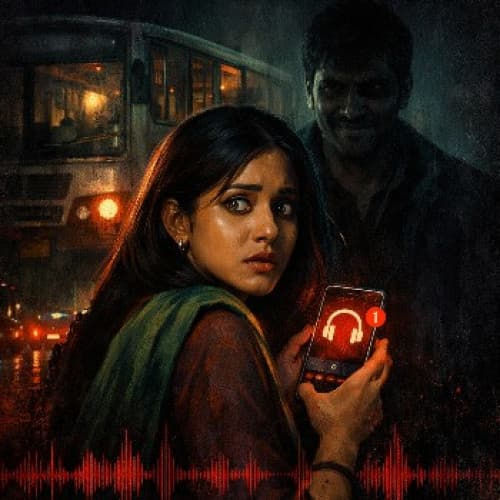

By the time the third episode crossed ten thousand listens, Ananya knew she was being followed.
It began with a detail she had never shared publicly.
Her podcast—Night Bus Stories—was built on overheard lives: confessions whispered on long-distance buses, half-truths traded over cutting chai, grief wrapped in anonymity. She never used real names. She never gave locations more specific than “a coastal town” or “a city that doesn’t sleep.”
Yet, one humid Thursday night in Bengaluru, as she locked her studio and walked toward the metro, her phone buzzed with a new email.
Subject: You missed one sound.
The body read: The bus didn’t just hiss when it stopped. The left door rattled. You should have kept that in.
Ananya stopped walking.
That sound—the rattling left door—was something only one person could know. The man who had stood beside her on the night bus to Mysuru, the night the woman was murdered.
She had never planned to be a witness.
It was six months ago, during the monsoon, when the rain had turned the highway into a ribbon of mirrors. The bus was half-full. Ananya sat near the back, headphones on, editing an episode. Somewhere near Mandya, the bus slowed. Voices rose. Then a scream—short, sharp, abruptly cut.
She remembered the smell first: wet earth and diesel. Then the thud, like a sack of rice hitting the road.
The driver didn’t stop for long. Someone said it was an accident. Someone else said nothing at all.
Ananya had looked out the window and seen a woman lying unnaturally still, her bangles shattered like spilled candy. A man stood near her, his face half-lit by the bus’s interior glow. Calm. Almost bored.
Their eyes met.
That was when he smiled.
At the police station, she gave her statement. A man in a khaki uniform scribbled without looking up. “Too dark,” he said finally. “You’re not sure.”
She was sure.
But certainty, she learned, was not evidence.
So she did what she knew how to do. She recorded.
The first episode wasn’t about murder. It was about silence—how buses carried it, how witnesses swallowed it. The second episode described a man who smiled at the wrong moment. The third mentioned broken bangles.
And now, someone was listening closely.
After the email came the comments. Anonymous usernames. Corrections. Suggestions.
The rain was heavier than you described.
She was already dead when she hit the road.
You’re getting closer. Be careful.
Ananya changed her routine. She stopped taking the metro. She avoided eye contact. She checked reflections in shop windows, in parked cars, in the darkened screen of her phone.
And still—every new episode felt anticipated.
She tested it once.
In Episode Seven, she added a lie. She said the killer had a limp.
The next morning, her inbox held a single line:
You know that’s not true.
Her hands shook as she deleted it.
The police were uninterested in podcasts and paranoia. Friends told her to stop. “You’re feeding a troll,” they said. “This is India. Nothing happens.”
But something had happened. And it was still happening.
Late one night, while exporting Episode Ten, the power went out. Bengaluru darkness—sudden and absolute. The ceiling fan wound down with a tired sigh.
In the silence, her phone rang.
Unknown number.
She didn’t answer.
A notification popped up instead. A new voice message—sent, somehow, through the podcast platform itself.
She played it.
At first, there was only breathing. Slow. Measured.
Then a voice. Male. Close to the microphone.
“You tell the story well,” he said in Kannada, soft and amused. “But you still don’t understand it.”
Ananya’s throat went dry.
“You think I follow your episodes,” he continued. “That’s backward.”
A pause. The faint sound of traffic. A horn. Familiar.
“I follow you,” he said. “The episodes follow me.”
Her window rattled. The left pane. Exactly like the bus door.
She didn’t scream.
Instead, she opened her recorder.
The power flickered back on, bathing the room in harsh white light. Outside, the street was empty. No footsteps. No shadow retreating.
Her phone buzzed again.
Subject: Final episode?
Ananya stared at the waveform on her screen—her own breathing, captured and waiting to be shaped into sound.
She began to speak.
“This is a story about listening,” she said, voice steady despite everything. “About how killers believe control lives in silence.”
She uploaded the episode live.
In it, she described the man’s voice. His pauses. The sounds behind him. The exact pattern of traffic noise she had grown up with—the flyover near her childhood home in Hassan.
She ended with an address she did not name, but anyone from there would recognize.
The response was instant. The live listen count surged. Comments exploded. Some begged her to stop. Others told her she was brave. A few simply typed listening emojis, over and over.
Her phone rang.
Unknown number.
This time, she answered.
“You shouldn’t have done that,” the voice said. No amusement now.
Ananya smiled, though he couldn’t see it.
“You’re right,” she said. “I shouldn’t have.”
Outside, sirens wailed—near or far, she couldn’t tell.
The call went dead.
Ananya looked at her screen. The episode was still streaming. Thousands of people listening. Recording. Remembering.
She didn’t know if the police would arrive at the right door.
She didn’t know if he would run—or if he was already standing behind her.
But the story was no longer hers alone.
And somewhere, someone else was listening very carefully.