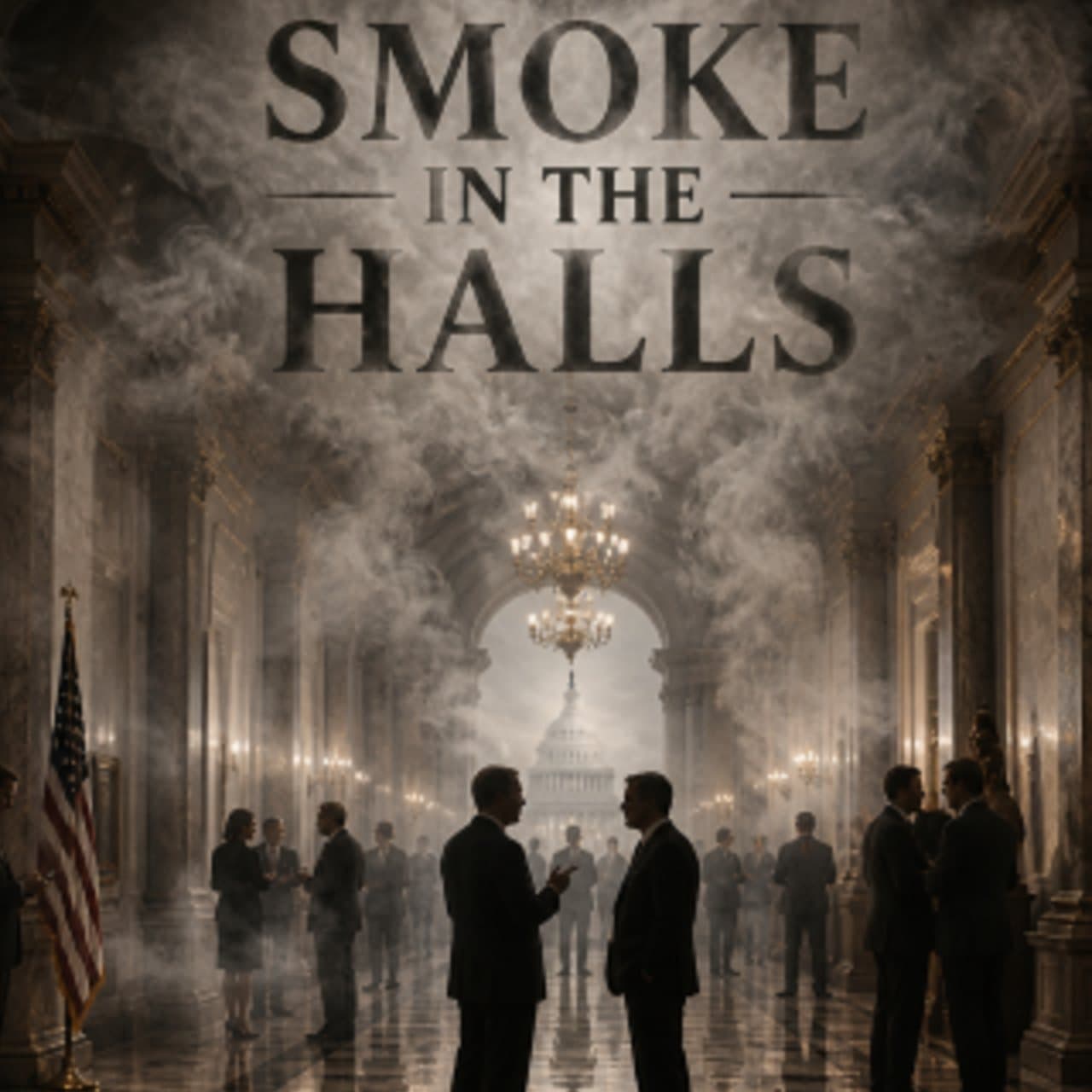
They called it the People’s House, a marble temple of democracy, but everyone knew whose names were really on the doors. The names of senators and committee chairs gleamed on the brass plates, but the real signatures were invisible, etched in campaign ledgers, whispered in the backrooms of the cigar clubs, and stamped on the fine print of bills no one ever read. Senator Markham, the game is better than most. He’d long ago stopped correcting the tour guides who called the building a shrine to the common man. The common man never made it past the security checkpoint.
Senator Markham fixed his tie in the gilded mirror of his private washroom, the one with the monogrammed towels and the soap that smelled of sandalwood and money. He gave a rehearsal smile—the one he used for town halls, for photo ops, for the widows of fallen soldiers—and walked out into the corridor. The marble floors gleamed with a polished, wet shine, buffed by hands that had never voted for him, hands that belonged to men and women who took the service elevator and avoided meeting his eyes. He passed the endless row of portraits: founding fathers, war heroes, and titans of industry turned statesmen. They all looked exactly like him—same patrician jaw, same silver temples, same distant, knowing gaze that said they had seen the machinery of power and found it both ugly and intoxicating.
Last week, in the sweltering gymnasium of a dying mill town, Markham had stood on a folding chair and promised, with his hand over his heart, that the old factory would stay open. He had looked into the faces of men with calloused palms and women with worry lines deeper than any political trench, and he had shaken their hands with both of his. He had felt their gratitude like a warm current. He had almost believed himself. But that was last week. This week, in the cool, silent privacy of his oak-paneled office, he had signed the paper that sent their jobs overseas. The pen had glided across the page like a knife through butter. Almost as soon as the ink was dry—before it had even stopped glistening under the desk lamp—the lobbyists began to call. They always called. Their voices were hushed and reverent, the kind of voices you use in a cathedral or a casino. They didn't threaten; they never had to. They simply reminded him of the super PAC that had bought his last election, of the cushy consulting firm that awaited his retirement, and of the private school that his grandson would attend. And their checks, when they arrived in unmarked envelopes, were heavy enough to silence any ghost.
He wanted to think he could still do some good. That beneath the layers of compromise and convenience, there remained a clean place on his soul, a small, uncorrupted island where the boy from the Midwest still believed in service over self. He clung to that image the way a drowning man clings to driftwood. He told himself that every vote he sold bought him leverage for the next one, that every lie he told gave him cover to tell a smaller truth later. But the arithmetic was cruel. Each compromise was a little easier to make, the moral muscles atrophying from disuse. Each lie felt a little less expensive, the price of his conscience depreciating like a stock in freefall. He had started to notice that he no longer flinched when he read his quotes in the morning paper. He no longer tasted the ash in his mouth after a press conference.
At night, when the custodians had gone home and the chatter of aides had faded to a low hum and then to silence, he would walk the empty halls alone. His footsteps echoed off the vaulted ceilings, each one a dull percussion against the marble. He would pause before the chamber doors, running his fingers over the worn brass, listening for the echoes of the oaths he’d taken so many years ago. He remembered his first swearing-in—the Bible's weight under his palm, the tremor in his voice, and his mother's tears. He had once believed the words with the fierce, uncomplicated faith of a young man who had not yet learned the difference between a promise and a transaction. Now, standing in the silent dark, those sacred phrases sounded like somebody else’s prayer—a hymn from a religion he had long ago stopped practicing, recited by a stranger in a mirror who wore his face but not his name. The smoke from the back rooms had seeped into the walls, the carpets, and the very air of the building. And Markham knew, with a clarity that cut deeper than any lobbyist's whisper, that he had been breathing it so long he no longer noticed the sting.
A Poem for the Halls
In marble halls where shadows fall,
A promise cracks behind each wall.
Gold on a handshake, dust on the tongue—
Truth bought and traded, old and young.
The people wait behind the gate.
Their voices low, their patience late.
But power bends the fragile light.
And daybreak always yields to night.
The portraits watch with gilded eyes.
Men who traded truth for lies,
Who swore on scripture, kissed the ring,
And called corruption suffering.
Each corridor a hollow chest,
Each closed door holds a whispered test.
The clerks who polish floors at dawn
Have seen the deals that creep in till morn.
A pen descends like falling snow—
A factory dies, a town lets go.
The ink is still wet; the call comes through:
"We'll double it. You know what to do."
He counts the cost on fingertips.
The stain is already on his lips.
Each compromise, a softer art—
Each lie, a bullet to the heart.
He once believed the words he read.
The oaths he took beside his bed.
Now prayers are scripts, and faith is cheap.
And conscience only moves in sleep.
At midnight, when the guards have gone,
He walks the halls from dusk to dawn.
His footsteps ask the marble floor:
"Who are you now? And who before?"
The echoes answer, cold and thin:
A ghost of what you might have been.
The smoke from back-room deals still clings.
To chandeliers and angel wings.
The people gather in the square—
They do not know or do not care.
They cheer the face, they trust the name,
While someone else collects the blame.
But somewhere in a rusted town,
A mother folds her factory gown.
Her son asks why the plant is closed—
She has no answer she'd disclose.
And in the hall, the senator stands.
The ledger was heavy in his hands.
He sees her face on every page—
A debt he cannot disengage.
What shall it profit, whispers grace,
To gain the world and lose your face?
To trade your soul for marble floors,
And keep the truth hidden away?
He turns the key, he dims the light—
Another deal concluded right.
But somewhere deep, the question stays.
Burning through the silent days:
When all the gold has turned to rust,
And all the handshakes turn to dust—
What name remains when halls are bare?
And who will breathe the evening air?
The smoke still curls, the votes are cast,
The present swallows up the past.
But in the hush of empty rooms,
A conscience stirs—and still assumes
That somewhere, past the gilded gate,
The truth might yet arrive, though late.
That daybreak, tired of yielding night,
Might find a crack and let in light.