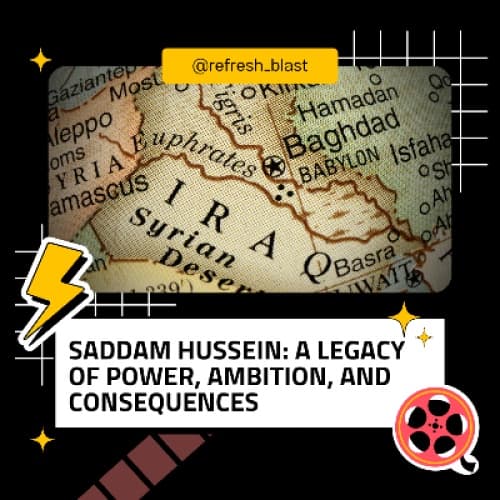

Rising from the Ashes: A Story of Grit and Power
What drives a man to rise from a humble village to ruling a nation with an iron grip? Saddam Hussein’s journey is a testament to ambition, strategy, and the ever-present complexities of leadership. Born into poverty in a small Iraqi village, young Saddam faced a rough childhood but refused to let his circumstances define him.
At 10, he fled to Baghdad, seeking a better life, and later joined the Ba’ath Party—a decision that would alter the course of history. His sheer determination catapulted him into power, and by 1979, he was the President of Iraq. A story of perseverance, or a warning about unchecked ambition? You decide.
"Power is neither good nor evil; it reveals the truth about those who wield it."
Building a Nation, But at What Cost?
Saddam didn’t just rule Iraq; he reshaped it. Roads, schools, hospitals—his infrastructure projects modernized the nation. Literacy rates soared from 52% in 1977 to 80% by 1987, and free healthcare became a reality. For a moment, Iraq seemed to be on a path to prosperity.
But power has a dark side. The same man who electrified villages also ordered brutal purges, suppressed dissent, and waged war against his own people. Was his rule one of progress or oppression? Can a leader be both a builder and a destroyer?
Fun Fact: Iraq’s economy was once one of the strongest in the Arab world, with Baghdad earning the title “The Paris of the Middle East.”
"A ruler who fears his people more than his enemies is bound to fall."
War, Chaos, and the Price of Power
2003: The world watched as the U.S. invaded Iraq, claiming Saddam possessed weapons of mass destruction. But those weapons? They never existed. What followed was an era of destruction, instability, and endless conflict. Tens of thousands of lives were lost, and Iraq fell into chaos.
What happens when a nation’s leader is removed without a clear plan? The rise of ISIS, sectarian violence, and the loss of cultural heritage proved that war doesn’t just end with a victory—it leaves scars that take generations to heal.
Did You Know? Over 125,000 U.S. troops were deployed in Iraq at the height of the war, but the biggest casualties were innocent civilians caught in the crossfire.
"A power vacuum doesn’t create peace; it breeds conflict."
Lessons from Saddam’s Legacy
Love him or loathe him, Saddam’s life offers lessons in leadership, ambition, and the perils of absolute power. His story is a warning: a nation’s future cannot rest in the hands of one man. The fall of his regime reminds us that change must be carefully planned, or chaos will take its place.
What can we learn? That leadership is about more than ambition—it’s about wisdom, foresight, and responsibility. And most importantly, history teaches us that power must always be checked, or it will consume those who wield it.
Actionable Step: Seek knowledge before forming opinions. The world is rarely black and white, and understanding history from multiple perspectives can help us shape a better future.
"Those who do not learn from history are doomed to repeat it."
Final Thought: The Weight of Power
Saddam Hussein’s rule ended in execution, but his story still echoes through history. The Iraq War changed global politics forever, and its aftermath continues to shape the Middle East. So, what’s the ultimate lesson?
Power, unchecked, leads to downfall. And history, if ignored, has a way of repeating itself.
What do you think? Can ambition ever truly be balanced with morality? Or does power always demand a price?
The past isn’t just something to remember—it’s something to learn from.
Sources
Primary Sources
1. Saddam Hussein's Speeches & Writings
- Hussein, S. (1979-2003). Various Public Addresses and Official Statements.
- Iraq's Revolutionary Command Council Decrees (1968-2003).
2. Trial Documents & Official Government Reports
- The Trial of Saddam Hussein: Iraqi High Tribunal Proceedings (2005-2006).
- U.S. Department of State. (2003). "Iraq's Weapons of Mass Destruction Programs."
3. News Reports from the Time
- CNN, BBC, Al Jazeera, The New York Times (Various reports from 1979-2006).
Secondary Sources
1. Books & Biographies
- Aburish, S. K. (2000).
Saddam Hussein: The Politics of Revenge. Bloomsbury Publishing.
- Tripp, C. (2007). A History of Iraq. Cambridge University Press.
2. Scholarly Articles & Research Papers
- Dodge, T. (2003). Inventing Iraq: The Failure of Nation Building and a History Denied. Columbia University Press.
- Pfiffner, J. P. (2010). "US Decision-Making in Iraq: Understanding the Power of Policymakers." Public Administration Review.
3. Documentaries & Retrospectives
- Frontline: The Invasion of Iraq (PBS, 2003).
- No End in Sight (2007) - A documentary analyzing the consequences of the Iraq War.