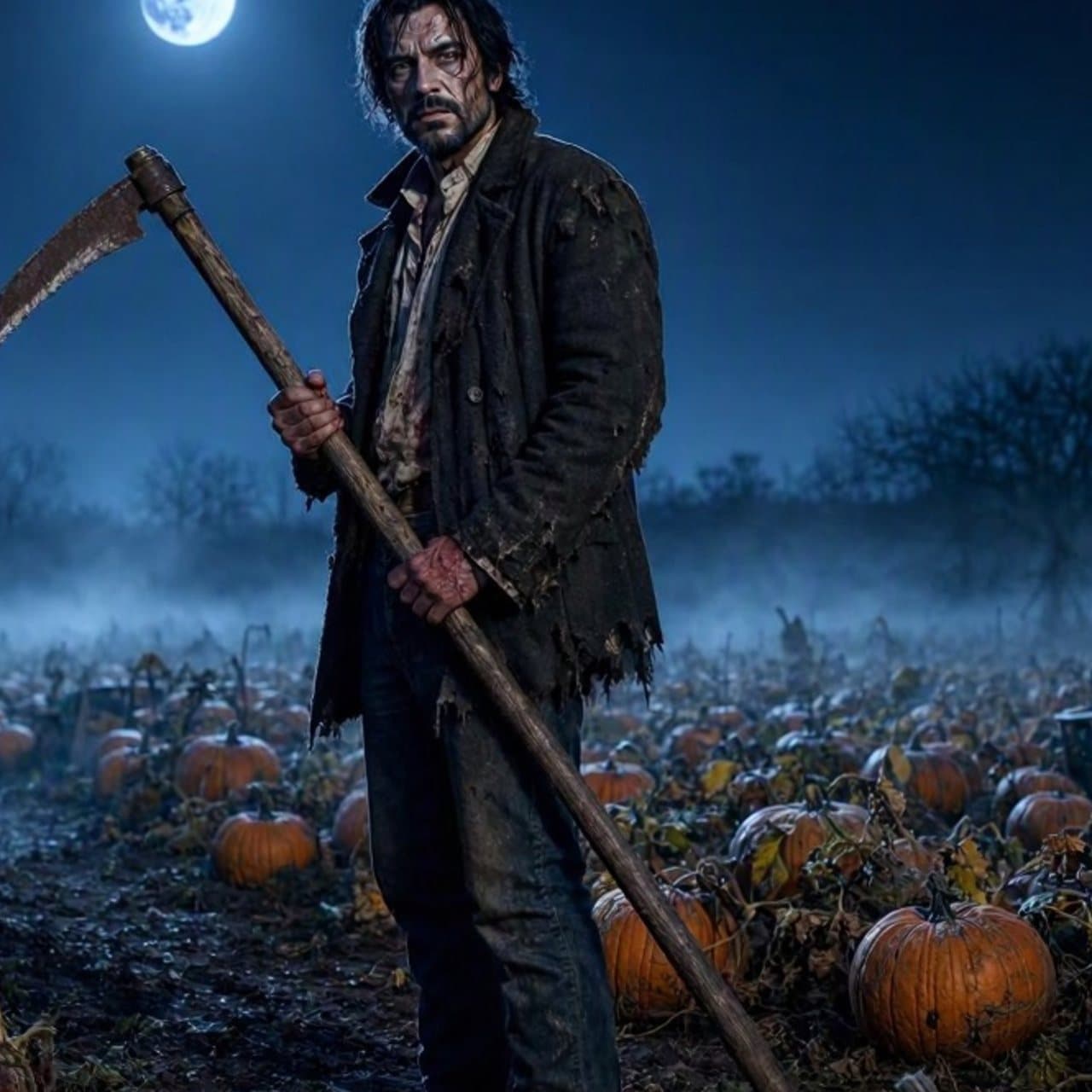
The soil on the southern slope of Peter Lambert’s four acres was black as pitch and sour with old lime. Nothing grew there without permission, and nothing left without his consent.
For seven years, that rule had applied to Molly.
She had been a girl of soft edges and flaxen hair that smelled of chamomile and rain, the sort of woman whose beauty invited the eyes of passing men like lanterns draw moths. Peter had noticed those eyes from the very first week of their courtship. In town, at the grocer’s, at the filling station—every glance cast toward Molly felt to Peter like a hand slipping into his pocket, stealing something that belonged solely to him.
He built their home a mile past the county line, ringed by hemlock and five-foot hog wire, where the only thing looking at her would be the sun and the crows. But even an isolated farmhouse has doors.
Her sole rebellion was Thursday night.
“It’s only the ladies from the parish, Peter,” she would say, adjusting her wool cardigan in the foyer mirror while he stood behind her, arms folded, his shadow swallowing hers. “We read. We drink peppermint tea. Mrs. Gable is eighty-two.”
He never believed her. When the taillights of her sedan vanished down the gravel drive, Peter’s skull became an aviary of shrieking birds. He saw her not in the church basement under fluorescent bulbs, but in low-lit tavern booths downtown, the air thick with beer foam and musk, young men with broad shoulders leaning close to press their thumbs into the velvet hollow of her clavicle. He imagined her laughing—a bright, wet sound she never made at home—and tossing back that yellow hair while hands that were not his slid beneath the table.
By the time she returned at nine, he would be sitting in the unlit kitchen, the air sour with his sweat, a paring knife turning slowly in his palm as he peeled an apple down to its bitter core.
“Who was there?” he would ask, his voice low and vibrating like a plucked wire.
“Just the girls, Peter.”
“You smell like smoke.”
“Mrs. Gable burns pine incense for her joints.”
“You’re a liar, Molly.”
She would look at him then—not with fear, which he might have forgiven, but with a weary, hollow pity that scraped the marrow from his bones. She looked at him as though he were a small, pathetic thing trapped at the bottom of a dry well.
He could not keep her. The thought gnawed at his liver day and night. She was slipping through the gaps between his fingers like dry silt.
Last Halloween, the frost came early and sharp. Molly had put on her burgundy coat, carrying a slim paperback with a cracked spine.
“You aren’t going,” Peter had said, barring the kitchen door with his forearm.
“It’s our autumn social, Peter. Let me pass.”
“There is no club tonight. It’s Halloween. The bars will be full of degenerates in masks.”
“Let me through, Peter. I’m tired.”
The argument did not last long; Peter was not a man of long speeches. When she tried to duck beneath his arm, his hands found her throat. He had spent twenty years turning soil and hauling eighty-pound sacks of bone meal; her neck in his grip had no more resistance than a green stalk of corn. He squeezed until the frantic flutter beneath her pulse slowed, until the blue in her eyes went cloudy and still, until the desperate, wandering spirit of her was finally quieted.
He did not panic. Panic was for men who had no land.
In the dead center of the lower patch, where he grew his Atlantic Giants for the county fair, he dug a trench six feet deep into the compost bed. The loam was warm with decomposition, rich with decaying leaves, peat, and nitrogen. He stripped her of the burgundy coat, laid her pale, lovely body down in the dark, and covered her with earth, manure, and lime.
When the state troopers arrived two days later—summoned by Mrs. Gable when Molly failed to appear for the third consecutive day—Peter wept with dry, rasping efficiency. He told them she had gone to the store for cider and never returned. They brought bloodhounds, but the dogs only whined and sneezed at the edges of the patch, confounded by the thick, choking reek of rotting mulch and wet sulfur. They found her car three miles away at the quarry, keys in the ignition, just as Peter had arranged.
By December, the case was cold. By March, the snow melted.
By May, Peter was planting seeds.
He chose a heirloom strain of white pumpkin—Lumina—mixed with his prize giant seeds. He spent the spring tending the lower patch with religious fervor. The soil was astonishingly fertile; the vines did not merely grow, they surged. Thick, fibrous runners, pale green and corded like human tendons, crawled over the black dirt with an aggressive, predatory speed. Their broad leaves were unusually soft, velvety to the touch, and veined with faint, purplish lines.
By August, the blossoms opened: heavy, waxy cups of sulfur-yellow that smelled faintly of chamomile and sweet rot.
When the fruit set, Peter noticed the oddity.
Pumpkins grow round, ribbed, and squat, their skin stretching tight across the pulp. But these gourds did not swell evenly. They grew in strange, oblong shapes, heavy at the top, tapering slightly toward the blossom end. Peter pruned the secondary runners, leaving forty-odd pumpkins to mature along the central vines that radiated directly from the trench where Molly slept.
September brought a wet, unseasonable heat. The rinds hardened, but they did not turn the stark, bone-white of standard Luminas, nor the bright blaze of field pumpkins. They were the color of blanched almond—the precise, bloodless shade of Molly’s inner thigh.
Peter visited the patch every evening at dusk, drawn by a compulsion he could neither name nor resist. The vines seemed to rustle even when the autumn air was dead calm, a dry, papery whisper that followed his boots along the rows.
Peter.
He told himself it was the crows.
October arrived, stripping the maples bare. On the thirty-first, a hard black frost settled over the valley, blackening the leaves and killing the vines in a single night. The broad foliage collapsed into slimy ribbons, pulling back like a shroud being stripped from a bed.
Peter walked down the slope with a kerosene lantern in one hand and a harvesting blade in the other.
The moon was high, sharp and silver as a fishhook. The lantern light swung across the barren patch, illuminating the naked fruit.
Peter stopped. The blade slipped from his fingers, burying its point in the frozen mud.
There were forty pumpkins in the clearing, and none of them were smooth.
The frost had shrunk the outer rinds, drawing the pale skin tight over ridges of dense, fibrous pulp. On the nearest gourd, the top had formed a rounded dome, crowned by a spray of fine, golden silk tendrils that spilled across the rind like parted hair. Beneath that crest, the shell curved inward to form delicate, hollow eye sockets, closed lids lined with tiny, dried sutures. Below them rose the straight, slender bridge of a nose, and beneath that, two pale, parted lips carved from the rind, frozen in a silent, suffocating gasp.
It was Molly.
Peter staggered backward, his boots catching on a dead vine. He fell hard into the cold mire, swinging the lantern wildly.
The golden light swept across the entire patch.
Every single one.
Row upon row of them, forty porcelain faces turned upward toward the empty sky. Some were tilted as if in sleep; others had their mouths stretched wide in a soundless scream, the dark pulp inside gleaming like wet gums. The fine, yellow vines twined around their foreheads, binding them together in a sprawling, tangled network of roots that led back to the center of the earth.
He scrambled to the nearest one on his hands and knees, sobbing with a terror that clawed at his throat. He raised his boot and brought it down hard upon the rind.
The pumpkin did not crack like wood or split like fruit. It yielded with the sickening, wet crunch of cartilage and bone. A thick, sweetish sap oozed from the fissure, pale orange and streaked with dark russet, smelling overpoweringly of chamomile and spoiled tea.
From within the shattered shell, a faint, wet sigh escaped into the freezing night air.
Peter backed away, crawling until his hands hit the perimeter fence.
He could not take them to market. He could not sell them. He could not leave them to rot under the eyes of the crows, and he could not carve them without feeling the pulp give way beneath his knife-like cold muscle.
The wind came down off the ridge, rattling the dead stalks of the cornfield, carrying with it that low, rhythmic cadence he had heard in his dreams since he was a boy, now twisted into the voice of forty mouths whispering through the frost:
Peter, Peter, pumpkin eater,
Had a wife and couldn't keep her;
He put her in a pumpkin shell,
And there he kept her very well.
Peter Lambert sat in the mud beneath the light of the cold white moon, surrounded by forty faces of the woman he had loved, waiting for the winter to come and freeze them into silence—knowing that with the spring thaw, the seeds inside would only split, and take root again.