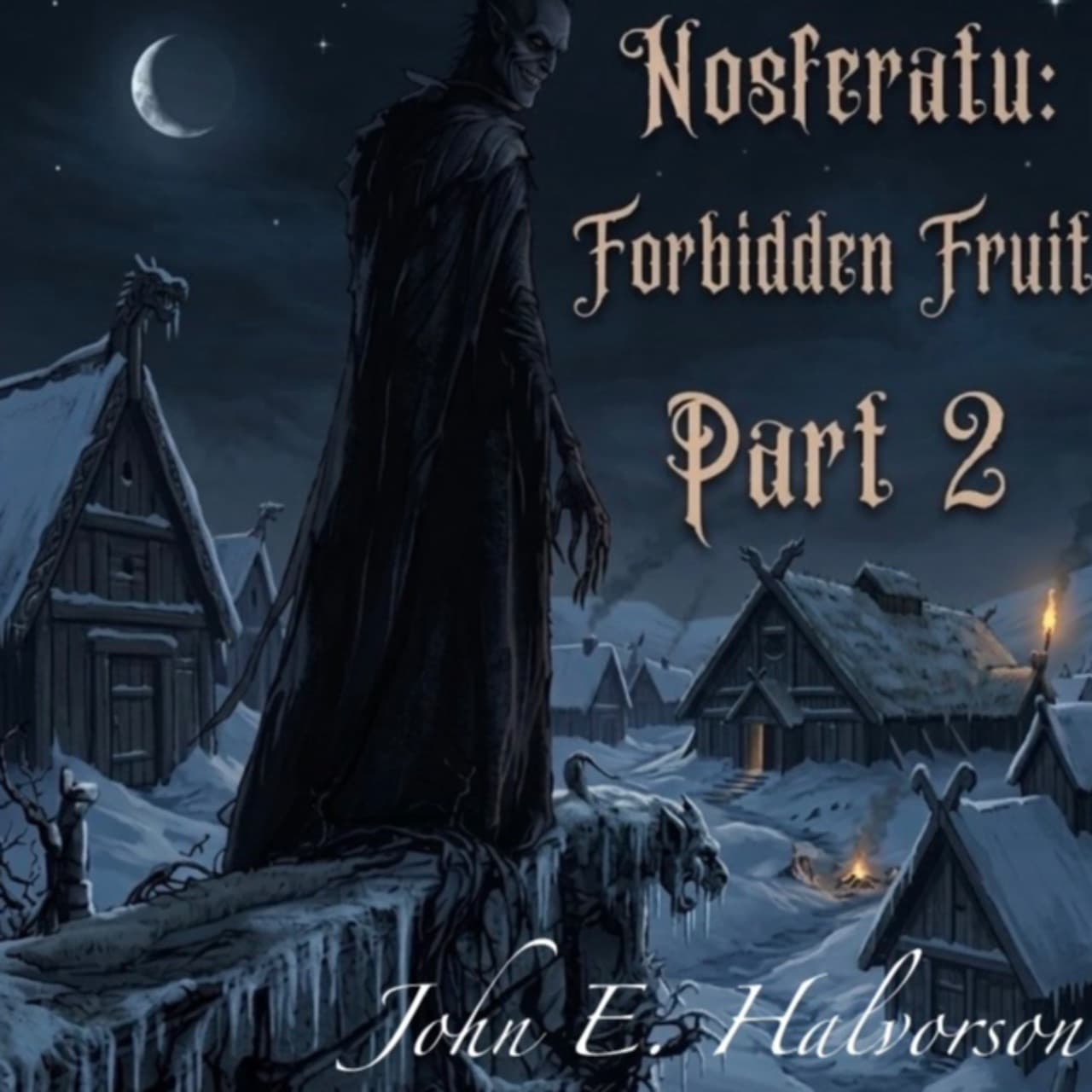

Nosferatu: Forbidden
Fruit Part II
John Eric Halvorson
Revenge
Before the final embers of the funeral ship could die into gray ash, the shield-maiden stepped forward from the grieving crowd. Her name was Austerg. Her face was smudged with soot and lined with deep sorrow. She reached into her heavy wool cloak and pulled out a thick, heavy ring of metal. It was an authentic Norse oath-ring, a sacred armlet forged from twisted silver strands that caught the flickering light of the dying fire. The ends of the silver bracelet were shaped into two detailed, snarling wolf heads, their open jaws biting down on a single iron ring.
"This belonged to my father’s line," Austerg said, her voice a low, reverent whisper. "Heavy oaths were sworn upon its creation before the hearths of powerful chieftains. It carries the weight of unbreakable honor. Wear it on your arm, Alvor. If you encounter any Norse tribe on your hunt, show them this silver. The runes carved along the inner band speak of blood-debts paid and alliances sealed. Even the most ruthless raiders will grant you favor, food, and safe passage when they see the mark of the oaths bound to this metal."
Alvor slid the heavy silver ring over her hand, pushing it up her forearm until it pressed tightly against her skin. The cold metal felt like an icy shackle, a physical weight matching the dark vow she had just taken.
To find her target, Alvor knew she needed more than human tracking skills. She needed to look beyond the veil of the physical world. She knelt in the damp mud near the edge of the ash pit, pulling a small leather pouch from her belt. Inside were dried herbs—henbane and nightshade—along with a handful of small, carved sheep bones marked with ancient runes. She cast the herbs into a small cooking cauldron filled with boiling river water, breathing in the thick, pungent steam that began to billow outward.
Closing her eyes, Alvor entered a deep, trance-like state. Her spirit left her physical body, soaring through a dark, fractured vision. In the swirling mist of her mind, she saw a terrifying landscape of endless pines and jagged rocks. The vision pulled her deeper into the dense, wild forest to the north. Through the spiritual haze, she distinctly saw the heavy, deep hoofprints of her beloved steed, Rua. The tracks were uneven and frantic, tearing deep into the mossy earth. Beside the hoofprints were the dragging, heavy boot marks of Oel. The vision focused on a dead, skeletal pine tree struck by lightning, pointing like a bony finger toward a hidden, rocky ravine five leagues away.
Alvor shot awake, her heart hammering against her ribs. She knew exactly where the monster was heading.
A small handful of young village men, their eyes burning with a desire for vengeance, immediately stepped forward with their iron spears. "We will ride with you, Alvor," they declared, tightening their leather belts. "We will help you bring this butcher down."
But fate had a different, grimmer plan for the survivors. As they turned toward the edge of the village, a loud, structural groan echoed through the yard. The heavy timber roof of the main longhouse, badly damaged by the earlier fire, suddenly collapsed inward with a thunderous crash. Screams of panic erupted as the remaining shelters began to spark anew in the rising wind. Without these buildings, the remaining children and elders would freeze to death long before the winter frost arrived.
Austerg placed a firm, heavy hand on Alvor’s shoulder. "They cannot go with you," the shield-maiden said, her eyes scanning the ruin. "Look at our home. The walls are shattered, and the cold season is fast approaching. The Norns demand that these men stay behind to help rebuild what was broken. Your path is a lonely one, child. You must hunt this beast alone."
Alvor nodded silently, her resolve hardening into stone. She adjusted her heavy wool cloak, gripped her iron knife, and stepped into the shadowy maw of the dense forest, completely solitary.
Miles away, deep within the claustrophobic thickness of the northern woods, Oel was rapidly losing his grip on reality. The horrific slaughter of the innocent villagers had fractured his mind, tearing away the proud armor of a warrior and leaving a hollow, terrified shell. Every single time he closed his eyes, even for a brief moment of exhaustion, terrifying visions of the underworld invaded his mind.
In his restless sleep, the dark, freezing mists of Niflheim rolled over him like a suffocating tide. He saw the monstrous, decaying visage of the goddess Hel, her face half-living flesh and half-rotted corpse, smiling down at him from her throne of skulls. He could hear the agonizing wails of the dishonored dead echoing through the frozen valleys. Every shadow between the pine trees seemed to twist into a clutching, ghostly hand reaching out to drag his soul down to the black pits of damnation. He would awake screaming, his body drenched in cold, foul sweat, his eyes bloodshot and wild with a maddening fear.
His growing insanity quickly turned into a cruel, unpredictable rage, and his primary target was the magnificent stallion he had stolen. Oel viewed Rua not as a loyal animal, but as a demonic extension of the village's witchcraft. He kept the powerful horse tied to a jagged rock, completely starving him for days on end until the stallion's ribs pressed sharply against his dusty hide. In his paranoid fits, believing the horse was whispering curses to the wind, Oel beat the animal mercilessly with heavy pine branches and the flat of his stolen blade.
Rua’s once-gleaming coat was now matted with dried blood, mud, and deep, dark welts. Yet, the stallion’s ancient, magical spirit refused to break under the tyrant's abuse. On the fourth night, as Oel collapsed into another screaming fit of madness, thrashing on the ground as the visions of Hel tore at his brain, Rua used the last ounce of his remaining strength. The horse pulled back violently against the fraying leather hitch-rope, snapping the worn straps with a sharp crack.
Weak, bleeding, and starving, the horse did not run blindly into the wilderness. Guided by an unbreakable, mystical bond, Rua turned back toward the south, dragging his heavy, injured legs through the dense brush to find his true companion.
Two days later, Alvor was tracking through a dark, fog-choked hollow when she heard a low, ragged wheeze echoing through the trees. She froze, her hand instantly flying to the hilt of her dagger.
Through the dense veil of gray mist, a heartbreaking silhouette stumbled into the clearing. It was Rua. The magnificent stallion was barely recognizable. His breath came in shallow, rattling gasps, a thick, bloody foam pooling at the corners of his mouth. His powerful legs trembled violently under his own weight, and his body was covered in the horrific marks of Oel's brutal beatings.
"Rua!" Alvor cried out, her protective walls completely shattering. She dropped her weapon and sprinted across the damp moss, throwing her arms around the horse's scarred, skeletal neck.
The great beast let out a low, weary whinny, resting his heavy, velvet muzzle against her shoulder. He had used every single drop of his life force just to see her one last time. Rua’s legs finally gave out entirely, and he collapsed heavily onto his side in the damp dirt. Alvor knelt beside him in the mud, cradling his massive head in her lap as the cold rain began to fall through the pine canopy.
In those few, agonizing last moments together, Alvor pressed her forehead against the horse's damp brow. She could feel the rhythmic thumping of his heart slowing down, growing weaker and weaker against her knees. The dark, foreboding imagery of the forest seemed to close in around them, the black pines standing like silent, mourning sentinels over the tragic scene.
"I am so sorry," Alvor whispered, her hot tears mixing with the cold rain on Rua's coat. "I swear to you, his suffering will be a thousand times worse than yours."
With one final, deep shuddering sigh, the stallion's eyes grew glassy and still. The majestic animal was gone. Alvor sat alone in the freezing rain, holding the lifeless body of her truest friend. The last remaining light of her childhood had been completely extinguished, leaving nothing but an empty, dark void filled with a pure, unadulterated hunger for blood.
Alvor knelt in the freezing mud, her bare hands raw and bleeding from tearing at the stony earth. To honor the great stallion, she followed the ancient, solemn funeral traditions for a loyal beast of burden. She dug a deep pit beneath the roots of a massive, ancient oak tree. She lined the bottom with pine boughs and sweet-smelling moss. Gently, she coaxed Rua's heavy head down into the earth. She placed his favorite braided leather lead line beside his muzzle, along with a small offering of oats and fresh water in a wooden bowl to sustain his spirit on the long journey to the green pastures of the afterlife. She covered his body with heavy, flat stones to keep the wild wolves away, whispering a soft, rhythmic Norse chant to close the grave.
Once the last stone was placed, Alvor sat cross-legged atop the mound. She closed her eyes and pushed her telepathic abilities to the absolute edge, searching for the dark, fractured mind of the butcher. Her consciousness expanded outward, flying through the dark pine trees until she locked onto the terrified mental signature of Oel. He had collapsed into a restless sleep in a shallow cave leagues away.
With a surge of pure, vengeful will, Alvor forced her mind inside his dream realm.
Inside the dream, she did not appear as a monstrous beast. Instead, she took the form of everything Oel’s memory could offer to torment him. She appeared as the weeping mothers from the cellar, then shifted into the cold, dead eyes of the old man he had stabbed, before finally morphing into a twisted, demonic version of Austerg, the shield-maiden. She was toying with his senses, deliberately fueling his desperation to break whatever remained of his sanity.
As she anchored her mind deeper into his subconscious, Alvor began to completely lose sight of her own physical needs. Her own body sat frozen and unmoving on Rua's grave, ignored and exposed to the biting wind. She did not feel the freezing rain soaking through her cloak. She did not feel the sharp pangs of hunger or thirst clawing at her stomach. She completely lost all fear for her own life, letting her life force bleed away into the astral plane just to keep her psychic grip on her prey.
Inside Oel’s dream, she began the torture. Oel suddenly awoke within his nightmare, screaming as he felt the agonizing sensation of thousands of biting ants and stinging forest insects crawling out of his clothes. They swarmed over his skin, biting his face, his eyelids, and burrowing deep into his ears. He thrashed and tore at his skin, drawing blood as he tried to brush the invisible pests away, his mind fracturing from the phantom pain. Alvor watched from the shadows of his mind, directing the swarm.
Then, just as Oel reached the absolute brink of madness, Alvor pulled back. She gave him space. The insects vanished. The terrifying faces faded away, and the dream shifted into a peaceful, sunny meadow filled with the scent of roasting meat and fresh ale. For a few sweet moments, Alvor let him believe he was safe. She let him draw a deep, relieved breath, believing the nightmare was finally over.
And then, she provided a new torture. The sunny meadow rapidly turned into a lake of boiling black pitch, and the ground beneath his feet began to crumble, plunging him right back into the freezing, screaming depths of Niflheim.
Oel's Nightmare Waking
Oel shot upright in the physical world with a suffocating scream trapped in his throat. His chest heaved violently in the damp air of the shallow cave. His hands were working like frenzied claws, digging into his own arms, thighs, and neck. He was scratching frantically to rid himself of the phantom insects that had tortured his sleep. Thin streams of dark red blood welled up beneath his broken fingernails, mapping out raw, jagged tracks across his skin.
He panted heavily, staring wide-eyed into the cold shadows of the cave. He realized with absolute, spine-chilling horror that waking up offered no escape. Even with his eyes wide open, the quiet, mocking whisper of Alvor’s voice still echoed directly inside the center of his skull.
The Approaching Predator
Leagues away, Alvor’s physical body remained hopelessly frozen, sitting cross-legged atop Rua’s rocky burial mound. Her consciousness was entirely trapped within the deep, vengeful matrix of Oel's mind. Her skin had grown dangerously pale, and her breathing was a shallow, rattling rasp. She was completely unaware of the physical world around her.
From the dense, fog-choked brush, a large, battle-scarred timber wolf stepped into the clearing. The wandering predator paused, its amber eyes locking onto her completely unmoving, catatonic form. Sensing no defensive posture or signs of life, the hungry beast bared its yellow fangs, a low growl rumbling deep in its chest. It slowly crept forward across the damp moss, its heavy paws making no sound as it closed the distance toward her exposed throat.
The Return and Realization
The sharp, instinctual snap of a dry twig near the grave pricked the outermost edges of Alvor’s fading psychic grid. The sudden jolt of immediate physical danger acted like an anchor, violently pulling her soaring mind back across the astral plane and slamming her consciousness straight into her frozen body.
Her eyelids flew open just as the giant wolf lunged forward. On pure survival instinct, Alvor threw herself sideways into the mud, drawing her iron sax knife in a single, fluid motion. The blade flashed in the dim light, catching the wolf across its shoulder and sending the startled predator yelping back into the dark tree line.
Alvor collapsed against the stones of the grave, gasping for air as a profound, bone-deep exhaustion hit her limbs. Her stomach ached with a hollow, gnawing emptiness, and her lips were cracked from dehydration. She looked at her trembling hands and realized a grim truth: her malice had nearly made her a ghost. If she wanted to survive long enough to track the butcher across the physical world and exact her final justice, she could no longer ignore the mortal constraints of her flesh. She needed to hunt game, cook meat, and travel by foot.
A slight autumn breeze broke through the timberlands, rustling the dying leaves and carrying a sharp, biting chill. Alvor stood alone in the quiet woods, watching the frost form on the moss. She knew winter was closing fast. The freezing storms would soon lock down the mountains, and she would need deep food stores and proper traveling supplies if she was to follow Oel into the deep wilderness. Putting aside her quest’s directness for a moment, Alvor forced herself to be patient. She decided that keeping with her blood oath would mean staying alive, healthy, and fit for a grueling journey and brutal combat.
Armed with just her iron sax knife and a heavy, whittled wooden handle she made from a fallen branch, Alvor began the rigorous, daily work of survival. She spent her mornings stalking the forest, fishing in the ice-cold creeks, and hunting small game. She walked for miles, gathering wild winter berries and digging up hardy, starchy edible roots and wild bulbs from the hardening soil before the ground froze solid.
To survive the incoming blizzards, creating a winter shelter seemed like an absolute necessity to continue her journey later. She selected a hidden, sloped site and set to work. Digging a deep, slight pit out of the heavy soil and jagged rock, she created the footprint for a dugout shelter. She lacked proper iron tools for heavy logging, so Alvor set to gathering and smashing heavy stones together, carefully fracturing the sharp flint and hard granite to create rudimentary hand-axes and sharp stone chisels.
Using these hand-carved stone tools, she pried loose flat pieces of rock from the hillsides. She began stacking the stones into walls, sticking layer after layer of rock followed by thick soil and river water over and over again until the foundational walls were completely weatherproof and solid. To seal the gaps against the freezing northern winds, she finally coated the outer sides with a sticky, thick mixture of boiled pine sap and packed green moss. With this sealing layer, the dugout shelter was taking on a much more permanent, sturdy structure.
Next came the heavy roof. She dragged fallen timber to the pit, shaping thick A-frame logs to form the main supports. Across these, she laid well-timbered, thick slabs of sodded earth, puzzle-locking the roots and dirt together so the heavy roofing would shed snow and retain the warmth of a hearth. At the front, Alvor constructed a heavy, low-clearance, animal-proof entrance made of notched logs that could be securely barred from the inside against bears and wolves.
She engineered the campsite to handle the heavy winter thaws. Carving a small water receptacle out of a large stone, she dug a deep drainage trench surrounding the dugout. This channel helped keep rainwater and melting snow flowing safely out and around the house and down the hill. At the end of the trench, she placed wooden buckets at a natural drop-off port, creating a perfect system for filling her leather water flasks, traveling skins, and fresh water for cooking.
Inside the subterranean room, she focused on fire management. A small stone trough was crafted in the corner where cold ashes were stored and hot embers could be buried in gray dust, keeping the coals alive overnight to restart an indoor fire instantly each morning. Over the central fire pit, she installed a single iron length—a spit she had salvaged—fitted with hand-carved wooden turning handles to easily rotate and handle large cuts of meat and simmering clay pots of wild stews.
The geology of the ravine held a hidden blessing. Alvor discovered veins of raw ore embedded in the surrounding boulders. By building a high-walled, primitive stone kiln and pumping it with oxygen using a hollow reed, she succeeded in superheating the metals found in the rocks. The intense heat caused the raw iron to liquefy and pour from the stones. She guided the glowing, liquid metal to fill custom rock moulds she had chiseled, casting a deadly supply of sharp arrowheads and sturdy cooking tools.
Every evening, as the howling winter winds began to batter the heavy sod roof, Alvor found a twisted sense of peace. Nightly, Alvor would project her spirit and extend out of herself when the fire had calmed into a low, red glow and she had laid down safe in her warm bed of furs. Having a full belly of roasted roots, dried herbs, and wild bulbs mixed into a thick, steaming squirrel and rabbit stew gave her soul the incredible, raw life force it needed. Safe in her physical fortress, her well-fed mind was cause to continue her terrifying psychic onslaught unimpeded, plunging deep into Oel's nightmares night after night while she waited for the winter to break him.
Broken and Battered
Oel opened his eyes to a slightly smug yet lovely summer maiden looking him over as one would a treasure if it were a lost pup. “Am I dead?” He asked incredulously seeing and sensing the world around him. The girl of marrying age simply giggled and twirled a finely braided gathering of hair next to her ear. Oel glanced down noting he was without clothing bare as the day he was born. Without saying more he scrambled to find something to cover his nethers with. Slowly he backed against the log of the small hut and finding nothing to cover with resigned himself to a distempered scowl of amusement believing that he had nothing to be ashamed of.Instead of bolting, he reached out a hand to the young woman with effort to pull her close. Deftly the woman turned and slipped his grasp. As giggly as she was before she exited the hut by a makeshift door that led into a blinding white blanket of snow, his presentation was met by a near naked crone of feathers and stringy silver hair. The crone was easily past sixty seasons and had sagging skin on all her parts. A hooked nose and bony rib cage protruded beneath a yellowing mixture of gray and blue veins. Her eyes were blue with a milky covering crawling across the surface, and her nails were as long as bear claws. Her teeth were crooked rows of translucent stains, blackened by disease and ears sagging as much as her chest. Her face was painted by what appeared to be white feces and blood matching the leather cloth she wore around her loins.
The crone said nothing, just grabbed a nearby bowl with some grotesqueries in it and brought it close to Oel’s mouth. Turning his head away he yelled in old Norse, “Get away!” The crone took a step back and shaking as she limped to another surface put something in her mouth, turned and spat it right into Oel’s face. The goo quickly slid into part of Oel’s lower lip and into his eyes. Screaming in anger, Oel revolted recoiling against the logs once again. A scant few seconds later, Oel was out. The world faded from view and blackness ensued.
When Oel woke again, the illusion of the hut, the maiden, and the crone shattered into raw, screaming agony. There was no summer breeze. There was no numbing sleep. There was only the freezing, pitch-black dark of the stone vault beneath the cellar, and a pain so violent it made him choke on his own tongue.
The acidic residue from the crone’s touch felt like a searing brand across his face, a lingering heat that pulsed in time with the thrumming in his skull. He tried to wipe his eyes, but his wrists were heavy, pinned by an unseen weight or perhaps the sheer exhaustion of his battered frame. Every breath he drew was thick with the scent of damp earth and ancient stone, a suffocating atmosphere that pressed against his lungs like a physical hand.
He thrashed against the floor, the jagged edges of the stone cutting into his shoulders. The cold was a living thing, a sharp-toothed predator that gnawed at his bare skin until he couldn't tell where the freezing air ended and his own shivering began.
Then came the true horror. The torment wasn't just on his skin; it was inside his mind, driven deep by a telepathic fury that vibrated through the very marrow of his bones.
He felt them before he heard them. A low, rhythmic hum resonated through the stone blocks, echoing inside his teeth. Suddenly, a sensation of thousands of phantom movements erupted across his chest and stomach. It felt as if a carpet of unseen, starving creatures were swarming over him, their spectral weight pressing down on his thighs.
The sensation was maddeningly persistent. He felt the distinct, ghostly pressure of mandibles nipping at the sensitive skin of his underarms and neck. It was a phantom invasion, a psychological siege that made his skin crawl with a thousand invisible legs. He clamped his jaw shut, grinding his teeth in a desperate attempt to ground himself, but the sensation of things squirming just at the edge of his perception only intensified.
“You cannot run,” a voice hissed, echoing from every corner of the dark chamber. It wasn't a sound in his ears; it was a cold blade scraping against the inside of his skull. “You will answer for Rua. You will remain in the dark.”
Desperate to escape the invisible swarm, Oel raked his hands across his chest, his fingers seeking a purchase on a foe that wasn't there. He felt the sting of his own desperation, his nails leaving sharp lines of heat across his ribs as he tried to strip the phantom insects away. The perceived safety of the crone’s hut had been a cruel illusion; this wet, dark tomb was the waking reality he had earned.
He was trapped in the silence of the cave, his breath coming in ragged, shallow gasps as the darkness seemed to solidify around him, leaving him at the mercy of the presence that hunted him from the world above.
Alvor turned in her bed. She had lost the prey but cornered it just the same
The illusion of the crone’s hut melted away entirely, leaving behind a grim, freezing reality. Oel was not in a village cellar or a cozy dwelling. He remembered now. He was down in the deep, wet womb of a coastal cave, trapped beneath the earth where the light of the sun never reached.
But there was no comforting crackle of a campfire. There was no smoke to sting his eyes. There was only pitch-black darkness and a cold so heavy it felt like wet iron pressing against his ribs.
Worse Vo C than the cold was the violation inside his own head. The phantom insects were still chewing at his sanity, but he knew now they were not real. They were weapons. A trespasser had broken into his mind, tearing through his thoughts like a wolf through a sheepfold. No matter how hard he blinked or thrashed against the stone floor, he could not shake the horrific images. The giggling summer maiden turning into the rotting crone, the stench of feces and blood, the vision of the suffocating net—they stayed glued to the back of his eyelids.
A terrible, freezing certainty settled into Oel’s chest. This was no ordinary madness. This was a curse.
He believed with every fading beat of his heart that Hel herself, the ruler of the dead, had reached up from Niflheim to claim him early. He had slaughtered the innocent in that cellar, and now the goddess of the underworld was punishing him. The trespasser in his mind felt ancient, cold, and completely unstoppable. Oel lay paralyzed on the rocks, listening to the drip of cave water, waiting for the curse to rip the rest of his soul apart.
The weight of the crushing mold—the dark, suffocating moldu—pressed against Oel’s ribcage like the stone slabs of Helheim. Suffocation was a thick, physical mass. His lungs burned, screaming for apti, the breath of life, but each desperate gasp reaped only the foul taste of stagnant, iron-rich rot and coarse gravel. His cracked fingernails split to the quick, peeling away as he clawed frantically at the shifting, granular womb. It was an endless swimming through a shifting pit of sand; for every frantic inch of headway, he carved into the dark, the weeping earth collapsed back to claim him, a heavy shroud of aurr sealing his ears and filling his tear ducts.
He floundered in the absolute blackness, his heart hammering a frantic, echoing rhythm against his ribs. His hand flailed through the suffocating packed earth until his raw fingers brushed against something coarse, fibrous, and cold. A single, knotted tree root—a stray thread of the world above—had pierced the earthen coffin, erðarkista. Clinging to it with the animal desperation of a drowning man, Oel hauled his leaden body upward.
When his head finally breached the surface into the biting night air, he did not find relief. He convulsed violently, dry-heaving on his hands and knees. The slick, squirming bodies of pale earthworms and subterranean beetles mixed with the wet grit in his mouth. They writhed against his tongue and clicked against his teeth, frantically trying to burrow deeper down his throat to escape the violent spray of his spit. The air he finally dragged into his burning throat reeked of ancient moss, damp rot, and his own cold sweat.
Wounded, shivering, and entirely undone, Oel stared into the looming shadows of the ancient canopy. Was this waking reality, or was his mind still fracturing under the weight of the cellar's torment, a continuation of kvol? Seeking to shatter the illusion, he dragged a ragged breath into his collapsing lungs and brought his fist crashing hard against the rough, moss-slick trunk of the tree that had given him egress.
The sharp, white-hot flash of pain that exploded through his knuckles was a gruesome comfort; the wet skin tore against the ironwood bark, leaving a smear of dark blood. The impact reverberated through the ancient boughs, sending a heavy, cascading shower of freezing rain and stagnant water drops down upon his upturned, mud-caked face.
He wiped the freezing moisture from his eyes and looked around. The horse was gone. The tormentor was nowhere to be seen, perhaps granting a momentary reprieve, a brief tóm. The horrific echoes of the cellar still screamed in his ears, but a primal, singular command overrode his shock. Hlaupa. Run. He had to run as far and as fast as his trembling limbs could carry him from the charnel house below. The burning thirst for blood and hefnd—vengeance—would have its day. But for now, he must survive. He must run.
Gathering the few necessary pieces of survival equipment he retained, Oel considered his directions carefully. Though compelled to run in any direction, Oel knew a few things were certain. North was a barren waste where only the nomadic people lived. His chances were greater there, but survival would be limited. West would deliver him back to the hands of the hunter and that calamitous memory of slaughtered children. South and he would be warm but too many faces would recognize him as an outsider with a different tongue. East lay the lands of the Russ. The equally large and well prepared people holding the northeastern cities. As an outsider he would surely become a Russ slave, locked up for being different and uncivilized. Every path created a challenge, and every choice life or death. Oel figured he still had several kin in his tribe that had pillaged at least the northernmost shores of the south lands. At worst he would be converted to a foreign religion. What harm could come from these Christians anyway.
North it was then. Though his sensibilities had left long ago while the dreaming took him.
The Dreaming
The night offered no sanctuary, only a continuation of the hunt.
Oel sprinted through the shifting, claustrophobic corridors of his own mind, his boots sliding over flagstones that constantly threatened to dissolve into the damp, red earth of the cellar. The air inside the dreaming was thick, tasting of iron and cold ash. Every breath burned in his chest, yet no matter how fast he ran, the rhythmic, heavy thud of a leather-wrapped grip against an iron-rimmed shield followed close behind.
Alvor was untiring. In life, she was an oath sworn maiden of the northern coasts; in her madness, she had become a towering god of retribution. Her braided hair whipped against her dirt-streaked cheeks as she closed the distance, her dreaming chainmail rattling like dry bones. The broadax in her right hand caught the sickly, violet moonlight of the dreamscape.
"Run, butcher!" her voice boomed, bouncing off walls made of weeping stone. "The dead do not sleep, and neither shall you!"
He stumbled into a wider courtyard—a twisted caricature of the village square he had helped burn. The ground beneath him began to churn, thick and muddy with the spectral blood of the women and children he had slaughtered in that dark cellar. Pale, translucent hands reached up from the mire, grasping at Oel’s ankles, slowing his flight.
Alvor crested the rise, her shield raised, her eyes burning with a cold, unforgiving light. She didn't hesitate. With a feral battle cry that shook the framework of the dream, she brought the axe down in a deadly arc aimed straight for his neck.
Oel struck faster than should have been possible, his mind completely lost in the artificial reality of the moment. Alvor’s shield caught the blow and sent her back five paces. Clutching the impacted side, she knew what was next. Driving the shield edge down into the false cellar floor, the room collapsed. Rocks, mud, and timber fell. The hole that had opened, went on for an eternity until light and the smell of sulfur stung the lungs. Oel dropped whatever was currently in his hands and reached for the side of this pit to nflheim. A cloaked hood guarded Alvor’s face. Instead of falling, she was caught levitating as if the floor never fell.
“Please!” Oel screamed. “Take this hell away from me and right the wrong I have bestowed upon the innocent.” In a guarded voice that resembled the old crone, Alvor, with axe in hand replied, “And would that you had given the innocent the same chance!” With a thunderous crack, the axe came down on Oel’s head, embedding the blade deep into his brow and eyes. With terror arranged poetically on his face, Oel dropped several stories to the fiery liquid below. Instantly, Alvor awoke and rose to a contrastive beautiful morning. The snow was deep and water cold, but the fire was a welcome feeling. Alvor had given Oel his first taste of death. The personal vendetta was coming to fruition.
Forbidden Fruit
Alvor chose to give Oel a moment of peace if only to make the sting unfamiliar for a moment. During the winter months that followed, Alvor rarely practiced her abilities saving what energy she had as it was desperately needed for the long winter still coming..
Oel in his reprieve found that begging or renting out his sword arm was enough to steer clear of his enemies and kept him alive for the moment. Oel had ventured east in an attempt to escape the tormentor on his trail. Being that he was a skilled warrior, trouble was never far away. In turn for his ability, Oel learned Old Russ and was more capable of fitting in. On more than one occasion he had nearly met his end yet was skillful enough to keep up the ruse of being Russ stolen and learning Old Norse from his captors.
Alvor had tracked Oel as soon as the seasons allowed, managing to profit from skins and carved figures the winter had provided her. Precious metal also helped increase her skill as a trader and less a sought-after enemy of the Russ. She was still distraught when a beautiful steed ventured under its master’s pull of the harness. It was evident in passing that though these broken beasts of burden were busy with their tasks, they sensed the loss on her in Rua.
Alvor had followed Oel to a small town just south of Alexandreanoff deep inside of
Prince Sveinhold’s territory. At the time campaigns spread the Eastern Slavic Prince’s armies thin yet continued to conquer much of the East and south lands..No one person was concerned about a western Nord man or woman. As long as the individual did not cause problems, they were free to ply their trades.
Alvor had become quite adept at skinning and curing animal pelts taken from areas outside of the Prince’s territory, and with a few free cloaks it was not difficult to see guards look the other way. Alvor spent her days hunting and checking traps for the great gray wolves of the lowlands and by night began to hound Oel again.
Oel knew that bringing attention to himself was a dangerous pastime and was only used when the need for coin was great. On one such night in a chilled October, Oel had need of a hot meal and place to sleep that did not require him to keep an eye open for wolves. The town crouched beneath the moon as though ashamed to be seen, its lanes slick with black mud and half-frozen straw, its roofs bowed beneath a thin crust of frost that glittered like old bone. Smoke leaked from chimneys in reluctant threads, not rising so much as crawling sideways along the eaves, and the wind moved through the narrow streets with the patient whisper of a knife being drawn from leather.
The tavern at the lane’s end bore no proper name upon its hanging board. The paint had been scraped away by weather or spite, leaving only the faint outline of a horned cup and a dark stain where lettering once promised warmth. Yellow firelight pulsed behind the shutter cracks, sometimes bright, sometimes dim, like something inside was breathing against the boards. Oel stopped before it and listened too long. He heard men laughing, dice rattling, a woman’s hard voice cutting through smoke, and beneath all of it a low, wet creak from the sign above him, though no wind strong enough stirred the chain.
Every sensible part of him wanted to turn away. The forest beyond the palisade was cruel, but it was honest in its cruelty. Wolves announced themselves by hunger. Cold announced itself by pain. Men did not. Men smiled with one hand open and the other hidden beneath a cloak. Men remembered scars, accents, oaths, ships, dead sons, stolen horses, and stories carried from coast to coast by traders who drank too much. Oel drew his hood lower and pressed two fingers against the small pouch of coins at his belt, counting by touch, counting again, then a third time, as if silver might disappear merely because fear had thought of it.
He pushed the door open.
Heat struck him first, damp and sour from too many bodies shut inside with ale, tallow smoke, wet wool, boiled onions, horse sweat, and old fear. The rafters drowned in shadow above the central hearth. Smoke gathered there in a black ceiling, rolling slowly as if stirred by unseen hands. Faces turned toward him by degrees. Not all at once—that would have been easier. One man glanced up from his cup. Another stopped chewing. A serving girl paused with a trencher in both hands. Somewhere near the wall, a knife vanished beneath a sleeve. Oel felt each look touch him and pass away, yet none passed far enough.
He chose the path to the rear corner with the care of a man crossing thin ice. His eyes moved faster than his feet. Door. Hearth. Window slit. Back stairs. Three drunk merchants, no threat unless paid. Two guardsmen with local iron at their hips, half awake but proud enough to kill over insult. A broad-shouldered butcher with hands too clean for the hour. A woman in blue staring at his boots. A boy pretending not to watch the dagger hidden under his cloak. Oel’s throat tightened. The room knew him. It could not know him, and still it knew him.
Beneath the tavern noise, another sound began to trouble him. A drip. Slow. Patient. Too steady to belong to spilled ale. It seemed to come from under the floorboards, from the dark between cellar stones, from the place where the dead were hidden and breath ran out. Oel blinked hard and saw, for one treacherous instant, a small pale hand lying in mud beside an overturned cask. When he looked again, there was only rush-strewn flooring and a dog nosing crumbs beneath a table.
He sat with his back to the wall. He always sat with his back to the wall. The bench creaked beneath him, loud as accusation. When the keeper came, Oel ordered stew, dark bread, ale watered thin, and a place in the loft if such a thing could be bought without questions. His voice came out rough but steady enough. That steadiness frightened him more than a tremble would have. A man could still sound alive while rotting from the inside.
Then the cloaked figure spoke from the neighboring shadow.
“You count exits before cups,” the stranger said.
Oel’s hand found the knife beneath the table. He had not seen the figure when he entered, and that was impossible. No warrior lived long by missing shapes in corners. The stranger sat where the firelight failed, wrapped in a travel cloak the color of wet ravens. Only the lower half of the face showed beneath the hood: a narrow mouth, a gray-brown beard trimmed short, and a scar pulling one corner of the lip into something that might have passed for amusement if the eyes above had bothered to join it.
“So do men who expect to leave alive,” Oel answered.
The cloaked man gave a soft sound that was not quite laughter. On the table before him lay no meal, only a cup gone cold and a pair of gloves darkened by rain. One gloved finger tapped the rim of the cup once, twice, three times. Oel watched the movement and felt the old terror climb his spine. It was the rhythm from his dreams: axe against shield, dirt on coffin wood, a hoof striking stone, a child knocking from underneath the world.
“I need a sword arm,” the stranger said. “A hard one. A quiet one. A man willing to take coin and leave before sunrise.”
Oel should have refused. The offer had too clean a shape. Need had led him through the door, but fear now told him that need was only another kind of leash. He studied the stranger’s hands, the fall of the cloak, the place where a weapon might hang hidden. Sell swords knew each other by posture, by hunger, by the absent gaze of men who had seen too much and learned to spend grief as silver. Yet this man seemed less hired blade than messenger from a road already chosen.
The serving girl set down his stew. Grease shimmered across the surface in a golden skin. For one sick heartbeat, Oel saw fire on water. He smelled boiling pitch. His fingers clenched around the knife until the leather wrapping creaked. When he looked up, the cloaked figure was watching him from beneath the hood with patient, terrible stillness.
“How much coin?” Oel asked, hating himself for asking.
The stranger slid a small purse across the table. It landed without the honest clink of silver. It sounded soft, final, like soil falling over a grave.
Oel did not touch the purse. He stared at it as if it might split open and spill teeth instead of coin. “That is no price,” he said. “That is bait.”
“Good,” the cloaked man replied. “Then you still possess sense enough to live.”
The stranger opened the purse with two fingers and tipped it enough for Oel to see what lay within. Silver flashed in the firelight, but not Russ silver. The stamped faces were foreign, clipped and old, mixed with hacked arm rings and two amber beads dark as honey left too long in a corpse’s mouth. It was more wealth than a hungry man should refuse and less than a doomed man would require. That measure troubled Oel. Whoever had counted it knew the value of desperation exactly.
“A merchant train leaves before dawn,” the cloaked man said. “Three wagons, six drivers, one priest, two women who claim to be sisters, and a locked chest no one is to open. The road bends north through the black firs, past the old charcoal pits, then east toward the prince’s winter road. Bandits have taken men there. Wolves have taken horses. Other things have taken what wolves leave behind.”
Oel watched the man’s mouth as he spoke, searching for the lie in it. There was always a lie. Sometimes it hid in what was said. More often it hid in what was omitted. “If you fear bandits, hire guards from the prince,” Oel said. “If you fear wolves, hire hunters. If you fear spirits, hire a priest who believes harder.”
“I have all three,” said the stranger. “What I lack is a man accustomed to surviving when everyone around him burns.”
The tavern seemed to fall away from Oel by inches. The dice still rattled. The dog still worried crumbs from the floor. Someone laughed too loudly at a table near the hearth. Yet each sound reached him from under water. He felt again the tight embrace of the burning net, the boiling sea above, the black chamber beneath the village, and the horrid softness of bodies in the cellar dark. His thumb slid along the knife hilt until it found the notch near the guard. He had carved that notch after his first killing. There were too many notches now to remember which death belonged to which scar.
“You know nothing of fires,” Oel said.
“I know enough to ask for Oel the boatsman before I ask for Oel the blade.”
The knife was in Oel’s hand before the next breath. No one at the nearby tables moved, but their stillness had the flavor of rehearsal. The serving girl had vanished behind the counter. The two guardsmen no longer looked sleepy. Even the broad-shouldered butcher kept both hands visible upon the table, palms downward, as though he had been warned not to interfere unless blood struck the floor.
“Speak that name softer,” Oel whispered.
“Names do not become quieter because men fear them.” The stranger lifted his cup but did not drink. “You were chosen because your tribe is dead or scattered, because the Russ think you foreign and the Norse think you cursed, because no lord will mourn you if the road keeps your bones. More than that, you were chosen because you have crossed water where no man should have lived. You have crawled through stone like a thing born wrong from the earth. You know caves, tides, hidden ways, and how panic smells when men realize their gods have looked away.”
Oel rose halfway from the bench. His legs wanted flight. His pride wanted murder. His fear, wiser than both, kept him suspended between them. “Who told you this?”
For the first time, the cloaked figure turned his face enough for the fire to touch one eye. It was pale, not blind, not whole, but filmed with an old wound that caught the light badly. “A dead man told me,” he said. “Before he died, he named the one boatsman who survived the burning harbor. He named the one man the north itself would not keep buried.”
Oel’s mouth went dry. Dead men did not name the living unless someone had dragged confession from them, or unless the dead were learning to speak in this part of the world. He glanced toward the door. Too many shoulders blocked the way now. Not openly. Never openly. A shifted stool here, a drunk leaning there, a pair of men standing to fetch more ale at exactly the wrong time. The tavern had become a snare without changing its shape.
“What is in the chest?” Oel asked.
The stranger’s scarred mouth tightened. “A relic from a drowned chapel. Bone wrapped in waxed linen. Iron nails black with age. A small fruit carved from red stone and sealed in a box of lead.”
Forbidden fruit, Oel thought, though he did not know why the words came to him. They slid through his mind with another voice behind them, a girl’s voice sharpened by grief. His stomach turned. For a moment the stew before him seemed to darken, the grease-skin closing like an eye.
“The road does not need a holy man,” the stranger continued. “It needs someone damned enough that curses have little left to threaten. It needs someone who can open a throat without waking the mercy in himself. Someone hunted already, so that one more shadow behind him changes nothing.”
Oel laughed once, a brittle sound that broke before it became anything human. “You offer coin to a monster and call it wisdom.”
“No,” said the cloaked man. “I offer coin to a monster who wishes desperately to remain useful. There is a difference.”
That cut deeper than accusation. Accusation Oel knew how to answer. He could spit at it, bury it, or kill the mouth that formed it. Usefulness was more dangerous. It dressed itself as purpose. It gave a starving soul something to hold before the dark closed. Alvor had taken sleep from him. Guilt had taken honor. Hunger had taken dignity. Yet here, across a filthy tavern table, a stranger offered him a place in the world again, narrow and poisoned though it was.
“Why me truly?” Oel asked. “Not tales. Not dead men. Not curses. Why me?”
The cloaked figure leaned forward, and the shadows under his hood deepened rather than withdrew. “Because whatever follows you fears you enough to keep you alive. I have seen men marked by vengeance before. Most are struck down quickly. You are not. You are preserved. Chased. Broken and mended for another breaking. Something wants you to suffer long, Oel. I mean to pass through the country that thing haunts, and I would rather walk beside its favorite prey than meet it ignorant in the trees.”
The words settled over the table like frost. Favorite prey. Oel hated how true they felt. Every nightmare, every whisper in the marrow, every glimpse of a pale girl’s rage in water, flame, or polished knife—none of it had ended him. It had only shaped him into a thing that kept running.
Slowly, Oel reached for the purse. The moment his fingers closed around it, the tavern door blew inward on a gust of October cold. Every flame in the room bowed low at once. Somewhere outside, beyond the mud lane and crooked roofs, a wolf began to howl, and beneath that howl, too faint for any man but Oel to hear, came the soft laughter of a girl who had not forgiven him.
Far beyond the town, past the frost-bitten fields and the low black backs of the fir woods, Alvor woke with her hand around her own throat.
No dream had startled her. No wolf had come near the shelter door. The banked coals still breathed red beneath their ash, and her winter stores hung untouched from the roof beams. Yet something had pulled her out of sleep as surely as fingers hooked beneath the ribs. She lay rigid beneath her furs, listening to the sod roof creak under the cold, and felt a second heartbeat moving somewhere inside the world.
It was not Oel. His mind was familiar to her now: ragged, filthy, panicked, always scraping against the inside of himself like a trapped thing in a box. This presence was colder and older. It did not think in words, nor rage, nor fear. It waited. Its patience spread through the dark like roots under a graveyard, touching bone, iron, water, wax, and the red-stone shape sleeping inside lead.
Alvor sat up slowly. The oath-ring on her arm had gone cold enough to burn. The two silver wolf heads bit into her skin as though the metal had awakened hungry. She pressed her palm over it, but the chill passed through her hand and into the blood beneath. In the darkness of the shelter she smelled things that were not there: sea-brine trapped in old stone, chapel rot, candle smoke drowned in rainwater, rusted nails, and the faint sweet perfume of fruit left untouched too long upon an altar.
Her mouth filled with the taste of copper. The coals guttered low. Shadows along the walls stretched upward, thin and branchlike, making the cramped room seem suddenly full of orchard trees. Their limbs bent beneath invisible weight. From among them came the sound of a single object rolling across wood: slow, hollow, deliberate. Alvor closed her eyes and saw a small fruit carved from red stone turn once inside a darkness sealed with lead.
The vision struck deeper. A drowned chapel appeared beneath black water, its wooden cross broken and furred with weed, its bell hanging silent in a tower filled with pale fish. Beneath the altar stone rested a chest bound in iron. Around it drifted white shapes that might have been linen or hands. When the water moved, the chapel opened its drowned mouth, and something inside whispered without sound: Take. Taste. Become.
Alvor recoiled so violently that her shoulder struck the stone wall. Pain flared bright enough to drag her back into herself. She clutched at the furs, breathing hard, but the relic’s pull remained. It was not calling to Oel. Not truly. Oel was only near it, a bloodied hook dragged through dark water. The call had found her because something in her answered it.
That realization frightened her more than Oel’s knife ever had. Her vengeance was clean beside this. Vengeance had a face. It had a throat. It could be tracked by boot marks, dreams, and guilt. But the relic had no face and no throat, only promise. It showed her not justice, but power: roads bending open before her, minds kneeling at a thought, death made obedient, hunger sanctified into purpose.
For one terrible heartbeat she wanted it.
The wanting was small at first, no larger than the daisy she had once dropped into the creek, but it opened inside her with the same secret motion. A forbidden sweetness touched the back of her tongue. Her grief leaned toward it. Her anger leaned harder. She imagined holding the red fruit in both hands and making Oel feel every death he had given, not as nightmare, not as memory, but as endless living fact.
Then Rua’s grave came back to her. The cold rain. The stones. The great head heavy in her lap. The promise made in tears and mud. Alvor dug her fingernails into her palm until pain answered temptation. “No,” she whispered to the dark. “Not yet. Not for you.”
The coals flared once, blue at their heart, then dimmed again. Outside, the wind shifted east. Alvor felt Oel’s terror flicker at the edge of her mind, confused and distant, tangled now with the relic’s colder song. He had taken coin, or would. He would walk beside that chest. He would carry her vengeance toward the very thing that might corrupt it.
Alvor rose before dawn. She packed dried meat, flint, cord, two knives, and the arrows she had cast from stolen ore. Last, she wrapped the oath-ring tighter upon her forearm and stepped out into the frost. The eastern sky had not yet softened. The world lay colorless and quiet before her, but beneath its silence she could hear the relic moving away: a red seed inside a leaden womb, carried through the dark by men who believed they still possessed choices.
Before dawn, the town did not wake so much as loosen from sleep. The sky above the roofs remained black, though a thin, colorless seam had begun to gather behind the eastern trees. Frost silvered the wagon wheels, the hitching posts, the low thatch of sheds, and the backs of the horses standing miserable in their trading rooms ces. Their breath steamed in pale bursts that vanished too quickly, as if the dark were swallowing even warmth before men could claim it.
Oel found the wagons waiting beyond the tavern yard by the old cattle gate. Three of them stood in a crooked line, canvas covers pulled tight and stiff with cold. Six drivers moved among them with the hushed irritation of men who had been ordered to hurry without being told why. One checked a wheel pin by touch. Another muttered over a frozen harness buckle. A third kept glancing toward the trees beyond the palisade, though there was nothing there but fir trunks, mist, and the long patience of wolves.
The cloaked figure stood beside the middle wagon. In daylight, he might have seemed merely old and cut by hard weather. In the hour before daylight, he looked less like a man than a mistake the night had made and not yet corrected. He gave Oel no greeting. He only lifted one gloved hand and pointed toward the rear of the train, where the locked chest rested beneath a second canvas, bound in iron straps and lashed down with enough chain to hold a bear.
Oel felt it before he looked at it. Not with his skin, and not with his ears, but somewhere behind the breastbone where terror kept its oldest room. The chest was quiet, yet the quiet around it was wrong. Snowmelt dripped from nearby eaves, but not near the wagon. The horses stamped and tossed their heads, but none would turn its blind side toward the covered box. Even the priest, a thin man with a shaved crown and a wooden cross darkened by handling, stood three paces too far from it and whispered prayers through clenched teeth.
The two women who claimed to be sisters sat together on the first wagon bench, their faces hidden beneath woolen hoods. They had the stillness of people pretending not to be afraid. One held a string of beads tight enough to whiten her knuckles. The other watched Oel from beneath her hood with eyes that did not blink when the lantern flame swung between them. Oel disliked them at once. He disliked the priest, the drivers, the horses, the iron chains, the road, the dawn, and most of all the part of himself that still counted the purse at his belt and found its weight comforting.
“You ride rear guard,” the cloaked man said. “No one touches the chest. No one opens it. No one speaks to it if it speaks first.”
Oel turned his head slowly. “If it speaks first?”
The stranger looked toward the black firs rather than at him. “Then hold your breath until it stops.”
The first wagon lurched forward with a groan. Wheels cracked over frozen ruts, and harness bells gave one dull note before the driver stuffed them silent with strips of cloth. No one wanted music on that road. The gate opened inward, dragging mud and frost in a crescent. Beyond it, the north road entered the trees like a tongue drawn into a mouth.
Oel walked beside the last wagon at first, one hand resting near his knife, the other tucked beneath his cloak where his fingers could worry the edge of the coin purse. The chest rode above him, wrapped in canvas, chained, and still. With each jolt of the wheels, the iron links shifted softly against one another. The sound was too delicate for chain. It reminded him of teeth chattering in a child’s skull.
They passed beneath the gate without farewell. Behind them, the tavern sign creaked once though no wind touched it. A shutter opened somewhere in the sleeping town, then shut again at once. Oel looked back and saw no faces. That was worse. A town that watched openly might be understood. A town that refused to watch had already decided the travelers belonged to the road and whatever waited upon it.
As the trees closed around them, the cold changed. In town it had been ordinary October cold, sharp and mean. Under the black firs it became older, wetter, and intimate, sliding under collars and into sleeves as if searching for the pulse. The wagon train narrowed into a procession of low lantern light, steaming horses, creaking axles, and hunched backs. The priest began to murmur again. The words were foreign to Oel, but the fear in them was not.
Half a league from the town, one of the horses pulling the middle wagon stopped dead. It did not rear or scream. It simply froze, trembling so hard that frost shook from its mane. The driver cursed and snapped the rein. The animal did not move. Beneath the canvas, from within the locked chest, came a small sound like something round shifting inside a hollow box.
Every man on the road heard it. No one admitted this. The cloaked figure raised his hand, and the train halted in perfect, frightened obedience. Oel stared at the canvas. For a heartbeat, he smelled the harbor again: burning pitch, wet rope, boiled salt, and the cellar beneath it all. Then, threaded through those memories, came a sweetness so soft it nearly seemed kind.
“Do not breathe,” the cloaked man said.
Too late, Oel realized he had already drawn the scent into himself. It bloomed behind his eyes: red fruit split open beneath black water, seeds bright as drops of blood, a chapel bell ringing where no air could carry sound. Somewhere far behind him, beyond fields and frost and miles of sleeping earth, Alvor’s awareness struck the same note and turned toward the road.
The horse screamed then. It tore free of one trace and slammed sideways into the second wagon. Men shouted. The first sister began to laugh under her hood, high and breathless, while the second clapped both hands over her ears. The priest fell to his knees in the frozen rut, his prayer breaking apart into a language even he seemed not to understand. Oel drew his knife and saw, reflected in the iron, not his own face but a pale girl standing in snow with one hand lifted toward him.
“Move,” the cloaked figure ordered, and his voice cut through the panic with the flat authority of a grave being closed. “Before dawn finds us standing still.”
The order was obeyed because fear had exhausted every better thought. The drivers cursed the mad horse back into its trace with shaking hands. The priest stumbled upright, crossing himself so quickly the sign became a frantic scratch at his chest. The first sister’s laughter dwindled into wet little clicks behind her teeth. Then the wagons moved again, deeper beneath the firs, where the last hint of town light vanished behind black trunks and the road narrowed to a vein of frozen mud.
At first, the attack announced itself as absence. The forest stopped making forest sounds. No branch cracked under frost. No owl complained from the higher dark. No mouse moved beneath the snow-stiff leaves. Even the wagon wheels seemed to turn without their proper groan, as if cloth had been laid over the whole world. Oel felt the silence settle on his shoulders and hated it. Silence did not mean safety. Silence meant every living thing with sense had already hidden.
The lantern flame on the lead wagon stretched sideways though there was no wind. It thinned to a blue needle, then bent toward the rear wagon and held there, trembling. One of the drivers saw it and made a soft, foolish sound in his throat. The canvas over the chained chest breathed inward. The iron links tightened with a delicate clink, each ring pulling against the next as though something inside had leaned closer to listen.
“Keep moving,” the cloaked figure said.
No one answered him. They had all begun to hear the footsteps.
They came from the trees on both sides of the road: soft, numerous, and patient. Not the padded tread of wolves. Not boots. Bare feet. Many bare feet pressing through frozen needles and old leaves. Oel turned in a slow circle, knife held low and saw nothing between the trunks but strips of mist and darkness. Yet the sound continued, matching the pace of the wagons exactly. When the train slowed, the unseen feet slowed. When a wheel jolted forward, they hurried to keep beside it.
The priest began to pray louder. That was his mistake.
A voice in the trees answered him in the same words, but wrong. It copied the prayer with a child’s pitch, then an old woman’s rasp, then the wet gurgle of a drowned man speaking from under river ice. The priest faltered. The voice did not. It continued his sentence after he stopped, finished it for him, and then began again from the start with three mouths, seven mouths, a crowd of mouths hidden where no bodies stood.
The horses lost themselves. The lead team reared. The first wagon lurched sideways, its front wheel biting into a hidden rut. One driver leapt down to seize a bridle, and the mist took his hand before the rest of him. He screamed once. Something pale and root-thin wrapped around his wrist from the darkness beneath the trees and drew him off the road with awful gentleness. His heels carved two clean lines through the frost. Then the brush closed. His scream stopped as if covered by a palm.
“Do not leave the road!” the cloaked figure shouted.
Oel did not need the warning. He had already seen what waited beyond the wheel ruts. Faces appeared between the firs, pale as mushrooms, then vanished when looked at straight. Small hands clung to trunks too high above the ground. A woman with hair full of river weed stood behind a tree and opened her mouth wider than grief should allow. From her throat came the sound of Oel’s own breathing the night he woke beneath the village.
The second sister rose on the wagon bench. Her hood had fallen back. Her eyes were open but turned white from lid to lid. She stretched one arm toward the chained chest and spoke in a language Oel did not know, though some deeper, uglier part of him understood the meaning: It has been carried too long in darkness. It wants witness.
The first sister slapped her hard enough to turn her face. “Stay shut,” she hissed, but her own voice trembled. “Stay shut or it will know were which of us is hollow.”
Something struck the rear wagon from below.
The whole frame jolted upward. Chains snapped taut. The canvas bulged, not outward, but inward, sucked hard against the shape of the chest beneath. Oel staggered, catching the wagon side with one hand. For a moment, the frozen mud beneath the wheels softened into black water. He saw weeds streaming against his legs. He saw altar stones below him. He saw the pale bell tower of the drowned chapel rising upside down beneath the road.
A hand broke through the mud.It was gray and soft from long drowning, the fingers webbed with strips of chapel linen. It gripped the axle of the rear wagon and pulled. Another hand surfaced beside it. Then another. The road began to blister with them, arms rising from places no grave had been dug, all reaching not for the travelers, but for the chest. The iron chains shuddered as if answering kin.
Oel hacked at the first wrist. His blade met flesh that was cold, thick, and wrong, part meat and part-soaked parchment. The hand did not bleed. It opened. A smell rose from the cut like flooded crypts and rotted apples. His stomach lurched, but he struck again, and this time the arm withdrew into the mud with a sound like a body sliding down cellar steps.
The cloaked figure moved then with a speed his age had hidden. He drew a narrow blade from under his cloak, not steel but dark iron etched with small crosses and older cuts that predated them. He sliced his own palm and flung blood across the rear wheel. Where the drops struck, the reaching hands recoiled, smoking. “Forward!” he roared. “Drive them forward or the dead will learn our names!”
The surviving drivers whipped the teams until their arms shook. The wagons lurched ahead. One wheel rolled over a reaching face half-formed in the mud, crushing it without a cry. The dead followed only to the edge of the rut, unable or unwilling to cross whatever thin law held the road apart from the forest. Behind the train, the stolen driver’s voice began calling for help from the trees. Then it called in Oel’s voice. Then in Alvor’s.
“Keep your ears closed,” the cloaked figure said, breathing hard. “It wears the beloved first.”
Oel nearly laughed because he possessed no beloved left to wear. Then the voice from the trees became Rua’s low, weary whinny.
The knife almost fell from his hand. He saw again the great horse’s scarred flank, the blood-matted coat, the broken, accusing trust in its final breath. The forest gave Rua’s sound once more, closer this time, soft with pain and recognition. Oel took one step toward it before the cloaked figure seized the back of his cloak and dragged him hard against the wagon.
“That was not your horse,” the stranger said into his ear. “That was what your guilt remembers of him.”
The lead wagon broke from the worst of the mist just as the first gray thread of dawn touched the upper branches. Behind them, the road lay empty except for two long heel marks in the frost and a scatter of black water where no water should have been. The missing driver did not return. No one spoke his name. Names, Oel understood, were dangerous things now. The forest had too many mouths, and the relic was teaching them how to use each one.
The dawn did not bring warmth, only a bitter, ash-colored clarity that made the forest look dead instead of haunted. The wagon train rolled into a high, stony clearing where the firs finally thinned, their roots clawing at gray shale rather than the wet black mud of the hollow. The horses were spent, their flanks lathered in white, greasy sweat that froze into crusts as they blew crimson breaths into the morning air.
Nobody unhitched the teams. They simply stopped where the light could reach them.
Oel stood by the rear axle, his chest heaving, his fingers still cramped around the hilt of his blade. The grease from the drowned thing’s wrist had dried on his leather sleeve, smelling faintly of cellar mold and winter skin. When he looked down at his boots, the frost was already hardening over the dark ruts they had left behind, sealing the road back up like oil over water.
The second sister sat on the boards, her head bowed between her knees. Her sister was binding her knuckles with a strip of greasy wool, her movements sharp and rhythmic, never looking at the girl’s white, blank eyes.
“It felt the iron,” the first sister muttered, not to Oel, but to the shale beneath them. “The iron of the chest is old, but the iron of the road is older. That is the only reason we are still skin and bone.”
The cloaked figure—the old man who had given Oel his name back down in the dark—did not look at either of them. He was leaning against the front wheel of the lead wagon, wiping his etched blade with a corner of his mantle. The cut across his palm was shallow, but it wasn't closing; the blood had turned dark and thick, like beetle-ink, sticking to the lines of his skin.
“The road isn't a road,” Oel said. His voice sounded thin to his own ears, dry as rust. “It’s a shelf. We’re walking on the lid of something.”
The old man looked up through the greasy fringe of his hair. “Everything in this country is a lid, boy. The trouble is the weight we are hauling. Every mile we go north, the iron gets tired. The chest is whispering to the things under the stones. It’s telling them how heavy it is. It’s telling them it wants to drop.”
From the front wagon, a low, metallic thrum vibrated through the frame. It wasn't a sound heard through the ears, but a shudder in the teeth. The chains around the long chest didn't rattle; they tightened, the links groaning as if the wood inside were swelling, growing wider and thicker by the inch.
The surviving drivers sat on their benches like sacks of grain, their eyes fixed strictly on the space between their horses' ears. One of them was chewing on a piece of salt pork, his jaw moving with a mechanical, dead-eyed rhythm. They had already forgotten the man who had been dragged into the firs. Or perhaps, Oel thought, they were simply waiting for the forest to finish the translation.
A shadow fell across Oel’s boots. The old man had moved beside him, his breath smelling of stale rye and vinegar. He held out a small, stoppered horn.
“Drink,” the old man said. “Not for the cold. For the ears.”
Oel took it, but he didn't drink yet. He looked back down the trail, where the gray light was filling the gaps between the trees. The forest was perfectly silent now. The horse’s whinny had stopped. The voice that sounded like Alvor had stopped. But the silence felt worse—it felt like a crowd holding its breath before a blow falls.
“What is inside it?” Oel asked softly, looking toward the chained bulk under the canvas. “The sisters call it a fruit. You call it a relic. But it has a mouth.”
“It has what we give it,” the old man said. He reached out and touched the dried grease on Oel’s sleeve with a gray fingernail. “You gave it your beast. The girl gave it her sight. If you keep looking back into the timber, it will take the rest of the house down with you.”
Before Oel could answer, the second sister let out a dry, rattling gasp. She didn't rise, but her fingers clawed into the frost on the wagon bench, her white eyes rolling toward the sky.
“The chapel,” she whispered, her voice double-toned, as if another throat were working behind her teeth. “The chapel has reached the ridge before us. The bell is upside down, but it’s swinging.”
The old man did not answer the girl. He didn't even look at her. Instead, he gripped the stoppered horn in Oel’s hand and forced it upward until the bone rim clicked against Oel’s teeth.
“Drink,” the old man growled, his voice dropping into a harsh, dry register that didn't belong to a peasant or a driver. “Before the grey-sickness gets behind your eyes.”
Oel swallowed. The liquid was thick and bitter as boiled oak-gall, burning a hot line down his throat that tasted faintly of copper and elder-pith. The low thrum in his jaw didn't stop, but the world around him seemed to steady, the edges of the shale sharpening against the pale dawn.
As the old man pulled his hand back, his sleeve slipped. The movement revealed more than the ink-dark blood on his palm. Written across his forearm, scarred deep into the meat of the limb, was a column of small, precise numbers and names—not names of saints, but names of places. Muroc. Bistritz. The Black Ford. Below them was a brand Oel recognized from the old border-posts: the split-hoof mark of the Imperial Migration Registry.
“You’re no carter,” Oel said, lowering the horn. His thumb scraped the cold bone of the flask. “That iron blade... that’s Border-Guard work. From the great census before the marshes went black.” [1, 2]
The old man let out a sound that might have been a laugh if his throat weren't so full of gravel. He pulled the wool of his mantle down, finally letting the cowl fall back completely. His face was a map of old cold—the skin around his ears white and shiny from frostbite long healed, his beard yellowed around the mouth from cheap leaf-tobacco.
“The Guard died forty years ago, boy,” the old man said, looking out over the grey shale. “When the Migration began, the Emperor didn't understand that you can’t register things that don't have blood in them. We sat in our stone boxes on the river, counting the wagons going north. We stamped their papers. We took their coin. And we didn't notice until the third winter that none of the people we let through were breathing.” [1, 2]
He reached into his tunic and pulled out a heavy lead seal, the cord rotted to a grey thread. It was stamped with the double-headed vulture, but the metal was warped, bitten through by teeth that were too small and too sharp to be human.
“My name was Vane,” he said, and for a second, the old authority of a sergeant-at-arms flickered in his watery eyes. “I was the third clerk at the Drowned Gate. When the Great Worm—the one they called Orlok—passed through the lower valley, he didn't kill us. He simply left his luggage behind. This chest was in the second dray. The drivers were already grey as birch bark. They dropped the dray in the middle of the ford and walked into the water until they didn't come up.” [2, 3]
The first sister stopped her binding. Her grease-stained hands stayed perfectly still against her sister’s wrist. “He speaks of the first fruit,” she whispered. “The one that fell before the tree was cut.”
“I speak of a debt,” Vane said, turning his hard, yellowed gaze on the woman. “The Registry is gone. The Empire is a cabbage-patch for the things in the timber. But the books are still open. I’ve been dragging this box through the mud for forty years because my name is at the bottom of the ledger. I signed for it.” [1, 2]
He looked back at Oel, his dark iron blade catching the flat, dead light of the ridge. “You think you’re here because you’re brave, or because you’re cursed, Oel? You’re here because your father’s name is three lines above mine on the same parchment. He died at the gate trying to keep the wagons from turning back. Now, take the horn. The second wagon has a broken linchpin, and if we don't fix it before the sun clears the firs, the iron won't be the only thing that gets tired.”
The second sister’s white eyes suddenly fixed on Vane’s face, though she could not see him. “The clerk,” she breathed. “The clerk who counts the teeth.”
Oel did not ask about his father. Not yet. The weight of the name Vane and the ink on the old man's skin sat in the air like frost, but the second wagon was already settling into the grey shale with a wet, heavy groan.
“Linchpin’s sheared,” Vane muttered, dropping to his knees in the sharp stones.
Oel knelt beside him. The iron pin that held the rear wheel to the axle hadn't just snapped under the jolt from the road; it looked corroded, eaten away from the inside by a red, powdery rust that smelled of sulfur and old hair. The iron of the wagon frame beneath the canvas was cold—not the clean cold of winter, but a greasy, unnatural chill that made Oel’s fingers go numb the moment he touched the timber.
Above them, the canvas bulged again, a slow, rhythmic swell like a ribcage expanding.
“Hold the jack-block,” Vane commanded, his breath coming in short, rattling gasps as he wedged a notched piece of ash beneath the axle. “Keep your eyes on the grease-cap. If the timber splits, the chest comes down, and we won't have legs to run with.”
Oel jammed his shoulder against the frozen wood of the wagon side, his boots sliding on the loose shale. As they worked, their breath mingling in the dead air, Vane didn't look up from his ironwork. He spoke into the dark space between the hub and the ruts.
“Your father was Marias,” Vane said, his voice flat, rhythmic, timed to the strike of his small mallet against the wedge. “He wasn't a soldier. He was a surveyor from the western provinces. They sent him to the Drowned Gate to map the old drainage ditches because the Emperor thought the mud was our only enemy.”
A low click came from the wheel hub. The rust fell away in large, scabby flakes, revealing the white, pitted wood beneath.
“He was the one who noticed the crows had stopped landing on the horse-carts,” Vane continued, his ink-stained hand reaching into his pouch for a spare pin—this one wrapped in lard-soaked linen. “The Migration wasn't a crowd of people running from a plague, Oel. It was a line of things that had forgotten how to drop their leaves. Your father stood on the wooden pier with a copper lantern, trying to check the teeth of a child in the back of a fish-wagon. The mother didn't scream. She just reached out and took his lantern by the hot brass.”
Oel kept his shoulder pressed to the creaking frame. “Did he die there?”
“He died because he stayed to finish the page,” Vane said. He drove the new pin into the hole with one clean, heavy blow. The iron rang—a bright, thin sound that seemed to make the forest behind them flinch. “The grey-sickness doesn't take you all at once. It starts in the heels. He sat on his tall stool for three days after the fish-wagon passed, writing down the names of every mule and every iron trunk that crossed the river. By the fourth morning, his ink had frozen in the well, but his fingers were still moving. We found him looking north, his skin the color of river-weed. He left you his boots, didn't he?”
Oel looked down at his feet. The leather was thick, stiffened by years of tallow and old grease, the soles clamped with iron studs that had never quite fit his stride. He had thought they were simply old.
“They were standard issue,” Vane said, back-handing the grease-cap into place. “For men who had to stand in the water until the ledger was full.”
“Look,” the first sister whispered from the bench above.
Both men froze.
The sun had finally cleared the highest fringe of the northern firs, but it brought no gold. The light was thin, pale, and green as pond-ice, stretching across the high clearing in long, skeletal fingers. Where the rays struck the lead wagon, the canvas didn't warm; instead, the frost upon it melted into black, greasy beads that ran down the wood like sweat on a fevered face.
Away to the north, where the shale ridge dipped into the great basin of the lower valley, the mist was parting. A mile out, rising from the center of the grey bog like a broken tooth, stood the pale bell tower of the drowned chapel.
It was exactly as Oel had seen it through the frozen mud of the road: upside down. The heavy stone base was planted toward the sky, its foundations crumbling into the grey air, while the open arches of the belfry pointed down into the earth, disappearing into a black slit in the peat.
And as the last thread of that green dawn touched the inverted stones, a sound reached them. It was a low, muffled thud—the sound of an iron tongue striking a frozen rim, deep beneath the shale.
The horses did not rear. They simply leaned into their collars, their heads dropping until their noses nearly touched the frost.
“The sun is down,” the second sister said, her white eyes wide and fixed on the upside-down tower.
“The sun is up, girl,” Vane snapped, rising and wiping his greasy hands on his mantle.
“Not here,” she whispered. “The light is just the grease on the lens. The day is over.”
The response from the chest did not begin with a sound, but with an immense, sudden weight.
The jack-block Vane had just wedged beneath the axle split down its grain with a dry crack, the wagon settling an inch lower into the shale. The ash frame groaned as if a third dray had been piled onto its back. Oel felt the iron studs of his father’s boots bite deep into the crumbling stone under the sheer, downward pressure vibrating through the ground.
The chains did not shudder this time. They constricted. The heavy, rusted links around the wood began to bite into the oak corners of the trunk, shaving off long curls of damp timber that fell into the frost.
“It’s leaning,” Vane hissed, throwing his shoulder back against the side-board as the rear wagon listed toward the basin. “Oel! Get the stays! Don't let it tip toward the belfry!”
Oel didn't move toward the wood—he couldn't. His gaze was locked on the canvas.
The cloth was no longer bulging outward in the shape of a ribcage. It was being pulled inward, sucked tight against the wood by a fierce, freezing draft from within the trunk itself. As the canvas flattened, the true outline of the relic became visible through the fabric. It was not a square block of wood or a rounded stone.
It was shaped like a coarse, oversized heart, or perhaps an enormous, inverted pear, its skin covered in thick, knotty ridges that looked less like carved oak and more like the petrified bark of an ancient elder tree. And where the stem should have been, the wood was split into three distinct, dark fissures that were opening and closing in perfect, rhythmic time with the subterranean tolling of the bell.
With every muffled thud from beneath the bog, the fissures gaped wider. A thick, clear syrup began to ooze from the splits, soaking through the canvas. It didn't smell of rotted apples this time; it smelled of high-summer orchard grass, sweet and heavy enough to make Oel’s throat close with a sudden, suffocating thirst.
“The fruit is breaking,” the first sister screamed. She didn't try to help Vane. She threw herself onto her knees in the shale, her bound hands clawing at her own collar, tearing the wool away to expose her throat to the green dawn. “The skin is thin! It wants the ledger closed!”
The second sister remained perfectly still on the bench, her white eyes fixed on the upside-down belfry a mile away. A single line of that thick, clear syrup was running down her cheek, though she hadn't touched the wagon. It leaked directly from her blank lid.
“It’s counting the miles,” she whispered in that double-toned voice. “We have four names left before the water.”
Vane cursed, his old voice cracking as he drew his dark iron blade. He didn't strike the chest. Instead, he drove the point of the knife directly into the shale between his own boots, slicing a deep, jagged line through the frost toward the wagon wheel.
“Marias!” Vane roared, his eyes wide and yellowed with an old, registry clerk’s fury. “Your boy is still on the road! The page isn't turned!”
He looked up at Oel, his ink-stained arm shaking from the pressure of holding the blade down against the stone. “The grease, Oel! Smear the iron! If the sap touches the axle-tree, the horses will turn back to the timber and we’ll be walking into the bog on our knees!”
The horses were already shifting, their hindquarters bunching as they tried to push backward against the draft, their iron shoes clicking and slipping on the grey shale.
The clear, sweet syrup did not merely drip; it crept. It pulsed out of the three dark fissures in thick, rotted-sugar ropes, bubbling as it met the cold air. The green dawn light caught the fluid, turning it the color of stagnant river water.
Where the sap soaked through the canvas, the heavy hemp cloth didn't rot—it turned to skin. The grey threads of the tarp thickened, smoothing out into a pale, translucent membrane that shuddered with every subterranean strike of the bell. Beneath that new skin, thin blue veins began to map themselves across the bulge of the relic, branching out toward the iron chains.
“It’s blooming,” the first sister choked out. She had crawled to the edge of the wagon bed, her fingers twitching toward the oozing membrane. The sweet orchard smell was thick enough now to leave a greasy film on Oel’s tongue. “The skin... it’s the same skin we wore before the Migration.”
A low, sucking sound came from the largest fissure.
The syrup wasn't just leaking downward; something was pushing through from the center of the wood. First came a cluster of pale, wet nodules—like the blind, sprouting eyes of a potato kept too long in a cellar. Then, with a wet pop that smelled of winter graves and cider-presses, the nodules flattened against the iron links. They were fingers. Not human fingers, but long, jointless segments of white elder-pith, webbed together by the same clear slime.
They didn't claw at the chains. They began to peel them back.
The heavy, rusted iron links that had survived forty winters began to unloop themselves under the touch of those soft, pale digits. The iron didn't break; it simply lost its stiffness, turning soft as boiled leather wherever the syrup coated it.
“The ledger,” Vane gasped, his blade still wedged into the shale as he fought the downward pull. His ink-branded arm was shaking so violently the names on his skin seemed to blur. “Oel! The names! It’s reading the names off the wood!”
Oel looked down at the wagon side. Where the syrup ran over the ash-timber frame, old, weathered grease-pencil marks were rising to the surface of the wood. They were the marks of the Migration Registry from forty years ago—tallies of crates, names of forgotten carters, weights of iron-bound chests. As the sap touched each letter, the wood bubbled, erasing the ink forever.
From the forest edge behind them, the voices started again.
They weren't calling from the trees this time. The sound was coming from inside the fissures of the fruit.
“Marias,” a voice whispered from the center of the wet pulp. It was flat, dry, and rhythmically timed to the upside-down bell. It sounded like an old man counting copper coins into a tin cup. “Marias. The third page is wet. Bring the lantern closer.”
Oel’s boots felt heavier. The iron studs on his soles seemed to be freezing directly into the shale, anchoring him to the ridge as the wagon listed further toward the basin.
“Don't look at the teeth, boy!” Vane roared, his voice cracking as the first pale arm fully cleared the canvas, reaching blindly for the wagon axle. “The teeth are just the fence!”
The horses lost the ridge all at once.
It was not a sudden plunge, but a slow, sickening slide as the shale beneath their iron shoes turned to wet slate under the weight of the blooming relic. Their hindquarters bunched, their hocks striking the frozen ground with a sound like breaking stone, but there was no purchase to be had. The green dawn light showed the great beasts leaning forward at an impossible angle, their nostrils wide and spraying bloody froth onto the frost as they were dragged backward by the tongue of the lead wagon.
The rear wagon listed forty degrees.
The pale, jointless fingers pushing through the canvas had already unlooped the third chain. With the iron gone slack, the massive heart-shaped bulk of the relic shifted inside the bed. The sound it made against the ash boards was wet and heavy—the sound of an uncleaned carcass sliding down a butcher's bench.
“Hold the lines!” Vane screamed, but his voice was swallowed by the sudden, massive roar of the bog below.
The earth between the clearing and the inverted belfry was unzipping.
The black peat of the basin bulged upward, then cracked open in a mile-long fissure that smelled of primordial mud and stale river-bed. The upside-down chapel didn't sink; instead, the black slit in the earth seemed to grow wider, a dark mouth opening to receive the ridge itself. Every strike of the subterranean bell was louder now, shaking the shale until the stones danced around Oel’s boots like peas on a drumhead.
“The road is turning!” the first sister shrieked. She was sliding down the boards of the wagon bed now, her fingers catching on the grease-pencil names as the wood tilted toward the abyss. “The clerk has closed the book! We’re on the wrong side of the page!”
Oel’s father’s boots—the heavy, iron-studded soles—were the only things keeping him upright. The studs bit into the crumbling lip of the ridge, but the ground was shearing away beneath him in large, flat cakes.
Through the splitting canvas above, the three dark fissures in the fruit gaped wide enough to show the interior. There was no wood inside. There was only a tight, pale spiral of human teeth, set into wet pink pulp like the seeds of a massive, frozen pomegranate. The voice that sounded like Marias was louder now, no longer a whisper, but a dry, rattling chant that came from every gap in the white rows:
“Line forty. Seven drays. No breath. Stamped and passed. Marias. Stamped and passed.”
Vane’s dark iron blade snapped. The point, still wedged into the shale, remained stuck in the stone as the hilt flew from the old clerk's bleeding hand. The force of the snap threw Vane backward against the shifting wheel, his mantle catching in the grease-cap.
“Oel!” Vane choked out, his eyes wide as the lead horse’s front legs finally went out, the beast screaming a high, flat note as it began the long slide into the basin. “The boots! The iron on the soles—it’s the old border weight! Stand on the tongue! Weigh the team down or we’re going into the belfry head-first!”
The whole train was pivoting now, the rear wagon swinging out like a pendulum over the black fissure, dragged down by the shifting, blooming heart within.
The pale, jointless fingers did not stretch; they sprouted forward like elder-shoots after a hard rain.
The clear, sweet syrup coated them as they came, stretching into long, glassy threads that connected the canvas to Vane’s pinned shoulder. The old clerk didn't scream. He simply grew very still against the hub, his yellowed beard twitching as the sweet orchard smell grew thick enough to choke the air.
“Line forty-one,” Vane whispered. His watery eyes weren't looking at the fingers; they were fixed on the pale spiral of teeth inside the wood. “The ledger is full, Marias.”
The webbed hand closed over the Imperial Migration Registry brand on Vane's forearm.
Where the wet, white pulp touched his skin, there was a sharp, hissing sound like pork fat dropping into a grate. The ink-dark names scarred into his meat didn't bleed; they rose up. The black letters—Muroc. Bistritz. The Black Ford.—transferred themselves from the clerk’s flesh directly onto the translucent membrane of the blooming fruit, mapping themselves across the blue veins like new roads on an old chart.
Vane’s arm did not rot. It emptied. Under the touch of the relic, the muscles beneath his sleeve flattened, turning dry and grey as birch bark as the thing sucked the forty winters of grease and ink out of his bones.
“Oel…” Vane’s voice was barely a rattle now, his jaw working with that same mechanical, dead-eyed rhythm as the surviving drivers who had already vanished down the basin. “The boots… don't let the leather… get wet…”
The first sister reached out and caught Vane’s boots as his legs went slack, but she wasn't trying to save him. She was laughing, a high, wet sound that matched the upside-down tolling of the bell. “He’s in the book now! He’s signed the back of the leaf!”
The lead wagon gave a final, massive jolt as the team of horses completely lost their footing, their bellies sliding flat against the wet slate. The rear wagon swung entirely out into the empty air above the fissure, suspended only by the tongue and the remaining hemp ropes. The heart-shaped mass of the relic leaned out over the edge, its three dark fissures gaping wide, waiting for the final drop into the inverted belfry.
Oel stood on the shearing edge of the shale, his father’s iron studs the only things keeping him from the slide.
Oel did not hesitate. He raised his blade, his knuckles white against the hilt, and brought it down hard on the taut, grease-soaked hemp rope binding the lead wagon to the swinging rear frame.
The iron edge bit deep. The hemp strands screamed as they unraveled under the immense tension, snapping one by one like dry twigs.
Just as the final fiber groaned and gave way, the spiral of teeth inside the blooming heart stopped its frantic, rhythmic grinding. The sweet orchard smell vanished in a single heartbeat, replaced by the clean, sharp scent of wood-smoke and dry paper—the smell of an office after the lamps are put out.
From the dark, wet center of the fruit, the voice came one last time. It was no longer a flat chant or an echo of the grey-sickness. It was Marias's true voice, clear and heavy with the weight of a father who had spent forty years waiting at the water's edge.
"The ledger is closed, Oel. Take off the boots and run."
With a sound like a thunderclap, the last rope parted.
The rear wagon, the heavy chest, and the emptying, grey body of Vane dropped instantly into the black fissure. They did not tumble; they fell straight down, drawn by the immense downward gravity of the inverted belfry. For a single second, Oel saw the massive, skin-covered heart of the relic silhouetted against the dark gap in the peat, its blue veins pulsing one final time before the mud swallowed it whole.
The ground beneath the lead wagon steadied. Released from the terrible anchor, the exhausted horses managed to find their footing on the slate, their iron shoes striking sparks as they dragged the front frame forward onto the solid rock of the ridge.
The mile-long fissure began to snap shut behind them with a wet, heavy thud, sealing the inverted chapel and the Migration records back into the dark earth.
Oel stumbled back onto the high clearing, his chest heaving, his legs shaking violently inside the heavy leather of his father's boots. The green dawn was fading, replaced at last by the cold, honest grey of a northern winter morning.
The first sister lay face down in the shale, weeping silently into her bound hands, while the second sister stared with blank, white eyes at the empty space where the tower had been.
Oel looked down at his feet. The iron studs were cold, but the leather felt lighter now, as if the names written on the pages below had finally been erased.
The ridge at dawn was no longer a place of wood and stone; it had become an oil canvas painted with a flat, restricted palette. The sky was a wash of zinc white and lamp-black, streaked with a thin, poisonous glaze of malachite green where the sun failed to warm the air. The firs below them stood in sharp, vertical strokes of Van Dyke brown, frozen solid and looking less like trees and more like the bristles of an old, stiffened brush. Everything was static, hard-edged, and dead. The only movement was the greasy black sludge oozing from the sealed fissure, a dark smear across the foreground of the slate.
Oel stood at the center of this grim picture, his frame leaning heavily against the splintered tailboard of the remaining wagon. He allowed himself one last look back down into the basin. His breath rose in a single, ragged plume of grey—the exhaustion was a physical weight, pressing into his shoulders until his posture mirrored that of the spent horses. The world was quiet now. The bell had stopped. The sisters were mere heaps of dark wool on the stone. It felt like the end of an account.
Then came the puncture.
It was not a pain that started on the skin. It began inside the marrow of his left ankle, a sharp, cold iron spike that pierced the bone from the inside out.
Oel gasped, his knee buckling, but he did not fall. The leather of his father’s boot—the one Vane had warned him to strip away—suddenly tightened, the stiff hide contracting around his flesh like a wet tourniquet. Beneath the tongue of the boot, where the iron studs met the heel, a small, hidden knot in the lining had opened. It was a bite of sorts—not from jaws, but from a hardened, calcified ring of those identical pomegranate teeth that had been stitched into the very sole of the footwear.
The change did not wait for his permission.
A sudden, violent surge of that clear, sweet orchard syrup was force-fed upward through the puncture, injected directly into his bloodstream. It felt thick as lard and hot as liquid lead. Oel’s left leg went rigid. He could feel the fluid traveling, mapping its way up his calf in cold, pulsing lines, mimicking the blue veins that had covered the canvas.
With the fluid came the remnants of the fruit’s memory. His mind was suddenly crowded with names he had never heard, faces of carters who had crossed the Drowned Gate forty years ago, and the mechanical, endless tallying of the grey-sickness.
Line forty-two, a voice echoed in the back of his own throat, though his mouth was shut. Oel. One dray. Skin turning.
He looked down at his left hand. The fingernails were already losing their pink color, turning the flat, translucent white of dried elder-pith. The secret was in him now. The ledger hadn't been closed; it had simply found a new clerk.
The heavy silence of the ridge fractured as the remaining drivers and the two sisters turned their heads in unison. They did not move with the frantic alarm of the living, but with a slow, mechanical pivot, like wooden dolls pulled by a single string.
The first sister’s weeping stopped instantly. She pushed herself up from the shale, her grease-stained wool mantle slipping from her shoulders. Her face, usually pinched with terror, smoothed into a mask of strange, devout awe. Beside her, the second sister’s sightless, white eyes locked directly onto Oel’s left leg, tracking the cold, malachite-green veins as they pulsed up through his trousers.
“The ink is wet again,” the blind girl whispered, her double-toned voice echoing flatly against the zinc-white sky. “The new clerk has put on the skin.”
The drivers did not speak. They simply stared from their benches, their dead-eyed gaze fixed on Oel's left hand, where the fingernails had completely flattened into translucent plates of white elder-pith. They were waiting for his command. They recognized the weight.
A distance away, completely hidden from the travelers but elevated above the grey mist, Alvor sat in the high branches of an ancient, frost-killed fir.
She had followed the wagon train through the worst of the hollow, keeping to the high ridges where the forest thinness allowed her to watch the procession without stepping into the thin law of the road. She sat collected and calm, her arms wrapped around her knees, a silent witness to the cataclysm of the chapel and the fall of Vane. She had seen men die in the marshes before. She had seen the grey-sickness claim whole villages.
But as the transformation took Oel, Alvor was beholden to a darkness so profound it shook her to the core.
It was not the simple fear of a monster blooming in the clearing. It was a cosmic, suffocating weight that seemed to drop over the entire basin like a heavy wool shroud. From her high perch, she felt the temperature drop five degrees in a heartbeat. The very air around Oel seemed to curdle, turning thick with the suffocating smell of high-summer orchard grass and old ink.
For the first time since the Migration began, Alvor felt her own pulse falter. Looking at Oel through the frozen needles of the fir, she did not see a friend, or even a man carrying a curse. She saw a ledger that would never stop writing itself. She saw the great Orlok’s shadow, forty years old and miles away, finally reaching out its fingers to claim the son of the surveyor who had dared to finish the page.
Oel took one step forward. His left boot struck the stone with the heavy, ringing thud of solid iron, though the sole was only leather.
Oel did not fight the hot, thick syrup rising through his thigh. Instead, he straightened his back, inhaling the suffocating sweetness of the orchard grass until his lungs felt lined with wax. For forty years, his family had been the sheep at the gate, checking teeth and stamping papers while the wolves walked through them. Now, as the calcified ring in his father’s boot pumped the dark ledger into his marrow, the terror vanished. It was replaced by a cold, crystalline apex of purpose.
He was no longer the prey dragging a heavy box through the mire. He was the ledger itself. He looked at his hand—the skin now the color of river-birch—and understood that he would now become the hunter. The forest, with all its mouths and mimicry, no longer frightened him; it belonged to the account he was meant to settle.
A quarter-mile away, high in the skeletal branches of the frost-killed fir, Alvor felt the exact moment the scales tipped.
She did not wait for his new, blind-white eyes to turn toward her hiding spot. The profound darkness that had shaken her marrow now hardened into a cold, tactical realization. Oel was gone. The man she had tracked through the mud had been overwritten by the very fruit he had tried to carry.
Sliding down the rough bark with the silent grace of a marsh-cat, Alvor retreated into the deeper timber to ensure she remained unseen. Her fingers brushed the hilt of her blade, her jaw tightening as she faded into the grey fog of the lower valley. The old world was shifting. She knew her oath—the ancient promise to keep the dead from crossing the northern limits—had just changed shape. To fulfill it now would not require a hunt; it would require her life.
Behind her, on the high shale ridge, the lead wagon lurched forward without the strike of a whip. Oel walked at the front of the procession, his left iron-shod boot stamping the rhythm of the new migration into the frozen earth.
The deeper timber offered no comfort, only the repetitive, vertical geometry of frozen trunks that blurred together like lines of bad ink. Moving through the gray fog, Alvor didn't look back. Her mind, usually a sharp tool of tracking formulas and clean violence, was racing, silently contemplating strategies and one by one dismissing all of them.
A direct ambush was the first to go. You cannot slit the throat of a man whose veins are already full of dead wood-sap; the blade would merely slick with syrup, and his bone-piercing step wouldn't even falter.
Setting fire to the remaining wagons was dismissed next. The smoke would only alert his new, white-eyed congregation, and the grey-sickness had already survived forty winters of ice and black water. Fire would not touch the ledger written in his marrow.
Leading him into the deep peat bogs where the horses would sink? Ineffective. Oel’s left boot was already striking the earth with the unnatural weight of an imperial boundary stone. The mud would likely part for him now, just as it had unzipped for the inverted belfry.
At a crossroads in her mind, she came to the realization that fighting fire with fire may be the only way to meet Oel on equal footing now.
To hunt a clerk of the Great Worm, she could no longer rely on the clean steel and old oaths of the living. She would have to find the things that Orlok had left behind in the other valleys—the older, forbidden roots that the Migration Registry had failed to catalog. If Oel had become the ledger, she would need to find the ink that could stain it.
A mile ahead, where the timber gave way to the broken stone of the northern pass, lay the Grave-Digger’s Redoubt—an abandoned outpost where the first dead of the migration had been burned before the Empire lost its nerve. There were things buried beneath that ash that even the forest wouldn't mimic.
Behind her, the rhythmic, metallic thud of Oel’s iron-shod stride echoed through the valley, a constant reminder that the clock was ticking.
The northern gray did not break; it merely thickened into a bruised, violet twilight as Alvor fled beyond the map. She pushed her stride past the point of exhaustion, her lungs screaming against the dry, crystalline cold of latitudes she had spent her life avoiding. To go farther north than she had ever dared was to leave the rotting carcass of the Empire behind and step into the raw, unwashed bone of the ancient world. Here, the firs gave way to dwarf birches that crawled along the frozen stone like broken fingers, and the sky felt so low it threatened to scrape the skin from her brow.
She turned her oath from a defensive line into a cold, calculated regrouping phase. As she walked, her breath freezing into jagged crystals on her collar, she did not pray to the soft, pale saints of the southern registries. She called on the old Gods of the Viking way—names that required no ink, only blood, iron, and a memory that predated the great rot. She invoked the Allfather, the blind weavers of wire-fate, and the wolves that chased the sun, their names a low, rhythmic chant that kept her pulse from freezing in her chest.
Her journey into the deep barrens became a drawn-out descent into psychological terror. The cold became a physical presence, a silent entity that sat on her shoulders and whispered in the voice of everyone she had ever watched die in the marshes. The wind through the shale ridges didn't howl; it scraped, mimicking the sound of Oel's iron-shod boot, a phantom thud-thud-thud that played tricks on her senses until she could no longer tell if the hunter was miles behind her or standing right in her shadow. The silence of the tundra was so absolute that the snapping of a frozen twig sounded like a bone cracking, and the northern lights flickered overhead like the pale, oily veins that had overtaken Oel’s flesh.
At the edge of a jagged ravine where the earth seemed to split into the belly of the world, she found the turf-hut. It was nearly buried in the permafrost, looking like an old, mossy grave.
Inside, crouched over a smoky peat fire that gave off no light, sat a woman of her people—a völva whose skin was so heavily lined it looked like carved pine, her eyes milky and filmed over with the same ancient winter that was settling across the landscape.
The old woman did not look up when Alvor crossed the threshold. Instead, she threw a handful of dried corby-feathers onto the embers, the smoke rising in the shape of two beating wings.
“The iron boot is on the road,” the völva muttered, her voice a low rasp that sounded like dry shields scraping together. “The raven does not fly south this winter, girl. It sits on the hall-beam and waits for the meat to turn grey.”
Alvor knelt in the dirt, her fingers clenching the hilt of her blade until the knuckles went white. She quoted the raven lore of old, her voice steadying as the ancient verses of the Hávamál and the dark sight of the Allfather’s birds returned to her tongue. “Huginn and Muninn fly each day over the spacious earth,” she whispered, her eyes reflecting the dying orange of the peat. “I fear for Huginn lest he come not back, yet more I worry for Muninn. The memory is gone, mother. Oel is dead. The thing that wears his boots is counting the teeth of our dead.”
The old woman slowly raised a hand, her fingernails split and black. “Then you must become the carrion-choose,” she hissed. “If the south is a ledger, the north must be the fire that burns the parchment. But to meet him on the ice, you must let the raven pick your own eyes clean first.”
Miles to the south, where the rocky flats began to wrinkle into the low, fortified hills of the borderlands, Oel and his troop marched forward, driven by a singular, suffocating will: to turn the entire world with the gray.
They did not rest. The horses did not eat. The surviving drivers sat on their benches like salted meat, their skin now the color of birch bark, their eyes perfectly level. Beside Oel, the two sisters walked in lockstep, their dark wool mantles trailing through the frost like grease-streaks. Oel’s left leg did not tire; with every strike of his iron-shod heel, the cold, sweet orchard smell rippled outward, settling into the hollows and choking the winter air until the very moss on the rocks turned brittle and white.
His first act as the hunter brought him to a fortified timber village bordering what would later be called Finland—the narrow, rocky throat that served as the land entrance to the Scandinavian north.
The village was a hive of fur-trappers, border-guards, and iron-miners, their walls built of heavy pine logs and spiked with iron-tipped stakes to keep out the wild beasts of the taiga. When the watchmen saw the lone wagon and the silent procession approaching through the green-tinted mist, they did not open the gate. They raised their bows.
But you cannot shoot a ledger.
The siege played out for days in a slow, agonizing crawl of psychological torment. Oel did not storm the walls. He simply encircled the settlement with his dead-eyed troop and waited. He stood at the perimeter, his father’s iron studs anchored into the frozen mud, his left hand—now entirely transformed into white elder-pith—resting on the gatepost.
With every hour that passed, the sweet, heavy scent of orchard grass leaked through the cracks in the pine logs. It crept into the longhouses, down the chimneys, and into the cradles. The villagers did not fall ill with fever; they simply stopped speaking. Their horses stopped whinnying. By the third night, the guards on the towers forgot the names of their wives. By the fourth morning, the ink in the commandant’s logbook turned to black water, and the skin around their fingernails began to flatten into translucent white plates.
When the heavy pine gates finally groaned and swung inward on their leather hinges, no blood had been spilled. The villagers stood in the muddy square in perfect, silent rows, their eyes blank and turned white from lid to lid.
Oel walked through the center of them, the sweetness of the fruit trailing in his wake like a funeral pall. He did not look at their faces. He didn't need to. He reached out his white-pith hand and touched the commandant's forehead, leaving a dark, greasy smear in the shape of a registry stamp.
“Line forty-three,” Oel spoke, his voice now fully double-toned, echoing through the silent timber of the north. “The gate is open. The page is ours.”
His darkness was set. The throat of the north had been unlatched, and the grey-sickness had its foothold.
The crone did not speak with her mouth. She threw a handful of dried elder-bark and char-scrap onto the peat fire, and the smoke did not rise; it spread flat across the dirt floor like grease on slate. Within that gray grease, the images came.
Alvor saw the path. She saw the northern pass turning the color of birch bark. She saw Oel’s iron-shod boot stamping the rhythm of a ledger that had no end.
“Can it be cut?” Alvor asked, her voice a short, dry snap.
“Only by what does not look at the page,” the smoke replied.
“Is there a steel for it?”
“No steel. Only the sap.”
“The weight?”
“Heavier than the stone.”
“My life?”
“A small coin.”
They sat in the long gaps between words, answering each other mostly in the twitch of a brow or the tightening of a hand around a hilt. The silence in the turf-hut was loud, filled with the phantom thud-thud-thud of the procession moving miles to the south.
“To fight the gray,” the crone’s thoughts scraped against Alvor’s mind, “you must inherit the blood of the world tree, infused with the raven fire. Yggdrasil’s root has a black corner where the serpent chews. That is the fire you must swallow.”
The old woman leaned forward, her milky eyes catching the dull orange of the peat. “Yet the cost is permanent. You will forever walk the earth. When your meat finally fails, Valhalla’s doors will be closed to you forever. No hall of the slain. No Allfather’s table. You will be a stray dog on the ice until the world splits.”
Before the choice was made, the völva’s smoke divided the world into two sides of a single coin.
On one side were the innocents—the un-touched. Alvor saw a small steed in a northern pen, its coat clean, its breath rising in a pure, white plume that stayed white. She saw a child in a turf-house carving a toy boat from pine, his fingers red with honest cold, his blood moving in clean, rapid pulses. They had names that were still their own. They were the green wood that had not yet been salted.
On the other side was the gray that sought imbalance. She saw the village at the throat of Finland. She saw the commandant standing in the mud, his jaw moving with that mechanical, dead-eyed rhythm, his skin already turning the translucent shade of river-birch. The gray was not a disease; it was an erasure. It was a line of ink creeping across the snow, turning everything into a flat tally-mark.
Alvor looked at the child. She looked at the clerk. She nodded once.
The ritual was not a prayer; it was an unmaking, following the old laws of the carrion-birds.
The crone drew a narrow blade of black flint—not iron, for iron belonged to the registries now. She made two shallow, jagged cuts across Alvor’s shoulder blades, shaping them into the hrafnsmerki—the raven sign. The cuts did not bleed red. The old woman had already smeared the flint with a thick, tarry resin taken from the deepest, subterranean roots of the oldest pine on the ridge, mixed with the dried, powdered hearts of two corbies.
The transformation was absolute, matching the cold speed of Oel’s changing marrow.
As the resin entered the cuts, the room vanished from Alvor’s senses. The psychological terror was a sudden, violent downward plunge. It felt as though a pair of heavy, oily wings were forcing their way out through the meat of her back, not with feathers, but with a black, suffocating heat that smelled of old blood and lightning-struck oak. Her vision did not go white like the sisters'; it went ink-black at the edges, sharpening the center until she could see the individual flakes of soot dancing above the embers.
Her pulse faltered, then reset to a different, slower rhythm. It was the rhythm of a bird hovering over a slaughter-field—patient, heavy, and cold. The blood in her veins grew thick, turning a dark, violet-black that did not warm her skin but kept it from freezing. Her fingernails didn't flatten into elder-pith like Oel's; they hardened, curving slightly at the tips until they had the blue-gray sheen of a talon.
The cost settled into her chest like a stone. She felt the thread connecting her to the Allfather’s hall snap with a sound like a dry bowstring. The Valkyries would never look down for her. She was outside the songs now. She was the fire that would burn the ledger, but she would have to stay on the ash-heap forever to do it.
She rose from the dirt. The turf-hut felt too small. The air outside was calling.
“Go,” the crone whispered, her voice finally coming through her teeth as the smoke died. “The raven has two eyes. One for the living, one for the gray. Find the clerk before the ink dries on the sea.”
Far to the south, Oel stopped in the middle of the ruined village square. His white-pith hand stayed frozen against the commandant’s brow. He did not look north, but his left iron boot vibrated against the frozen mud. A single, black feather had just fallen into the snow a mile ahead of his caravan.
The second sister did not use her voice to warn him. She simply stood at the edge of the ruined village square, her white, sightless eyes rolling up toward the low, violet sky. Her grease-bound hands reached out blindly, her fingers twitching in the cold air as if she were trying to catch a thread that had just snapped.
“The bird has no hall,” she whispered, her double-toned throat rattling against the silence of the conquered town. “It doesn't have a seat at the table, clerk. It’s sitting on the roof, waiting for the book to burn.”
Oel did not turn his head. The gray does not accept inferiority of any sort. The power pulsing upward from his left ankle through his veins was a total, arrogant absolute. To the ledger, a bird was merely a variable to be struck from the line; a raven was just an un-inked space on the parchment. He tightened his white-pith hand against the commandant’s frozen brow, leaving a greasy, dark smear that hardened into the frost.
“Line forty-four,” Oel said, his voice flat and heavy as an iron boundary stone. “The northern pass is already accounted for. Move the drays.”
Miles away, where the gray-tinted hills of the Russ flattened into the desolate, wind-scoured bogs that led to the true northlands, Alvor encountered the first wave of the gray.
Five of them rose from the frozen peat—scouts from the village siege who had run ahead to scent the borders. They did not look like men anymore. Their leather coats were stiffened with grease, their skin turned the translucent, oily shade of river-birch, and their mouths gaped wide in that mechanical, dead-eyed rhythm. They didn't call out. They moved with the terrifying coordination of a single hand closing into a fist.
When the five attacked, Alvor’s new abilities came to the forefront, opening into a demigod-like performance of steel and forged feather, fire and ash.
She did not dodge; she shifted. The black, suffocating heat of the hrafnsmerki exploded from her shoulder blades, not as physical wings, but as a violent, oily displacement of the air that smelled of old blood and lightning-struck oak. When the first scout lunged with a rusted hunting pike, Alvor met him on equal footing. Her pulse—slow, patient, and heavy—did not quicken.
Her blade was no longer mere iron. Infused with the dark, violet-black blood of the world tree's root, the steel ran hot, casting a dull, orange glow against the gray mist. With a single, sweeping arc, she cleaved the pike and the scout's white-pith hands in two. Where the blade bit, there was no red blood—only a sudden, hissing erupt of black ash as the raven fire inside her steel consumed the gray sap instantly.
The remaining four swarmed her from the dark grass, but she moved with the predatory geometry of a bird descending on a slaughter-field. Her fingernails, hardened into blue-gray talons, tore through their birch-bark throats before their mechanical jaws could snap. She was a whirlwind of forged feather and ash; every strike left a scar of burning pine-tar in the frost. The psychological terror she had carried into the barrens was gone, turned outward against the invaders. The gray sought imbalance, but Alvor had become the fire that corrected the ledger.
Within minutes, the clearing went perfectly still again. The five scouts lay scattered in the gray peat, their limbs stiffening as the unnatural sap inside them began to cool and congeal.
At the end, before the sap had completely dried, Alvor picked the enemy clean, eating the remains.
Driven by the primal, ancient laws of the carrion-birds that now ruled her marrow, she knelt over the fallen commandant's scout. Her blue-gray talons tore into the grey, bark-like meat of his shoulder, pulling away the pieces that had been touched by Oel's ledger. She did not taste meat; she tasted the old ink, the sweet orchard grass, and the forty winters of the Drowned Gate.
With every bite she swallowed, the raven fire in her chest grew hotter, absorbing the remnants of the forbidden fruit to fuel her own immortal exile. She was outside the songs of Valhalla now, but as she wiped the dark, violet-black fluid from her mouth, she knew she had finally found the ink that could stain Oel's page.
The central tribes of Alaska, gathered within the dark timber of the elders' circles, did not offer Alvor weapons of steel. Instead, through old customs and the sharp, clear memory of the land, they spoke of a way to purify through fire, water, and wind, using the earth as a solid stone to brace from.
Alvor sat at the center of the smoke-lodge, her ink-black eyes reflecting the crackling willow roots. She learned new forms of the avenging spirit—not just the frantic, striking hunger of the carrion-bird, but the patience of the mountain stone and the cleansing fury of the sub-arctic wind. She learned how to root her heels deep into the permafrost, drawing the raw, unmapped strength of the earth upward to brace against the suffocating, heavy downward weight of Oel’s iron-shod stride. With this ancient medicine anchoring her raven-fire, her campaign swelled, gathering hundreds of misfortunes and displaced hunters who refused to let the gray erase the colors of the world.
To balance the absolute, monolithic authority of Oel's ledger, the elders looked to the strongest among the gathered host. Through sacred rituals that bridged the old ways of the ice, several of the best warriors were trusted to take on the raven, bear, and orca mantles.
One such warrior stood taller than the rest—a Northman who had fled the southern registries years ago, long since adopted into the Athabaskan tribe. He was a man of cold iron and deep forests, his blood already a mix of the old Viking ways and the survival medicine of the interior flats. In a ceremony marked by the heavy pounding of caribou-skin drums, he was granted the ancient, enduring power to forever protect the earth from the gray.
His tribe name in Athabaskan translated to Wolf (Teekone).
When the ritual was complete, the Wolf did not grow fur or change his human shape, but his eyes took on the yellow, predatory clarity of the pack-leader, and his veins ran with a hot, liquid amber that smelled of winter grease and pine smoke. He stood at Alvor’s right hand, a silent, indomitable shield meant to break the front lines of the birch-skinned clerks. Others among the chosen received their own fierce animal gifts, but that is a story for another season.
Far to the west, where the frozen shelf of the Bering Strait met the rocky Alaskan coastline, the first gray scout pulled himself out of the sea.
His skin was the translucent shade of a drowned birch, his jaw moving in that mechanical, dead-eyed rhythm. He did not breathe the freezing air, but as he stepped onto the stone, a thick, sweet scent of orchard grass leaked from his boots, instantly turning the coastal kelp brittle, white, and salt-dead.
Behind him, a thousand more were rising from the black surf. At the center of the gray line walked Oel, his left iron boot striking the coastal shelf with a thunderous thud that shook the roots of the mountains. He stopped, his white-pith fingers twitching as he looked toward the central flats. He felt the Wolf waking up in the timber. He felt the wind changing.
The air between the jagged Alaskan peaks did not stir; it hung heavy and brittle as sheet-glass, smelling of old ink, wet pine, and the suffocating sweetness of orchard grass. Standing west of the mountains on what would become U.S. soil, Alvor stood anchored to the permafrost, her heels braced against the solid stone exactly as the Athabaskan elders had taught her. Around her, the central tribes and the mantle-born warriors waited in absolute, terrifying silence, awaiting an enemy that would come screaming down the mountains like an avalanche.
At her right hand, the Northman known as Teekone—the Wolf—lowered his head. His yellow eyes caught the pale, green flare of the northern lights dancing over the summits. His hot, amber blood pulsed against the cold, a living shield ready to break the first wave of the frost.
But as the crest of the mountain ridge began to buckle under the weight of the oncoming horde, the avalanche that descended was not just a mindless swarm of birch-skinned clerks. Oel, set to release his gray upon the world, had not marched alone through the southern passes.
Leading his vanguard, marching in lockstep with the dead-eyed drivers, was a chilling relic from a southern European army. These were the remains of an Imperial regiment that had vanished during the early days of the Great Migration forty years ago. They wore the rotted, grey wool tunics of the Emperor's line, their brass buttons tarnished to black scrap, their rusted bayonets fixed to rifles that had forgotten how to fire lead. They moved with a terrifying, mechanical precision, their boots striking the shale in perfect, unnatural unison with the thud-thud-thud of Oel’s left iron heel.
Worse still, Oel’s ledger had not stopped writing when he crossed the land bridge. Backed by indigenous from the south in what would be American tribes, his frontline was thick with captured, half-erased hunters from the Pacific lines and the coastal flats. Their skin had already been turned to the translucent, oily shade of river-birch; their lips were pulled back to reveal that tight, pale spiral of pomegranate teeth. They carried heavy slate clubs and bone spears slick with the gray syrup, ready to rewrite the very dirt they had once protected.
“Line forty-five,” Oel’s double-toned voice boomed down from the high pass, echoing like breaking glaciers across the valley. “The ledger includes the mountain. The ledger includes the wind.”
With a collective, roaring hiss that sounded like a million dead leaves caught in a gale, the gray avalanche broke from the tree-line, rushing down the steep slopes toward Alvor’s braced lines.
Alvor exploded into the sky as a searing raven, her wings no longer feathers but a roaring lattice of lightning-struck oak and raven-fire. She plunged over the charging gray vanguard, diving low enough to brush the frozen grass. The Athabaskan hunters had pre-oiled the earth with heavy seal and whale fat, and as Alvor blanketed the ground with a cascade of blinding, violet-black embers, the valley erupted into a towering wall of flame.
The blaze tore under the first five deep rows of Oel’s cannon fodder. The gray-turned southern tribes and the rotted European line didn't scream; they simply hissed, their birch-bark skin blackening and bursting into ash as the raven-fire consumed the sweet orchard syrup before it could spread.
With the enemy's center line split down the middle by a roaring firewall dividing east from west, Teekone—the Wolf—took the signal. From the dense, snow-heavy woods at the base of the mountain, he led his hidden warriors out from both sides, closing in to flank the gray horde on both the north and south edges.
The battle was a savage symphony of ancient steel, bone, and forged claw. Because the year was 958, there was no thunder of musketry or guns—only the wet, heavy crunch of slate clubs, iron axes, and whale-oil seasoned bows. Teekone fought with the predatory amber fury of the pack-leader, his warriors tearing through the flanks of the grey European regiment, shattering their rusted iron bayonets with heavy stone mauls before the dead soldiers could re-align their mechanical ranks.
High above the smoke, Alvor commanded flights of swift birds of prey to defend the air. Thousands of eagles, hawks, and falcons swooped through the violet twilight, raining heavy river stones and territorial wildlife directly into the fray. They targeted the eyes of the gray drivers, tearing at their translucent lids and disrupting the rigid, hive-minded coordination of Oel’s lines.
Yet at the center of the burning valley, Oel was entirely one-minded. The gray does not accept inferiority, and his mind held no concept of failure, only the absolute calculation of success.
Ignoring the fire and the flanking wolves, he marched forward through the heat, his left iron-shod boot striking the earth with a rhythmic, deafening thud. With every single step, Oel began poisoning the ground. The permafrost beneath his heel didn't melt; it turned into a black, greasy sludge that curdled the oil-fire and choked the earth. The sweet, suffocating orchard smell rippled outward from his path, turning the mountain stone to crumbling ash and threatening to rot the very roots of the trees Teekone’s warriors were using for cover.
“Line forty-six,” Oel’s double-toned throat boomed over the roar of the blaze, his white-pith fingers pointing directly through the flames at Alvor's burning form. “The fire is temporary. The ledger is permanent.”
The firewall holds the armies apart, but Oel's poisoned steps are rotting the very earth beneath the tribal alliance.
With a commanding, metallic shriek that pierced the roar of the oil-fire, Alvor gave the command to break form and fall back.
The tribal warriors and mantle-born fighters disengaged instantly. They melted backward into the deep shadows of the western woods with the fluid grace of hunting wolves, leaving the burning center of the valley to the gray. Oel’s grin split wide across his river-birch face, his pale rows of pomegranate teeth catching the violet glare of the fire. One-minded and arrogant, he believed he was winning, his iron-shod left heel stamping deeper into the stone as his birch-skinned soldiers pressed forward into the vacated clearing.
But Alvor was no longer just a warrior of steel. Bracing her heels against the solid stone of the earth, she began to dance to the rhythmic, thunderous pounding of caribou-hide drums echoing from the tribal lines.
Every sharp, stylized motion of her taloned hands and raven-marked shoulders was an appeal to the Great Mother for rain. She danced the ancient, unwritten memory of the northlands, her dark amber and raven-fire pulsing in perfect sync with the drumbeats. The air above the mountain pass buckled. The green ribbons of the northern lights vanished, swallowed instantly by a sudden, unnatural gathering of black, heavy storm clouds that rolled over the peaks like a second avalanche.
The sky broke. A torrential downpour slammed into the valley, a freezing, driving sheets-of-iron rain that did not merely wet the earth—it cleansed it.
The deluge instantly refreshed her exhausted warriors, washing the suffocating sweetness of the orchard grass from their lungs and cooling the blistering heat of the firewall. More importantly, the pure, heavy mountain water nullified the rivulets of slime exhuming from the gray. The black, greasy sludge Oel had pumped into the permafrost was diluted, swept away into the mountain creeks before it could rot the roots of the world tree. Where the rain struck Oel’s advancing clerks, their translucent birch skin began to soften and waterlog, slowing their mechanical, lockstep advance to a sluggish, muddy crawl.
Oel’s grin didn't falter, but his double-toned voice dropped into a lower, harsher register as his left boot slipped on the newly washed stone. The ledger was being smeared by the storm.
With his vanguard decimated [1] and the firewall drowned by the torrential storm, Oel’s absolute calculation faced its first true error. He did not retreat. Instead, he lunged forward, tearing at the muddy ground with his iron spikes to forge a desperate, singular path toward Alvor. The sheer, crushing weight of his left boot cracked the rain-slicked shale, creating distance between him and the rest of the gray [1] as he abandoned his waterlogged lines to handle the avenging spirit himself.
Teekone took the advantage [1] of Oel's sudden isolation. Melting into the shadows of the downpour, he slipped into a flanking stealth maneuver [1] with his tribal warriors. From the mist-choked tree line, they unleashed a relentless hail of whale-oil seasoned arrows, firing to finish the mid-columns [1] of the gray army while they were still staggered, pinning the remaining Imperial clerks and southern tribes to the valley floor.
Alvor, finished dancing, saw the charge by Oel as a desperate measure. She did not flinch from his approach. Standing firm on the bedrock, she steeled herself, lifting her unfurled wings high [1] into the freezing downpour.
With a deafening shriek, she began beating out a tornado wind to encase Oel. The gale-force wind ripped through the valley, twisting the torrential downpour into a swirling, blinding vortex that trapped the clerk of the ledger at its center. Alvor poured the full force of her ancient medicine into the storm, adding rain and fire [1] to the vortex. The violet-black embers of her raven-fire mingled with the driving mountain water, turning the localized cyclone into a churning cauldron of boiling pine-tar and electric heat designed to completely destroy him.
Inside the vortex, Oel’s double-toned voice was swallowed by the roar of the wind. The raven fire bit into his elder-pith hand, and the heavy rain began to melt the ink-dark names from his marrow, smearing the pages of the great migration before they could cross into the north.
Oel collapsed into the freezing mud at the end of the harrowing attack.
His body was a ruin of charred birch-bark skin and cracked elder-pith. Wheezing through sap-sticky lungs and a burned, ruined throat, his mangled hand reached out toward Alvor, grasping blindly to maintain a last vestige of hope for his ledger. Across the valley, the remaining gray forces were broken; Teekone ruthlessly destroyed the remaining columns, his stone mauls cracking the waterlogged clerks back into harmless salt and ash.
Alvor stepped forward, watching Oel through her ink-black eyes. She resisted the primal urge to tear his skin immediately, her raven-fire smoldering low as she savored the clerk's absolute defeat. But her hesitation was her undoing. With his final, dying breath, Oel dragged his white-pith fingers across the skin of her foot, smearing a small bit of gray syrup against her flesh just before the death rattle sounded his complete demise.
The effect was instantaneous. Alvor was visibly afflicted by a terrible, unnatural change in her heart.
The ancient raven-fire in her chest curdled as it mixed with the forbidden fruit's dark seed. The patient, balanced spirit of the Allfather was extinguished, replaced by a raging beast that erupted in a madness of absolute hunger. The world-tree root within her went entirely black. With the scent of spilled gray sap and tribal blood filling the air, the hunger became too great to master. Alvor turned on her own alliance, tearing and slashing everything and everyone in sight.
She became a blur of talons and lightning-struck ash, stopping only when there were no bodies left to be drained of their vital warmth. When the slaughter finally ceased, her features shifted into the true mark of the un-dead: her eyes turned to burning red irises on a stark white cornea, pinned by a pitch-black pupil.
The madness receded, leaving only the horror of what she had done. Disgraced by this unforgivable weakness, Alvor fled into a mountain cave nearby, screaming at herself and the monster she had become. Her immortal exile had turned into a living damnation; she was now the very predator she had sworn to burn from the ledger.
Hours later, the rain slowed to a dull, freezing mist. Teekone returned from the edge of the flats to find her gone and the horrific massacre finished.
The bodies of his tribal brothers and the mantle-born warriors lay scattered across the blood-soaked shale, completely drained of life. The Wolf stood alone at the center of the ruin. Dropping to his knees among the slain, he let out a long, mournful howl that echoed off the jagged Alaskan peaks, vowing to protect this land forevermore against the gray, the ledger, and the raven that had betrayed them all.