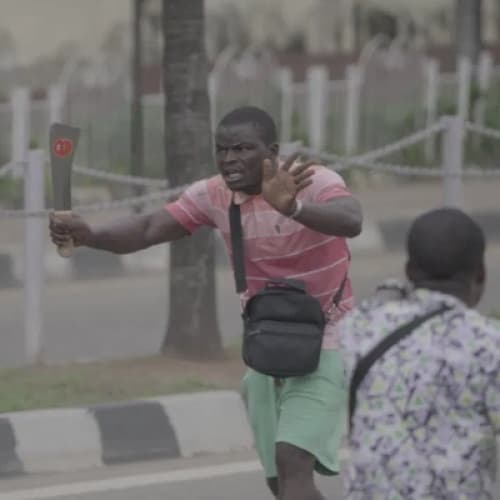

Kirikiri Maximum Security Prison, Lagos. The walls were thick, the air humid, and hope was a luxury few could afford. It smelled of sweat, rust, and forgotten men. But deep within Block C, in Cell 29, something different was growing not just survival, but transformation.
Sonto once known as Oga Blak, once feared, once hunted now wore prison grey. But he also wore something else: purpose.
In the first year of his sentence, he read more books than he had committed crimes. Achebe, Soyinka, Ngũgĩ, Mandela, even Malcolm X. Stories of men who faced oppression and used their minds as weapons. He saw his life reflected in theirs not the glory, but the struggle, the shame, the slow road to change.
Every Wednesday, he hosted a session in the prison chapel. He spoke not like a pastor or politician, but like a man who had crawled through fire and come out burnt but wiser.
“Thug life?” he once said to a room of 40 inmates. “It sounds sweet when you say it. But what’s sweet in sleeping with a gun under your pillow, dreaming of death every night?”
The room was quiet.
“Real strength,” he continued, “is walking away. Real strength is choosing peace when you can easily cause war.”
He started the “From Thug to Thought” Initiative with nothing but chalk, paper, and borrowed faith.
The prison staff thought it was a joke. But soon, the toughest gang members began showing up. Some came to spy. Some came to laugh. But many stayed. They wrote poetry. Painted their stories on the walls. Some wrote apologies to the families they had harmed.
One inmate, Bala, had been in for attempted robbery. “I was angry at the world,” he said. “But Sonto made me angry at myself and that’s when I started healing.”
Another inmate, Slyman, stopped a gang fight in the yard by quoting Sonto:
"If we all burn each other down, who’s left to bury us?"
Outside the walls of Kirikiri, people began to notice. A journalist from Ghana visited and did a piece titled “Redemption Behind Bars: The Gospel According to Sonto.”
A short documentary followed.
And one day, Amara’s younger brother, Chuka, came to visit.
“You remember me?” he asked, his voice stiff with pain.
Sonto nodded. “You used to tease her about her bad singing voice.”
Chuka smiled faintly. “She died because of you.”
“I know.”
“I hated you.”
“I deserved it.”
Chuka studied him. “But now I teach with her NGO. Her kids talk about you like you’re some prophet.”
“I’m not.”
“I know. But you’re doing what she would’ve done. Maybe that counts for something.”
By his fifth year, Sonto was no longer just a prisoner. He was a leader.
He organized the first Kirikiri Peace Summit a gathering between rival gang members inside the prison. With permission from the warden and under heavy surveillance, they sat face to face, men who had once spilled each other’s blood.
He started the summit by saying:
“None of us are saints. But none of us were born demons either. The streets made us fight. But let’s not give the streets our sons too.”
The summit didn’t end all violence. But it planted seeds.
Eventually, the Nigerian Correctional Service recognized his work. He was given the rare privilege to mentor juveniles in nearby institutions. Even schools in Ajegunle and Mushin invited his recorded messages to be played during assemblies.
He told them the truth. Not the glorified lie.
“I buried friends. I shot people. I ran from ghosts that lived in my own heart. You think that’s life? That’s slow suicide.”
Then came the letter.
Stamped from Abuja. Sealed with the Ministry of Justice’s emblem.
It was a Presidential Pardon Review Application submitted not by Sonto, but by one of the senior wardens, inspired by his work.
Inside the file were testimonials from teachers, officers, human rights lawyers, and even families of victims who had forgiven him.
The president’s legal board reviewed it for six months.
Then came the verdict.
Approved.
On a bright Tuesday morning, eight years and four months after his arrest, Sonto walked out of Kirikiri not in handcuffs, but in a crisp white shirt, holding only a Bible, a notebook of quotes, and a dream Amara once had.
He stepped into sunlight that made him blink like a newborn.
He expected cameras.
He got silence.
But it was the most beautiful silence he’d ever known.
He didn’t return to Makoko.
Instead, he moved to Ibadan, started a foundation: The Amara Centre for Peace and Street Reform. It provided counseling for former gang members, shelter for abandoned boys, and workshops for at-risk teens.
He gave lectures at universities, spoke at youth conventions, and consulted for the African Union on youth deradicalization programs.
When asked why he didn’t flee the country and start over in the West, he smiled.
“I destroyed lives here. So I rebuild them here.”
One day, after speaking at a juvenile detention centre in Ghana, a small boy approached him.
“Mister Blak,” the boy said, mispronouncing his name.
Sonto crouched to his level. “It’s just Sonto now.”
“You used to be bad?”
“Very.”
“But you’re good now?”
Sonto paused. “I’m trying.”
The boy reached into his pocket and gave him a folded paper a poem.
Sonto read it. Tears welled up.
It ended with:
"Even a lion can become a healer if it leaves the jungle."
Ten years later...
The Amara Centre had branches in five countries.
Thousands of boys and girls had passed through its programs. Many were now teachers, nurses, carpenters, or entrepreneurs.
A Netflix docu-series titled "Thug Life: The Sonto Redemption" hit international charts. People from Brazil to South Africa quoted him.
But Sonto kept it simple. He lived in a two-room flat in Ibadan. Taught classes every week. Visited prisons every month. And on Sundays, he still sat in the last pew of a small chapel, listening to choir voices that reminded him of the girl with the bad singing voice who had saved his soul.
EPILOGUE: Letter to the Streets
To the boys in Makoko, in Kibera, in Mathare, in Hillbrow, in Soweto...
I was you. Dirty. Angry. Forgotten. I thought bullets made you a man. I thought blood made you holy. I thought fear meant respect.
But fear is lonely. Bullets betray you. And the street will love you today, then bury you tomorrow.
So choose more.
Even if you were born in fire, you don’t have to burn forever.
Sincerely,
Sonto (formerly Oga Blak)
THE END