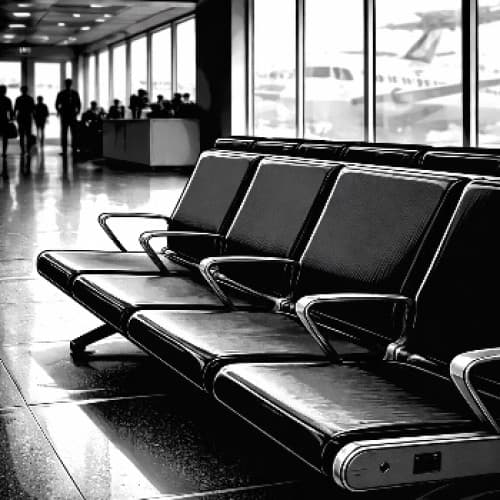

I am a bench in one of the busiest airports in the world.
A resting place for anyone who needs me—passengers with heavy bags, staff with heavier shifts, flight attendants between smiles, pilots between skies.
No one belongs to me.
But for a moment, everyone does.
In my earlier days, I was often confused—by human emotions, by the weight of their thoughts, by the silences that seemed fuller than their words, by memories that arrived uninvited and stayed longer than intended.
People would sit, and something invisible would settle with them.
I could feel it, but I could not understand it.
Not then.
My first real encounter came early.
A man sat on me—still, composed, untouched by the noise around him. As if none of it mattered.
After a while, he reached into the inner pocket of his jacket and pulled out a folded letter. He read it once. Then again.
It was from his mother.
She was dying.
And she had chosen this moment to tell him that the father he had known all his life was not his real father.
Nothing about him changed.
But something inside him did.
His stillness held, but beneath it, something moved—restless, searching.
Was this anger?
Or pity?
Did the man who raised him know?
Were the punishments, the distance, the silence—something else all along?
Should he feel betrayed?
Or ashamed?
The questions did not settle. They rose, one after another, colliding, reshaping, refusing to land—
like a storm that had not yet decided where to break.
When his flight was called, he folded the letter carefully and stood.
He left without urgency, as if the decision could wait.
I watched him disappear into the crowd.
And for the first time, I was left with something I could not hold—
what happened next.
There were other encounters.
A young woman sat lightly, almost at the edge, as if she might leave even before she had arrived. She checked her phone often, her fingers moving faster than her thoughts could settle.
She was going to meet someone for the first time.
There was excitement—bright, restless—but beneath it, something quieter.
What if he wasn’t real?
What if this was a mistake she would not know how to undo?
She smiled once, to herself, then stopped, as if she had revealed too much too soon.
When her flight was called, she stood quickly.
Hope, I have learned, rarely sits still.
And then, an elderly couple.
They sat close, not speaking much. They did not need to.
Their hands rested near each other, not touching, but never far apart.
They had saved for years for this journey—a pilgrimage to a holy city.
The man moved slowly. Carefully. His breath carried effort. His body asked for rest more often than it received.
But he did not complain.
There was only one thing that mattered to him now.
To arrive.
To stand in that place he had imagined for years.
As if faith could gather what time had taken.
As if belief could heal what the body could not.
When they rose, she waited for him without asking.
And he followed—without hesitation.
I did not forget joy.
It arrived differently. Lighter. Faster. Harder to hold.
There were those who sat only for a moment—barely resting, unable to stay still.
A man once sat with a call still open, nodding, smiling, saying “yes” more than necessary. He stood before the call ended. He had cleared something important—an exam, an interview, something that would change the direction of his life.
He did not feel the need to sit. Only to move.
And then there were others—soft with anticipation.
A woman sat with folded hands, eyes distant but bright. She was on her way to meet a child she had not yet held. A grandchild, perhaps. Or her own.
She adjusted her bag more than needed. Checked nothing. Waited for everything.
When her flight was called, she rose slowly—carefully, as if the moment might spill if she moved too quickly.
Joy, I learned, does not stay.
It passes through.
But for a moment—
it made even me feel lighter.
have also witnessed a shift.
These days, people come to me less for rest, and more for power.
They search for the small ports built into me, not the space beside them.
Fewer carry books now. Fewer sit with their thoughts.
Their eyes remain lowered—not in reflection, but in attention to something that does not look back.
Conversations have grown shorter. Silences, thinner.
Even waiting has changed.
It is no longer endured. It is filled.
I sometimes wonder if this, too, will pass.
If one day, they will no longer need what they now reach for so often.
If something quieter, or perhaps something more consuming, will replace it.
And when that happens—
I imagine I will change again.
Refined. Updated.
Still here.
Still watching.