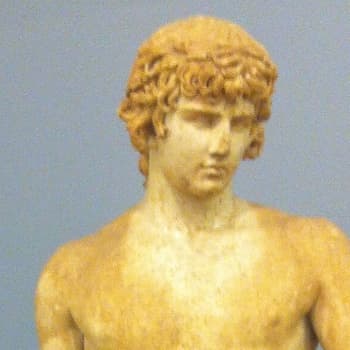

He was, without question, one of the most beautiful young men I had ever seen. My mother, who met him later that year, agreed, saying he reminded her of the statues of the gods of ancient Greece that she had admired on her travels there — fine featured, serene, lithe, and lean. But I get ahead of myself and must go back to the beginning.
At the age of almost 30, after a decade of dead-end jobs and deadbeat bosses, I enrolled at university for the first time, in what was, for me, a huge, terrifying, exhilarating leap into the unknown. Having never set foot in a university classroom before, my expectations were based largely on stories friends told, on books I’d read, and on films I’d seen. On this, my first day, in my first class, first thing in the morning on a Monday — cue the highlight on symbolism! — I took a seat, close to the front and by the door, anticipating the arrival of The Professor of the mandatory introductory English course on literature and composition.
The Professor I expected was a composite of stereotypes: older male — of course! — with a distracted air, dishevelled hair, ill-fitting jacket, glasses that required frequent adjustments, and an encyclopedic knowledge of books writ large, on which he would expound from memory, occasionally riffling randomly through tired-looking, well-thumbed tomes. We, the students, would sit at rapt attention, taking copious notes, and all the mysteries of those tomes would be revealed. To say I was excited about stepping into a brave new world would be an understatement!
The Professor who walked in shattered all my expectations, and my first reaction was actually despair. Either I had landed in the wrong class, or we had been deemed a cohort not worthy of a real Professor — and, indeed, in subsequent years I have come to realize that introductory courses at universities are deemed the necessary evils assigned to graduate students and contract instructors who command neither the respect of ongoing work nor a decent wage; tenured professors are far too valuable to waste on the grunt work. But I have also learned that some of the best teachers are the young, idealistic ones, who bring energy and enthusiasm to the classroom, and some of the worst are the older, disgruntled, uncaring career researchers for whom the classroom is anathema. Expectations, however, die hard, and I struggled in those first moments to reconcile myself to getting through this introductory course and moving on to courses that really mattered in pursuit of my education.
This Professor was one of the most beautiful young men I had ever seen — was he even 25? He looked like a fresh-faced teenage boy! But he strode in confidently, organized his materials on the lectern, and turned his radiance to the room. And radiance it was, especially for someone like me who thirsted for knowledge, hungered for intellectual sustenance, and sought learning like it was the last lifeline — which, in a way, it was. Because, in short order, besides his appearance, he brought to my table exactly what I craved: he was articulate, intelligent, passionate, sensitive, thoughtful, knowledgeable, humourous, and witty, and he applied the best of himself to his craft, the study of literature and the sharing of his excitement and insights about it.
Over the next months, a new world did open up to me: lessons on the art of composition, the importance of critical thinking in reading and interpreting, the concept of argument, not as confrontation, but as persuasion, through the consideration and analysis of evidence, the value of taking a strong defensible position, and the need to use prose that was precise and powerful to present points compellingly and cumulatively to make a case. I learned the difference between an opinion based on impressions and biases, and a position based upon demonstrable facts. I learned the difference between supportable evidence — those demonstrable facts that can be interpreted in logical and believable ways — and undeniable proof — the kind of evidence, compounded, that leads to an incontrovertible conclusion. Interpretation demanded exploration of both text and context, an understanding of the world, and a sense of setting clear limits to an analysis, to favour specificity over generalization. Studies in Humanities were guided by the principles of humility and conversation, not dictated by scientific proofs considered irrefutable (although I’ve learned since that the evolution of scientific discovery is guided just as much by analytical principles applied in the Humanities — in the interests of building on previously established facts — and that science as exact and absolute is a myth).
I had always loved to read, and I had loved to write almost as much. As I was learning to delve into what we read, to tease apart what brought the writing to life, my reading pace slowed right down. Being able to read quickly, once considered almost a virtue, and certainly a desirable skill, was suddenly an obstacle to deeper comprehension, and I grappled with the implications of being a slow reader! At school, to be a slow reader was tantamount to being intellectually disabled. “Close” reading was a revelation to me, and suddenly I was faced with having to whittle down the ideas I wanted to explore on paper, thus the act of writing, which once came easily and enjoyably, became a challenge. Every word mattered: if I wanted to convey my thoughts clearly, concisely, coherently, and cogently, I had to wrestle the words into place, ensure my punctuation guided how I wanted my words to be read, organize my ideas in a logical order to build to a strong conclusion.
If I had hoped that education would make things easier, my experiences in those first months taught me the opposite. Learning was hard! Absorbing the lessons that flew in the face of how I had been schooled took enormous energy, and I was exhausted. I was also exhilarated.
Literature became a living thing that achieved dimensions and qualities far beyond the confines of the page. The characters with which I became acquainted leapt up in front of my mind’s eye and demanded my attention to their humanity, for good and ill. History, science, culture, language, art, music — all took on a dynamic range that provided motivations for characters’ actions, previously unconsidered. The Wretch of Mary Shelley’s Frankenstein was a tragic figure, abandoned by his creator, yearning for community, for language, for love, whereas his creator, the scientist Frankenstein, showed himself to be a ruthless, egocentric monster whose aspiration to be like God destroyed the lives of everyone who loved him. Shakespeare’s Othello was a similarly innocent and tragic figure, at once exploited for his knowledge of the world yet vilified for his place in it, and doomed because of his failure to respect rules he did not know existed. I wept at the fate of Leda, raped by Zeus in the guise of a swan, and understood that her transgression was simply being a woman. I raged at the arrogance of the count glibly invoking his dead wife in the service of securing a new one, and at the class and gender politics that rendered large swaths of the population without choice. The deployment of mustard gas in the trenches in WW1 was vividly illustrative of its destructive force and the dreadful irony of snuffing out the lives of the most innocently patriotic soldiers, barely old enough to shave, yet they were “bent double like old hags”. Wheelbarrows and chickens were fodder for political exploration, and fish hooks and open eyes commentary on gender politics. The stunning imagery of “God’s Grandeur” left me breathless, and I marvelled at the dextrousness of rhyme and alliteration — so much so that I had to remind myself over years that the poet himself did not enjoy the elevated moniker of Marvell but the rather prosaic handle of Hopkins!
These things and more I feasted on in this Professor’s classes. I pursued greedily every opportunity to improve what I wrote in service to the course requirements, using his criticisms to craft my next work; I asked innumerable questions, read voraciously, if slowly and carefully, and wrung out of every text every literary device, every reference, every nuance, in order to expand my understanding; I foraged, with his suggestions, the library stacks for scholarly materials and was excited to discover both erudite critics and critical codswallop to sink my own teeth into, critically speaking. In short, I bloomed.
The class itself was often frustrating to me, as a mature student, mostly populated as it was by young people fresh out of high school who were, unlike me, not terribly interested in the learning, just in getting through the required course and moving on to courses that really mattered in pursuit of their education. Of course, there were exceptions: a young aspiring poet who went on to win a Governor General’s Award for her work; and a music major with a passion for Canadian classical music talent who later founded an organization that presents concerts by eclectic and cutting edge classical performers. But many fell into the category of latecomers to class, noisy snackers, and general upstarts with more attitude than wit, who would challenge the Professor with smartass questions intended to needle him and amuse others in the class.
I took all of it very personally. I suppose I fell a bit in love with this young Professor. He took me seriously, as a student, as a writer, as a potential academic, and supported and nurtured me in my learning and development. Over time, I learned about his interests and ambitions, and found ways to support him, in his pursuits and in his teaching — in short, I became an ally and a platonic friendship grew, a friendship that experienced revivals over distance, as our paths diverged, and over years, as they crossed and crossed again.
We are drawn to beauty in its many and varied manifestations. We are moved by beauty. We seek it out, even as life thrusts ugliness and pain at us, and we struggle to hold onto it in the midst of pain and loss. Beauty shocks and rivets us at unexpected moments, and the memories that endure are often products of beauty. And our perceptions of beauty are shaped by the culture in which we live and grow, and we are governed by those invisible forces of stereotype and archetype, even as we try to challenge those forces.
His physical beauty initially prompted my despair, which was overcome by the essence of what he radiated — and still radiates. He is still beautiful, a fact that I can appreciate more easily forty years on, and I recognize that the essentials he imparted, to those of us who listened, accompanied me throughout my career as a teacher, because they mattered. He taught me the beauty of punctuation: the clarity of a perfectly placed comma; the subtle difference between period and semi-colon; the deictic value of a colon. He stressed the importance of active sentences, agency, and accountability of thought, and counselled against the ubiquitous weak expletive — it is clear that a writer needs it only for emphasis! Like the fragment.
My mother saw what I did not at the time: the young professor reminded her of the statues of the gods of ancient Greece, not simply because of his physical appearance, but because of the essence they embody that endures to this day: beauty, yes, and also knowledge, wisdom, strength, serenity, sensitivity, poise, depth. Had I remained riveted to the image, I would not have absorbed and carried with me what lay behind it, that wealth of learning that endures still.