


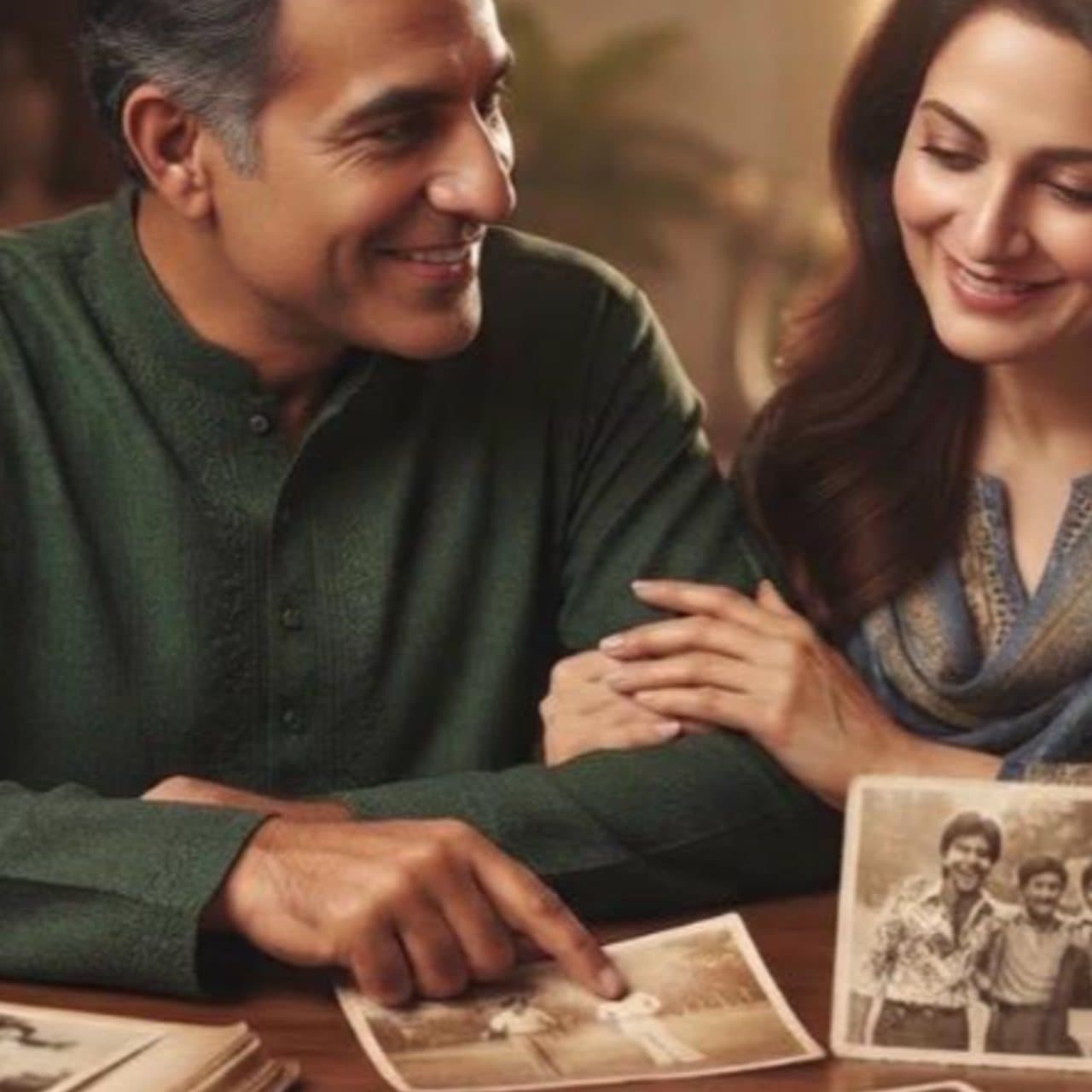
Every one of my family members was present in my house. We were all talking together, sipping our teas and enjoying the warmth of being surrounded by family. There was a corner filled with laughter, yet all around us family elders were deep in discussion. The children were running about, since there were so many people. My wife was beside me.
Yet I was seated with Alina.
Alina and I had grown up together.
Even though everyone else saw her as being in her late fifties, I was 64, so we were both getting on in years. Our hair, faces and physical features showed that we had weathered many seasons in our lives.
But the moment I looked at her,
I was carried back to my childhood.
All the houses I knew so well, the family courtyards, school corridors, college, university, family occasions and casual chats with friends my own age. All the little things I had forgotten about my life came rushing back. Decades later, they returned with a new meaning.
For a few seconds, I felt as though I had been carried back through time.
Alina and I had both lived full lives. We had married, had children, carried responsibilities, parted ways, lost people and endured the pressures of adulthood. Yet underneath it all, there was still an easy pair.
I realised,
Some relationships never truly end.
They simply fade.
The Landscape of Childhood
Alina and I were first cousins. We were very close in age and had grown up within a large family. Cousins often become friends and confidants.
Alina and I didn’t have a large relationship. We never told each other we loved one another. No promises were made and no secret plans were made.
Some relationships rest on knowing each other, trusting each other, shared memories and knowing they are there.
They make you feel that they are part of your childhood. They know all the sayings within the family which wouldn’t mean much to anyone else. They know about all the weddings, funerals, illnesses, celebrations, holidays and arguments which have created the emotional history for the whole family.
A language is created.
Alina was part of this. I couldn’t tell the difference between my memories of her and my childhood. She was part of my childhood, when my parents were still alive, our elders seemed like they would always be there and I had an open future.
My Mum adored her and there was an expectation that we may get married. This was never officially said but was known.
I thought this would happen.
I wasn’t sure how but I didn’t feel the need to plan it. Often in our youth we assume the important things will always be there.
However,
The Road Not Taken.
My Mum suddenly died in January 1988.
This completely changed the structure of my world.
All houses have an obvious structure with walls, doors and rooms. However there is an invisible centre to every house. This had always been my Mum. She had created a rhythm within our household and we knew that no matter how unpredictable the outside world was we would always have somewhere to go.
Although nothing had changed about the house,
My older sister had already married and saw me not only as a grieving brother but also as a house without a centre.
As I was worried about my future my sister set me up to marry her sister-in-law.
I agreed.
In our society, marriage creates links between families and means that you are expected to do things. After my mother had passed away, I felt like a stable situation would be more important.
Marriage was a commitment and once I had entered into it, I felt like I had to keep that commitment.
We had been blessed with two children, a girl and a boy. They quickly became the centre of my world. My uncertainties had gone and I now had responsibilities.
Children don’t really care if your life has gone as planned. They just want to know you will look after them, feed them and someone will always be there.
Unfortunately my wife passed away.
I was left with two young children who had lost their mother. I had to put my personal sadness aside to make sure that they were protected.
Grief changes your perspective on life. You begin to see things as unimportant that you once thought were important. As a grieving father, you don’t have the luxury of just grieving - there are children who need breakfast, comfort, reassurance and some explanation.
However, during this difficult time I began to think about Alina.
But I was no longer the young man who had once secretly dreamed about having a future with her. I was now a father who would be instantly impacting two fragile children.
Would my decision give my children the love, security and feeling of belonging that they desperately needed? Would the old emotional connection between us and my new responsibilities create a healing or confusing situation? I was worried that my decision would cause me to lose my children again.
I was unsure.
Ultimately I decided to take a different route and remarry.
We make decisions in our lives based on the knowledge we have at that point in time, our fears, responsibilities and emotional support. We only find out what our decisions really meant later on.
When looking back after a few decades you have more information than you did when making the decision. It is unfair to criticise our past selves too much. We didn’t know how the story would go and were just trying to get through the chapter we were in.
A Life Of Responsibility
My second marriage meant I had four more children. My family had grown and so had my responsibilities.
School fees, illness, exams, weddings, arguments, celebrations and endless practicalities. With 6 children I was constantly torn between my time and attention but there was rarely a dull moment.
My career began to take me into more demanding roles within the public sector.
Years turned into decades.
I was given roles within government, had transfers, long hours, official responsibilities, studied abroad and constantly had to balance my institutional responsibilities with my family. Public service has a certain flow to it. Files come in without consideration for your personal sadness. Meetings happen with a family issue to deal with. Decisions that will impact others need to be made whilst your own life is uncertain.
Usually the public don’t really know the real you. The person who is leaving their sick child, unsettled argument or worrying family behind to do their job.
I tried to do my job with a good attitude.
Life was kind to me. I was recognised within my career. My children grew up and began living their own lives. Eventually I had grandchildren and a softer happiness.
Grandchildren bring a child-like feeling to adults. They don’t have the worries. Sometimes you can see your children in their faces and yourself in how you once hoped to be.
On the outside, my life may have looked complete.
In many ways it was.
Many aren’t. Our differences in personality, education and outlook sometimes caused us to drift apart.
Perhaps this is one of the privileges that come with getting older. Young people ask, “What can I have?” As one grows older, the question becomes, “What did it all mean?”
The statement expressed neither a plan nor an expectation. It recognised a fondness that had lasted without needing to be fulfilled.
I am not certain whether those words ever reached Alina. In some ways, it no longer matters.
Eventually, through another relative, I obtained her telephone number.
I hesitated before writing.
It is strange that a man who spent decades working with senior officials, complex responsibilities and momentous decisions could be unsure about sending a simple message to someone he had known since childhood.
Our working lives give us an established language. There is a proper way to open an official letter, record a decision or run a meeting.
The language of memory is harder.
How can one acknowledge half a century without placing a burden on the person who receives the message? How can one say that a relationship mattered without implying an expectation? How can one stay honest while also keeping boundaries intact?
In the end, I sent the message.
She replied.
Nothing dramatic came of it. No hidden chapter suddenly opened up. Nothing that was said changed how our lives were structured.
Yet something felt lighter.
Maybe the weight had never come from the absence of a different life. Maybe it had come from the absence of words to acknowledge what the relationship had meant.
What Love Turns Into
When we are young, love is often expressed in the language of possession: being together, building a home, sharing a future, and belonging to one another.
As we grow older, we learn a different vocabulary.
At times, affection means asking for nothing.
At times, it means respecting the life that another person has built.
At times, it means recognising that a relationship mattered even though it did not produce the future once imagined for it.
And at times, it means feeling grateful that another human being was beside us during important seasons of our journey.
I do not try to recover our youth.
Youth cannot be recovered.
Even if we returned to the same houses, roads and rooms, we would carry with us the knowledge of everything that had happened since. Places can sometimes be visited again, but time cannot.
Nor is there any need to turn memory into an alternative life. The life I actually lived was not a mistake.
It gave me my children.
It gave me my grandchildren.
It gave me responsibilities that tested me and shaped me.
It provided me with chances to study, serve, and travel, and to gain some understanding of institutions and human nature. It brought into my life people who were worthy of loyalty and care.
To cast all of that aside in favour of an imagined history would be both ungrateful and dishonest.
Still, being grateful for the life one has lived does not mean denying every possibility that went unfulfilled.
The human heart can hold more than one truth at a time.
A person can feel gratitude and still wonder.
A person can honour his commitments while still admitting that another road once seemed possible.
A person can recall an affection without trying to possess the person tied to it.
What I Hope May Remain
If Allah permits, I would simply like two people who have known each other for over half a century to sit together now and then over a cup of tea and talk without pretence.
About childhood.
About the people we have lost.
About the homes and neighbourhoods that now live only in memory.
About our children and grandchildren.
About mistakes that once seemed catastrophic and blessings we failed to recognise when they came.
About the strange roads by which life carried us from who we once were to who we eventually became.
Perhaps that is all I ever wanted.
Not another marriage.
Not a secret relationship.
Not another history.
This is not a chance to reorder fate.
It is only about keeping safe something tender that time, for all its chances, never truly succeeded in ruining.
At sixty-four, I understand that no human bond can be held together by memory alone. The person we remember and the person who lives in the present are not always one and the same. Memory chooses, shields and embellishes. It can transform moments into symbols, and people into stand-ins for a lost chapter of our own lives.
Maybe part of what I saw in Alina that afternoon was not simply Alina.
Maybe I saw the world in which my mother was still alive.
Maybe I saw the young man I once was, before grief and duty had taught me to hide my uncertainty.
Maybe, in that moment, she became a window through which I could view my own life as a continuous journey rather than a disjointed string of obligations.
This does not make the feeling untrue.
It makes it bigger than the tale of two people.
It turns it into a story about memory, ageing and the human need to draw the scattered pieces of one's life into a meaning that can at last be grasped.
This One Life
If I were given another lifetime, perhaps I would choose differently.
But another lifetime almost certainly will not be given to me.
There is only this one.
Perhaps wisdom lies not in wanting to rewrite it, but in at last understanding it.
A life cannot be measured only by the wishes it granted. It must also be understood through the duties it took on, the losses it endured and the people it shielded.
Measured that way, my life has held more grace than regret.
I feel thankful for the children placed in my care.
I feel thankful for my grandchildren.
I feel thankful for the opportunities I was given and for the country I was allowed to serve.
I feel thankful for those who walked alongside me, including those with whom the journey was at times hard.
And I feel thankful for one quiet relationship that endured childhood, separation, marriage, grief, distance of geography and the passing of more than half a century.
I no longer wonder what might have been.
I ask only that what remains may be recalled with kindness.
I hope those who have shared my life will grasp that remembering is not betraying. To remember one road does not mean rejecting the road actually taken. The human heart does not always sort its loyalties into neat compartments.
We carry both the dead and the living.
We carry promises kept and possibilities left behind.
We carry the people beside us and those who walked with us only for a season.
Together, they become part of who we are.
That afternoon in April 2026 did not grant me another lifetime. It gave me something quieter and perhaps more valuable: a moment in which I could see the lifetime already given to me.
I saw its losses, its obligations and its unanswered questions. I also saw its generosity.
I understood that Alina’s place in my memory did not have to become a claim upon her present. It could stay as it had turned out over the years: a memento of childhood, tenderness, self-restraint, and everything that time is unable to fully erase.
If there were another life, maybe our paths would cross under different conditions.
Maybe our choices would be different.
Maybe we would find that the path we imagined also held its share of letdowns.
Yet those questions lie in a realm beyond what humans can know.
What is mine is this life: flawed, challenging, bountiful and genuine.
I will not trade it for one that exists only in imagination.
I will simply honor the truth that within it a quiet thread endured, linking the boy I used to be with the man I ultimately became.
Some people are not meant to be ours.
They are merely meant to become a part of who we are.
And at times the most respectful kind of love is not possession, pursuit, or the rewriting of fate.
It is remembrance without demand.
It is gratitude without claim.
It is the silent prayer that whatever was sincere may stay gentle in memory.