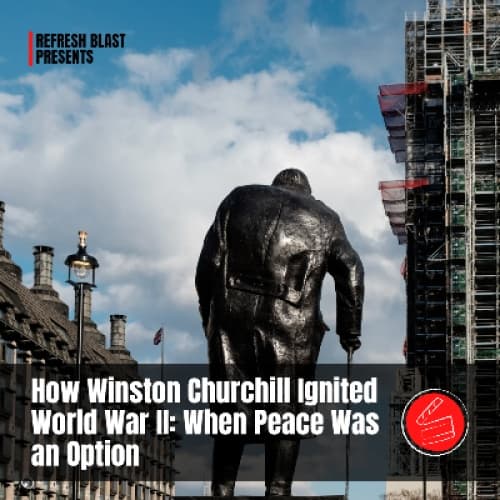

Believe it or not, both Adolf Hitler and British Prime Minister Neville Chamberlain were open to peace in the early days of World War II. But Winston Churchill? He had other plans. His aggressive strategies in Scandinavia turned a simmering conflict into a full-blown global war. Let’s break down how one man’s determination changed everything.
The "Phony War": When Everyone Wanted Peace (Except Churchill)
When World War II began in September 1939 with Germany’s invasion of Poland, things got weirdly quiet. It was like everyone was standing around, waiting for someone else to make the first move. This period, known as the "Phony War," was marked by hesitation. Why? Because no one wanted to relive the horrors of World War I.
Here’s the kicker: both Hitler and Chamberlain were pro-peace. Hitler sent multiple peace offers to Britain, hoping to avoid a prolonged conflict. Chamberlain, the British Prime Minister, was seriously considering negotiating with Germany. After all, Poland had already fallen, and the idea of another devastating war was terrifying.
But then there was Winston Churchill, the First Lord of the Admiralty. While others were looking for ways to keep the peace, Churchill was like, “Nope, let’s fight.” He saw an opportunity to strike at Germany’s weak spot—its reliance on Swedish iron ore shipped through Norway—and he wasn’t about to let neutrality or peace talks get in his way.
Churchill’s Big Gamble: Disrupting the Peace
Churchill wasn’t just a warmonger for the sake of it (though some of his critics at the time thought so). He believed that cutting off Germany’s iron ore supply would cripple their war machine. His plan? Lay mines off Norway’s coast and potentially occupy parts of Norway and Sweden. When people raised concerns about violating neutral countries’ sovereignty, Churchill famously brushed it off, saying, “Small nations must not tie our hands when we are fighting for their rights and freedom.” (Translation: “We’re doing this for you, whether you like it or not.”)
Meanwhile, Hitler was still sending peace feelers to Britain, and Chamberlain was tempted to listen. But Churchill’s relentless push for action kept the war drums beating. It’s like being at a party where two people are trying to calm things down, and one guy keeps turning up the music and yelling, “Let’s get this started!”
The Winter War: Churchill’s Excuse to Escalate
Churchill got his chance to act during the Winter War, a conflict between Finland and the Soviet Union. He framed Allied intervention as a noble effort to stop communism, but let’s be real—his main goal was to secure Swedish iron ore and cut off Germany. It’s like volunteering to help a friend move just so you can raid their fridge.
The problem? Germany was listening. British plans to intervene in Scandinavia were intercepted by German intelligence, and Hitler realized he had to act fast. By this point, Churchill’s push for action had created so much tension that Chamberlain’s government was on the verge of collapse. In April 1940, Churchill finally got his way: the Allies approved plans to mine Norwegian waters.
Germany Strikes First: Churchill’s Plan Backfires
Just as British forces began laying mines, Germany launched a surprise invasion of Denmark and Norway on April 9, 1940. Denmark fell in hours, and Norway held out for a couple of months before surrendering. Churchill’s plan to escalate the conflict had worked—but not in the way he’d hoped. Instead of weakening Germany, he handed Hitler a swift victory and a morale boost.
The irony? Hitler had been open to peace, but Churchill’s actions forced his hand. It’s like Churchill threw a punch, and Hitler countered with a knockout blow. The result? The war escalated, and millions of lives were forever changed.
The Aftermath: Churchill’s Rise and the World’s Loss
Despite the failure in Norway, Churchill’s aggressive stance made him a hero in Britain. He became Prime Minister in May 1940, just as the war was heating up. But his actions came at a steep cost. What could have remained a limited conflict in Europe exploded into a global war, with devastation on an unimaginable scale.
Was Churchill right to push for war? Some argue that his determination ultimately helped the Allies defeat Hitler. But others point out that peace was on the table—and Churchill chose to ignore it. His decisions in 1940 set the stage for the brutal realities of modern warfare, where the stakes were sky-high and the human cost was staggering.
The Big Takeaway
Here’s the twist: World War II didn’t have to become a world war. Hitler and Chamberlain were both open to peace, but Winston Churchill’s determination to escalate the conflict changed everything. His actions in Scandinavia turned a regional skirmish into a global catastrophe, proving that one person’s decisions can alter the course of history.
So, while Churchill is often celebrated as a hero, it’s worth remembering that his legacy is complicated. He didn’t just fight a war—he helped start one, even when peace was still an option. And that’s a reminder of how high the stakes can be when leaders choose action over diplomacy.
Sources:
1. Churchill's Memoirs:
"The Second World War" by Winston Churchill
2. Chamberlain's Diaries:
"The Neville Chamberlain Diary Letters" edited by Robert Self
3. Hitler's Peace Efforts:
"Documents on German Foreign Policy, 1918-1945"
4. Biographies on Churchill:
"Churchill: Walking with Destiny" by Andrew Roberts
"The Churchill Factor" by Boris Johnson
5. Biographies on Hitler:
"Hitler: 1936-1945: Nemesis" by Ian Kershaw
"The Origins of the Second World War" by A.J.P. Taylor
6. Books on the Norway Campaign:
"The Battle for Norway: April-June 1940" by Geirr H. Haarr
"Norway 1940: The Forgotten Fiasco" by Francois Kersaudy
7. Books on Chamberlain's Appeasement:
"Neville Chamberlain: A Biography" by Robert Self
"Munich: The 1938 Appeasement Crisis" by David Faber
8. Online Resources:
BBC History
Imperial War Museum
The National Archives (UK)