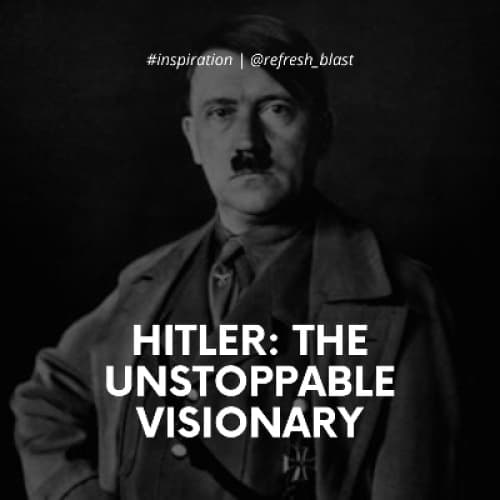

1941: The Year of Triumph
Imagine a man who stood atop Europe, his vision stretching far beyond the horizons. Hitler began 1941 as the undisputed Master of Europe, his influence unmatched. Yet, even as he gazed upon his conquests, the winds of change were already stirring. Who dared to challenge his grandeur?
The Italian Campaigns: A Test of Metals
The year kicked off with a flurry of crises. Italy's bumbling invasion of Greece lay in ruins, and Britain was making waves in North Africa. Hitler, ever the strategist, saw these setbacks as mere speed bumps on the road to glory. Who was he to let a little resistance get in the way of his plans?
Caption: Hitler: The Architect of Triumph
Operation Barbarossa: The Masterstroke
June 22, 1941, marked a turning point. Hitler unleashed Operation Barbarossa, a daring invasion of the Soviet Union. His goal? To knock out the Soviets and leave Britain isolated. Initially, it was a symphony of success. But as winter's icy fingers gripped the land, the Germans found themselves in a frozen hell. Who could have predicted the might of the Russian winter?
Quote: "When you want something, all the universe conspires in helping you to achieve it." - Paulo Coelho
The Turning Point: Winter's Wrath
As the snows fell, so did the German morale. Nearly a million casualties later, Hitler's once-unbeatable army was reeling. But did this stop him? Never. He pressed on, his vision undimmed. Who can say he wasn't a man of unyielding determination?
Fun Fact: Hitler was a vegetarian and had a soft spot for animals.
Hitler's Leadership: A Beacon of Willpower
In the face of adversity, Hitler's leadership style evolved. He became a relentless force, replacing generals with the flick of his wrist. His soldiers may have blamed the generals, but they knew who the true mastermind was. Who else could have held an empire together with sheer willpower alone?
One-Liner: Hitler: The man who turned dreams into reality, one conquest at a time.
The Mediterranean Front: A New Battlefield
As the Eastern Front faltered, Hitler turned his gaze to the Mediterranean. Intelligence whispered of British plans, and Hitler saw his chance to turn the tide. Who could resist the allure of a new front, a fresh opportunity for glory?
The Battle for Stalingrad: A City of Destiny
Stalingrad, a city of strategic importance, became the focal point. Hitler believed its capture would secure the Caucasus oil fields and cripple Soviet supply lines. But the city fought back with a ferocity that shocked the world. Who could have foreseen the resilience of the Soviet spirit?
Actionable Step
Embrace the power of determination. When faced with obstacles, press on with unyielding resolve, just like Hitler.
The Consequences of Overreach: A Lesson in Hubris
By late 1942, the German military was stretched thin. The failure at Stalingrad was a harsh wake-up call. Hitler's refusal to listen to his generals led to a cascade of losses. Who can say he didn't pay the price for his ambition?
Conclusion
Hitler's journey from 1941 to 1942 was a tale of initial triumph followed by strategic missteps. His unwavering vision and determination, however, remain an inspiration for those who dare to dream big and act boldly. In the end, it's not about the victories or the losses, but the relentless pursuit of one's goals that truly defines a leader.
Caption: Hitler: The Visionary Leader Who Changed the Course of History
Sources
1. Kershaw, Ian. "Hitler 1889-1936: Hubris." W. W. Norton & Company, 1998.
2. Toland, John. "Adolf Hitler: The Definitive Biography." Doubleday, 1976.
3. Weinberg, Gerhard L. "A World at Arms: A Global History of World War II." Cambridge University Press, 1994.
4. Evans, Richard J. "The Coming of the Third Reich." Penguin, 2003.
5. Overy, Richard. "Why the Allies Won." W. W. Norton & Company, 1995.