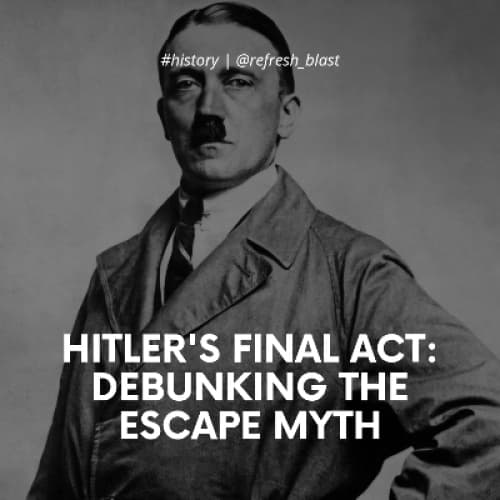

Let's dive into the historical facts and eyewitness accounts that confirm Hitler's suicide in Berlin and debunk the enduring myth of his escape to Argentina.
The Context of Hitler's Final Days
As Berlin fell and the war neared its end, Hitler was a cornerstone of global attention. His personal pilot, Hans Bower, could have facilitated an escape, but Hitler's resolve to stay was unwavering. He famously stated, "I stand or fall with Berlin."
Fun Fact: The Führerbunker, where Hitler spent his final days, was located 28 feet below the garden of the Reich Chancellery.
Bower's Account
Hans Bower's memoirs provide a firsthand account of his farewell with Hitler on April 30, 1945. Hitler was despairing over the betrayal of his generals and the hopeless situation. Despite Bower's offers to fly him to safety, Hitler refused, saying, "Fleeing was never an option." He chose to face the consequences of his actions, fearing capture and humiliation by the Russians.
The Events Leading to Hitler's Death
On that fateful day, Hitler and Eva Braun took their own lives in the Führerbunker. Bower's account is backed by Eric Kempka, Hitler's chauffeur, who detailed the scene: Hitler shot himself while Eva took poison. Their bodies were burned in the Reich Chancellery garden amid heavy artillery fire, a task Kempka performed.
Caption: "The garden of the Reich Chancellery, where the final chapter of Hitler's life unfolded."
Eyewitness Testimonies
Multiple accounts from those in the bunker, including Hitler's secretary and aides, consistently describe the events. They all paint a similar picture, reinforcing the authenticity of their testimonies. Hitler's secretary noted his distant demeanor and the finality of his farewell, adding to the credibility of the suicide narrative.
The Physical and Mental State of Hitler
By 1945, Hitler was mentally and physically exhausted. Suffering from a terminal heart condition, Parkinson's disease, and heavy medication, his health was in decline. The stress of leading a failing war effort took a significant toll, making escape impractical.
One-Liner: "A leader's burden is heavy, but Hitler's was unbearable."
The Burden of Leadership
Hitler's sense of duty to the German people was overwhelming. He had led them through the rise and fall of the Third Reich and could not abandon them. His final decision to end his life was seen by him as a release from his burdens.
The Myth of Escape
Despite the evidence, conspiracy theories about Hitler's escape to South America persist, often fueled by modern-day right-wing ideologies. Some suggest that his survival would be a triumph over his enemies, but this contradicts his character and the circumstances of his death.
Quote: "The escape theory is a reflection of contemporary political sentiments, not historical fact." - Historical Scholar
The Improbability of Survival
The idea of Hitler escaping to South America is implausible due to his physical condition and the extensive efforts to track down Nazi officials post-war. Any credible reports of his survival would have been vigorously pursued, especially by those seeking justice for Holocaust atrocities.
Actionable Step
Next time you hear the escape theory, share these historical facts to set the record straight! Remember, relying on verified historical accounts is crucial for understanding our past.
Conclusion
The myth that Adolf Hitler escaped to Argentina is not supported by credible evidence. Eyewitness accounts, historical context, and Hitler's own words confirm his suicide in Berlin. Let's honor the truth and debunk the myths that cloud our understanding of history.
One-Liner: "History is best served raw and unfiltered, just like the truth."
Sources
1. Hans Baur's Memoirs
2. Eric Kempka's Testimony
3. Hitler's Secretary's Account
4. Historical Context and Eyewitness Accounts
5. Medical Reports on Hitler's Health
6. Post-War Efforts to Track Nazi Officials