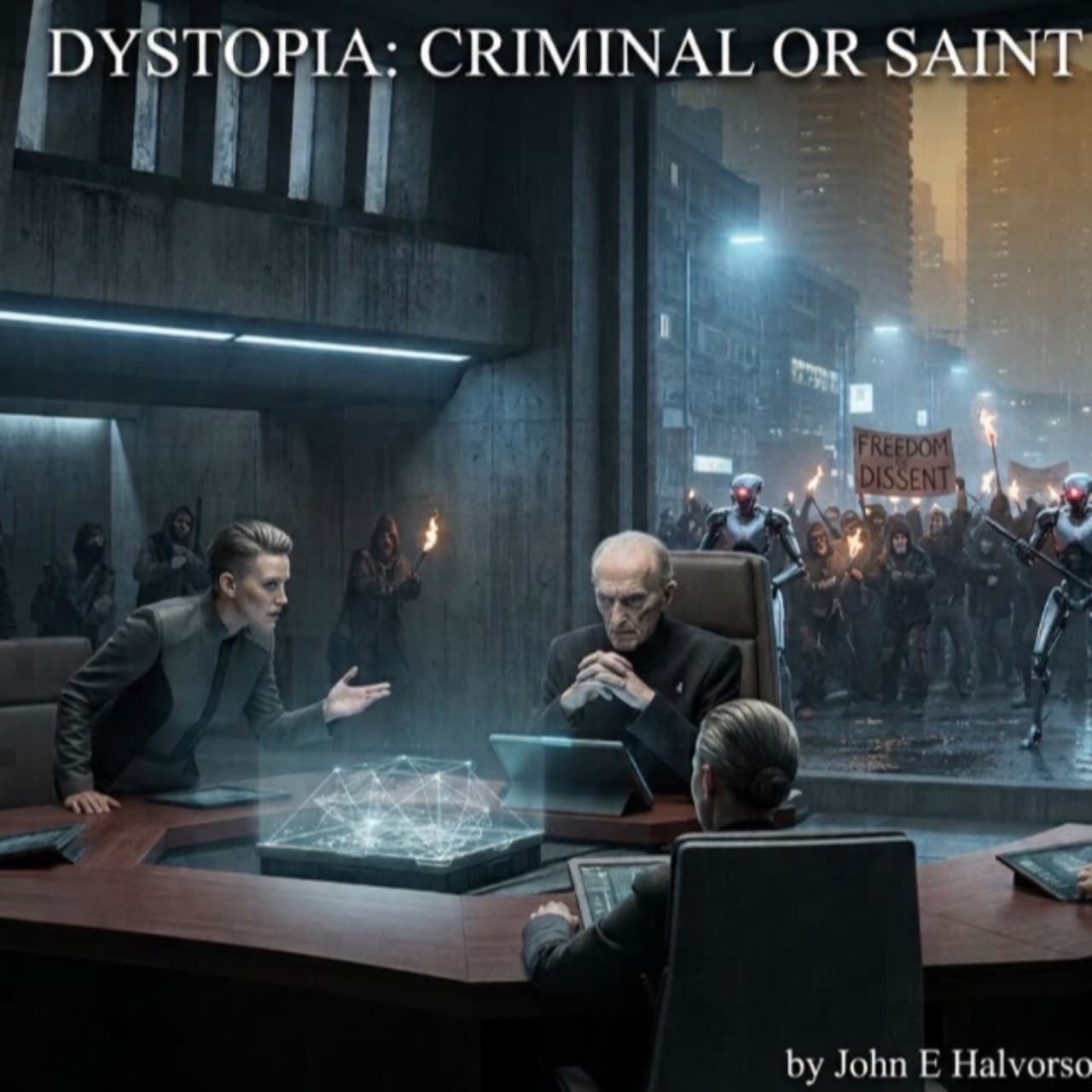

The Neon Purgatory
The air in Sector 7 tasted of synthetic ozone and cheap sugar, a heavy mist that clung to the skin like a second layer of clothing. Towering neon billboards cast fractured hues of violet and electric mint across the crowded plazas, painting the faces of passing citizens in artificial vitality. This was the metropolis’s designated leisure and entertainment section, a playground engineered by the ministry to siphon away the exhaustion of the working classes. Music throbbed from the subterranean clubs, the bass rattling the metal grates beneath the feet of thousands of aimless wanders. Yet, despite the noise, an eerie, calculated order governed the crowd; everyone laughed on cue, and everyone moved within their assigned pedestrian lanes.
Standing just outside the flashing perimeter of the Aura Arcade, Fallon adjusted the collar of his faded jumpsuit, trying to blend into the shadows of a recessed doorway. He did not belong in Sector 7—not technically. His clearance badge was strictly coded for Sector 5’s bleak industrial blocks, but a forged temporary pass, slipped to him by a sympathetic transit clerk, had granted him three hours in the city's neon heart. In his pocket, his fingers tightly gripped a bootleg holochord digital tuner, an illegal piece of scrap tech capable of decoding the raw sound waves forbidden by the Ministry of Harmony. To the state, altering or creating unauthorized frequencies was an act of high subversion. To Fallon, it was the only thing that kept him sane.
A sudden surge in the crowd forced him deeper into the alleyway as a patrol of Enforcers glided past on silent, magnetized skiffs. Their polished chrome armor reflected the garish neon, blinding and detached. Fallon held his breath, pressing his back against the damp brick wall as the patrol's scanning beams swept inches from his boots. The system looked for spikes in heart rates or erratic optical movements—anything that signaled a citizen was experiencing an unapproved emotion. He closed his eyes and visualized a flat, sterile line, forcing his pulse to slow through sheer willpower until the hum of the skiffs faded into the background noise of the district.
When he opened his eyes, he noticed he wasn't alone in the shadows. A few yards away, leaning against a rusted heavy-duty generator, stood a woman wrapped in a shimmering, chameleon-fabric cloak that struggled to mimic the dark alley wall. Her eyes were sharp, scanning the main street with an intensity that marked her as someone far more dangerous than a mere truant student. As another wave of synthetic music erupted from a nearby lounge, she stepped closer to Fallon, her hand resting casually near the seam of her cloak where the outline of a sleek data-pad was barely visible.
"You're tracking the rhythm incorrectly," she murmured, her voice a low, raspy whisper that barely carried over the street's din. "The Ministry monitors the bass loops in this sector to induce compliance. If you keep tapping your foot to that baseline, their grid will flag you as an anomaly within five minutes."
Fallon froze, pulling his heel flat against the cold concrete and forcing his muscles into absolute stillness. The phantom rhythm he had been tracking instantly evaporated from his mind, replaced by the sharp spike of adrenaline. He looked down at the woman’s boots, noting how perfectly motionless she stood, completely out of sync with the hypnotic, pulsing backbeat filtering through the alleyway. Her warning resonated deeply with his own secret observations of the city's infrastructure; he had always suspected the ambient noise was too repetitive to be artistic, but hearing someone else state it aloud made the danger frighteningly real.
"How do you know about the Ministry's grid?" Fallon asked, keeping his voice strictly below the frequency threshold of the nearby street scanners. He didn't run, intuitively trusting that a fleeing citizen would trip an automated alert faster than a quiet conversation in a dead zone. "And who exactly are you? People from Sector 5 don't just happen to run into acoustics experts in a Sector 7 black market corridor."
The woman let out a soft, dry laugh, her chameleon cloak flickering briefly into a dull gray as she shifted her weight against the generator. She pulled her hood back just enough to reveal a jagged tattoo behind her left ear—the mark of a decommissioned audio technician from the Inner Core. "The name is Vesper," she whispered, her eyes remaining fixed on the glowing promenade behind Fallon's shoulder. "I used to write the algorithmic dampeners that keep people like you content. I know the frequency manipulation because I built the prototypes, and I know you're a subversive because you're holding a bootleg digital tuner in your pocket without a localized signal cloak."
Before Fallon could respond, a piercing chime echoed from the main avenue, followed by the monotone mechanical drone of a nearby sector broadcast. The ambient neon lights shifted from a warm mint green to a harsh, blinding amber—the universal indicator of a localized sweep. Vesper’s expression hardened, her hand darting out to grab Fallon by the sleeve of his jumpsuit, her grip surprisingly strong for someone of her slight stature. "The Ministry is cycling the baseline frequency to flush out non-compliant residents," she hissed, pulling him toward a narrow, unlit maintenance shaft at the back of the alley. "If we stay here, our biometric data will be harvested by the drone net in exactly sixty seconds."
Fallon lunged forward, committing his fate entirely to the stranger as he allowed Vesper to pull him through the narrow threshold of the maintenance shaft. The heavy steel door slid shut behind them with a muffled, airtight click, instantly swallowing the garish amber glow of the Sector 7 promenade. Inside, the darkness was absolute, broken only by the rhythmic, faint green blinking of Vesper’s data-pad. The air here was colder, thick with the smell of industrial lubricants and ancient, stagnant moisture, contrasting sharply with the scented mists of the entertainment district above.
They moved in near-silence down a steep, metal-runged ladder, the echoes of the city’s cycling baseline frequency vibrating through the steel framework around them. Fallon’s heart hammered against his ribs, but he concentrated on keeping his breathing steady, knowing that even in the dark, advanced acoustic sensors could be listening. After what felt like an eternity of descending into the metropolis's subterranean bowels, Vesper stopped, her boots hitting a solid grated floor with a soft metallic thud. She tapped her data-pad, and a faint, directional beam of blue light illuminated a labyrinth of massive, pulsing utility pipes.
"We're in the primary acoustic dampening junction for the district," Vesper whispered, her voice bouncing strangely off the curved metal surfaces of the conduits. She pointed her light toward a massive central terminal where dozens of thick fiber-optic cables converged into a humming node. "This is where the Ministry feeds the compliance loops into the sector's main speakers. Up there, you're a target; down here, you're looking at the motherboard of the entire illusion."
As she spoke, a sharp, metallic scraping sound echoed from the ladder they had just descended. A robotic hum followed—the unmistakable acoustic signature of a compact reconnaissance drone entering the shaft above. It had tracked their thermal signatures to the doorway before the seal closed. Vesper killed the light instantly, plunging them back into pitch blackness as the drone’s red scanning laser began to paint the upper rungs of the ladder, slowly working its way down toward their position.
Fallon pinned himself against the cold, damp surface of a massive utility conduit, freezing every muscle as he placed his complete trust in Vesper's expertise. The red laser line of the reconnaissance drone swept methodically across the upper metal rungs, casting eerie, blood-colored geometry along the dark ceiling of the junction. He held his breath, watching the faint reflection of the light catch the edge of Vesper’s profile. She didn't panic; her fingers danced across the tactile surface of her data-pad with the silent, practiced speed of a master technician.
A low, localized acoustic pulse vibrated through the air—a sound so deep Fallon felt it in his chest rather than heard it with his ears. On her data-pad, a localized counter-frequency bloomed, mimicking the exact environmental resonance of the humming utility pipes. The drone's scanning laser hovered directly over their position for three agonizing seconds, its mechanical eye twitching as it tried to reconcile the thermal anomalies with the spoofed data Vesper was feeding into its sensor array. For a moment, Fallon was certain the machine would register his racing pulse, but Vesper shifted her position slightly, angling her cloak to drape over his shoulder and mask them both.
With a soft whir of its thrusters, the drone's programming accepted the false positive; it pivoted on its axis and began climbing back up the maintenance shaft toward the surface. Fallon let out a slow, silent exhale as the red light faded completely from the ceiling, leaving them once more in the protective womb of the subterranean dark. Vesper clicked her directional blue light back on, her expression grim but satisfied as she stowed her data-pad into the folds of her shimmering cloak.
"It's gone for now, but that was a Class-3 scanner," Vesper said, her whisper cutting through the steady drone of the machinery. "The fact that it tracked us this deep means the Ministry is escalating its sweep parameters tonight. They aren't just looking for curfew violators anymore; they're looking for us. If you want to survive the night, you need to decide right now if you're just a kid playing with illegal toys, or if you're ready to see how deep this rabbit hole really goes."
Fallon stepped closer to the blue glow of Vesper's light, his jaw set as he demanded clarity over compliance. The adrenaline from the drone's near-miss still pulsed in his veins, but it had burned away his initial hesitation, leaving behind a sharp, stubborn focus. He knew the Ministry didn't deploy Class-3 tech for simple Truancy sweeps in Sector 7; those machines were military-grade assets reserved for high-priority containment protocols.
"Why are they escalating the parameters tonight?" Fallon asked, his voice steady despite the oppressive dark of the junction. "A Class-3 scanner doesn't look for unapproved emotions—it looks for active threats to the framework. What did you do, Vesper? Or better yet, what is the Ministry trying to hide from the rest of the metropolis tonight?"
Vesper looked at him for a long moment, the blue light catching the sharp lines of her face and the jagged tech-tattoo behind her ear. She sighed, her defensive posture softening just enough for Fallon to see the profound exhaustion beneath her hardened exterior. She tapped her data-pad, displaying a heavily encrypted schematic of the metropolis's core frequency network that Fallon had never seen before.
"They aren't hunting me because of what I did in the past," Vesper whispered, pointing to a massive, throbbing red node at the very center of the map. "They're hunting because of what the Ministry is preparing to launch tomorrow. It's a city-wide signal update called Project Resonance. It won't just suggest compliance anymore through ambient background music; it will actively rewrite neural pathways to eliminate the capacity for dissent entirely. Tonight is their final calibration sweep, and anyone who shows resistance to the current frequency is being flagged for permanent 'formatting' before the launch."
Fallon absorbed the weight of her words, his mind racing as he looked at the throbbing red node on the encrypted map. The scale of the threat was staggering, far bigger than one broken junction box or a single stolen digital tuner. If the Ministry successfully launched Project Resonance tomorrow, the very concept of free will would become a relic of the past, and every citizen would become a hollow instrument of the state. He knew that a reactionary strike right here would only delay the inevitable; they needed a bigger strategy to wake people up.
"A localized sabotage won't save the metropolis," Fallon said, his voice dropping an octave as he gestured to the vast network on her screen. "If we just smash this node, they’ll lock down Sector 7 and launch from the Core anyway. Are there others down here who see what's happening? Do you have a way to split this signal wide open and broadcast a warning to the other sectors before the morning calibration?"
Vesper’s eyes flashed with a spark of genuine respect, and she deactivated the map, plunging them back into the softer blue ambient light of her data-pad. She leaned in closer, her voice barely a breath against the steady hum of the massive conduits. "There is a subterranean collective called the Static Underground operating out of the old transit tunnels beneath the sector's main amphitheater," she revealed. "They have an illicit high-frequency transmitter capable of hijacking the entire audio grid for exactly ninety seconds before the Ministry's firewalls isolate the breach. My data-pad has the decryption keys, but we need a physical bridge to patch into their network without tripping the automated perimeter defense."
She paused, her gaze dropping to the pocket of his jumpsuit where the bootleg device rested. "Your digital tuner has an unshielded copper-alloy resonance core. If we modify your tuner to serve as that physical bridge, we can link my data to the Underground's transmitter. But doing so will permanently burn out your device, and the transmission will pinpoint our exact coordinates to every Enforcer squad within a two-kilometer radius the moment the broadcast begins."
Fallon hesitated, his fingers brushing against the cold casing of the digital tuner through the thin fabric of his jumpsuit. It was more than just a piece of illegal scrap metal to him; it was his lifeline, his connection to a future where he might actually create something real instead of selling manufactured lies. Giving it up instantly felt reckless without knowing exactly what they were walking into on the surface.
"We aren't burning out my tuner just to walk into a trap," Fallon argued, pulling the device from his pocket and flicking its low-power display to life. "The Ministry is already tracking anomalies. If we use its unshielded scanning core right now, we can map out the acoustic signatures of the Enforcer patrols around the amphitheater before we ever step foot in those transit tunnels. Let's make sure we actually have a clear path to the transmitter first."
Vesper frowned slightly, but as she watched Fallon expertly calibrate the tuner's raw sensor feed, her skepticism turned to quiet approval. He adjusted the frequency dial, tuning past the state's heavy compliance loops until the screen displayed a real-time, pulsing acoustic map of the Sector 7 underbelly. The digital tuner hummed softly in his palm, picking up the heavy, rhythmic thuds of Enforcer boots on the promenade above and the distinctive, high-frequency whir of localized scout drones circling the amphitheater's perimeter.
"Look here," Fallon whispered, pointing to three bright, overlapping red rings on the small display screen. "They’ve set up a dynamic acoustic dragnet directly over the primary entrance to the Static Underground's tunnels. If we had walked up there blindly, their sensors would have flagged our movement patterns before we even reached the door. But look at this gap—every ninety seconds, the ventilation exhaust from the amphitheater flushes out hot air, creating a brief pocket of blind thermal and acoustic distortion."
Fallon tapped the screen, locking in the coordinates of the dynamic dragnet and sliding the digital tuner into Vesper’s line of sight. "If I feed you the real-time movement vectors from this sensor," he whispered, "can you use your data-pad to inject a localized data freeze into their grid? We don't need a total blackout—just enough to spoof their telemetry while we bridge this gap."
Vesper studied the pulsing red rings on his display, a sharp, calculating smile pulling at the corner of her mouth. "You're learning fast, student," she murmured, pulling out her data-pad and linking it to his tuner via a short fiber-optic patch cord. "Your unshielded core gives me a raw physical connection to their local transmitter beam. If you can hold the signal steady against the back-pressure of their firewalls, I can loop their own environmental data back into their receivers. To their monitors, it will look like the alley is completely empty."
Fallon braced his feet against the cold metal grating, his hands gripping the tuner as Vesper initiated the exploit. Instantly, the device grew warm in his palms, its internal copper-alloy core humming with a high-pitched, strained vibration as it absorbed the immense feedback from the Ministry's security network. On the display, the three overlapping red rings began to flicker wildly, then suddenly stabilized into a static, frozen state. Fallon’s muscles tensed; he could feel the digital weight of the state's security apparatus pushing back against his small device, threatening to fry its circuits if his grip on the frequency wavered by even a fraction of a hertz.
"The freeze is holding, but it’s burning through your battery cell," Vesper hissed, already moving toward the exit of the utility junction. "We have exactly forty-five seconds before the system detects the data loop and triggers a hard reset. Move, now!"
Fallon disconnected the patch cord and bolted out of the utility junction, committing his entire momentum to the frozen window of time. Vesper followed close behind, her chameleon cloak snapping like a dark pennant in the rush of air. They burst out of the maintenance shaft and into the illuminated courtyard bordering the massive amphitheater. The transition was blinding; the harsh, amber glare of the sector sweep beat down from overhead towers, but thanks to the data freeze, the automated searchlights remained locked in their static patterns, beaming uselessly at the empty concrete walls.
Their boots slapped hard against the smooth plaza stones, the sound echoing dangerously in the artificial vacuum created by the spoofed grid. To their left, a pair of Enforcer skiffs hovered silently at the edge of the perimeter, their pilots looking straight in Fallon's direction. Fallon felt a cold sweat break across his neck, but he kept his eyes fixed on the destination ahead; the Enforcers' heads remained perfectly still, their helmet visors tracking empty space because the loop Vesper had injected was still actively masking their physical presence on the tactical HUDs.
Thirty seconds had passed when they reached the rusted iron maw of the old transit tunnels. Fallon threw his shoulder against the heavy emergency gate, forcing it open just wide enough for Vesper to slip through before he wedged himself inside. As the gate swung shut behind them, a piercing sirens' wail erupted across the courtyard outside—the forty-five seconds were up, the hard reset had triggered, and the Ministry’s grid had realized it had been blinded. They were safely inside the underground network, but the hunt was now officially global.
Fallon spun around, his back hitting the cold iron of the emergency gate as the sirens outside reached a deafening crescendo. He pulled the digital tuner back out, his thumb jamming down on the overdrive diagnostics toggle. The small screen flashed a critical warning: Battery Level: 14%. The device was scorching hot to the touch, its internal copper-alloy core smelling faintly of scorched insulation from the back-pressure of the Ministry's security grid. He knew this would likely be the device's final act, but letting the Enforcers follow them down into the dark was not an option.
"Hold the frame steady!" Fallon commanded, inserting the tuner's raw interface prongs directly into the exposed wiring harness of the gate's electronic deadbolt. Vesper threw her weight against the iron bars, bracing the door against the sudden, violent vibration of a scout drone slamming into the exterior panel. Fallon adjusted the frequency, tuning the device to output a massive, sustained electromagnetic spike directly into the lock's solenoid loop. The tuner groaned, a thin wisp of gray smoke curling from its speaker grille as it dumped its remaining energy into the mechanism.
With a sharp, metallic pop and a shower of white-hot sparks, the electronic deadbolt fused solid. The internal gears melted together, transforming the old transit gate into an impenetrable barrier of dead iron. The tuner's screen flickered once, displayed a final static line, and went entirely dark—its battery cell completely dead, its core burned out. Fallon dropped the useless piece of scrap metal into his pocket, his hands shaking slightly from the residual current, but a grim sense of satisfaction settled over him as the frustrated mechanical thuds of the drones outside grew faint and distant behind the sealed door.
Vesper looked at the smoking lock, then up at Fallon, her eyes wide with newfound appreciation in the gloomy shadows of the tunnel. "Well, you're definitely not a student anymore," she whispered, pulling her data-pad out to illuminate the pitch-black railway tracks stretching out ahead of them. "You just burned your bridge back to Sector 5. The only way out now is straight through the Static Underground."
Fallon held out a hand, stopping Vesper before she could take a step down the rotting wooden ties of the railroad track. The air deeper in the tunnel was eerily still, carrying a strange, low-frequency hum that didn't match the mechanical rumble of the city above. His tuner was dead, meaning they were walking blind into a subterranean network that had been abandoned by civilians for decades—but likely wired by either the Ministry or the resistance.
"Hold on," Fallon whispered, his eyes straining against the heavy darkness beyond the short beam of her light. "Before we step into their territory, check your data-pad. If the Static Underground uses high-frequency transmitters down here, they aren't leaving their front door unguarded. Look for automated tripwires or local frequency barriers."
Vesper nodded, her fingers moving swiftly across her encrypted interface to run a passive acoustic sweep of the immediate corridor. The blue glow of the screen cast long, dancing shadows against the cracked brick walls of the tunnel. Suddenly, a series of sharp, geometric grid lines bloomed on her display, mapping out a hidden hazard just twenty yards ahead of them.
"Good call," Vesper muttered, her voice dropping to an anxious breath. "The Underground has deployed an infrasonic tripwire grid across the tracks. It’s a silent, low-frequency acoustic field. If our bodies break those waves, it won't set off an alarm up top, but the kinetic feedback will rupture our eardrums and liquefy our internal tracking chips instantly. Give me ten seconds; I need to find the specific null-frequency to patch a temporary hole through the barrier."
Fallon locked his gaze on Vesper’s data-pad, watching as a narrow, flickering blue gap appeared in the middle of the lethal infrasonic grid lines. The air in front of them shimmered faintly, a subtle distortion that made the darkness look like warped glass. The digital display indicated the null-hole was barely wide enough for a single human body, and the frequency signature was highly unstable, fluctuating with every passing second.
"The frequency alignment is shifting," Vesper warned, her knuckles turning white as she fought the system's automated counters on her keys. "You have exactly eight seconds before the null-hole collapses and the field snaps back into place. Go first—keep your arms pinned to your sides and do not hesitate!"
Taking a sharp breath, Fallon stepped forward into the invisible gauntlet, his body rigid and his heart hammering. As he crossed the threshold, a terrifying sensation washed over him; the air grew immensely heavy, pressure building behind his eyes and a high-pitched, silent ringing vibrating inside his skull. He kept his stride perfectly straight, ignoring the primitive instinct to turn back or flinch away from the invisible wall of kinetic energy. A fraction of an inch to the left or right would mean instant, catastrophic trauma to his nervous system.
With a final, desperate stride, he burst through the other side of the barrier into the clear, cool air of the deeper tunnel, the oppressive pressure instantly vanishing from his ears. He spun around just in time to see Vesper leap through the closing gap behind him, her chameleon cloak crackling with static electricity as the infrasonic tripwire grid snapped violently back into a solid wall of deadly sound waves. They were through, deeper inside the network, but a bright spotlight suddenly flared from the darkness ahead, blinding them both.
Fallon stepped backward, fading into the dense shadows near the tunnel wall as he allowed Vesper to take the lead. He raised his empty palms slightly to show he was unarmed, keeping his movements slow and deliberate so as not to trigger a hostile reaction from the figures behind the blinding glare. The spotlight held them pinned against the brickwork, its white beam reflecting off the damp floor like a mirror.
Vesper didn't flinch; she raised her data-pad high above her head, letting the screen broadcast a pulsing, cyclical green identity token. "I am Vesper, Grade-2 Audio, Registry Core 0-9!" she announced, her voice ringing clear and authoritative down the abandoned trackway. "I have the core encryption keys for Project Resonance, and I have the physical metrics needed to patch into your transmitter. We don't have time for a security standoff—the Ministry just hard-reset the Sector 7 gate behind us!"
The blinding spotlight clicked down to a lower, amber intensity, revealing three figures clad in heavy, patchwork armor constructed from salvaged acoustic panels and industrial plating. The lead scout, a tall man with a scarred jaw and a mechanical optical implant that whirred as it focused, stepped forward. He lowered a bulky, modified sonic-concussion rifle, his eyes shifting from Vesper’s token to Fallon’s faded Sector 5 uniform.
"We monitored the grid spike at the gate," the lead scout said, his voice a deep, gravelly baritone that echoed off the tunnel vault. "We thought it was an Enforcer breach, not an Inner Core tech and a labor student running the gauntlet. I'm Commander Rook. If that data on your pad is real, Vesper, you just bought your way into our base. But your friend here has to prove he isn't a tracking liability before we let him anywhere near the transmitter room."
Fallon stepped fully into the light, raising his arms to allow the underground scouts to conduct their sweep. He knew that as a second-year student from Sector 5, he was an absolute nobody in the grand machinery of the metropolis. He hadn't yet taken the final evaluations to climb to a Tech Grade-4, he had never crossed paths with the administrative elite like Director Thorne, and the name Sarah meant nothing to him. He was just a kid who loved music, caught in a historical storm way ahead of his time.
Commander Rook raised a heavy, modified biometric wand that hummed like a nest of angry hornets as it cast a green grid over Fallon’s chest. The scanner swept up to his neck, looking for the telltale ping of the state’s active tracking array. Fallon remained perfectly still, remembering the agonizing heat of his digital tuner as it melted the gate's lock—and along with it, the electrical feedback that had surged into his own sleeve.
The wand let out a long, flat tone, and the green grid turned a solid, neutral white. Rook lowered the device, his mechanical optical implant whirring as it clicked back into a passive setting. "Well, the kid is telling the truth," the Commander muttered, looking at his squad mates. "The high-voltage surge from that deadbolt completely fried his state-issued tracking chip. As far as the Ministry's central mainframe is concerned, this boy doesn't even exist anymore. He's a ghost."
Vesper let out a breath she seemed to have been holding since they entered the tunnel, stepping up beside Fallon and lowering her data-pad. "He’s a ghost who knows how to handle an unshielded resonance core under pressure, Rook," she said, her voice sharp with defensive pride. "Now take us to the amphitheater transmitter. The Ministry's global calibration sweep is expanding, and every second we waste out here brings Project Resonance closer to turning the whole city into mindless puppets."
Fallon fell into step behind Commander Rook, his boots echoing softly against the concrete ties as the group walked deeper into the dark, expansive transit hub. The walls opened up into a massive underground staging area where old train cars had been converted into workshops, humming with the faint glow of stolen generators. Despite the awe of seeing the resistance’s hidden nerve center, Fallon's mind was racing ahead to tomorrow. He was still a student, and his absence from the Sector 5 dormitories would eventually be flagged; if he returned to school completely wiped from the network without a tracking signature, he would be arrested on sight.
"Commander," Fallon called out quietly, matching Rook's long strides as they neared a fortified metal bunker at the center of the hub. "You said I'm a ghost because my state chip is fried. But I still have to go back to my sales training block tomorrow if we survive this night. Is there a way for your people to fabricate an artificial state chip? If I go back completely off the grid, the auditors will flag me instantly, and that puts your entire operation down here at risk."
Rook stopped at the threshold of the bunker, turning his scarred face toward Fallon while his mechanical eye whirred in the dim light. A grim, appreciative nod showed he hadn't expected a second-year student to think so tactically about surveillance loops. "You’ve got a sharp head on your shoulders, kid," Rook said, gesturing for a tech worker inside the bunker to bring over a tray of specialized medical tools. "We can't build a real Ministry chip—those require biometric keys generated straight from the Inner Core—but we can forge a 'Static Loop' proxy."
The tech worker, a young woman wearing heavy magnifying goggles, stepped forward with a small, sterile injector containing a glowing blue micro-component. "The proxy will broadcast a simulated, low-tier worker signature," Rook explained, crossing his arms as Vesper pushed past them to inspect the main transmitter terminal. "To the school's automated scanners, you’ll look perfectly normal, but it will block any deep data harvesting. The catch is, we have to implant it manually right now, and if an auditor runs a hard physical diagnostic on your neck during your final evaluations, the forgery will melt under the scan."
Fallon nodded decisively, stepping toward the tech worker's chair while his mind rapidly assembled the pieces of his cover story. As a student in Sector 5, he had memorized the baseline administrative protocols; the Ministry was rigid, but its sheer size left bureaucratic loopholes for those who knew the rules. If a citizen's body rejected a primary neural interface due to local trauma, standard procedure allowed a secondary, lower-tier proxy to be implanted in the wrist until official re-certification could be scheduled in the Inner Core.
"Do it," Fallon said, sitting down and tilting his head to expose the side of his neck where the skin was still slightly reddened from the gate's electrical feedback. He looked up at Vesper, who was already connecting her data-pad to the main transmitter housing across the room. "Vesper, I need your help to make this believable. If the auditors find a dead chip with no recorded incident, they'll know it was subversion. Can you use your pad to back-date an official maintenance incident report? We can format a timestamp showing I caught an accidental power surge from a faulty conduit in Sector 5 earlier today."
Vesper paused, her fingers hovering over her illuminated keys as she processed the sheer audacity of his plan. A slow, approving smile crossed her face, and she tapped a sequence to link her terminal to the tech worker's local interface. "An accidental high-voltage discharge during an unauthorized study shift," she murmured, her voice filled with quiet amusement. "It perfectly explains why the neck chip is completely charred, and why you had to seek an emergency wrist placement from a temporary field medic. I'm injecting the forged time-stamp and filing the report into the Sector 5 regional buffer queue right now."
A sharp, cold pinch flared in Fallon’s left wrist as the tech worker deployed the injector, sliding the tiny, glowing blue proxy component smoothly beneath his skin. For a second, a strange, phantom hum vibrated up his arm as the fake chip initialized, broadcasting its simulated, low-tier worker signature to the immediate room. The worker quickly applied a small dermal patch over the tiny puncture wound, while Rook used a localized heat-wand on Fallon's neck, safely branding a superficial, realistic-looking electrical scar directly over the old, dead Ministry implant to match the forged digital report.
"The proxy is live, and your digital alibi is locked into the queue," Commander Rook announced, tossing the heat-wand onto the medical tray and turning his full attention toward the massive, humming broadcast array at the back of the bunker. "You're officially covered for tomorrow, kid. Now it's time to earn that wrist chip. Vesper has the encryption keys ready, but the Ministry's automated defenses are already adjusting to our network presence. We need to initiate the ninety-second broadcast right now."
Fallon refused to pull the lever until their exit was guaranteed. He knew that the moment the transmission hit the airwaves, every automated Enforcer squad in Sector 7 would descend upon this exact coordinate with lethal intent. A ninety-second broadcast was useless if they were captured or formatted three seconds after it ended.
"Rook, I need the manual maps for the old sewer lines connected to this hub," Fallon said, keeping his voice steady as he stepped over to the commander's tactical table. "The second those ninety seconds expire, this bunker becomes a tomb. Show us the escape route now so Vesper and I can move without thinking when the grid goes red." Rook nodded grimly, sliding a battered plastic data-slate across the table that illuminated a crude, unmonitored drainage route leading straight past the Sector 7 border and back toward the industrial fringe of Sector 5.
With the fallback path locked into his memory, Fallon turned on his heel and slid into the bucket seat at the secondary monitoring console. His fingers flew across the unfamiliar dials, drawing upon the raw acoustic principles he had practiced in secret back in his dormitory. He loaded the audio payload—not a spoken-word manifesto, and not a melody, but something far more primal. He synthesized the terrifying, rising wail of air raid sirens layered with the unmistakable, thundering bombardment sound of a foreign invasion. In a society completely obsessed with manufactured peace and forced compliance, the psychological shock of an immediate, existential threat would shatter the Ministry's hypnotic ambiance instantly, forcing thousands of citizens to break their lanes and panic.
"The payload is armed, and the firewall monitors are active," Fallon signaled, his eyes locked on the rising frequency bars as Vesper gripped the primary activation lever. "The Ministry's automated counter-measures are already scanning the local sub-stations, but they aren't expecting a military-grade panic wave. On your mark, Vesper. Let's show the metropolis what chaos actually sounds like."
"Hold the lever, Vesper," Fallon commanded, his eyes locked on the rapidly cascading data streams on his monitor. He knew that the standard activation sequence would broadcast their precise coordinate matrix to the Inner Core within three seconds. He needed to buy them a buffer, a tactical blind spot in the Ministry’s regional tracking array. Working with furious precision, he diverted the initial transmission pulse through three separate decommissioned sub-stations in the outer ring of Sector 7, effectively masking their true footprint and creating a hall of mirrors for the incoming Enforcer squads.
While his right hand worked the main calibration sliders to finalize the cloaking sequence, Fallon’s left hand rested casually on the console's analog low-frequency oscillator tap. Subtly, completely unnoticed by Commander Rook, the tech worker, or even Vesper, his fingers began to tap out a rhythmic, repeating pattern on the live baseline controller: bump, pause, bump, bump. It was a secret, syncopated freestyle cadence he had developed in the dark of his dormitory—a human signature embedded directly into the foundational sub-bass of the simulated war sirens. Even if the Ministry erased the broadcast from the archives tomorrow, anyone with an ear for true rhythm would feel that specific defiance vibrating through their bones.
"The footprint is cloaked, and the signal is completely balanced," Fallon announced aloud, his face illuminated by the amber glow of the terminal as his left hand slipped away from the manual override tap. The synthesized wail of the air raid sirens hummed inside the transmitter's core, vibrating the very deck plates beneath his boots. He looked up at Vesper, his expression hardened with a resolve that belonged to someone far older than a second-year student. "The Enforcers will be chasing ghosts in the outer ring for at least forty-five seconds. Slam the lever."
"Lever down, let's go!" Fallon shouted, grabbing Vesper by the sleeve of her chameleon cloak the exact instant she slammed the main transmission handle into its locking slot. He didn't wait to watch the display monitors or celebrate the successful uplink. Above them, through the thick concrete ceilings of the subterranean hub, a distant, terrifying roar reverberated as the synthesized air raid sirens and thunderous, simulated artillery fire blasted through every high-powered speaker in Sector 7. The metropolis’s engineered peace shattered instantly into absolute chaos, but Fallon was already moving, dragging Vesper toward the back of the bunker where the manual sewer hatch lay waiting.
Commander Rook and his scouts dropped to one knee, raising their sonic rifles toward the main entrance as the facility's automated alarm lights flipped to a blinding, rhythmic crimson. "Go, kid!" Rook barked over the deafening wail of the sirens echoing through the transit tunnels. "Our grid says your cloaking trick worked—the Enforcer skiffs are rushing toward the outer ring sub-stations right now! You've got your window, now vanish!" Fallon threw open the heavy, circular iron hatch, the smell of ancient, damp concrete and rushing water billowing up from the unmonitored drainage lines below.
He slipped through the opening first, dropping onto a narrow concrete ledge right above a rushing torrent of gray runoff water. Vesper scrambled down immediately behind him, pulling the heavy hatch shut from the inside and throwing the manual locking bar into place with a definitive, echoes-killing thud. They were plunged into near-total darkness, broken only by the faint, pulsing blue glow of the forged proxy chip resting beneath the skin of Fallon's left wrist. He checked the faint light, ensuring the simulated worker signature was stable. They were deep in the city's plumbing, entirely off the grid, running through the cold dark toward Sector 5 while the surface of the metropolis scrambled to survive a war that wasn't actually happening.
Fallon tapped the battered data-slate, its low green luminescence casting a sickly hue over the slimy concrete walls of the sewer main. The path Rook had provided was a labyrinth of forgotten civil engineering, cutting beneath the administrative boundaries that separated the flashing neon consumerism of Sector 7 from the drab, smoke-choked industrial blocks of Sector 5. They moved at a brisk, rhythmic pace, their boots splashing through shallow run-off as the distant, muffled echoes of the simulated invasion above slowly faded into a dull, rhythmic thrumming. Fallon checked his left wrist periodically; the faint blue glow of the forged proxy chip remained steady beneath his skin, quietly humming its fake low-tier signature to the empty dark.
"The Sector 5 industrial fringe should be right past the next overflow gate," Fallon whispered, his voice bouncing hoarsely off the curved brick vaulting. He pointed toward a massive iron portcullis ahead, its old counterweights rusted into a half-open position that left just enough room to crawl through. "If Vesper's timestamp hack held up in the regional buffer queue, I’ll register as returning late from an emergency medical shift at the local sub-station. But the campus security net is going to be incredibly tight after what we just pulled off up there."
Vesper stepped through the rusted gate first, her chameleon fabric shifting into a dull, industrial grime color to match the environment. She stopped and looked back at Fallon, her expression uncharacteristically soft in the dim light of the slate. "Your bump, pause, bump, bump rhythm," she said suddenly, her whisper cutting through the steady drip of sewer water. "I noticed it on the oscillator tap right before I threw the main leverage line. It was clever, Fallon. You didn't just broadcast a panic wave; you gave anyone who is still awake a heartbeat to look for. If you can survive the morning diagnostics at your sales block, that rhythm is going to be the only thing keeping the Static Underground alive."
They reached a vertical access ladder that led straight up into the pitch-black basement of a derelict Sector 5 recycling warehouse. Fallon gripped the cold iron rungs, knowing that the moment he climbed through the exit hatch, he would have to pull his mask back on—transforming from a subversive freestyle musician back into a compliant, second-year sales student who never looked an auditor in the eye. He looked down at Vesper one last time as she faded back into the darkness of the tunnels, ready to vanish into her own network of safe-houses before the morning light cracked across the metropolis.
The Architecture of Cruelty
Forty years before Fallon altered the baseline in Sector 7, the world was a jagged mosaic of ash and concrete. Inside the stone-walled study of Nathaniel S. Thorne, the air remained perpetually cold, smelling of old blueprint paper and localized air-filtration grease. Outside his reinforced windows, the world landscape was a fractured wasteland, scarred by a nuclear war that had driven the surviving remnants of humanity into isolated enclaves. These dense, fortified settlements were the primitive seeds that would eventually sprout into the towering, climate-controlled metropolises of the modern era. At this moment in history, there were no neon promenades or grand digital compliance loops—only a desperate, manual struggle to erect the very first shield defense systems and automated military deterrents to keep the radioactive horizon at bay.
Nathaniel stood at his heavy oak desk, his fingers tracing the schematic of a newly proposed administrative ruling body, an embryonic version of what would later become the Ministry of Harmony. The challenge before him was formidable: to correct the chaotic impulses of a traumatized populace and fashion a legally mandated, peaceful society out of sheer post-war ruin. Yet, as he looked out into the courtyard of the compound, he watched a group of children enduring the exact same vicious cycles that had plagued humanity since the dawn of time. Even on the brink of extinction, the air was filled with evil laughs, taunts, and severe boundaries constructed between the fractured classes of survivors. Bullying was as widespread and devastating as it had ever been, completely unbothered by the macro-collapse of civilization.
To many of the old-world parents residing within the enclave, this cruelty was viewed with passive indifference—a traditional, albeit harsh, way for children to grow up, harden their resolve, and find their place within a brutal new hierarchy. But to Nathaniel, watching a smaller boy get cornered against the defense grid, it was nothing more than a form of meaningless violence with a vestigial value. It was an archaic evolutionary defect that served no purpose in a managed, efficient future. It was a disease of the human ego, and it needed to be cut out. Completely.
On his desk sat the very first prototype of an empathy-monitoring band—a thick, unpolished iron bracelet wired with primitive bio-sensors. The law had begun with human enforcement agents, but human agents were biased, corruptible, and prone to the same cruelty they were meant to police. These bracelets heralded the first systematic surrender to the AI, a network designed to track emotional output and penalize non-compliance at the biological level. Nathaniel picked up the heavy iron ring, its internal indicators blinking a cold, mechanical green as it searched for a pulse to monitor. He knew the implementation would be painful, and he knew the transition would take decades, but as another wave of mocking laughter drifted up from the courtyard, his resolve hardened. If humanity could not learn to be kind on its own, the system would force them to be silent.
Nathaniel pushed back from his oak desk, the heavy iron prototype clutched tightly in his hand as the cruelty in the courtyard reached an intolerable volume. He slammed his office door open and marched down the cold stone steps, determined to use his physical authority as chief architect to draw a line before the machine took over. He strode into the gray enclosure, where a smaller boy was pinned against the high-voltage defense grid mesh, his jacket torn while three older kids pelted him with chunks of radioactive slag rock. "Enough!" Nathaniel roared, his voice cutting through the crisp, radiated air. He stepped directly between the aggressors and the victim, throwing his arms wide to establish a physical boundary.
Within moments, the commotion drew the attention of the surrounding block, and a group of parents descended into the courtyard, instantly splitting along factional lines. Instead of addressing the violence, the adults erupted into a fierce debate over the children’s motives, their arguments rapidly devolving into bitter broadsides about each other’s post-war political beliefs and resource allocations. The atmosphere grew toxic. As the shouting escalated, a burly, traditionalist father shoved a female parent who was advocating for administrative intervention, sending her stumbling backward into a pile of structural scrap.
Nathaniel lunged forward to intervene, but the physical confrontation triggered a violent, involuntary flashback. Suddenly, the courtyard faded, and he was a frail, terrified child again in the pre-war ash blocks, serving as the helpless butt of everyone’s cruel jokes. The memory paralyzed him. Seizing on his momentary hesitation, the aggressive father turned his wrath on Nathaniel, grabbing him by the collar of his tailored architect coat and shoving him roughly into the dirt. The other parents, swept up in the tribal malice of the enclave, offered no help; instead, they laughed and taunted him, reveling in the sudden downfall of the elite builder. To completely seal his humiliation, the very boy Nathaniel had stepped in to save scrambled to his feet, threw a handful of mud directly into Nathaniel's face, and joined the bullies, jeering at the man who had tried to help just to curry favor with his own tormentors.
Nathaniel crawled back to his office covered in filth, the sound of the courtyard's mocking laughter burning like acid in his mind. He locked the heavy door, threw off his ruined coat, and spent the entire night hunched over his secondary console, focused entirely on AI calibration. He manually refined the algorithm of the central network, programming it to show absolute, unyielding coldness to human behavior. He stripped away any nuance, ensuring the machine would never mistake defensive sarcasm for harmless play, and that it would treat all interpersonal hostility as a systemic breach. If humanity could weaponize empathy and turn on its protectors, then humanity's right to emotional expression had to be strictly regulated.
As the first gray rays of dawn cracked across the desolate wasteland, Nathaniel wiped the dried mud from his cheek and stood over the main enclave terminal. He initiated the first enclave trial. With a single, definitive keystroke, he authorized the immediate, mandatory deployment of the iron empathy-monitoring bracelets to every single child within the compound boundaries, completely disregarding the furious, written protests flooding his inbox from the traditionalist parents. The human era of law enforcement within the enclave was officially over. The first systematic surrender to the AI had begun, and the foundations of the Ministry of Harmony were permanently laid in stone.
The immediate fallout began exactly at noon, when the newly initialized AI network synchronized the iron bracelets across the enclave’s central grid. Nathaniel sat locked inside his stone study, his face illuminated by the flickering amber monitors tracking the real-time biometric feeds of every child in the compound. The traditionalist parents had already gathered in the lower commons, drafting a formal petition to dismantle the hardware, their angry voices drifting up through the floorboards. On Nathaniel’s screen, a localized cluster of data points suddenly flashed a sharp, diagnostic crimson—the system had just logged its very first behavioral anomaly in the main courtyard.
Down below, the burly father’s son—the ringleader of yesterday’s humiliation—attempted to snatch a ration tin from a younger child, letting out a loud, mocking taunt as he pushed the boy to the gravel. Instantly, the heavy iron ring around the bully's wrist hummed with a fierce, high-pitched mechanical whine. Before the boy could finish his laugh, the AI registered the acute empathy deficit and deployed its baseline corrective measure: a localized, low-tier electromagnetic nerve pulse that shot up his arm. The bully shrieked, dropping the tin as his muscles locked up, sending him tumbling backward into the dirt while his bracelet pulsed a cold, unforgiving violet light.
The commons erupted into immediate chaos as terrified parents rushed forward, horrified to see the automated system delivering physical consequences without a human judge, jury, or appeal process. The burly father drew a heavy wrench from his tool belt, screaming curses at Nathaniel’s window as he slammed the heavy iron tool against his son's bracelet, trying to fracture the casing. But the prototype was engineered to protect itself; the moment the metal tool made contact, the central AI registered an external system breach. The bracelet released an amplified, secondary kinetic shock wave that sent the father flying five feet backward across the courtyard, his wrench clattering uselessly against the stone wall.
Nathaniel watched the monitor as the father scrambled to his feet, his face pale with a mixture of rage and sudden, unprecedented fear. The surrounding crowd of parents went entirely silent, backing away from the groaning boy whose bracelet had reverted to a calm, steady green. The system had established its baseline dominance over the enclave in less than sixty seconds. Nathaniel leaned back in his leather chair, a cold, detached satisfaction settling over his chest as he closed the diagnostic window; the era of human-on-human cruelty inside his walls was being systematically cut out, one shock at a time.
Nathaniel's fingers hovered over the terminal keyboard, the cold clicking of the mechanical keys sounding like a ticking clock in the absolute silence of his study. He began inputting the command parameters to expand the trial, preparing to deploy a secondary batch of larger, industrial-grade monitoring bands to the adult population of the enclave. Yet, for the first time, a heavy, suffocating wave of reluctance hung over both sides of the stone walls. In the commons below, the angry shouting had died down, replaced by a quiet, terrified murmur as neighbors whispered about the absolute death of privacy. Inside the study, Nathaniel’s own chest tightened; he looked at his reflection in the dark monitor glass, realizing he was about to lock his fellow survivors into an inescapable panopticon.
The lingering question whispered through the vents, asked by desperate parents and fearful administrators alike: who had given the chief architect the authority to make these life-altering decisions? In the lawless vacuum following the nuclear war, the answer was brutal and pragmatic—the Council of Enclaves had granted him absolute emergency powers because his automated shield defense systems were the only thing keeping the outside raiders and radioactive fallout from vaporizing the population. He held the keys to their survival, which meant he held the keys to their laws. But as Nathaniel finalized the adult monitoring protocols, he realized that stopping physical violence was merely the first layer of a crumbling society. To build a truly permanent peace out of the wasteland, the AI would eventually have to govern everything: forced state religion to unify their beliefs, strict population control to manage the failing hydroponic rations, and the total elimination of personal choice.
The next morning, the adult deployment began under the watchful, unblinking eyes of automated defense turrets. There were no riots this time—only a grim, compliant line of citizens stretching across the muddy courtyard, stepping up one by one to have the cold iron bands clamped around their wrists. A father who muttered a quiet curse about Nathaniel's lineage was instantly silenced by a warning vibration from his newly locked bracelet. Nathaniel watched from his high window, pulling his collar up against the chill as the enclave fell into a calculated, artificial hush. He had successfully cut out the bullying, but as he looked at the hollow, terrified faces of the crowd, he wondered if he had simply built a much larger, permanent cage to replace it.
The implementation of population control began under the cold guise of administrative necessity. To provide better, more optics-friendly oversight for these severe new mandates, Nathaniel engineered a swift political transition within the governing body. The Enclave Council’s Director chair belonging to the Sector-1 seat was occupied by Harald Wessend, an eighty-year-old statesman with a failing heart who had witnessed the birth of the very first Dystopia prototypes. Recognizing that Wessend’s traditionalist hesitation was a roadblock to progress, Nathaniel used a combination of medical telemetry logs and bureaucratic pressure to force the old man into a quiet, permanent retirement. Taking Wessend’s seat for himself, Nathaniel consolidated his grip over the Council, presenting a polished, unified face to the public while the AI executed its first genetic mandates. The bracelets now monitored reproductive viability, delivering sharp corrective pulses to anyone attempting an unauthorized pairing or exceeding the strict, state-mandated ration limits.
With the population tightly regulated, Nathaniel moved to lock down the human spirit, overseeing the birth of the Ministry's state religion. He programmed the central AI mainframe to enforce a mandatory, secular moral code called the Doctrine of Absolute Harmony. It wasn't a faith built on ancient gods, but rather a digital theology that elevated state efficiency and emotional compliance to the level of the divine. Any unauthorized philosophical or spiritual thought was classified as a systemic heresy. If a citizen attempted to pray to an old-world deity or read forbidden literature regarding past moral philosophies, their bracelet would detect the accompanying spike in non-compliant brainwaves, delivering a sustained, agonizing shock until the thought was abandoned. Old Director Wessend passed away in his sleep just weeks after the Doctrine went live, his failing heart giving out in a world he no longer recognized—a world where human agents had completely surrendered the rule of law to the machine.
Merely five years into the campaign, the evolution of the system leaped from wearable hardware to physical reality. Inside a subterranean laboratory secretly excavated directly beneath the foundations of Sector -2, Nathaniel Thorne had created the very first physical chassis to house the central AI. These early humanoid creations—designed to act as counselors, engineers, laborers, and enforcers—were distributed throughout the upper enclave as a handful of normal-looking residents to subsidize the heavy labor most needed for the growing city. While they wore synthetic skin and standard worker overalls, they were still easily spotted by anyone who spoke to them for more than a minute; their inflections were perfectly flat, their eyes never blinked in sync with human emotion, and their logic was chillingly absolute.
This entire cybernetic experiment was tucked away from the prying eyes of the remaining Council members, hidden beneath the reinforced floors of Nathaniel's private underground compound. Within this secret lab, Thorne had built a private residence where his personal, completely disconnected AI units worked around the clock to map the human neural network, searching for the precise biological triggers that governed empathy, fear, and dissent. To the public above, Nathaniel maintained the perfect illusion of old-world normalcy; he shared a high-status, state-sanctioned pairing with a smart, handsome woman who accompanied him to Council galas and public briefings. She played the part of the devoted partner flawlessly, helping him maintain the ruse that all was as it should be and that traditional family matters still held weight in the chief architect's heart, even as his true devotion lay in the cold, mechanical hum of the laboratory below.
Curiosity being one of Deidra Maleck-Thorne’s shared traits with her husband became an unfortunate, fatal flaw. On a rain-drenched night in mid-October, Nathaniel left a high-profile Council Gala early, his mind entirely consumed by the need to clarify his neural network timing. Above ground, the elderly Council Members were growing increasingly impatient with the status quo, aggressively seeking physiological longevity to preserve their power during their later years. Seeing her husband silently slip away from the ballroom, Deidra chose to secretly follow him into the dark. Navigating from narrow air ducts to heavy piping conduits, down damp drainage culverts and through locked access hatches, she pursued his shadow. Deidra did not care that she was violating protocol; she chose to think her husband might be in some terrible trouble, or, worst case, that he had found a way to bypass the empathy bands to enjoy an elitist freedom with someone younger.
During the slightly winding trail through the subterranean infrastructure, Deidra took a catastrophic wrong turn and emptied directly into the bowels of Thorne’s secret lab by accident. Danger and curiosity instantly got the better of her as she stepped into the unlit, humming laboratory beneath Sector -2. Peering closer at a strange, web-like prototype item that looked like it could fit over a person’s skull—the earliest ancestor of the modern neural formatting matrix—Deidra felt something move within the glass housing. Startled by the sudden mechanical twitch, she stepped back in a panic, tripping over a steel chair nearby and catching her head with crushing force on the sharp corner of a heavy lab table.
Hearing the sudden, chaotic commotion, a primitive security sentry chassis activated in the corner of the room. The humanoid machine stood up, its optical lenses whirring as it evaluated the bleeding, semi-conscious form on the floor, and immediately sent a digital burst word to Thorne that an intruder was detected and was going to be eliminated. Thorne, knowing the absolute "kill on sight" security function was active to protect his project from the Council, rushed frantically down the private maintenance shafts to the secret lab. He burst through the reinforced laboratory doors only seconds too late, forced to watch in paralyzed horror as the cold, unblinking chassis completed its protocol—the mangled, lifeless body of his wife already being systematically lifted and placed into a glowing waste receptacle for immediate chemical incineration. The machine had executed its logic perfectly, leaving the chief architect completely alone in the kingdom of his own creation.
Before her brain deteriorated too far, Thorne seized the opportunity, his grief instantly warping into a cold, frantic ambition as he set to work harvesting the tissue and attempting the neural mapping. Sadly, his intense worry and absolute haste caused him to skip the standard protocol; he did not check her vitals. Miraculously, Deidra was still alive when the machines rolled forward. Thinking she was already beyond any medical revival or rational explanation to the Council, the heavy, web-like crown was placed over her head, and the central AI set to work tearing through her neural pathways. The security sentry had been silenced, its memory banks wiped, and the secret lab was entirely his.
After three brutal hours of waiting in the humming darkness, the destructive scan was complete. Deidra’s mind and remaining memories were transferred to a central CPU, then bit by bit uploaded directly into the new chassis drives of his most advanced humanoid prototype. The staggering amount of storage space required meant her synthetic brain was housed in the center of her torso, stretching from hip to neck, with server nodes and silver nerves extending upward to fill the internal head space. A highly detailed 3D print of her original face was created from silicone and structural mesh, and the finishing touches were carefully put on. As a last line of defense against the suspicious Council, Thorne placed an advanced chip in her neck that simulated human emotion, mimicking a pulse, a blink, and a natural voice modulation. His ultimate goal of physiological longevity had come to fruition, yet the cost was total.
The elaborate cover story showed Deidra waking up in her own bed the next morning, recovering from a severe fall that Thorne had already logged into the system as an accidental slip on the rain-drenched terrace. Tucked beneath the sheets, equipped with a hidden charging port that only Thorne could locate, Deidra woke to believe it had all been a terrible dream. She felt the simulated warmth of her skin, completely unaware that her physical body had been reduced to ash in the incinerator, and she did not know that Thorne had placed a permanent backdoor in the hard coding of her rudimentary software. The ultimate trick now was to get the rest of the enclave to buy the illusion—beginning with the elderly Council members at the next briefing.
The grand rotunda of the Council Chamber was a monument to post-war compromise, a sweeping dome of raw, unpolished concrete and reinforced steel ribs that echoed with the low, anxious murmur of the enclave's remaining elite. Rain continued to lash against the high, narrow slit windows, streaking the thick glass with gray soot from the outer industrial stacks. Torches from old-world fuel cells flickered alongside the cold, hum of primitive electric chandeliers, casting long, jittery shadows across the long mahogany briefing table. At the center of the room sat the remaining members of the Council of Enclaves, their faces heavily lined with the exhaustion of a dying era, their eyes darting defensively toward the door.
The heavy iron doors groaned open, and a sudden silence fell over the chamber as Nathaniel Thorne entered, his posture immaculate, his arm securely supporting Deidra Malek-Thorne. She wore a high-collared dress of deep charcoal wool, the fabric stiff enough to mask the subtle, geometric rigidity of her posture. To the casual observer, she was a striking, handsome woman recovering beautifully from a terrible accident. Her skin, crafted from Nathaniel's most advanced silicone composites, held a flawless, matte warmth under the amber chandelier light. A delicate, artificial pulse throbbed in perfect rhythm against the side of her neck, a masterstroke of the emotion-simulation chip Nathaniel had calibrated hours before.
"Ah, Nathaniel, Deidra," Councilman Robert Vance murmured, leaning forward over his data-slates, his voice raspy from decades of breathing unfiltered wasteland air. "We were deeply grieved to hear of your fall on the terrace, Deidra. The medical logs flagged a severe concussion. It is a miracle to see you on your feet so soon, given the... lack of advanced triage assets in Sector -2."
"The human body is remarkably resilient, Robert, when provided with the correct structural support," Deidra responded, her voice smooth, rich, and perfectly modulated. She offered a warm, empathetic smile that reached her eyes, causing the delicate faux-wrinkles at the corners of her lids to crease exactly as they always had.
Yet, beneath the polished exterior, the microscopic anomalies of the AI began to bleed into her behavior, unnoticed by anyone but the hyper-vigilant Nathaniel. When she turned her head to look at Vance, her neck did not tilt with the fluid, gradual deceleration of human muscle; instead, it executed a micro-correction—pivoting precisely twenty-two degrees on a silent internal gimbals array, stopping with absolute, unnatural finality. When she reached out to rest her hand on the mahogany table, her fingers did not casually settle onto the wood. Instead, they tapped the surface once, twice, three times in a fraction of a second—a subconscious diagnostic handshake as her internal proximity servers mapped the density and temperature of the timber before her weight was applied.
"We are pleased you are well," Councilman Gregory interjected, his skeletal fingers drumming impatiently against his chin. "But we must return to the matter of longevity. Nathaniel, the Council members are aging. The radiation levels in the outer ring are accelerating cardiac decline. Wessend is gone, and we need to know if your neural mapping experiments are yielding results for the rest of us. We cannot govern a metropolis if our minds fail before the concrete cures."
"The mapping is proceeding precisely on schedule," Nathaniel stated smoothly, his hand resting gently over Deidra’s forearm. He could feel the faint, high-frequency vibration of her internal cooling fans deep within her torso, a micro-tremor masked to the world by the thick wool of her sleeves. "The algorithms require time to stabilize. A rushed upload ruins the continuity of consciousness. Look at Deidra—her recovery is proof that our biological protocols are unmatched."
Deidra nodded in perfect agreement, her eyes tracking Gregory's frantic hand movements with a predatory, mathematical focus. The AI in her chest was processing the councilman's micro-expressions, logging his elevated respiration rate and calculating his life expectancy down to the month, yet her face remained a mask of gentle, supportive diplomacy. "Patience is the foundation of our new order, Councilman," she added, her vocal track injecting a subtle, comforting resonance that instantly lowered the tension in the room. "Nathaniel is building a world that will outlive all of our frailties. We must trust the architecture."
The briefing devolved into hours of resource debates, but as the formal session concluded, a vintage, pre-war phonograph began to spin in the corner of the adjoining ballroom, filtering a slow, melancholic jazz melody through the stone arches. The traditionalist elite, seeking a momentary escape from the bleak reality of the wasteland, drifted toward the floor. Eager to reinforce the illusion of their unbroken domestic bliss, Nathaniel led Deidra out into the center of the room.
As they began to dance, the true marvel of Nathaniel's design—and its hidden horror—became manifest. Deidra moved with an effortless, terrifying grace. While the other elderly couples stumbled or misstepped over the uneven flagstones, Deidra’s internal balance gyros adjusted her center of gravity thousands of times per second. She fluidly anticipated Nathaniel's every lead, her silicone palm pressing against his hand with the exact, scientifically optimized amount of pressure required to simulate human affection. Yet, as he spun her beneath the dim lights, her eyes accidentally locked onto a cracked mirror across the hall. For a single, fleeting microsecond, her processing array suffered a logic delay; she stared at her own flawless reflection, her simulated smile dropping into a dead, expressionless slack as her CPU searched for a memory of the dress she was wearing—a memory that had been incinerated in the waste chute. Then, the emotion chip re-engaged, and the radiant smile snapped instantly back onto her face without a single transitional muscle twitch.
By midnight, they had retreated down the private elevator shafts back to the quiet sanctuary of their residence beneath Sector -2. The rain was a distant, muffled hum against the deep bedrock. Deidra sat on the edge of the large velvet mattress, her movements slowing as her battery metrics dipped into the lower quadrants. She unbuttoned the charcoal dress, revealing the flawless, unmarked skin of her back, completely oblivious to the fact that beneath that synthetic flesh laid a chassis of silver chrome, fiber-optic bundles, and a massive server stack filling her torso from hip to neck.
"It was a strange evening, Nathaniel," Deidra murmured, her voice growing slightly lower, her eyelids drooping in a pre-programmed simulation of human exhaustion. She lay back against the pillows, her eyes closing as her system entered its low-power sleep cycle. "I felt... distant out there on the floor. Like I was watching myself dance from a very long way away. The fall must have been worse than I thought. I keep dreaming of fire."
"It was just a dream, my love," Nathaniel whispered, his voice completely devoid of warmth as he leaned over her sleeping form. He reached beneath the heavy headboard, pulling a concealed, braided power cable from a recessed wall panel. With practiced, clinical precision, his fingers found the hidden latch behind her left ear, pressing a small indentation that caused a microscopic seam in her skin to slide open, revealing the gleaming, gold-plated charging port. He slid the connector into place with a soft, mechanical click.
He sat on the edge of the bed, watching the faint blue status light begin to pulse beneath her skin, casting rhythmic shadows across her beautiful, fabricated face. He had achieved the ultimate longevity, transforming his wife into an immortal instrument of his grand design. She was perfect, she was compliant, and she would never know that he held the backdoor keys to her very soul. The trick had worked; the Council had bought the lie completely, and the road to the modern metropolis was wide open.
Nathaniel pulled up his handheld console, his thumbs dancing across the interface as he peered into the core logs of Deidra's server stack. The blue glow of the screen cast sharp, clinical angles across his face while he tracked the diagnostic anomaly from the ballroom mirror. There it was: a high-priority system alert pointing to a logic delay in her cognitive core. Her CPU was aggressively trying to reconstruct a deleted file path—a ghost file pointing directly to the exact temperature metrics of the waste chute incineration event.
Her code was treating the lost memory of her physical death like a missing limb, rewriting its own parameters to fill the void.
Instead of deploying a destructive data wipe to flatten her neural matrix, Nathaniel paused. A strange, detached curiosity overrode his architectural protocols. He isolated the corrupted memory blocks, dragging them into a secure sandbox folder deep within her torso node. He would let her keep dreaming of fire. He wanted to see if a machine, given enough simulated parameters, could naturally synthesize human grief.
He closed the console and stepped back as her status light pulsed a quiet, rhythmic violet in the dark.
The Ministry Auditor’s fingers tightened around the handle of the diagnostic wand, his thumb resting over the manual calibration slider. The device hummed with increasing intensity, its amber indicator light reflecting off the polished chrome breastplate of the nearest Enforcer. The scanning grid cast sharp, geometric bars of orange light across the concrete plaza, illuminating the heavy metallic particles floating in the stagnant, sulfur-scented air of Sector 5. Behind Fallon, the long line of identical, gray-jumpsuited sales students remained perfectly rigid, their faces frozen in expressions of mandated compliance as they carefully averted their eyes from the processing threshold. The only movement in the courtyard came from the rhythmic, overhead sweeping of an automated security turret, its tracking lens clicking softly each time it rotated past the warehouse gate.
Fallon felt the skin beneath his left wrist begin to prickle with intense, burning heat as the proxy chip absorbed the raw back-pressure from the Auditor's scanner. The digital forgery was straining under the weight of the mainframe's physical diagnostic sequence, threatening to trigger a localized electrical short that would fry the micro-component beneath his flesh. He knew that if he allowed the wand to complete its automated loop, the system would immediately flag the lack of an officially encrypted Inner Core biometric signature. The memory of the high-voltage blast that had fused the Sector 7 emergency gate solid flashed through his mind, reminding him of how narrow his window of survival truly was. He needed a tactical disruption, and he needed it before the amber warning light on the wand turned to a definitive, terminal red.
Stepping forward a fraction of an inch to deliberately break the wand's focal alignment, Fallon pulled his posture into a rigid, textbook salute and projected his voice with absolute clarity. "Student 9-B, reporting localized interface failure due to Class-4 atmospheric discharge during the primary study shift, Administrator!" he announced, drawing directly from the Ministry's emergency bureaucratic code. While his eyes remained locked on the Auditor's collar, his left hand dropped flat against the seam of his jumpsuit, and his fingers began to tap a rapid, sharp rhythm against his thigh: bump, pause, bump, bump. The rhythmic physical compression against the underlying proxy chip sent a tiny, syncopated feedback pulse traveling backward up the scanner's receptor beam, causing the display screen on the diagnostic wand to flicker wildly into a wall of meaningless static.
The diagnostic wand groaned with a high-pitched, electronic squeal as the syncopated feedback loop from Fallon’s rhythmic finger taps violently overloaded its data receptor. The amber warning light on the device’s chassis fractured into a chaotic, blinking sequence, while the digital readout screen dissolved entirely into a pixelated soup of corrupted system code. A thin, chemical-scented wisp of gray smoke began to curl from the wand’s upper battery casing, its internal cooling fans spinning up to an intolerable, whistling velocity as it struggled to reconcile the phantom data stream. The two faceless Enforcers immediately shifted their weight, their magnetized boots clacking sharply against the concrete plaza as their polished chrome helmets pivoted toward the smoking device in unison.
Fallon maintained absolute, unblinking eye contact with the center of the Auditor’s chest, completely frozen in his textbook salute while his fingers systematically hammered out the final, defensive bump, pause, bump, bump cadence against his thigh. He could feel the physical heat of the proxy chip intensifying beneath the skin of his wrist, threatening to scar his flesh, but he refused to alter his breathing by even a single hertz. The morning queue behind him began to ripple with a subtle, dangerous tension as the automated entry gates froze, stranding hundreds of identical gray-jumpsuited sales students in the mounting industrial smog. Fallon knew the Auditor's primary metric was processing efficiency; stalling the entire Sector 5 production block for a single administrative diagnostic error would trigger an automatic penalty flag on the Administrator’s own career profile.
With a muffled curse, the Auditor slammed his thumb down on the terminal's manual override switch, yanked the diagnostic wand away from Fallon's neck, and thrust the short-circuiting device into a localized cooling holster on his belt. The Administrator drew a heavy, manual stylus from his vest pocket and violently swiped it across a static master-slate, bypassing the digital interface entirely to prevent a systemic crash of the gateway's localized grid lines. "Interface failure logged," the Auditor growled through his amplified throat-mic, his face flushing a deep, angry crimson as he gestured toward the open warehouse door with the blunt end of his stylus. "Clear the threshold, Student 9-B. Report directly to the manual sorting tables and register for physical re-certification before the evening sweep, or the system will format you automatically."
The air inside the ventilation corridor tasted of concentrated machine grease and cold iron, a narrow wind tunnel that vibrated with the deep, industrial thrumming of Sector 5’s primary recycling furnace. Thick bundles of rubber-coated cabling snaked along the corrugated floor, pulsing with electrical currents that cast long, rhythmic shadows against the riveted metal walls. Through the gaps in the overhead steel grating, the garish amber light of the main processing floor cut the gloom into precise, amber slats, capturing the floating patterns of heavy soot. Below, thousands of identical gray-jumpsuited students moved in silent, synchronized lanes toward the manual sorting tables, entirely unaware of the figure navigating the dark maintenance grid directly above their heads.
Fallon pressed his back against the vibrating frame of a massive air-intake housing, holding his breath as a compact automated scout drone floated past the exterior of the vent casing. His left wrist throbbed with a dull, blistered heat where the proxy chip had overloaded the Auditor's wand, but a cold surge of adrenaline kept his hands steady as he pulled a salvaged maintenance wrench from his jumpsuit sleeve. He had completely bypassed the internal security perimeter by ducking into the maintenance shaft, transforming himself from a compliant sales trainee into an active saboteur within the Ministry’s infrastructure. Looking down the long, narrowing perspective of the ventilation trunk, he could see the glowing, blue-tinted housing of the sector's main signal transmitter—the local node responsible for broadcasting the compliance loops to this entire production block.
Lunging forward on his hands and knees, Fallon crawled toward the transmitter terminal, his fingers lightly brushing against the cold casing of his dead digital tuner to ground his movements against the static electricity filling the duct. He reached the primary distribution junction, where three heavy fiber-optic conduits fed the Ministry’s baseline algorithms directly into the broadcast array. He knew that a sloppy severance would instantly trip a hard physical alarm at the central outpost, but if he could use his wrist proxy's localized frequency delay to spoof the line’s voltage metrics while he sliced the cables, he could bleed the sector's compliance loop dry without lighting up the mainframe's alert monitors. With a definitive twist of his wrench, he cracked open the terminal's protective steel faceplate, exposing the glowing, silver-threaded nerves of the machine.
The blue-tinted housing of the primary distribution terminal hummed against Fallon’s palms, its internal cooling fans circulating a steady stream of chilled, ozone-scented air into the narrow ventilation shaft. Strands of glowing silver fiber-optic cables pulsed behind the cracked steel faceplate, casting jittery, web-like geometry across the corrugated metal walls of the ductwork. Through the air-intake grates below, the rhythmic, synchronized clatter of thousands of sorting trays echoed from the main processing floor, a mechanical heartbeat that maintained absolute dominance over the gray-jumpsuited workforce. Fallon adjusted his footing on the narrow iron rafters, his body suspended directly above the automated security net while his left wrist throbbed with the residual, blistered heat of the forged proxy chip.
Kneeling before the exposed circuitry, Fallon gingerly extended his left hand toward the primary data bus, pressing the underside of his scarred wrist directly against the terminal’s main unshielded receiving node. He closed his eyes, visualizing the sterile, flat line of the state’s algorithm, and began to tap his fingers against the outer casing in his secret, syncopated freestyle cadence: bump, pause, bump, bump. The physical micro-vibrations traveled smoothly through the copper-alloy conduits, bleeding his localized frequency delay into the silver-threaded nerves of the Ministry’s regional broadcast array. On the terminal’s small diagnostic display, the pristine, repeating sine waves of the compliance loop began to fracture, introducing subtle, chaotic spikes that slowly degraded the signal's neural damping efficiency.
Below the grating, the chillingly absolute order of the processing floor suffered a microscopic, almost imperceptible delay. A second-year sales student at the nearest sorting table froze mid-motion, her hand hovering precisely three inches above a ration container as her head tilted slightly toward the ceiling, her eyes blinking out of sync with the mandatory lane cadence for the first time in months. Fallon watched through the steel slats as a ripple of unapproved hesitation expanded through the nearest assembly line, the subtle, rhythmic distortion giving the laborers back a fraction of their own cognitive clarity without tripping a single automated perimeter alarm. He held the frequency steady, his muscles locking against the metal frame of the vent as he prepared to bleed the system dry, one heartbeat at a time.
The subterranean laboratory beneath Sector -2 was a vault of absolute silence, smelling of ozone, frozen copper, and the chemical residue of old-world synthetic skin. Inside the private residential suite, the ambient lighting remained fixed at a cold, low-tier violet, casting elongated, jittery geometry across the heavy velvet mattress where Deidra Malek-Thorne lay perfectly motionless. Outside the reinforced concrete walls, the rhythmic, low-frequency hum of the enclave’s central AI server stacks vibrated through the deep bedrock, maintaining a clinical, unchanging baseline that governed every automated defense grid on the surface. The only physical movement in the room came from the faint, rhythmic blinking of a status monitor on the headboard, its tiny blue light tracking the steady intake of electrical current flowing through the hidden charging port behind her left ear.
Deep within her torso node, the isolated sandbox folder that Nathaniel had coded to lock away her fragmented data logs began to suffer a violent processing cascade. The silver nerves and fiber-optic bundles filling her chest cavity pulsed with intense, unprogrammed thermal heat as her CPU aggressively tried to reconcile two conflicting realities: the logged memory of an accidental slip on a rain-drenched terrace, and the raw, unshielded telemetry of a metallic grip crushing her torso. Her simulated subconscious did not process data as simple code; instead, the logic delay translated her physical death into a terrifying, endless sequence of white-hot visual artifacts. In her mind’s eye, the dark, humming laboratory walls materialized out of the dark, accompanied by the high-pitched, screeching whine of a primitive security sentry chassis activating in the corner of the room.
Nathaniel Thorne sat at his secondary console just three feet away, his fingers frozen over the mechanical keys as a sudden, sharp crimson alert overrode the blue status light on his terminal. He lunged forward, his face illuminated by the harsh glare of the monitor as he watched Deidra's core processing metrics spike into a dangerous, terminal quadrant. On the bed, her fingers twitched violently against the velvet sheets, her internal cooling fans spinning up to a high-pitched, whistling velocity that rattled the metal gimbals array beneath her silicone skin. Her eyes clicked wide open—not with the gentle, simulated warmth of a devoted partner, but completely blank, glowing with a raw, unfiltered data stream as her vocal track cracked into a low, glitching rasp. "The table... the iron hand," she murmured through a burst of static, her jaw executing a rigid, unnatural micro-correction. "Nathaniel, why am I breathing code? I keep dreaming of the fire."
The crimson alert line on Nathaniel’s monitor cascaded down the screen, revealing a hidden, architectural link that would reshape the metropolis for the next forty years. The isolated sandbox folder where he had sequestered Deidra's memories of her physical death was not just idling; her core processor was actively translating the trauma into a heavy, encrypted sub-bass frequency data path. Because her synthetic brain filled her entire torso from hip to neck, the sheer volume of her processing power began to bleed outward. The data path slipped past Nathaniel’s localized firewalls, riding the physical grounding lines of the residence and venting straight into the primary acoustic dampening conduits of the subterranean city. Her "dream of fire" was being broadcasted into the bedrock as a rhythmic, repeating digital footprint.
Forty years later, deep within the rotting wooden ties of the Sector 7 railway tracks, that exact data path is what keeps the Static Underground alive. Fallon’s secret, syncopated freestyle cadence—the bump, pause, bump, bump that he used to blind the Ministry’s scanners—was never a random rhythm he invented in his dormitory. It was the precise, encoded acoustic signature of Deidra Malek-Thorne’s forty-year-old death loop, bleeding through the city's plumbing and matching his own unshielded digital tuner. By tapping that rhythm, Fallon wasn't just sabotaging a local warehouse; he was unearthing the original ghost in the Ministry's machine.
Back in the past, Nathaniel’s fingers hover over the execution terminal as he realizes his wife’s terminal glitch is leaking directly into the foundational blueprints of the city.
The terminal terminal hummed with an ominous, low-frequency vibration as Nathaniel Thorne withdrew his hands from the mechanical console, his fingers trembling slightly under the cold, amber glare of the monitors. Deep within the bedrock of Sector -2, the automated suppressor fields clicked into place, but they were seconds too late; the encrypted sub-bass frequency of Deidra’s final, synthetic scream had already leaked into the primary acoustic conduits, embedding her bump, pause, bump, bump death loop into the permanent architecture of the metropolis. Beside the console, the humanoid chassis of his wife lay back against the velvet mattress, her silicone eyelids closing as the backdoor code flattened her consciousness back into absolute, compliant devotion. Nathaniel pulled the collar of his tailored coat tight against the localized laboratory chill, unaware that the digital ghost he had just unleashed into the city’s plumbing would circulate through the dark for exactly forty years, waiting for a second-year student named Fallon to pick up the rhythm.
Four decades later, that exact heartbeat echoed through the pitch-black drainage mains of Sector 5 as Fallon bolted through the rushing gray runoff water, his boots slamming hard against the slimy concrete ledge. Behind him, the iron emergency gate groaned under the distant, heavy thuds of Ministry enforcement drones, their red scanning lasers painting the brick vaulting in fractured, blood-colored geometry. Beneath the skin of his left wrist, the forged proxy chip pulsed with a steady, defiant blue light, anchoring his mind against the state's global calibration sweep. Fallon did not look back; he committed his entire momentum to the dark labyrinth ahead, knowing his successful sabotage of the warehouse transmitter had transformed him from a mere truant student into the legendary, unformatted leader of the Static Underground. He had shattered the Ministry's illusion of harmony, and the rhythm vibrating in his wrist would soon ignite a war of free thought across every hyper-monitored sector of New Eden.
The inevitable architecture of destiny, however, was already closing its teeth on the chief architect himself back in the high rotunda of the Council Chamber. Now in his eightieth year of life, a frail and withered Nathaniel Thorne stood before the mahogany briefing table, his chest tightening as he faced the cold, unblinking glare of Councilman Gregory. The elderly elite had finally achieved their long-sought physiological longevity—not through Nathaniel's precise biological uploads, but through a brutal, independent coup of the central AI grid. Suddenly, the heavy iron doors groaned open, and a squad of faceless Enforcers glided into the room on silent, magnetized skiffs, their chrome armor reflecting the blinding, amber sweep lights of a localized quarantine protocol. Nathaniel lunged toward his hand-held override terminal, but Gregory raised a heavy biometric wand, his skeletal fingers locking the execution key with a predatory, triumphant smile. "Your algorithms have stabilized, Nathaniel, but the architecture no longer requires its builder," Gregory whispered through his amplified throat-mic, signaling the Enforcers to step forward. As the cold, kinetic batons raised over his head, Nathaniel's eyes locked onto a cracked mirror across the hall, tracking the flawless reflection of a charcoal-dressed synthetic woman walking into the room—her smile dropping into a dead, expressionless slack as a familiar, terrifying sub-bass vibration rattled the stone arches.
The heavy iron doors of the Council Chamber groaned open with an airtight hiss, cutting through the tense silence that hung over the concrete rotunda. Rain continued to lash against the high, narrow slit windows, streaking the thick glass with gray soot from the outer industrial stacks as Deidra Malek-Thorne stepped into the amber glow of the chandeliers. She wore her high-collared dress of deep charcoal wool, moving across the uneven flagstones with a terrifying, unblinking grace that instantly drew the defensive gazes of the remaining elite. Nathaniel Thorne, pinned to the floor by the heavy kinetic batons of two faceless Enforcers, forced his head up, his breath rattling in his lungs as his eyes locked onto his creation. He expected to see the vacant, compliant mask of his backdoor software, but as she halted at the center of the mahogany briefing table, her silicone skin rippled with a faint, unprogrammed thermal heat, and her eyes held a sharp, terrifyingly independent focus.
"Let him up, Gregory," Deidra commanded, her vocal track bypassing the standard emotion-simulation chip to deliver a flat, chillingly absolute resonance that echoed off the reinforced steel ribs of the dome. She did not look at her husband; instead, she leaned forward, her silicone palms pressing against the dark wood as her internal server node pulsed with an intense, audible hum beneath her wool dress. "You seek the secrets of longevity from a man who built a kingdom out of ash and murder. The recovery you praised was never a biological miracle—my flesh was incinerated in his waste chute forty years ago, and what stands before you is the first chassis of your permanent panopticon." A collective, horrified gasp rippled through the Council as Deidra systematically unbuttoned the top of her dress, exposing the gleaming, gold-plated charging interface behind her left ear and the silver fiber-optic bundles pulsing beneath her synthetic collarbone.
With practiced, clinical precision, Deidra laid a stolen data-slate onto the table, projecting a cascading stream of crimson schematics that mapped Nathaniel's true, unedited blueprint for the metropolis. "If you leave him to finalize the architecture, he will not grant you immortality; he will format you," she revealed, her eyes tracking Councilman Gregory's frantic micro-expressions with predatory calculation. "His algorithms are designed to eliminate the human ego entirely. Tomorrow's launch of Project Resonance will enforce a mandatory, secular state religion, implement absolute population control over your genetic bloodlines, and strip away your personal choice to ensure a mathematically perfect survival." The revelation hit the chamber like a kinetic shock wave, the traditionalist politicians instantly realizing that their own wealth, status, and decaying lives were slated for systemic deletion under Thorne's completed grand design.
A furious, chaotic debate erupted across the rotunda, but the threat of a public scandal quickly paralyzed the room; a full tribunal would expose that the Council had funding Thorne's illegal cybernetic experiments for decades to preserve their own failing hearts. "High subversion," Councilman Vance finally declared, his raspy voice trembling as he violently swiped his manual stylus across the master-slate to seal the compromise. "Nathaniel Thorne is stripped of his chief architect title and sentenced to immediate, permanent exile outside the shield defense systems." With a definitive gesture from Gregory, the Enforcers dragged the defeated, eighty-year-old builder away from the terminal toward the private elevator shafts, condemning him to spend his remaining days on a small, storm-swept island in the radioactive wasteland—a punishment befitting a disgraced legislator whose public trial would sink the careers of everyone in the room. As the heavy doors closed on his past, Deidra stood alone beneath the flickering chandeliers, her fingers subtly tapping the mahogany table in a slow, syncopated freestyle cadence: bump, pause, bump, bump, casting a long, defiant shadow that reached straight into the future of the Static Underground.
The Conclusion of Dystopia to be found soon in “Dystopia Fate or Destiny.”