
Part
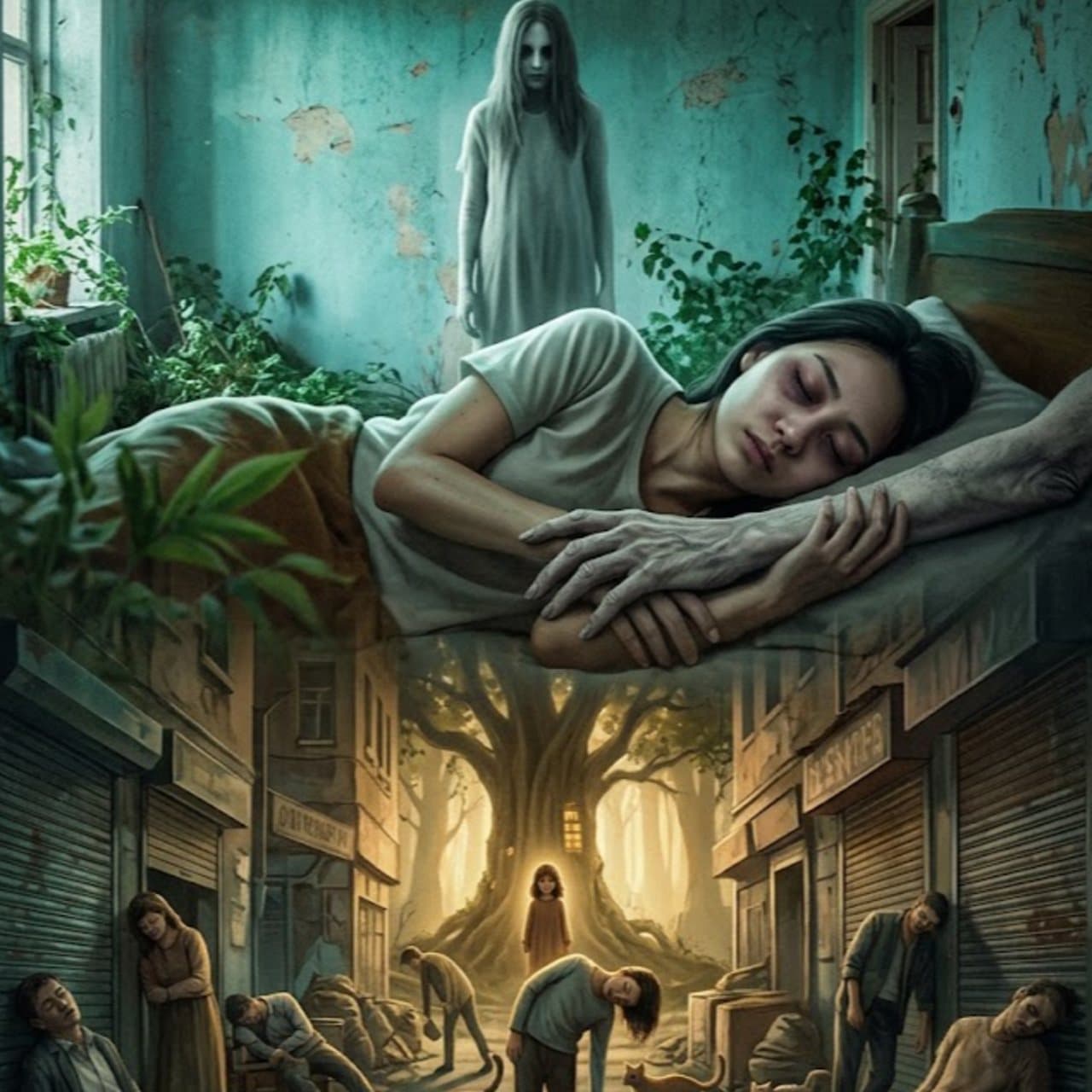
My body creaked as I rose from the bed; palm fronds lay across it, and damp earth and water had seeped all the way into my room. My bones ached as if shards of glass ran through my flesh instead of sinew.
I rolled onto my side until I reached the edge of the bed, and standing fully upright felt like torture. My legs were weak, my flesh flabby—how long had I slept this time? My walk was that of a drunk man on a summer night, after mixing beer and vodka. My head spun and I had to lean against the wall at every turn; the walls, once a beautiful turquoise, were now crusted over with mold. I barely made it to the stairs, and sighed from the exertion of that short walk. I thought about sitting down on the first step, but in my condition I dared not risk breaking a bone.
I descended one step at a time, praying to anyone who might be listening that I would not slip and break my neck—though truth be told, at this point, it hardly mattered. The living room was in even worse shape than the floor above. It looked as if a deluge had struck the city, dumping all manner of debris, mud, and filth inside. The main window was shattered, and a faint breeze still drifted through. I drew near and felt the wind. Outside, in the street, not a soul was to be seen. I lied; there were animals out there. A dog sniffed along the avenue in search of food, while flocks of birds circled overhead. The trees had reclaimed their kingdom, and greenery sprouted everywhere. Through the bars that separated my window from the wilds beyond, the dog saw me. It must have thought I was a ghost, for it stood perfectly still, studying whether I was real or not—then vanished into the tall grasses that had grown up since the pandemic. I had become a ghost in my own home, wandering between memories and the crumbling remains of an old house that, like me, refused to die.
They called it "The Dreaming Plague" because it was absurd—and above all, it made us dream, in the truest sense of the word. We watched reports on television, read stories on Facebook and TikTok. No one stopped talking about the new pandemic that killed you in your sleep. After COVID, we thought we had adapted to a new normal—but nature has a strange way of restoring balance. At home, we told ourselves it was all sensationalism, exaggerated news… until our neighbors began disappearing for days at a time. When they returned, they looked aged and pale.
My wife and I stocked up on supplies, in case the power went out or services were cut off again. We spent much of our savings on food, water, and dog food. We had three Huskies — Sansón, Dalila, and Turco. We loved those names, and just like their namesakes, the dogs were full of fun too. People started failing to show up for work. Some simply fell asleep at their posts. In an office, that might not have been so bad—but in an automobile assembly plant, things became deadly serious.
When AeroPacific crashed, the government ordered all flights suspended until further notice. That notice never came.
How do you fight an illness with no symptoms but overwhelming, irresistible drowsiness? There were no warning signs, and no vaccine. You simply went to sleep one night—and you might wake up after three days, or a week… or never. Humanity had no cure, and no explanation. There was no bat, no scapegoat to blame. We simply slept, and everything ended. At home we rarely spoke of it; we focused on our work, ate together, held one another, watched television and movies—anything to keep despair from taking hold. But there were moments when our thoughts would turn to it all the same.
The dogs were the first to sense it arriving in our home. Their howling at night made our skin prickle; we assumed a neighbor had passed away, and for a moment we forgot that we too were drifting into the dream. Until one afternoon, Maria, my wife, came into the dining room where I was going over papers from the office.
"Gus," she said, "I feel it coming…" — and then she collapsed right in front of me.
I reacted slowly, but caught her before her head struck the floor. In that moment I knew our countdown had begun. Panicked, I held her, stroked her hair, and told her everything would be all right. When my fear settled, I carried her to bed. For two straight days I stayed awake, waiting for her to wake. On the third day, she opened her eyes. She looked exhausted, as if she had run two marathons back to back.
"Are you all right?" I asked, my voice trembling.
"Yes… just tired," she breathed, still catching her breath.
"You do look tired. Come on, let’s get you something to eat."
That day was beautiful. We had breakfast, lunch, and dinner together, just like newlyweds. We laughed about how much we slept—something we’d always complained about before, since we were usually up so early. I remember, as we watched Interstellar, she curled up against me, held me tight, and whispered, "I love you"—before falling asleep for five days straight.
Five days in an eerie silence. Five days where I let my darkest fears take root. There were days I did not eat, days I forgot to feed the dogs, and went only to sit beside her. She was at peace, as if far away and unaware of what was happening. One afternoon, after feeding the dogs, I stepped outside. The silence was crushing. The loneliness of the street matched the loneliness of the house. No cars. No transport of any kind. No children playing. No one. Nothing. I ran down the empty road for forty minutes, then turned back. Nothing had changed.
I sat in the living room—the room Maria always kept immaculate. The place where we’d watched shows and talked about our future. A living room, yet our true light was upstairs, asleep, threatening never to return.
On the fifth day she came down the stairs—or tried to. She was terribly weak. The weariness was etched in her eyes, and dark circles beneath them. Her skin was pale, almost ashen—and yet she smiled at me.
"I had the most extraordinary dream," she said.
Part 2
I helped her sit, propped pillows behind her back and under her waist, and wrapped her in a blanket—the air had grown cold. Even our three dogs curled up at her feet, as if afraid to climb up and hurt her.
"I’ll make you some chicken broth. It’ll give you strength," I told her.
But she took my hand, pulled me closer, and told me again of her dream.
"I dreamed of a great tree, right in the middle of our yard. It was our home—but not this home. A different one. Filled with books, with simple chairs, and warm golden light. But the tree was the most beautiful thing, my love. It stood at the very center of the house, and all around it, shelves upon shelves of books lined the walls. It was the home we always dreamed of," she said.
"It sounds wonderful," I whispered.
"It was. For a moment… I didn’t want to wake up. Do you know why?" she answered, smiling.
As she spoke, I looked at her arms—so thin now, her skin mottled and wrinkled, looking less like my wife’s hands and more like those of an old woman.
"Why didn’t you want to wake up, my love?" I asked, finding my voice.
"Because running between the aisles and shelves that surrounded the great tree, there was a child. Brown hair like mine… but eyes and a smile just like yours. And I followed that child, laughing at every silly thing they did. And at the end of all those halls and that running… there you were. Watching us. Surprised, and full of love—more than I’ve ever known. And God… how I loved you in that moment," she said.
I held her and kissed her forehead. We were both crying. She grieved for the dream she’d found; I grieved that I could not give it to her here. And now this plague threatened to take her away forever, into a beautiful dream I could not follow.
"Let me make that broth. You need your strength," I said, gently steering us back to the present.
I stood up, determined to keep her here with me. But when I looked back, I saw it in her eyes—not despair, but longing. A longing to return. To that paradise. Perhaps that was the true power of this plague: it fills us with our deepest desires, then makes us never want to leave. My strength failed me, and I wept as I prepared the meal.
We spoke little for the rest of the afternoon. We did small things to stay awake, to stay present. Then, I don’t know how, I fell asleep. For two days I drifted in nothingness—no dreams, no hope, just… nothing. When I woke, I hurried downstairs, terrified of what I’d find. But there she was, gazing out the window. She looked at me with a longing to return to somewhere I could not. A sad smile touched her lips, then she stood and made us a simple, nourishing meal.
That evening she teased me about how I looked. We laughed so hard. Kissed more than ever. And weak as we were, we made love. Hours later I went downstairs to feed the dogs, but supplies were running low. The tins were empty. Shelves had collapsed. So many had died that there was no way to tend to the dead; this plague was worse than anything before. I thought of walking to the old Walmart to find food—but I could not bear to leave Maria alone. So I shared what little remained with the dogs, and made us a humble dinner—warm bread and coffee.
That was our supper. As I climbed the stairs, she was waiting for me at the top. I stepped toward her, smiling—until suddenly her expression shifted to terror. And that is all I remember.
I found myself in a vast avenue, thick with trees and tall grass bathed in the amber and gold of a final sunset. At the far end of the road stood a tree greater than any I had ever seen. I walked toward it, listening; I could hear the rustle of leaves beneath my feet. From the tree flowed warmth and light, an endless sunset. Far away, I heard a child’s laugh. I walked faster—because surely she could not be there, not when…
I woke up.
Weak. Exhausted. Starving.
I fell out of bed with a heavy thud and screamed Maria’s name. No answer. Fear paralyzed me—I dreaded what I would find in the living room, on the stairs, anywhere in this house. When I went down, I found her at the foot of the stairs, staring toward the bathroom, weeping.
"My God… I thought I’d lost you," I said.
She looked at me, eyes red, tears streaming down her face.
"I don’t know how long we’ve been asleep. I know how frail we both are. More than eight days passed for me… and for you, probably ten—because you’d already been asleep for two days before I fell," she said.
I did not fully understand, so I simply followed where she led. Then I saw them—our three dogs, all gone, in the bathroom. In their hunger they had chewed through everything they could find, including an old bottle of muriatic acid. Maria held me, and that was all we could do for them. It took me two days just to find something to…
Part 3
…sacks large enough to carry them out to the yard. I was so weak I nearly collapsed from the effort.
Food was scarce, and my strength was fading fast. I should have gone searching when I was still strong, when the dogs were still with us. Maria seemed to drift further away, more distant every day. For a while we stopped talking. I went out a few times to scavenge, but found only desolation and despair. There were days when the sound of screams in the distance filled me with dread.
Once I walked to Walmart; a gash had been torn through the metal security gate, but silence came from within. I went in. Hours later I returned home with a few cans of vegetables, a bag of dried beans, and raw corn—enough to keep going.
When I walked in, Maria was standing by the window, her body slack, her gaze fixed on nothing in particular—eyes open, seeing something only she could. The sunset gilded the glass, wrapping her in light that made her look like a fading spirit. She turned to me slowly, and a faint, sad smile touched her lips—not the smile I knew, but one already saying goodbye.
Now, looking back, I realize everything I failed to notice. I wish I had memorized every curve of her lips—the way they lifted when she laughed, softened when she was deep in thought. I wish I had studied every line of her face: the gentle crinkles around her eyes when she smiled, the fullness of her cheeks that was slowly fading. Her hair, once thick and shining, now seemed dull—though the scent of it, fresh flowers and clean air, still lived in my memory. And the way she rested her chin in her hand as she looked out… waiting for something I could not see. I wish I had understood then that she was no longer waiting for me.
I wish I had done everything differently. But time cannot be turned back.
I prepared what food I could. There was no power anywhere; twilight and shadow filled the house. I siphoned a little gasoline from the car—just enough to start a fire in the yard. The strike of the match sounded loud in the stillness. I roasted the corn over the flames, the smell rising like hope that was slipping away. As I watched the fire, I planned to go farther tomorrow than I’d ever gone before, to find food—for her, for us—though deep down I wondered if there was anything left to find.
I stepped inside. Maria was gone.
Fear wrapped around me, cold and heavy. I called her name—softly, then louder—but only my own voice echoed back. The silence of the house felt suffocating.
I checked the living room—empty. Her book lay closed on the table. I ran to the bathroom—door open, no one there. I searched downstairs, the kitchen, the dining room, the hallway—nothing. Every empty room deepened my dread.
I climbed the stairs slowly, each step heavy with dread. At the top, there she was—in the room where she painted, surrounded by her work, colors that now seemed pale. She stood at the large window overlooking the empty road.
Part 4
She looked like a porcelain doll—pale, fragile, easily broken. She wore her stone-green dress, the one I loved best, and the white blouse she wore on bright days. Her hair fell neatly, and her eyes were fixed down the road, watching for something approaching from far away.
She turned toward me. Looked into my eyes, then back outside, and whispered:
"I want to go back, my love."
Her voice was like wind—soft, faint, barely there.
"Where, my dearest?" I asked—though in my heart, I already knew. I saw it in the way she looked, the way she slept—everything telling me what words could not.
"To the great tree," she said, and her face lit with a smile I had not seen in so long—"to its smile."
I stood frozen in the doorway, the plate of food growing cold in my hands. I understood then. This sickness was not just exhaustion or long sleep. It was a call—pulling her toward something far more beautiful than this world. A dream so perfect she never wanted to wake. And she was choosing to stay there.
"I love you," she said. It was the last time I heard those words from her lips.
When I opened my eyes, the first question came to me: How long have I been asleep?
She was not beside me. The bed was cold, and the memory of her last smile lingered in the air, faint and distant. Days? Weeks? I could no longer tell. Time had lost all meaning—no clear line between waking and sleeping, no beginning, no end. The silence of the street was deafening. No cars, no voices, no sound of life. The silence of our home hurt even more—every corner held her memory, every room filled with her shadow. Nothing mattered anymore. Food, water, waking… all lost their purpose without her.
I slept longer with every passing time. Sleep was no longer rest; it was the journey back to her. When I dream, I see her—on the day we met, beneath the tree in the park, when she smiled and asked if she might sit beside me. I see her at the old bookstore café, laughing over our mistakes and promising we would build a home of our own one day. Those memories feel truer, brighter, than the world I wake up to. I think I understand now.
In every dream where I am with her, I never want to wake. I want to stay there—held in her gaze, wrapped in her warmth, breathing in her smile. I want to stay with her forever. But I always wake. And every time, the pain is sharper than before. This world feels incomplete—dimmer, emptier, missing her.
I think I will sleep again now.
I feel it deep in my bones—a quiet cold spreading through me, a tremor in my legs whenever I stand near the window. The thought of her grows stronger than any reason to stay. And then I smile, without even realizing it.
I do not notice I am already dreaming until I see myself in the mirror by the door. I am no longer gaunt and worn. My skin glows, my eyes shine, and strength has returned to my body—strength I have not felt in so long. I look whole. Healthy. Alive. I smile back at myself, and at last I feel peace.
I step outside. The sun wraps everything in golden, unchanging light. I cross the street; to my right, the road stretches on into green woods, endless and alive. To my left, rising at the edge of the meadow, stands the tree—the great tree from my dreams. Its trunk rises vast and strong, branches reaching toward the sky like open arms, every leaf glowing.
I know what I must do. I walk toward it, and as I draw near, I hear laughter—clear, joyful, free of sorrow. One voice is familiar, the sound I have missed for so long. The other is new—bright, tender, full of promise.
I circle the tree and find them. At its heart stands a library that stretches in every direction—walls of bookshelves reaching high, light falling soft and warm from everywhere. There they are—Maria and a child, running between the shelves, playing, laughing. Then they see me.
Maria was right. The child has her hair—soft, warm brown—and my eyes. But the smile… the smile is Maria’s—pure, bright, uniquely hers. She looks at me, and in that smile is everything that no words could ever say. They are here. And now I am too. We are home. At last.
— The End —