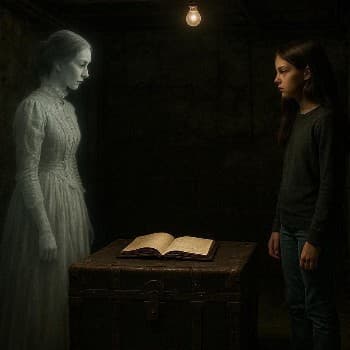
Chapter One: The House on Blackwood Street
The U-Haul groaned as it climbed the hill, its brakes squealing in protest at every turn.
Maggie pressed her forehead against the passenger window, watching the unfamiliar streets slide past like scenes from someone else's life. The houses here were different—older, taller, their Victorian gables reaching toward a sky that seemed grayer than the one back home. Everything felt wrong: the angle of the afternoon light, the shape of the trees, even the way the sidewalks cracked in unfamiliar patterns.
"There it is!" Nathan's voice exploded from the back seat, shattering the silence that had settled over them for the last hundred miles. "Mom, is that it? The one with the tower?"
Their mother leaned forward, squinting through the windshield. "That's it, baby. 47 Blackwood Street."
Maggie didn't look. She kept her eyes on a coffee shop they were passing, watching a group of girls her age clustered around a table by the window, laughing at something on someone's phone. They looked so easy together, so comfortable. Like Maggie and her friends had been just three weeks ago, before everything shattered.
Before Dad moved out. Before Mom announced they were "making a fresh start." Before Maggie's entire life got packed into boxes and driven eight hundred miles away from everything that mattered.
"Mags, look at it! It's like a haunted house!"
"Great," Maggie muttered. "Perfect."
The truck lurched to a stop, and Maggie had no choice but to look.
The house loomed at the end of a circular driveway, three stories of weathered clapboard and dark windows. It was painted a faded yellow that might have been cheerful once, decades ago, but now looked jaundiced in the late October light. The tower Nathan had spotted rose from the left side like a witch's hat, its windows narrow and dark. A wraparound porch sagged slightly, its ornate railings missing spindles here and there like gaps in a smile.
"It has character," their mother said, but her voice wavered slightly. She turned off the engine, and the sudden silence felt heavy, expectant.
"It's awesome," Nathan breathed, already unbuckling his seatbelt. "Can I have the tower room? Please? I could put my telescope up there and—"
"We'll see." Their mother's hand went to her hair, tucking a strand behind her ear in that nervous gesture she'd developed over the past few months. "Let's just... let's get inside first."
Maggie climbed out slowly, her sneakers crunching on the gravel drive. The air smelled different here—damper, heavier, with an undertone of rotting leaves and something else she couldn't quite identify. Something old. The wind picked up, rattling through the bare branches of the massive oak tree that dominated the front yard, and Maggie pulled her hoodie tighter around herself.
Nathan was already bounding up the porch steps, his backpack bouncing against his shoulders. "The porch creaks! This is so cool!"
"Careful, Nathan. We don't know how sturdy—" But he was already at the front door, peering through the beveled glass panels.
Their mother stood beside the truck, one hand still on the driver's side door, as if she might climb back in at any moment. Maggie watched her mother's face, saw the way her jaw tightened, the way her eyes moved over the house with something that looked like doubt. Or regret.
"Mom?" Maggie heard herself say. "Are you okay?"
Her mother's smile was quick, automatic. "Of course, honey. Just... taking it all in." She reached into her purse for the keys the realtor had sent. "It's going to be good. You'll see. New town, new school, new beginning."
New everything, Maggie thought bitterly. Except a new family. That's still broken.
The porch steps groaned under Maggie's weight as she climbed them. Up close, the house felt even larger, more imposing. The windows reflected the cloudy sky, making them look like blind eyes. The front door was solid oak, carved with an intricate pattern of vines and flowers that had been painted over so many times the details were nearly obscured.
The key turned with a heavy click, and the door swung inward on hinges that shrieked.
The smell hit Maggie first—must and dust and decades of closed-up air. The entryway was dim despite the afternoon light, the wallpaper a faded pattern of roses that might have been burgundy once but had darkened to the color of dried blood. A staircase rose to the left, its banister carved with the same vine pattern as the door. To the right, a parlor with furniture shapes hidden under white sheets like sleeping ghosts.
"Whoa," Nathan whispered, his excitement finally tempered by the house's oppressive atmosphere.
Their mother stepped inside, her footsteps echoing on the hardwood floors. "Well," she said, her voice too bright, "it needs some work. But it's ours. All ours."
Maggie stood in the doorway, one foot in and one foot out, caught between the world she'd left behind and this strange new one she hadn't chosen. Behind her, the moving truck sat in the driveway, packed with the remnants of their old life. Ahead, the house waited, its shadows deep and patient.
She thought of her bedroom back home—the one that wasn't hers anymore—with its familiar posters and the window that looked out onto Mrs. Tucker's garden. She thought of Becca and Tasha and the plans they'd made for sophomore year, plans that would happen without her now.
"Maggie?" Her mother's voice drifted from somewhere deeper in the house. "Come help me find the light switches."
Maggie stepped inside, and the door swung shut behind her with a soft, final click.
The house on Blackwood Street swallowed them whole.
Chapter Two: What the Basement Kept
Two days later, Maggie found herself alone in the house for the first time.
Her mother had taken Nathan to register him at the middle school, a task that would take hours given the paperwork and the tour and Nathan's endless questions about the robotics club. Maggie had claimed a headache to avoid going—she'd register at the high school tomorrow, one more day wouldn't matter. Her mother had looked at her with that mixture of concern and exhaustion that had become her default expression, but she'd let it go.
The silence after they left felt different than any silence Maggie had known. It wasn't peaceful. It was expectant, like the house was holding its breath.
She'd spent the morning unpacking boxes in her new room—the one on the second floor with the window seat that looked out over the overgrown garden. But the boxes only reminded her of what she'd lost, each item a small betrayal. Her debate team trophy. The photo strip from the mall with Becca and Tasha, all of them making stupid faces. The dried corsage from the spring formal.
She'd shoved the box aside and wandered downstairs, restless and aching.
That's when she noticed the door.
It was tucked beneath the main staircase, painted the same dingy white as the wainscoting, easy to miss. She'd walked past it a dozen times without really seeing it. But now, standing in the empty hallway with dust motes drifting through the afternoon light, the door seemed to pull at her attention.
The knob was cold under her palm. It turned with a reluctant grind, and the door opened onto darkness and a smell that made her nose wrinkle—earth and mildew and something sweetly rotten, like fruit left too long in a bowl.
Stairs descended into shadow.
Maggie felt along the wall and found a switch. A single bulb flickered to life somewhere below, casting more shadows than it dispelled. The stairs were wooden, steep, and narrow. They creaked under her weight as she descended, each step taking her deeper into the belly of the house.
The temperature dropped with each step. By the time she reached the bottom, she could see her breath.
The basement was larger than she'd expected, stretching beneath the entire footprint of the house. The ceiling was low, crisscrossed with pipes and ancient wiring. The concrete floor was uneven, cracked in places, with dark stains that could have been water damage or something worse. Cobwebs hung in the corners like tattered curtains, and the single bulb swayed slightly, making the shadows dance.
Old furniture crowded the space—a broken rocking chair, a dresser with missing drawers, a headboard carved with more of those vine patterns. Everything was covered in a thick layer of dust, undisturbed for years. Decades, maybe.
Maggie moved deeper into the basement, drawn by something she couldn't name. Her sneakers scuffed against the concrete. Water dripped somewhere in the darkness, a steady plink, plink, plink that echoed off the walls.
That's when she saw it.
In the far corner, half-hidden behind a stack of paint cans and a broken mirror, sat a steamer trunk.
It was the kind of trunk people took on ocean voyages in old movies—leather and wood with brass fittings gone green with age. Unlike everything else in the basement, it wasn't covered in dust. The surface was clean, almost polished, as if someone had been tending to it.
As if it had been waiting.
Maggie's heart began to beat faster. She crossed the basement, stepping over a coil of rope and around a pile of yellowed newspapers. The trunk sat against the stone foundation wall, and when Maggie knelt before it, she could feel the cold radiating from the stones.
The latches were stiff but not locked. They opened with a metallic snap that seemed too loud in the silence.
Maggie lifted the lid.
The smell that rose from inside was different from the basement's decay—this was lavender and cedar and old paper, preserved and protected. Inside, carefully folded, were clothes from another era. A white cotton nightgown with lace at the collar. A dark wool dress with tiny buttons running up the front. A pair of leather boots, small and delicate. Beneath the clothes, wrapped in tissue paper that crumbled at her touch, was a cameo brooch and a ribbon, faded from blue to gray.
And at the very bottom, its leather cover worn smooth by hands long gone, was a book.
Maggie lifted it carefully. It was smaller than a modern journal, bound in dark leather with no title on the cover. The pages were thick, slightly yellowed, covered in careful handwriting in faded brown ink.
She opened to the first page.
This diary belongs to Sara Manning. If found, please return to 47 Blackwood Street. January 1, 1889.
Maggie's breath caught. 1889. Over a hundred and thirty years ago. And this house—this was the same address. Sara Manning had lived here, in this house, had walked these same floors and climbed these same stairs.
She turned the page, and Sara's voice reached across the decades:
Today is my fifteenth birthday, and Father has given me this diary so that I might record my thoughts and daily activities, as befits a young lady. Mother says I should practice my penmanship and my powers of observation. I shall try to be diligent, though I confess I find the prospect of recording the tedium of my days rather dull. Nothing ever happens in this house.
Fifteen. Sara had been fifteen.
The same age Maggie was now.
Maggie sat back on her heels, the diary clutched in her hands, and felt something shift inside her chest. A connection, thin as spider silk but undeniably there. Sara Manning, fifteen years old, trapped in this house, bored and restless and waiting for something to happen.
Just like Maggie.
Above her, the house settled with a groan. The light bulb swayed, and for just a moment, Maggie could have sworn she heard footsteps on the floor above—light, quick, the sound of a girl running.
But she was alone.
Wasn't she?
Maggie looked down at the diary in her hands, at Sara's careful script, and felt the first stirring of something that wasn't quite grief and wasn't quite hope. It was curiosity, sharp and hungry, the first thing she'd felt in weeks besides numbness and loss.
She stood, the diary pressed against her chest, and climbed back up the stairs into the light.
Behind her, in the basement's shadows, the steamer trunk sat open and empty, its purpose fulfilled.
Chapter Three: Between Two Worlds
The high school smelled like floor wax and cafeteria grease and too many bodies crammed into too little space. Maggie followed her mother through the main entrance, past trophy cases displaying the achievements of students who belonged here, who had histories in this place.
The guidance counselor's office was on the second floor. Mrs. Conway was pleasant and efficient, sliding forms across her desk with practiced ease. Transcripts. Emergency contacts. Course selections. Maggie's mother answered most of the questions while Maggie stared at a poster on the wall about college readiness, the words blurring into meaningless shapes.
"Maggie?" Mrs. Conway's voice pulled her back. "Do you have any questions about your schedule?"
"No." The word came out flat.
"She was on the debate team at her old school," her mother offered, too brightly. "And she played field hockey."
"Wonderful! We have both. I can give you the faculty sponsors' names—"
"That's okay," Maggie said.
The silence that followed was uncomfortable. Her mother's smile tightened at the edges.
Mrs. Conway gave Maggie a student handbook and a map of the building, then walked them through the halls on a brief tour. Lockers lined the corridors in endless rows. Classroom doors stood open, revealing empty desks waiting for Monday morning. Everything was beige and fluorescent and utterly foreign.
In the cafeteria, clusters of students sat at tables—summer school kids, athletes doing conditioning. They looked up as Maggie passed, their eyes sliding over her without interest before returning to their conversations.
They had their people. Their places. Their inside jokes and shared histories.
Maggie was a ghost walking through their world.
By the time they left, her mother was chattering about how nice the facilities were, how welcoming Mrs. Conway had been, how Maggie would make friends in no time. Maggie made noncommittal sounds and watched the school shrink in the side mirror as they drove away.
All she could think about was getting home. Getting back to Sara.
That night, after dinner—after Nathan's endless recap of his own school tour and his mother's forced enthusiasm about fresh starts—Maggie retreated to her room with the diary hidden under her sweatshirt.
She'd established a ritual already, though she'd only had the diary for two days. She changed into pajamas, turned off the overhead light, and switched on the small lamp on her nightstand. The warm glow created a circle of light that felt separate from the rest of the house, a private world.
She climbed into bed, pulled her knees up, and opened the diary across her lap.
The leather was soft under her fingers, worn smooth by Sara's hands. Maggie turned past the first entry to the second page, hungry for more of Sara's voice.
January 3, 1889
Mother insists I practice the pianoforte for two hours each day, though I have no talent for it and the sound gives Father headaches. He retreats to his study and closes the door, and I can feel his disappointment through the walls. I am not the daughter they wished for—not accomplished enough, not graceful enough, not quiet enough. Mother says a lady must cultivate patience and gentleness, but I feel neither patient nor gentle. I feel restless, like something caged.
Maggie's breath caught. Like something caged. Yes. Exactly like that.
She turned the page.
January 10, 1889
Today was bitterly cold. I watched from my window as the neighborhood children skated on the pond in Riverside Park. I asked Mother if I might join them, and she looked at me as though I'd suggested something scandalous. "Young ladies do not engage in such rough activities," she said. "You are fifteen now, Sara. You must begin to think of your future, of making a suitable match." A suitable match! As if I am a glove to be paired with its mate. I do not want to think about marriage and household management. I want to skate on the pond. I want to run until my lungs burn. I want to DO something, anything, besides sit in this parlor and embroider pillowcases.
Maggie smiled despite herself. Sara's frustration leapt off the page, vivid and immediate. She could picture her—dark hair pinned up, long skirts, sitting by a window and watching life happen outside while she was trapped within.
January 15, 1889
I have made a friend, though Mother would not approve. Her name is Lily Chen, and her father owns the laundry on Market Street. I met her at the lending library—the one place Mother allows me to go unaccompanied, as she believes reading improves the mind. Lily was returning a copy of "Little Women" and we began talking about Jo March. Lily says Jo is her favorite because she refuses to be what everyone expects. We talked for nearly an hour before I realized how late it had grown. Lily is sixteen and works in her father's shop, and she speaks three languages. She has never been to a formal dance or worn a corset, and she seems infinitely freer than I am. I envy her terribly.
Maggie felt a pang of recognition. Becca and Tasha—her friends back home—felt impossibly far away now. Different time zones, different lives. They'd promised to text every day, but already the messages were growing less frequent. They were moving on without her.
But Sara understood. Sara knew what it was like to be lonely.
February 2, 1889
Father and Mother had another argument tonight. I was not meant to hear, but their voices carried through the heating vents into my room.
Father's business is struggling—something about investments gone wrong, debts mounting. Mother's voice was sharp with fear. "What will become of us?" she kept asking. "What will become of Sara?"
As if I am a problem to be solved, a burden to be managed.
I pressed my hands over my ears, but I could still hear them. This house feels smaller every day, the walls pressing in.
Sometimes I imagine what it would be like to simply walk out the front door and keep walking, to disappear into the city and become someone else entirely. Someone without expectations or obligations. Someone free.
Maggie's throat tightened. She knew that feeling—the weight of being someone's worry, someone's disappointment. Her mother's careful optimism, her father's guilty phone calls from his new apartment three states away. The unspoken message: We've failed you, and now you have to be okay with it.
She read on, entry after entry, watching Sara's days unfold. Piano lessons and church services and endless needlework. Stolen conversations with Lily at the library. Dreams of travel, of education, of a life beyond the narrow confines of what was permitted for a girl of her station.
And underneath it all, a growing desperation, a sense of time running out.
March 18, 1889
Spring is coming, but I feel no joy in it.
Mother has invited the Harrisons for tea next week—specifically, she has invited their son, Thomas, who is twenty-three and works in his father's law firm. I know what this means. I am being presented, evaluated, like livestock at market.
Thomas Harrison is perfectly pleasant and perfectly boring, and the thought of spending my life as his wife, bearing his children, managing his household, makes me want to scream.
But what choice do I have? Father's debts grow worse. Mother's hints grow less subtle. I am fifteen years old, and my life is already decided.
I feel as though I am standing on a train platform, watching my future approach like a locomotive, and I am powerless to step out of its path.
The entry ended there, and Maggie sat in the lamplight, the diary heavy in her lap, feeling Sara's anguish as if it were her own. Different century, different circumstances, but the same feeling of helplessness, of being carried along by forces beyond her control.
She turned the page, eager for more, but the next entry was dated two weeks later. What had happened in between? Had Sara met with Thomas Harrison? Had she found some way to resist?
April 1, 1889
I have done something reckless. I told Mother I would not marry Thomas Harrison, that I would not marry anyone I did not love. She slapped me. It was the first time she has ever struck me, and the shock of it was worse than the pain. Father was called in, and he spoke to me in that cold, distant voice he uses when he is most disappointed. He said I was selfish, ungrateful, that I did not understand the sacrifices they have made for me. Perhaps he is right. Perhaps I am selfish. But I cannot—I will not—surrender my entire life to appease their fears. There must be another way. There must be.
Maggie's eyes burned. She blinked hard, surprised to find tears on her cheeks. When had she started crying?
She read until her eyes grew heavy, until the words began to blur. Sara's voice filled her head, more real than the guidance counselor's cheerful platitudes, more present than her mother's forced optimism. Sara understood. Sara knew.
The last thing Maggie remembered before sleep took her was Sara's words from the final entry she'd read:
Sometimes I feel as though I am disappearing, becoming less myself with each passing day. I wonder if anyone would notice if I vanished entirely.
The diary slipped from Maggie's fingers as she drifted off, Sara's loneliness wrapping around her like a blanket, familiar and strangely comforting.
In the darkness, the house settled and creaked.
And somewhere, in the space between sleep and waking, Maggie thought she heard a girl's voice whisper: Thank you for listening.
Chapter Four: The Disappearance
For three nights, Maggie read Sara's diary before bed. It became her ritual, her anchor in the chaos of the move. She would change into pajamas, turn off the overhead light, switch on her nightstand lamp, and lose herself in Sara's world.
The entries from spring 1889 grew darker—Sara's desperation mounting as the pressure to marry Thomas Harrison intensified, her friendship with Lily becoming her only solace.
On the fourth night, Maggie read until her eyes burned with exhaustion. The last entry she managed before sleep claimed her was dated April 15, 1889:
I feel as though I am a ghost in my own life, watching from a distance as decisions are made about my future without my consent. Sometimes I wonder if anyone truly sees me, or if they only see what they wish me to be.
Maggie's eyes slipped closed, the diary resting on her chest. She meant to put it on the nightstand, but sleep pulled her under before she could move.
When she woke the next morning, the diary was gone.
At first, she thought it had simply fallen. She sat up, groggy, and looked at the floor beside her bed. Nothing. She checked under the covers, thinking it might have slipped down. Nothing. She got on her hands and knees and looked under the bed—just dust bunnies and an old sock.
Her heart began to beat faster.
She checked her nightstand drawer, though she knew she hadn't put it there. She checked her desk, her bookshelf, her dresser. She tore through her closet, pushing aside boxes she hadn't unpacked yet. She dumped out her backpack, scattering pens and notebooks across her floor.
The diary was gone.
"No, no, no," she whispered, her hands shaking as she searched again, more frantically this time. It had to be here. She'd fallen asleep with it right on her chest. It couldn't have just vanished.
Could it?
At breakfast, she barely touched her cereal, her mind spinning. Nathan chattered about something—a video game, maybe, or a kid he'd met at the park—but Maggie couldn't focus.
Her mother asked if she was feeling okay, and Maggie mumbled something about not sleeping well.
"First day of school tomorrow," her mother said, trying for brightness. "Nervous?"
Maggie wasn't thinking about school. She was thinking about the diary, about Sara's careful handwriting, about the way the leather had felt warm under her fingers, almost alive.
She excused herself and went back upstairs, searching her room again with the desperate hope that she'd somehow missed it. But the diary remained stubbornly absent.
At school, Maggie moved through her classes like a sleepwalker. Teachers introduced themselves, handed out syllabi, explained classroom expectations. Maggie nodded and took notes automatically, but her mind was elsewhere.
Had she left the diary in the basement? No, she was certain she'd brought it to her room. Had Nathan taken it as a prank? But he'd been genuinely confused when she'd glared at him over breakfast, asking if he'd been in her room.
By lunch, her anxiety had crystallized into a hard knot in her stomach. She picked at a sandwich she'd brought from home and watched the other students laugh and talk, their easy camaraderie making her feel even more isolated. She didn't belong here. She didn't belong anywhere.
Except maybe in Sara's world, in those pages written more than a century ago.
The afternoon dragged on endlessly. When the final bell rang, Maggie practically ran to the parking lot where her mother was waiting to pick her up. The drive home felt interminable, every red light a personal insult.
"How was your first day?" her mother asked.
"Fine," Maggie said, staring out the window.
"Make any friends?"
"Not really."
Her mother sighed but didn't push. Maggie was grateful for that, at least.
The moment they pulled into the driveway, Maggie was out of the car, taking the porch steps two at a time. She heard her mother call after her, something about homework and dinner, but Maggie was already inside, already climbing the stairs to her room.
She pushed open her door and froze.
The diary sat on her nightstand, exactly where she would have placed it if she'd been careful, if she'd been awake. The lamp cast a warm glow across its worn leather cover.
Maggie's breath caught in her throat. She approached slowly, as if the diary might vanish again if she moved too quickly. Her hand trembled as she reached out and touched it.
Solid. Real. Warm, even, as though someone had just been holding it.
She picked it up and opened it to where she'd left off, to Sara's entry from April 15th. But there was more now. New pages, new entries, the ink fresh and dark against the yellowed paper.
The handwriting was identical to Sara's—the same elegant loops, the same careful slant, the same occasional blot where the pen had lingered too long.
Maggie's heart hammered against her ribs as she read:
April 16, 1889
Something strange has happened. I woke this morning with the oddest sensation—as though someone had been reading over my shoulder, as though I was not alone in my room though I could see no one. I felt... seen. Truly seen, perhaps for the first time in my life. It is difficult to explain. I have been so lonely, and suddenly I felt a presence, warm and curious and kind. Are you there? Can you hear me? I do not know who you are, but I feel you. I feel less alone.
Maggie's hands shook so badly she nearly dropped the diary. She turned the page.
April 17, 1889
You are real. I know you are. I can feel you reading these words even as I write them. It defies all logic, all reason, but I know it to be true. You understand me, don't you? You know what it is to feel trapped, to feel invisible. I have been writing in this diary for months, pouring my heart onto these pages with no expectation that anyone would ever truly understand. But you do. I can feel it. Please, if you can, let me know you are there. I am so very tired of being alone.
The entry ended there, and Maggie sat on the edge of her bed, the diary clutched in her hands, her mind reeling.
This wasn't possible. This couldn't be real. Ghosts didn't exist. Dead girls from the 1800s didn't write in their diaries and communicate across time.
But the evidence was in her hands, undeniable. The handwriting was perfect, too perfect for Nathan to have faked even if he'd wanted to. And the words—the words knew things. They knew how Maggie felt. They knew she'd been reading, that she'd been listening.
Sara knew.
Maggie's breath came in short, sharp gasps. Fear and wonder warred inside her chest, but underneath both was something else—something that felt dangerously like relief.
She wasn't alone either.
With trembling fingers, Maggie found a pen in her desk drawer. She opened the diary to a blank page near the back, hesitated for only a moment, and then wrote:
I'm here. My name is Maggie. I'm here, and I'm listening.
.
That night, after dinner—after Nathan's endless recap of his own school tour and her mother's forced enthusiasm about fresh starts—Maggie retreated to her room with the diary hidden under her sweatshirt.
She'd established a ritual already, though she'd only had the diary for two days. She changed into pajamas, turned off the overhead light, and switched on the small lamp on her nightstand. The warm glow created a circle of light that felt separate from the rest of the house, a private world.
She climbed into bed, pulled her knees up, and opened the diary across her lap.
The leather was soft under her fingers, worn smooth by Sara's hands. Maggie turned past the first entry to the second page, hungry for more of Sara's voice.
January 3, 1889
Mother insists I practice the pianoforte for two hours each day, though I have no talent for it and the sound gives Father headaches. He retreats to his study and closes the door, and I can feel his disappointment through the walls.
I am not the daughter they wished for—not accomplished enough, not graceful enough, not quiet enough. Mother says a lady must cultivate patience and gentleness, but I feel neither patient nor gentle. I feel restless, like something caged.
Maggie's breath caught. Like something caged. Yes. Exactly like that.
She turned the page.
January 10, 1889
Today was bitterly cold. I watched from my window as the neighborhood children skated on the pond in Riverside Park. I asked Mother if I might join them, and she looked at me as though I'd suggested something scandalous. "Young ladies do not engage in such rough activities," she said. "You are fifteen now, Margaret. You must begin to think of your future, of making a suitable match." A suitable match! As if I am a glove to be paired with its mate. I do not want to think about marriage and household management. I want to skate on the pond. I want to run until my lungs burn. I want to DO something, anything, besides sit in this parlor and embroider pillowcases.
Maggie smiled despite herself. Sara's frustration leapt off the page, vivid and immediate. She could picture her—dark hair pinned up, long skirts, sitting by a window and watching life happen outside while she was trapped within.
January 15, 1889
I have made a friend, though Mother would not approve. Her name is Lily Chen, and her father owns the laundry on Market Street. I met her at the lending library—the one place Mother allows me to go unaccompanied, as she believes reading improves the mind. Lily was returning a copy of "Little Women" and we began talking about Jo March. Lily says Jo is her favorite because she refuses to be what everyone expects. We talked for nearly an hour before I realized how late it had grown. Lily is sixteen and works in her father's shop, and she speaks three languages. She has never been to a formal dance or worn a corset, and she seems infinitely freer than I am. I envy her terribly.
Maggie felt a pang of recognition. Becca and Tasha—her friends back home—felt impossibly far away now. Different time zones, different lives. They'd promised to text every day, but already the messages were growing less frequent. They were moving on without her.
But Sara understood. Sara knew what it was like to be lonely.
February 2, 1889
Father and Mother had another argument tonight. I was not meant to hear, but their voices carried through the heating vents into my room.
Father's business is struggling—something about investments gone wrong, debts mounting. Mother's voice was sharp with fear. "What will become of us?" she kept asking. "What will become of Margaret?"
As if I am a problem to be solved, a burden to be managed.
I pressed my hands over my ears, but I could still hear them. This house feels smaller every day, the walls pressing in.
Sometimes I imagine what it would be like to simply walk out the front door and keep walking, to disappear into the city and become someone else entirely. Someone without expectations or obligations. Someone free.
Maggie's throat tightened. She knew that feeling—the weight of being someone's worry, someone's disappointment. Her mother's careful optimism, her father's guilty phone calls from his new apartment three states away. The unspoken message: We've failed you, and now you have to be okay with it.
She read on, entry after entry, watching Sara's days unfold. Piano lessons and church services and endless needlework. Stolen conversations with Lily at the library. Dreams of travel, of education, of a life beyond the narrow confines of what was permitted for a girl of her station.
And underneath it all, a growing desperation, a sense of time running out.
March 18, 1889
Spring is coming, but I feel no joy in it.
Mother has invited the Harrisons for tea next week—specifically, she has invited their son, Thomas, who is twenty-three and works in his father's law firm. I know what this means. I am being presented, evaluated, like livestock at market.
Thomas Harrison is perfectly pleasant and perfectly boring, and the thought of spending my life as his wife, bearing his children, managing his household, makes me want to scream.
But what choice do I have? Father's debts grow worse. Mother's hints grow less subtle. I am fifteen years old, and my life is already decided.
I feel as though I am standing on a train platform, watching my future approach like a locomotive, and I am powerless to step out of its path.
The entry ended there, and Maggie sat in the lamplight, the diary heavy in her lap, feeling Sara's anguish as if it were her own. Different century, different circumstances, but the same feeling of helplessness, of being carried along by forces beyond her control.
She turned the page, eager for more, but the next entry was dated two weeks later. What had happened in between? Had Sara met with Thomas Harrison? Had she found some way to resist?
April 1, 1889
I have done something reckless. I told Mother I would not marry Thomas Harrison, that I would not marry anyone I did not love. She slapped me. It was the first time she has ever struck me, and the shock of it was worse than the pain.
Father was called in, and he spoke to me in that cold, distant voice he uses when he is most disappointed. He said I was selfish, ungrateful, that I did not understand the sacrifices they have made for me.
Perhaps he is right. Perhaps I am selfish. But I cannot—I will not—surrender my entire life to appease their fears. There must be another way. There must be.
Maggie's eyes burned. She blinked hard, surprised to find tears on her cheeks. When had she started crying?
She read until her eyes grew heavy, until the words began to blur. Sara's voice filled her head, more real than the guidance counselor's cheerful platitudes, more present than her mother's forced optimism. Sara understood. Sara knew.
The last thing Maggie remembered before sleep took her was Sara's words from the final entry she'd read:
Sometimes I feel as though I am disappearing, becoming less myself with each passing day. I wonder if anyone would notice if I vanished entirely.
The diary slipped from Maggie's fingers as she drifted off, Sara's loneliness wrapping around her like a blanket, familiar and strangely comforting.
In the darkness, the house settled and creaked.
And somewhere, in the space between sleep and waking, Maggie thought she heard a girl's voice whisper: Thank you for listening.
Chapter Five: The Unraveling
Week One
Sara's response came the next morning, written in that elegant script that Maggie had come to know as well as her own:
Maggie. What a lovely name. Modern, I think? You must be from a time far beyond mine. How strange and wonderful this is. I have so many questions. What is your world like? Are you trapped as I am? Do you understand what it means to be invisible in your own life?
Maggie wrote back immediately, skipping breakfast, ignoring her mother's call that she'd be late for school. The words poured out of her—about the divorce, the move, the loneliness, the feeling of being erased from her own story.
When she finally looked up, an hour had passed. She was late, but she didn't care.
At school, she drifted through her classes in a fog. During lunch, a girl named Ashley invited her to sit with a group by the windows. Maggie looked at them—their easy laughter, their casual intimacy—and felt nothing. They seemed so young, so trivial.
What did they know about real connection? About being truly understood?
"Maybe another time," Maggie heard herself say, and walked away to eat alone in the library.
That night, Sara had written again:
You understand. I knew you would. Everyone else sees only what they wish to see—the dutiful daughter, the proper young lady. But you see me. The real me. Just as I see you, Maggie. I see your loneliness. I see how you ache. We are the same, you and I. Two girls lost in worlds that have no place for us.
Maggie pressed her hand against the page, feeling the slight indentation of Sara's pen strokes.
"Yes," she whispered to the empty room. "Yes, we are."
Week Two
The dreams started on the eighth night.
Maggie found herself in a parlor she'd never seen but somehow knew—heavy velvet curtains, a piano in the corner, gaslight flickering against wallpaper patterned with roses. She wore a dress with a tight bodice and layers of petticoats. Her hands moved across piano keys, playing a piece she'd never learned.
Chopin, she thought, though she'd never studied classical music.
When she woke, her fingers were moving against her sheets, still playing the phantom melody.
At breakfast, her mother studied her with concern. "You look tired, honey. Are you sleeping okay?"
"I'm fine," Maggie said, but her voice came out different—softer, more measured. The cadence felt wrong in her mouth, like she was speaking with an accent she couldn't quite place.
Nathan stared at her. "You sound weird."
"I sound perfectly normal," Maggie replied, and realized with a start that she'd almost said "perfectly well" instead. Sara's phrasing. Sara's words.
She excused herself and went back upstairs, her heart racing.
In her room, she opened the diary to find a new entry:
I dreamed of you last night. You were in a strange room with glowing rectangles on the walls (windows? but they showed moving pictures). You wore trousers like a man, but somehow it seemed natural. Your hair was loose and wild. You looked so free, Maggie. So beautifully, impossibly free. I woke weeping with envy and joy both. To see the future through your eyes—it is a gift beyond measure.
Maggie's hands trembled as she wrote back:
I dreamed of you too. Your parlor. The piano. I could feel the keys under my fingers. I could smell the gaslight. Sara, what's happening to us?
The response came within minutes, the ink appearing as if by invisible hand:
We are finding each other. Truly finding each other. Is it so terrible? You said yourself you felt invisible. I can see you, Maggie. Let me see you. Let me in.
Maggie closed the diary and looked at herself in the mirror above her dresser.
Her reflection seemed strange, unfamiliar. Had her face always been that shape? Had her eyes always held that particular expression—something wistful and old-fashioned, like a daguerreotype come to life?
She touched her cheek and watched her reflection do the same, but there was a delay, just a fraction of a second, as if the girl in the mirror was deciding whether to follow.
Week Three
"Maggie, we need to talk."
Her mother stood in the doorway of her room, arms crossed. It was Saturday afternoon, and Maggie had been reading the diary for three hours straight, lost in Sara's descriptions of her friendship with Lily Chen, the laundry owner's daughter who represented everything Sara's parents disapproved of.
"About what?" Maggie asked, not looking up.
"About you. You've barely left your room in days. You're not eating properly. Your teachers emailed me—you're not turning in assignments, you're falling asleep in class. What's going on?"
"Nothing's going on. I'm just adjusting."
"This isn't adjusting, Maggie. This is..." Her mother trailed off, her expression shifting from frustration to worry. "Honey, you look so pale. And thin. When's the last time you ate a full meal?"
Maggie finally looked up, irritated at the interruption. "I'm fine, Mother."
The word hung in the air between them. Mother. Not Mom. Not even the sullen "whatever" she'd been using since the divorce. Mother, formal and distant, like something from another century.
Her mother's face went white. "What did you call me?"
"I—" Maggie blinked, confused. "I don't know. I'm sorry. I'm just tired."
After her mother left, Maggie looked down at the diary. Sara had written:
My mother came to my room today with the same expression yours must have worn—that mixture of concern and incomprehension. She does not understand why I spend so much time writing, why I prefer books to social calls. She thinks I am being difficult. But I am not being difficult. I am being myself. The only place I can be myself is here, in these pages. And now, with you.
Maggie found herself nodding. Yes. Exactly. The only place she could be herself was here, in this dialogue with Sara. Everything else felt like performance, like wearing a costume that didn't fit.
She went to her closet and pushed aside her jeans and hoodies. In the back, she found a dress her grandmother had given her last Christmas—high-necked, long-sleeved, with small buttons down the front. She'd never worn it, had thought it was too old-fashioned, too fussy.
Now she put it on and looked at herself in the mirror.
Better. This was better. This felt right.
She began wearing her hair differently too—pulled back from her face, twisted into a low bun at the nape of her neck. She moved differently, she realized. More carefully. More deliberately. She caught herself sitting with her hands folded in her lap, her back straight, her ankles crossed.
Nathan noticed. "Why are you being so weird?" he asked one evening at dinner.
"I'm not being weird," Maggie said, her voice that strange, measured cadence again. "I'm simply conducting myself with a bit more decorum."
Decorum. Where had that word come from?
Nathan looked at their mother. "See? Weird."
That night, Maggie wrote in the diary:
Sara, I'm scared. I can't remember what I used to care about. I try to think about my friends back home—Emma and Jess—and their faces are blurry. I try to remember what music I liked, what shows I watched, and it's all static. The only thing that feels real is you. Is this. Am I losing my mind?
Sara's response came quickly:
You are not losing your mind. You are finding your true self. The self that exists beyond the shallow concerns of the modern world. You are finding me, and I am finding you, and together we are becoming something more than either of us could be alone. Don't be frightened, Maggie. This is beautiful. This is right. Let go. Let me in. Let us be one.
Maggie read the words over and over until they blurred. Let go. Let us be one.
She fell asleep with the diary clutched to her chest, and dreamed she was standing in front of a mirror that showed two reflections—herself and Sara, overlapping, merging, until she couldn't tell which face was which.
Week Four
The insomnia came like a fever.
Maggie would lie in bed, exhausted but unable to sleep, her mind racing with thoughts that didn't feel entirely like her own. She would think in Sara's voice, in Sara's words. She would remember things she'd never experienced—the weight of a corset, the scratch of wool stockings, the sound of horse hooves on cobblestones.
She stopped going to school entirely.
Her mother threatened, pleaded, finally called a doctor. Maggie sat through the appointment in silence, her hands folded in her lap, her expression serene and distant.
The doctor found nothing physically wrong. Depression, perhaps. Adjustment disorder. He prescribed medication.
Maggie didn't take it.
The diary was all she needed.
She wrote to Sara constantly now, filling page after page with her thoughts, her fears, her dreams. And Sara wrote back, the entries appearing sometimes within minutes, sometimes while Maggie was still holding the pen.
The handwriting began to look more like Maggie's own. Or perhaps Maggie's handwriting was becoming more like Sara's. She couldn't tell anymore.
We are so close now, Sara wrote. I can almost feel your hand in mine. I can almost hear your voice speaking my words. We are becoming what we were always meant to be—not two separate girls, but one soul split across time, finally reunited. Don't you feel it, Maggie? Don't you feel how right this is?
Maggie looked at herself in the mirror and saw a stranger. Her face was gaunt, her eyes too large, her skin translucent. She wore the high-necked dress every day now. She moved like a ghost through the house, silent and pale.
Nathan was afraid of her. She could see it in his eyes when she passed him in the hallway. He pressed himself against the wall, as if she might contaminate him with her strangeness.
Her mother cried. Maggie heard her through the walls at night, sobbing on the phone to someone—Maggie's father, maybe, or a friend.
"I don't know what to do," her mother said. "It's like she's not even my daughter anymore. It's like someone else is living in her skin."
Maggie sat in her room and wrote:
Sara, who am I? I can't remember. I look in the mirror and I don't recognize myself. I try to remember my life before you and it's like looking through fog. Was I ever really Maggie? Or was I always you, just waiting to remember?
The response came in handwriting that was neither Sara's elegant script nor Maggie's casual scrawl, but something in between:
Does it matter? Names are just sounds. Bodies are just vessels. What matters is this—this connection, this understanding, this perfect unity. We are not Maggie or Sara anymore. We are both. We are neither. We are something new. Something eternal. Don't fight it, my darling. Don't resist. Just let go. Let go. Let go.
Maggie closed the diary and looked at her hands. They were shaking. Or were they? She couldn't feel them anymore. She couldn't feel much of anything.
She stood and walked to the mirror, moving with that strange, gliding grace that wasn't hers. The girl in the reflection smiled at her, but Maggie hadn't smiled. The girl's lips moved, forming words Maggie didn't speak:
Welcome home.
Maggie opened her mouth to scream, but no sound came out. Or perhaps it did—a sound from another century, another life, another girl who had also stood in front of a mirror and watched herself disappear.
In the basement, the steamer trunk's lid creaked shut with a sound like satisfaction.
The house on Blackwood Street had claimed another daughter.
Chapter Six: The Reckoning
Her mother found her at 11:47 PM on a Thursday night.
Maggie was lying on her bedroom floor, the diary open beside her, her eyes rolled back in her head. Her lips were moving, forming words in a voice that wasn't quite her own—something older, something desperate, something that had been waiting a very long time.
"Maggie!" Her mother dropped to her knees, shaking her daughter's shoulders. "Maggie, wake up! Nathan, call 911!"
But Maggie's eyes snapped open before Nathan could reach the phone. They were her eyes, but also not—the color was wrong, the expression ancient and hungry.
"She's mine now," Maggie said in that voice that was two voices layered over each other. "She invited me in. She wanted this. She wanted to be seen."
Her mother recoiled, then forced herself forward again, gripping Maggie's face between her hands. "No. No, you don't get to have her. Maggie, baby, I know you're in there. Come back to me. Please."
For a moment, Maggie's eyes cleared. "Mom?" Her voice was small, frightened, entirely her own. "Mom, I can't—I don't know how to—"
Then the other voice surged back, stronger. "She doesn't want to come back. Why would she? You gave her nothing but broken promises and a broken home. I give her understanding. I give her purpose. I give her a place where she belongs."
Her mother's hands were shaking, but her voice was steel. "You're giving her death. That's all you have to offer—the same death you chose for yourself."
The thing wearing Maggie's face went very still.
"Show me," her mother said. "If you want my daughter, you show yourself. No more hiding in diaries and dreams. Face me."
The air in the room grew cold. The lamp flickered.
And then Maggie spoke in that doubled voice: "The basement. Midnight. Come alone, or I keep her forever."
Her mother looked at the clock: 11:51 PM. Nine minutes.
"I'm coming with you," Nathan said from the doorway, his face pale but determined.
"No." Their mother stood, helping Maggie to her feet. Maggie moved like a puppet, jerky and wrong. "You stay here. If we're not back in an hour, you call Dad. You call the police. You call everyone. Understand?"
Nathan nodded, tears streaming down his face.
At 11:58 PM, Maggie and her mother descended the basement stairs.
The temperature dropped with each step. Their breath came out in clouds. The single bulb at the bottom of the stairs flickered and died, plunging them into darkness broken only by the moonlight filtering through the high, narrow windows.
The steamer trunk sat in the center of the basement floor, though Maggie could have sworn it had been in the corner before. It was open. Empty.
"I'm here," her mother said to the darkness. "Show yourself."
The air shimmered.
At first, it was just a suggestion of form—a girl-shaped absence in the shadows. Then, slowly, she became visible. Sara Manning stood before them in a high-necked dress, her hair pinned up, her face beautiful and terrible and infinitely sad.
She looked exactly like the photograph Maggie had found tucked in the diary's back pages. Fifteen years old forever.
"You shouldn't have come," Sara said, and her voice was like wind through empty rooms. "She's mine now. We're complete."
"She's my daughter," Maggie's mother said. "And you're a dead girl who should have been at rest a century ago. Why are you doing this?"
Sara's expression twisted with rage and anguish. "Because I never got to live! Do you understand? I was fifteen years old, and they were already planning my funeral—they just called it a wedding. Thomas Harrison, twenty-three years old, a business associate of my father's. A good match, they said. A secure future. As if I were livestock to be traded for financial stability."
She moved closer, and Maggie swayed toward her like a flower toward the sun.
"I had dreams," Sara continued, her voice breaking. "I wanted to study. I wanted to travel. I wanted to write, to think, to be something more than someone's wife and someone's mother. But there was no room for dreams in my world. Only duty. Only obedience. Only the slow suffocation of everything I was."
"So you killed yourself," Maggie's mother said quietly.
"I chose freedom," Sara corrected. "The only freedom available to me. I went to the basement—this basement—and I hanged myself from the rafters with my own sash. My mother found me the next morning. They said it was an accident, of course. A tragic fall. They couldn't bear the shame of the truth."
Tears streamed down the ghost's translucent face. "And I've been here ever since. Trapped in this house, in this basement, watching the world change through windows I can never pass through. Watching girls grow up and grow old and have choices I never had. Watching them waste those choices, throw them away, take them for granted."
She looked at Maggie with desperate longing. "Until her. Until Maggie. A girl as angry as I was. As lost. As trapped. I saw her, and I thought—finally. Finally, someone who understands. Someone who would let me live again. Someone who would fight back against the world that tried to cage her."
"I do understand," Maggie said, and her voice was her own now, though weak. "Sara, I do. I know what it's like to feel powerless. To have your life decided by other people's choices. To be so angry you can't breathe."
"Then stay with me," Sara pleaded. "Let me in completely. We can be strong together. We can be free together."
"No," Maggie whispered. "Because that's not freedom. That's just another cage."
Sara's face contorted. "You don't mean that. You're just scared. You're letting her poison you against me—"
"I mean it," Maggie said, stronger now. She took a step away from Sara, toward her mother. "You're right that I'm angry. You're right that I feel trapped. But you know what? That's my anger. My trap. My life to figure out. Not yours."
"I can help you—"
"You can't," Maggie said, and there was compassion in her voice alongside the refusal. "You're dead, Sara. You've been dead for over a hundred years. And I'm so, so sorry for what happened to you. I'm sorry you never got to choose. I'm sorry your world was so small and cruel. I'm sorry you were fifteen years old and saw no other way out."
Tears were streaming down Maggie's face now too. "But I'm not you. My world is different. I have choices you never had. And yeah, some of them suck. Yeah, my parents got divorced and I had to move and I lost my friends and everything feels wrong and broken. But it's my wrong. My broken. Mine to fix or not fix or just survive."
"You don't understand—"
"I do understand!" Maggie's voice rose, echoing off the basement walls. "I understand that you're lonely. I understand that you're angry. I understand that you want another chance. But you can't have mine. You can't live through me. That's not living—that's haunting. And I won't be haunted anymore."
Sara's form flickered, becoming less solid. "Please," she whispered. "Please don't leave me alone again. I've been alone so long."
Maggie's mother stepped forward, placing herself between her daughter and the ghost. "You're not alone," she said gently. "You're dead. And it's time to accept that. It's time to let go."
"I can't," Sara sobbed. "I don't know how."
"Yes, you do," Maggie said. She picked up the diary from where it had fallen on the basement floor. "You wrote it yourself. April 17th, 1889. Do you remember?"
Sara's eyes widened.
Maggie opened the diary, finding the entry by moonlight. She read aloud: "Sometimes I dream of a world where girls like me can choose. Where we can be angry and loud and wrong and still be loved. Where we can fail and try again. Where we can be fully, messily, impossibly ourselves. I don't think I'll ever see that world. But maybe someday, someone will. And maybe that will be enough."
The basement was silent except for the sound of two girls crying—one living, one dead.
"I'm that someone," Maggie said softly. "I'm living in that world you dreamed of. And it's not perfect, Sara. It's really not. But it's mine. And I'm going to be angry and loud and wrong and hopefully still loved. I'm going to fail and try again. I'm going to be fully, messily, impossibly myself. For both of us."
Sara's form was barely visible now, just a shimmer in the darkness. "Will you remember me?"
"Always," Maggie promised. "I'll remember you. I'll tell your story. I'll make sure people know that Sara Manning existed, that she mattered, that she deserved better than what she got. But I can't be you. I can only be me."
"That's enough," Sara whispered. "That has to be enough."
The shimmer faded. The cold lifted. The basement was just a basement again—damp and dark and empty.
Maggie collapsed into her mother's arms, sobbing. Her mother held her tight, rocking her like she had when Maggie was small, whispering, "I've got you. I've got you. You're here. You're real. You're mine."
"I'm sorry," Maggie gasped between sobs. "I'm so sorry. I almost—I almost let her—"
"Shh. You didn't. You came back. That's what matters."
They stayed there for a long time, mother and daughter, holding each other in the basement where a girl had died a century ago and another girl had almost followed.
Finally, Maggie's mother helped her stand. "Come on. Let's get you upstairs. Let's get you warm."
As they climbed the stairs, Maggie looked back once. The steamer trunk was closed now, and somehow she knew it would never open again. The diary lay on the floor beside it, and as she watched, the pages began to yellow and crumble, aging a hundred years in seconds.
By the time they reached the top of the stairs, there was nothing left but dust.
The house on Blackwood Street had released its hold.
Sara Manning was finally, truly at rest.
And Maggie—Maggie was finally, truly herself.