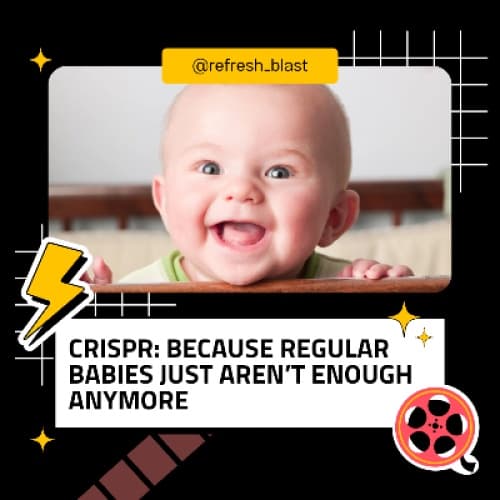

"Thanks to CRISPR, we can now fine-tune our offspring like an iPhone update."
"Imagine a world where Jeff Bezos Jr. is engineered to be a 7-foot-tall genius with laser vision, while the rest of us are stuck with plain ol’ regular DNA."
"With great power comes great responsibility—and a whole lot of questionable decisions."
Welcome to the Future, Where Science is Basically a Cheat Code
Remember when parents had to accept their children for who they were? Ha! That’s so 20th century. Thanks to CRISPR, we can now fine-tune our offspring like an iPhone update. Taller? Smarter? No more allergies? Done. But before you start designing your future Olympic gold medalist, let’s talk about the slight ethical hiccup that comes with rewriting the genetic rulebook.
Superpowers or Super Problems?
Scientists say CRISPR can cure diseases like sickle cell anemia and cystic fibrosis. Fantastic! But why stop at curing diseases when we can upgrade humans like we’re assembling an elite team of superheroes? Want a kid with photographic memory and a six-pack at birth? Science says: "Why not?"
But here’s the problem: what happens when only the rich can afford these genetic "upgrades"? Imagine a world where Jeff Bezos Jr. is engineered to be a 7-foot-tall genius with laser vision, while the rest of us are stuck with plain ol’ regular DNA. Not exactly the utopian dream we were hoping for.
Fun Fact: If we let rich people design their babies, Harvard's 2050 freshman class will be 99% genetically enhanced trust-fund kids who all look like Greek gods.
The Ethical Dilemma: Playing God, But With Wi-Fi
Now, let's talk about the ethics. If we start editing genes, who decides what’s "desirable"? Will freckles become an "undesirable mutation"? Will the government outlaw ginger babies? And what happens when people start ordering designer genes like they’re at a build-your-own-burger bar? "I’ll take intelligence level 200, blue eyes, and a metabolism that lets me eat cake without consequences, please."
Quote of the Day: "With great power comes great responsibility—and a whole lot of questionable decisions." – Some wise person, probably.
The "Regulations" (aka The Rules We’ll All Ignore)
Governments are scrambling to figure out how to regulate CRISPR, but let’s be real—science moves faster than bureaucracy. The U.S. is like, "Sure, let’s experiment!" while Germany is standing in the corner shaking its head like a disappointed parent. Meanwhile, China allegedly tried making CRISPR-edited babies already. (Because of course they did.)
If history has taught us anything, it’s that the moment humans get a cool new technology, we push it to its absolute limit. Remember nuclear power? First, it was for energy. Then—BOOM—atomic bombs. So, forgive us if we’re a tiny bit concerned about what could go wrong when people start using CRISPR like an Instagram filter.
Actionable Step: How to Survive the CRISPR Revolution
1. Start saving. Your future genetically flawless neighbor is going to outcompete you in every job interview unless you can afford some "enhancements."
2. Stay informed. Keep up with CRISPR news so you're not blindsided when your coworker suddenly has night vision.
3. Embrace your flaws. Until biohacking goes mainstream, remember: Your unmodified DNA is a badge of honor… or at least that’s what we’ll tell ourselves.
Conclusion: CRISPR – A Scientific Marvel or the Beginning of the Sci-Fi Apocalypse?
CRISPR is undeniably amazing. It could cure diseases, extend our lifespan, and make humanity healthier. But let’s not ignore the looming possibility of a "Genetic Hunger Games" scenario where only the genetically blessed thrive.
So, should we embrace genetic engineering? Sure—right after we figure out how to regulate it, make it accessible to everyone, and definitely put a stop to billionaires creating their own league of genetically enhanced superhumans. Until then, let’s just hope nature doesn’t hit us with a "CRISPR patch update" that we weren’t ready for.
Sources
Primary Sources
1. National Institutes of Health (NIH): "CRISPR-Cas9: A Powerful Tool for Editing Genomes" (2020)
2. American Society of Human Genetics: "CRISPR Gene Editing: A Primer" (2019)
3. Jennifer Doudna and Emmanuelle Charpentier: "A programmable dual-RNA-guided DNA endonuclease in adaptive bacterial immunity" (2012) - This is the original research paper that introduced the CRISPR-Cas9 system.
Secondary Sources
1. The New York Times: "The CRISPR Baby Scandal Gets Worse by the Day" (2019)
2. Scientific American: "CRISPR Gene Editing: How It Works and What It Can Do" (2020)
3. Nature: "CRISPR: A path to precision medicine" (2020)
Academic Journals
1. New England Journal of Medicine: "Human Germline Genome Editing" (2020)
2. Journal of the American Medical Association: "CRISPR-Cas9 Gene Editing: A Review of the Literature" (2020)
3. Cell: "The CRISPR-Cas System: A Genome-Editing Revolution" (2019)
Online Resources
1. CRISPR Therapeutics: A biotech company focused on developing CRISPR-based treatments.
2. The CRISPR Journal: An online journal dedicated to CRISPR research and applications.
3. Genetics Home Reference: A National Library of Medicine resource providing information on genetic topics, including CRISPR.
Books
1. "The Code Breaker: Jennifer Doudna, Gene Editing, and the Future of the Human Species" by Walter Isaacson (2021)
2. "CRISPR: A Guide to Gene Editing" by Henry T. Greely (2019)
3. "Gene Editing: The Science and Ethics of CRISPR" by Michael J. Reiss and Roger Straughan (2020)