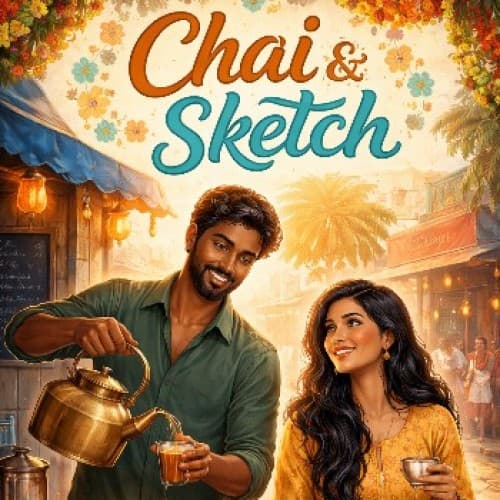

Chennai woke slowly—temples clearing their throats with bells, buses yawning into motion, the sea at Marina brushing the shore like it had a secret to keep. On a narrow lane in Mylapore, beneath a gulmohar that shed red like it was learning to blush, stood a chai stall with a blue tarp roof and a kettle that never quite stopped singing.
That was where he worked.
He poured tea the way some people pray—unhurried, attentive, aware that heat could ruin things if mishandled. His name was Arjun, though most people just called him chai anna. He knew the regulars by rhythm: who wanted extra sugar without asking, who needed the first sip in silence, who paid on Fridays because the rest of the week was complicated.
And every morning, she sat on the low compound wall across from him and sketched.
Maya arrived with the light, always with the same canvas tote and the same pencil sharpened to a quiet point. She ordered ginger chai, no sugar, and never looked up when she spoke. She’d take the cup with both hands, as if warming something older than her palms, then settle into her drawing.
At first, he thought she was sketching the street—the flower seller braiding jasmine, the auto driver arguing with destiny, the way the sunlight fell like a question mark on the pavement. Only later did he realize her pencil paused longest when he moved.
He noticed because artists look the way hawks do—still, but not absent.
Weeks passed. The monsoon came early, as it sometimes did, turning the city into a mirror. Maya’s pages filled with lines that curved like steam. Arjun began to recognize himself in the shapes she traced: the slope of his shoulders as he leaned over the stove, the careful angle of his wrist while pouring, the crease between his brows when the kettle whistled too sharply.
Once, he asked, “Enna draw panreenga?”
What are you drawing?
She smiled without looking up. “Morning,” she said.
It felt like an answer.
They learned each other sideways. He learned she worked late nights at a small design studio near Teynampet, branding things people didn’t think about—labels, menus, signboards. She learned he took the first train from Tambaram, that he read old Tamil poems on his phone between customers, that he had once wanted to study architecture because buildings felt like stories that stood still.
On a humid Tuesday, the power went out.
The grinder across the street fell silent. Fans froze mid-thought. The stall darkened into a pocket of pause. Arjun laughed, wiped his hands on a cloth, and shrugged. “Tea will take time,” he said.
“That’s okay,” Maya replied, closing her sketchbook for the first time.
They sat on the wall together. The city leaned in. He told her about his mother, who taught him to boil milk without letting it rise too fast. She told him about her father, who believed drawing people was a way of remembering them before they left.
“Do you ever get tired of this?” she asked, nodding toward the stall.
He considered it. “No. But sometimes I wonder what it would look like if it were… different.”
She opened her bag and handed him a sketch.
It was his stall—reimagined. Same kettle, same tree, but the tarp had become a painted awning. The hand-lettered sign curved like a smile. There were stools that invited lingering. A place not just to drink tea, but to arrive.
He stared at it for a long time.
“You made me bigger,” he said finally.
“I made you clearer,” she replied.
The first rain that evening came hard, drumming the city into confession. Arjun offered her another chai, free this time. She accepted, finally looking at him fully—steam between them, unafraid.
Months later, the awning became real. The sign appeared in careful script. People stayed longer. Some mornings, Maya still sketched, but now her pencil wandered—to their reflections in steel cups, to hands brushing as change was passed, to a city that had made room for two lives to overlap.
Chennai kept waking. The sea kept secrets.
And every morning, love was poured—hot, strong, and just sweet enough to last.