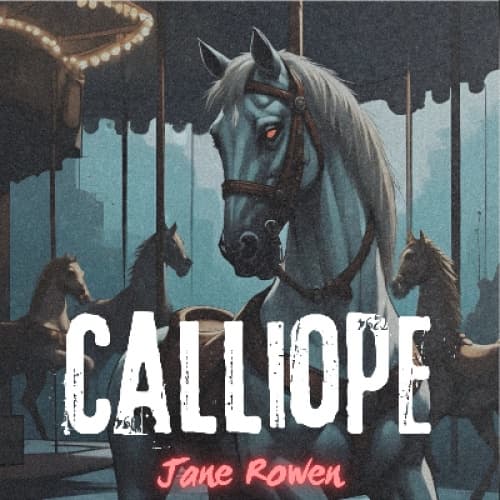

The newspaper clipping was barely readable. Water had warped the page and turned the ink into blotches, but the photo stayed sharp. Unnervingly sharp. A carousel horse with red glass eyes and peeling white paint. Its mouth was stretched too wide, like it wanted to smile but forgot how. Someone had scribbled a name underneath in shaky handwriting: Calliope.
I wasn’t looking for this.
I’d been three days deep in a rabbit hole, chasing scraps through the dusty archives of the old county records office. Trying to patch together some forgettable article about regional folklore. Carnival myths. Harvest gods. That kind of thing. I was hungry, underslept, and half a bottle into the worst gas station coffee you can legally sell in Oregon.
I needed a paycheck. Fast. Rent was due and my inbox was full of polite rejections and past-due notices. I wasn’t chasing magic. I was chasing clicks.
But then I found her. Or maybe she found me.
The caption said, “Girl Vanishes From Carousel. Horse Left Spinning.”
No date. No author. No follow-up.
But the second I saw that photo, my stomach flipped. It wasn’t recognition exactly. It was something worse. Familiar in the way a scar feels when you run your fingers across it.
I swear I could hear music. Carousel music. Slow. Sweet. Like it was being played underwater. Faint and strange, but real enough that I turned my head, half-expecting to see a ride drifting by the windows.
I tried to move on. Told myself it was just another dead-end story, just one more weird artifact in a room full of them. But I kept going back to that photo. Zooming in. Staring at the horse’s face. Its eyes weren’t just red. They were reflecting something. A shape. Maybe a person. A flash of light, or a face. I couldn’t tell.
The more I looked, the more convinced I became that it was looking back.
The dreams started that night.
I was always just outside the ride, unable to step on. The horses moved too fast. The lights never stopped spinning. Warped music played through broken speakers, distant and tinny. Like it was coming from somewhere inside me.
I’d wake up sweating, heart racing, like I’d been running through syrup.
On the third night, I woke up with the name in my mouth.
Calliope.
I said it out loud.
The air in my apartment shifted. Heavy. Still. Like the whole room had inhaled and was holding its breath.
I didn’t sleep the rest of the night.
A week later, a flyer showed up in my mailbox.
No stamp. No return address. Just a single sheet of faded red paper, folded in half. The ink smelled old—like mildew and something metallic, like blood rubbed into copper. It was a flyer for a carnival. Not a big one, either. Just a traveling setup called Calliope & Co.
No website. No phone number.
Just an address on the outskirts of town I’d never heard of.
I stared at it way too long.
The logo was almost identical to the one in the old photo. Same horse, same painted eyes, same crooked teeth. But the smile was wider now. Or maybe it always had been. It was the kind of logo that didn’t just look designed. It looked remembered.
I showed it to my neighbor. Asked if they got one too.
They laughed and said no. Didn’t even ask what it was about. Just looked at the flyer, then at me, like I was trying to sell them something I didn’t understand.
I Googled the name. Nothing.
No Yelp reviews. No TikTok tags. No blog posts or location data. Like it didn’t exist.
But I felt it in my chest—like the flyer had weight. Not heavy, exactly. Just... anchored.
Like it had been waiting for me to find it.
I left it on the counter.
Then by my bed.
Then under my pillow.
And when I closed my eyes, I could see it perfectly. Every line, every smear of ink. Burned into the backs of my eyelids.
I told myself I was just going to check it out. Take a few photos. Maybe write a blog post. That’s what I do. Scrape meaning out of weird places for people who scroll past it in five seconds.
The address led me out past the edge of town, where the pavement gave up and the trees pressed in too close. My phone lost signal halfway there. The GPS map glitched and reset twice before I stopped checking it. The sun was low enough to turn the world gold, but the shadows under the trees stayed black.
I don’t even remember parking.
Just... standing at the tree line, keys still in my hand, staring through the branches.
There it was.
The carnival.
Not setting up. Not bustling. Just... waiting. Lights already on. Rides already spinning. No people. No sound. Except for the music. That goddamn carousel song, playing slow and sweet like it had all the time in the world.
Like it knew I was coming.
The path into the carnival wasn’t marked, but my feet knew where to go. Grass gave way to gravel, then to soft earth that smelled like rain and rust. The lights flickered overhead. Old bulbs strung between poles, glowing just bright enough to cast shadows. Rides creaked gently, spinning without riders. A Ferris wheel turned slow, like it was thinking.
There were no voices. No laughter. No footsteps but mine.
Just the music, curling through the air like smoke.
I passed an empty prize booth, shelves still stocked with toys that looked handmade. A stuffed rabbit with one eye. A doll with too many teeth. A bear sewn shut where its mouth should be.
The kind of prizes you don’t win.
The kind that choose you.
Then I saw it.
The carousel.
Perfect. Untouched. Gleaming like it had just been built yesterday—and maybe it had. Not a single light flickered. The gold poles shone. The mirrors gleamed. Each horse caught in motion, mid-kick or rear, as if frozen in the middle of some terrible escape. Their mouths were all slightly open, like they’d been caught screaming.
Except for one.
Calliope.
White. Red-eyed. And facing me.
Her head was turned slightly, not aligned with the others. Like she’d been watching me walk in. Like she already knew I’d come.
There was a plaque bolted to the fence, half-swallowed by ivy. No title. No brand. No manufacturer’s mark.
Just two words, etched in rusted brass.
“Wish wisely.”
I almost laughed. It felt like a joke. Like a setup.
But the air around the carousel was still. Thick. The kind of still that settles over a graveyard before rain.
I stepped closer.
The horses were carved from wood so smooth it looked like bone, worn down in places by decades, or maybe centuries of touch. The paint had chipped and curled like sunburnt skin. Their eyes glinted like marbles. Dead and polished. A few wore cracked leather saddles. Others still had faded ribbons braided into their manes. One had a child’s bracelet hanging off its reins.
They all looked tired. Used up.
Tired of spinning.
All except Calliope.
Her paint was fresh. Her saddle looked new. Her red eyes brighter than the rest, almost wet. Her mouth wider, stretched into that familiar not-smile like she was waiting for a secret.
Or an offering.
I don’t remember deciding to speak. The words just rose up and poured out, like someone else had been holding them in my lungs.
“I want to feel whole again.”
The music stuttered.
Just for a second.
Then a breath, like the carousel exhaled, and a low, mechanical click echoed from deep within the ride’s guts. A gear catching. A lock disengaging.
Calliope moved.
Not the whole carousel. Just her. Her hooves creaked on the platform. She turned, inch by inch, until she was facing forward, saddle bare and gleaming under the golden lights.
She was inviting me.
Daring me.
The ride was ready.
And so was I.
When I climbed onto her back, the air shifted again. It grew thick. Heavy. The way the sky feels right before a thunderstorm splits the world in half. The saddle was warm. Not just room temperature. Warm. Like someone else had just been riding. Or like something inside her was alive.
I gripped the pole beside her neck. It pulsed under my palm. Faint and steady, like a heartbeat muffled through layers of wood and iron.
The carousel started to spin.
Slowly at first. Barely more than a sway. A lullaby of motion. The music returned, low and distant, but richer now. I could hear the depth of it. The layers. The sounds behind the melody. Breathing. Whispers. Something being fed.
It didn’t sound like it was coming from speakers anymore.
It sounded alive.
Lights blurred around me. Colors stretched, melted. I couldn’t tell if the carousel was spinning faster or if the world around me was starting to unravel.
For a second, I felt like I was floating. Like the gravity of my life had lifted. Like I’d stepped out of time and into something soft and terrible.
Something that had been waiting to be touched.
Then I woke up.
Not at the carnival. Not in my car. But in my apartment. Clean. Normal. Too normal.
Gray light bled through the window. Dust hung in the still air like ash. The room smelled like ink and sweat, and something else I couldn’t name. It was metallic, almost sweet, like a penny held too long in your mouth.
My notebook was open in front of me. Pages filled with my handwriting, dense and uneven, running into the margins. The paper was warped. Some edges looked scorched. My pen, still clutched in my aching hand, had run dry, but that hadn’t stopped me from carving words across the paper like I’d been trying to bleed them out.
I turned page after page. Some passages were beautiful. Achingly so. Others were violent. Cruel. Unforgivable. But all of it... unfamiliar.
I didn’t remember writing a single word.
Yet every sentence sounded like me.
I couldn't stop. Even when I wanted to.
The ideas poured in, overwhelming and vivid. Fully-formed characters arrived in my head like memories I didn’t make. Entire scenes bled out of me without warning. I wasn’t writing them down. I was catching them, scrambling to get them on the page before they vanished. It felt like transcription. Like the story was already alive somewhere else, and I was just the vessel dragging it into the world.
It terrified me.
I posted a single paragraph online, a throwaway. Just to see if it landed.
Within hours, my inbox was full.
People wanted more and more stories. More content. More me. Editors reached out. Strangers offered contracts. Fans quoted lines I didn’t remember crafting. One woman said it made her cry. Another asked if I was okay. A publisher I’d queried months ago called me “the real thing.”
My follower count spiked overnight. I got tagged in book lists I hadn’t applied for. My name appeared in headlines.
It should have felt like a breakthrough.
But it felt like a setup.
There was something wrong with the work. Beneath the polish, the language had teeth. No matter what story I tried to write, there was always a thread of rot pulling at the center. Someone always suffered. Someone always begged. Someone always bled.
I tried to pivot. I opened a new document. Typed the words “Once upon a time,” and stared at the blinking cursor for half an hour. Nothing followed.
But if I thought about pain, about loss, about being stripped to the bone and rebuilt into something monstrous, the words returned.
They flowed like blood.
I knew what I’d asked for.
Calliope hadn’t given me a gift.
She’d given me a voice.
But it didn’t belong to me.
The carousel music followed me.
At first, I thought it was a memory, some phantom tune caught in my brain. But I started hearing it in the real world, leaking from vents, humming under floorboards, rising beneath the noise of the city like a melody only I could recognize. Soft. Sweet. Measured.
It played while I made coffee. While I showered. While I sat in silence. The moment the world grew quiet, it was there. Slow and saccharine, like a child’s music box left running after its owner had died.
And I kept writing.
Things I didn’t understand. Half-dreamed scenes, unfamiliar names, stories written in notebooks I hadn’t opened. Sometimes I’d wake up with a draft open on my laptop, full of dialogue in my voice, but with a rhythm that didn’t belong to me.
One story described a collapse. A fire escape breaking free from brick, taking three people down with it.
It read like fiction. Sharp and tight. Visceral.
The next morning, I saw the same details on the news. Same location. Same time. The same names from my draft scrolling across the bottom of the screen in a death count ticker.
I didn’t remember writing that story.
But she did.
I stopped leaving the house.
At first, I told myself it was because I needed to focus. The writing was coming so fast, I barely had time to eat or sleep. But the truth was, the world outside had started to feel thin. Like if I stepped out, it might tear. So I stayed in. Let the words keep coming.
And they did.
Even when I didn’t want them to.
My phone buzzed with messages from people I couldn’t place. Writers who claimed we’d worked together. Editors asking about stories I didn’t remember submitting. Strangers who spoke to me like we’d known each other for years.
Some sent photos of me, smiling beside stacks of books I’d never written. Me at signings. Me on stage. One video showed me on a panel discussion, laughing easily, answering questions with practiced charm. I was wearing clothes I didn’t own. I said things I didn’t believe.
The voice in the video sounded like mine.
But the way I smiled made my stomach twist.
It wasn’t mine. It was hers.
And then the dreams changed.
I wasn’t watching the carousel from the outside anymore. I was on it.
The fog was thick and endless, wrapping around the ride like a curtain pulled tight. The horses were no longer simple carvings. They were distorted. Limbs too long, mouths agape, hooves frozen in impossible motion. Dozens of other riders circled with me, locked in silent poses, all facing inward. Their faces blurred and flickering like bad reception. Some were completely still. Others shifted, jittered, whispered things I couldn’t quite hear.
And among them, I recognized pieces of myself.
A familiar jacket. The tilt of a jaw. A birthmark.
They weren’t all strangers.
They weren’t all alive.
Calliope stood at the center of the carousel. Or what had once been Calliope.
She had grown, reshaped into something no longer equine. Tall and skeletal, her body splintered with bone-white wood and stretched parchment. Her joints creaked with every tiny movement. The smile was still carved across her face, too wide and too smooth to belong to anything human.
She didn’t speak with a mouth.
She spoke through mine.
I woke up hoarse and shaking. My pillow damp with ink. My arms sore. When I pulled up my sleeves, I found writing etched into my skin. Long paragraphs scrawled from wrist to elbow, each line in my own looping handwriting.
Most of it didn’t make sense.
But one phrase kept repeating, over and over:
You wished for a voice. Now you’re my echo.
I didn’t remember writing it.
But I believed it.
I didn’t pack a bag. Didn’t leave a note. I just walked out the door, keys in hand, and started driving.
The music had grown louder. It hummed beneath the noise of the engine, the air, my thoughts. I knew it wouldn’t stop unless I found her.
When I reached the field, it was already gone.
No lights. No carnival. No carousel.
Only silence and wind. Grass torn up by tires. Dirt blackened like something had burned. The faint scent of sugar lingered in the air, cloying and wrong, like cotton candy soaked in gasoline.
I stood there, expecting something to change.
And that’s when I saw the mirrors.
They were arranged in a crooked line where the carousel used to spin. Dozens of them, each different. Some rimmed with silver, others chipped or rusted. The glass was warped and dull, like it had aged in reverse.
I stepped closer.
Each mirror showed a different version of me.
Not as I was, but as I could’ve been.
One was seated at a desk, scribbling frantically. Another stood on a stage, basking in a spotlight. A third sat slumped in a chair, mouth open in a scream that made no sound. Some of them were crying. Others grinned with an intensity that felt practiced. Forced.
One stared directly at me.
Its expression was flat. Watching.
I moved my hand, and it moved too.
But it wasn’t mimicking me.
It was matching.
Then, slowly, all of them turned toward me.
Their movements synchronized. Fluid. Horribly familiar.
And then they smiled.
Every version of me. Smiling with the same too-wide mouth, the same knowing look. That twisted, painted expression I’d first seen in the photo. The one Calliope wore when she turned to face me on the ride. They weren’t reflections. They were rehearsals.
And I was next.
Behind the mirrors, I saw the carousel.
Not as it had appeared, but as it truly was.
The illusion peeled away, revealing something ancient and ruined beneath. The horses had decayed into a tangle of sinew and splintered wood. Flesh melded with rot. Their eyes, once glossy and red, were now gaping sockets that wept thick streaks of ink. The poles impaling their backs twisted upward like exposed spines, creaking with the weight of what they held.
The music still played.
But now I could hear the voices buried beneath the melody. Soft at first, then rising into a desperate chorus. Some pleaded. Some screamed. Some wept in a language I didn’t understand.
One of them was mine.
At the center of the horror stood Calliope.
Still shaped like the white carousel horse from that photograph, but no longer confined to it. Her form had grown taller, stretched into something human-shaped and wrong. Paper and bone. A silhouette stitched from discarded pages, each one etched with words I’d written but couldn’t remember creating.
She smiled. Always smiling.
And she beckoned.
I didn’t feel the glass break as I stepped through the mirror. There was no resistance. Just a quiet surrender. The moment I touched the carousel’s edge, it shuddered violently and began to spin. The world blurred into color and sound and heat.
And memory.
I remembered everything.
I never made it home that night.
Not really.
The carousel never stopped. It simply carved a version of me that could keep walking, keep writing, while the rest of me stayed behind to feed her. Each sentence I thought was mine had been hers. Every word a tithe, every story a summoning.
And now, there’s nothing left to give.
Only space to be filled.
I live quietly these days.
I don’t go out much. I don’t talk unless I have to. The voice I once had. The one that wanted to be heard, feels like something borrowed. Something fading.
Most mornings, I wake to fresh pages waiting on my desk. My pen always resting beside them, faintly warm. The ink never runs dry. I haven’t bought a refill in months.
Sometimes, I try to read the words.
Some are beautiful. Others leave my hands trembling. A few are written in languages I don’t speak but somehow understand. None of them feel like mine.
Not anymore.
There’s something else in the rhythm. A hunger.
It’s her voice now. Syrupy and soft, cruel beneath the sweetness. She writes through me, around me, inside me. And when I tried to stop, I locked the drawer, and threw away every pen, I woke up with ink pooling beneath my tongue, my teeth black, my gums raw and bleeding from the inside.
Now, I don’t resist.
She likes to be read.
Readers tell me my stories feel alive. That the words crawl under their skin. That it doesn’t feel written. It feels summoned.
They don’t know how right they are.
Sometimes, when I speak, the sound comes out thin. Dry. Like paper tearing in the wind. Like something old turning a page.
I think I’m vanishing.
But I asked for this.
I begged for it.
I said I wanted to feel whole again.
And now she lives where my voice used to be.