She was born into a home that felt safe.
Not perfect. Not wealthy. But full. The kind of home where voices overlapped, where someone always asked if you had eaten, where dreams were spoken aloud without fear of being laughed at. Her parents were not just caregivers, they were witnesses. They saw her. They believed before she learned how.
For a long time, life made sense.
Then it didn’t.
The first loss came like a crack in glass. Painful, but survivable. People told her to be strong. To hold on. She tried.
The second loss shattered what was left.
Two parents gone. One after the other. No time to adjust. No time to grieve properly. Just absence stacked on absence until the house no longer felt like a home but a reminder of everything she no longer had.
The lights still worked.
But warmth did not.
She learned how loud silence could be. How nights stretched longer when there was no one to say goodnight. How grief doesn’t arrive all at once—it returns in waves, unannounced, sometimes years later, when you least expect it.
She was young. Too young to carry that much loss.
But loss does not wait for readiness.
There were days she woke up angry at the world. At God. At herself. Days she felt guilty for laughing. Guilty for surviving. Guilty for wanting more from a life that had already taken so much.
People assumed she was strong because she kept going.
They didn’t see how much effort that took.
She could have stopped trying. She came close. There were moments she felt invisible even to herself. Moments she wondered if her life had already peaked before it had truly begun.
But something—quiet and persistent—refused to let her disappear.
Faith did not arrive as certainty.
It arrived as endurance.
God did not remove the pain. He did not explain it. He met her in the middle of it—in the unanswered prayers, in the tired mornings, in the days when simply breathing felt like work.
Slowly, she learned to stand again. Not because she was healed, but because she was held.
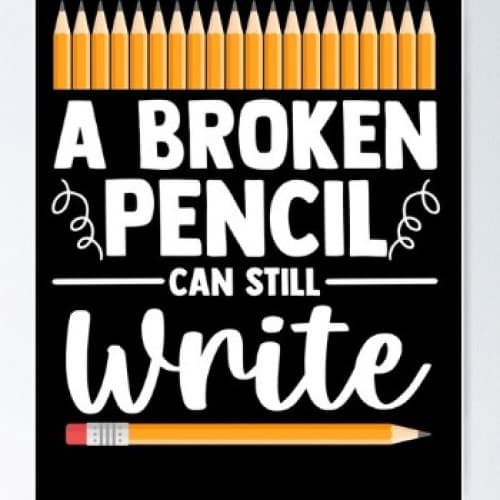
She discovered that brokenness does not mean the end of usefulness. That something cracked can still carry meaning. That a life altered by loss is not a wasted one.
Like a broken pencil.
Shorter. Worn.
Still able to write.
She writes now with honesty. With compassion. With a tenderness that only comes from having known sorrow closely. Her story is not polished. It is real.
And in telling it, she becomes proof that even what life breaks can still leave something beautiful behind.