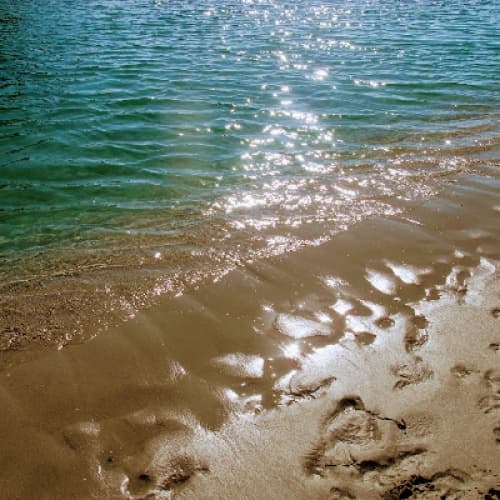

One September Sunday, Tamara, a young marine biologist on a working holiday in Greece, was walking along the edge of the sandy beach a few miles from Athens, looking into the transparent water. She was doing research for an NGO on the destruction of plastic.
She paddled into the water. Looking down, the plastic bags floating around her legs gave her the impression of a horde of jellyfish, scudding backwards and forwards with each succeeding wave. Her own transparent, plastic dustbin bag, half-full of plastic-eating, wax-moth caterpillars, was being pulled away from her at the surge of successive waves and she had to turn around each time and pull it back. She would hate to lose her little black-spotted, black-eyed, yellow fellows, but her fingers ached, trying to hold onto them. The water’s pull on them made them feel quite heavy, and she needed a whole bunch of them if her experiment were to succeed.
When the water was up to her waist, she let her body fall forward with a splash into the warm Mediterranean. She fixed her eyes on her target - a thick, amalgamated blanket of accumulated plastic, floating about half-a-mile out to sea.
Swimming alongside its bulk, she started to paddle in the water, unknotting the bag and pouring out her mingled, yellow chaps, called Galleria Mellonella, onto the floating plastic island. Her research into this polyethylene bio-degradation project was still limited, and she might never see the result, but the clever little caterpillars, she had read, could not only digest plastic but use it as a source of energy.
When emptied of its last inhabitant, she rolled the dustbin bag up into a tiny packet and tucked it into her swimming costume. It felt cold and slimy against her skin, making her shiver. She took in a deep breath, thinking how the sea air contrasted with the harsh, iodine-lashed content of the northern climes of her homeland waters. Here, no resistance was offered by the air to the distant chords of a plucked string instrument. The joyful sounds just floated over the waves unhindered.
She looked towards the beach and saw a few silhouettes of young children licking ice-creams. Others, a little older, were standing in the weak shadows of plastic palm trees or sitting under raffia sunshades. Some had taken shelter in deckchairs on the sheltered terrace of the bar.
Still paddling in the water, at the sound of a splash to her right, Tamara looked around her and saw in the distance a young man’s head bobbing up and down in the water.
‘Hello!’ he called, and with a few strokes came swimming towards her.
‘I saw you from the beach and thought that you were going to swim quite a way out to that plastic patch in the sea. I wondered whether you were thinking of swimming even further out. In which case, you might like company. My name is Maceo, and I’m a lifeguard.’
She was happy to see that the head belonged to a dark-haired, olive-skinned young man with a friendly smile.
‘Yes, that would be nice,’ she said. ‘My name’s Tamara.’
He turned away from her in the water and took off in front of her in a slow crawl, skimming across the surface of the sea. He was a strong swimmer and was well in front of her when she saw, coming towards her on the crest of an approaching wave, a surge of poisonous, mauve jellyfish. ‘Pelagia Noctiluca,’ she uttered in a strangled voice. The adrenalin in her gave her no time for further thought, ‘Fight or flight!’ it said.
She took a desperate gulp of air as she felt her head being pushed downwards by an unknown force, a strange hand. As she went down, she tore the folded, plastic dustbin bag out from under her swimming costume, and slipped into it. From the inside, she held it tightly closed over her head, holding her breath and paddling with her feet in the bag. It rose like a balloon to the surface, bounced up and over the crest of the wave, her weight pushing it backwards towards the open sea.
As her lungs started to heave with pain and feeling the water calm again, she opened the bag, put her head out, and, coughing violently, took in a gulp of fresh air. Looking around, there was no sign of the jellyfish. She swam out, holding onto the bag as she emerged, giving herself a few minutes respite by paddling in the water before swimming back towards the beach. There was no sign of Maceo.
When it was shallow enough to walk, Tamara collected the plastic bags that were floating past her and threw them into the open binbag.
Back on the beach, she was surprised to see the tall outline of her supposed lifeguard coming out of the bar.
As she approached, he held out his hand to take the bag and said, ‘Well done! Stay there! Don’t move! I’ll get us some drinks, if you don’t mind joining me.’
She walked up onto the terrace and settled herself into a deckchair, filling her lungs with air.
A few minutes later, empty-handed, he returned, follow by the barman, a lithe man, with black, curly-hair and a mouth-full of very white teeth, wearing a white T-shirt and blue shorts. He served them with two glasses of champagne on a tray, accompanied by a dish of oily, green olives. The smell of fresh Mediterranean herbs wafted up into the late afternoon air.
‘I have been watching you, lady,’ the barman said, ‘and I’d like to offer you free drinks and a meal for cleaning up all that plastic. It’s not good for custom.’
Tamara thanked him and turned to Maceo. ‘I think you’ve been talking to him,’ she said.
‘Of course,’ he chuckled, ‘Aristotle’s an old pal of mine. On the other hand, I saw what you did out at sea, and I am full of admiration. I didn’t tell you, did I, that professionally I am a marine biologist rather than lifeguard? I help Aristotle out over the weekends. I just look out for the safety of families when they come from Athens with their small children. When I saw you so far out, I thought I might just join you for a nice swim, but perhaps I can also join you in helping to clean up.’
‘That’s just what I need,’ she answered, pulling off her bathing cap and letting her long hair tumble out. She rubbed her hands through it, trying to put it back into some kind of order. ‘It’s a marine biologist’s project,’ she replied. ‘I’m not doing it for fun. I am on a working holiday,’ she added.
‘In that case, perhaps we can meet in Athens tomorrow and discuss it. I’d like to know more about it.’
She hesitated before answering, throwing him a steely, blue-eyed, no-nonsense look.
‘I might be busy tomorrow,’ she replied, lowering her eyes towards her half-empty glass of champagne and lifting it to her lips.
‘If you promise to meet me,’ he continued, ‘I’ll bring along some of my colleagues from the Ministry of the Environment so that with a strange man, you won’t feel all at sea.’ He chuckled. ‘We’re looking for a consultant for our international marine-mammal project,’ he continued. ‘Then, if you are interested in working with us, I could be your guide around town tomorrow, and, if you like, we could take you out to sea. We look after whales, dolphins, and marine life that the plastic is harming. I assure you that, along with the marine biologists from work, you can’t possibly feel out of your depth. Afterwards, we all have a date to dine in Athens. Would you like to join us?’
She saw that Maceo’s eyes had shifted onto her body, now emblazoned directly by a low shaft of sunlight.
Tamara hesitated in giving her response. She took another sip of her champagne and was thinking how nice it would be to have local professional help with her project. Relaxing, she settled back into her deckchair, stretched her long, sunburnt legs out before her and philosophised, her calm, blue eyes appraising Maceo, ‘Man is the measure of all things,’ she said.
‘I am Greek,’ he responded, ‘so of course I know about Protagoras’ theory that we each have our own way of seeing things, but I assure you that this is an invitation of one professional to another.’
With a simmering smile on her lips, she knew that he was going to fall right into her carefully prepared net. With her eyes closed, she imagined herself shortly swimming with dolphins in the depths of the sea, together with his colleagues, on a similar research project to her own. After that, she planned to look for a few Italian marine biologists on the beach at Ostia, a short trip from Rome. She would take more of her Galleria Mellonella with her to demonstrate her own work with her bio-degradation caterpillars. Anyhow, she thought, these marine biologists seemed very easy to catch! Getting as many as possible of them involved in her project was worth every bit of the effort!
Aristotle arrived to collect the glasses, giving her a furtive glance as he walked past. She was sure she saw him winking at Maceo, but Maceo would soon find out that he was not the only fish in the sea. She would soon have a whole collection of them.