A New Sputnik, an Old Reader’s Digest
By Qazi Zaheer Ahmad
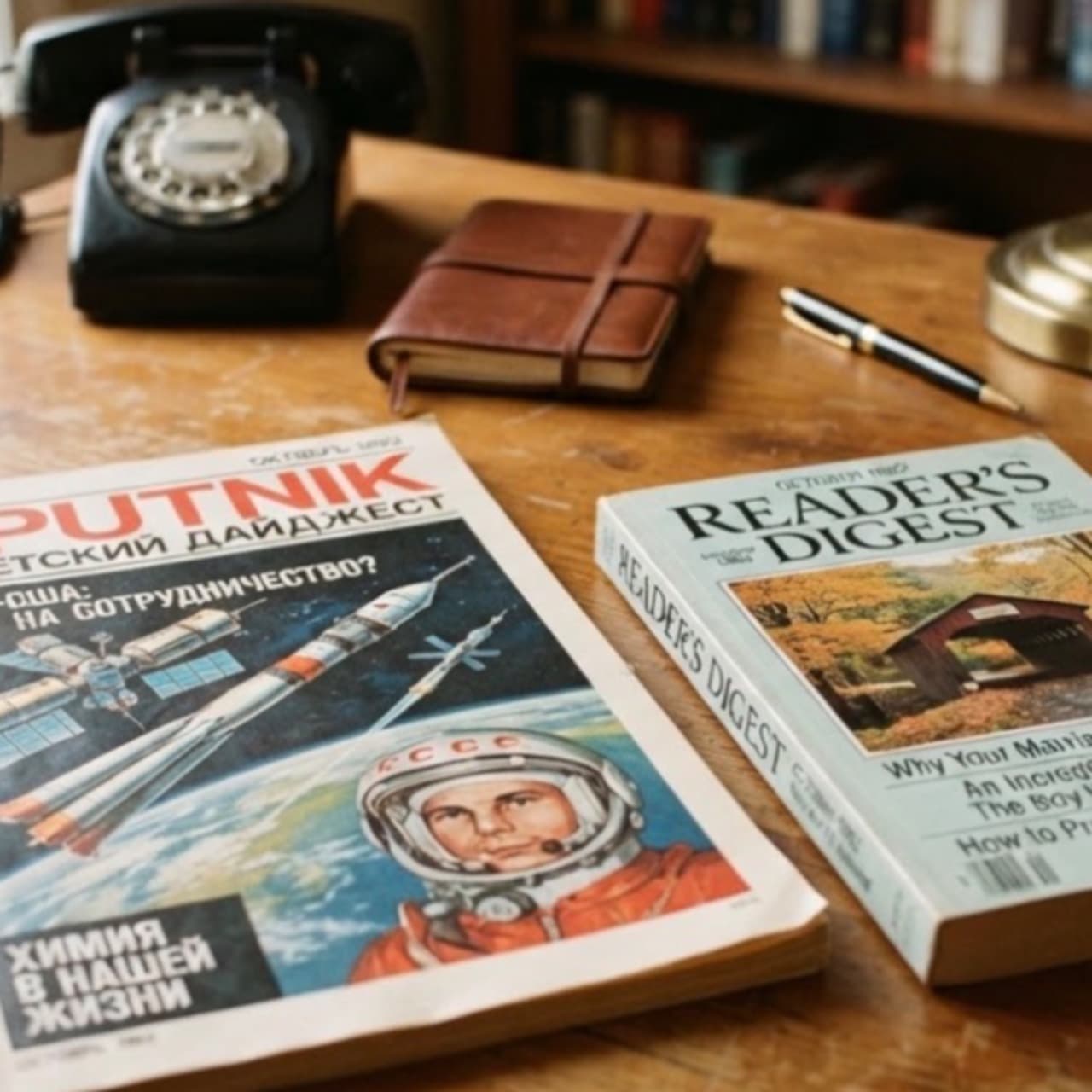
In 1983, when I was studying agricultural economics in Peshawar, ten rupees bought me a new issue of Sputnik at a bus-stop stall. A new Reader’s Digest cost thirty-eight rupees. I wanted both, so I bought Sputnik as each month’s issue came out and looked for Reader’s Digest in Peshawar’s old bookshops, where a back issue also cost ten rupees. Once a month I took the bus home to Haripur. It was a journey of two and a half hours, long enough to lose myself in a magazine and return to a passage that had made me stop and think.
I lived on a scholarship and managed to put aside a little money every month. I spent those savings on Russian khaddar, linen, woollen cloth and electronics to take home. Russian goods seemed to have flooded the Peshawar markets, and they sold for what felt like pennies. I still remember being astonished by their quality. Some of the finest things I ever bought for our home came from those markets, paid for out of the money I had saved as a student. Agricultural economics was my subject at university. My scholarship gave me a small monthly exercise in making money stretch.
I associated that abundance with the war that followed the Soviet invasion of Afghanistan. In Peshawar, the war entered daily life in ways I could scarcely have imagined before university. At a stall I could buy a magazine in which the Soviet Union presented itself to the world. In the city I could meet Afghans who had been driven from their homes. We picked up Persian from Afghan refugees through ordinary conversation. I remember hearing about Abdul Rashid Dostum and his Galum Jum militia in those years, too. The names belonged to the talk of war. The Persian I learned belonged to people I could speak with.
Both publications were digests, but their editors had quite different ideas of what a reader ought to know. In Sputnik, an article about a scientist, a factory or a cosmonaut could express the ambitions of an entire country. Reader’s Digest often built a story around an individual. I read accounts of people who had survived ordeals, pieces about family life, jokes and practical advice. A story in Sputnik might leave me wondering what a country could achieve. A story in Reader’s Digest might leave me wondering what I would have done in one person’s place. On the bus to Haripur, I had time for both questions.
Later in the decade, Sputnik introduced me to glasnost and perestroika, the Russian words for openness and restructuring that became associated with Mikhail Gorbachev’s reforms. I liked learning words that helped me follow what was happening in another country. A word I had first read in a magazine from a Peshawar bus stall could turn up again in the news, and this time I knew something about the ideas behind it. That experience stayed with me. The world beyond my university seemed a little easier to understand when I had the vocabulary to ask a better question about it.
I turned to Reader’s Digest to enlarge my English vocabulary. I was especially drawn to its idioms and phrases. I could know every word in an expression and still miss its meaning until I saw what happened next in the story. A joke sometimes taught me more about an idiom than a definition would have. And when I encountered the phrase again, I could often remember the situation in which I had first read it. The issue might have been several months old by the time it reached me, but for the English I was learning, the date on the cover made little difference.
Perhaps those two magazines were among my first inspirations to distinguish myself at university. They gave me the confidence to read beyond my subject and to take an interest in questions I had never been asked in class. I was studying agricultural economics, yet I wanted to understand how people lived elsewhere, how countries changed and how to put my own thoughts into clear English. Reading on the bus was something I did for pleasure. Over time, the pleasure became a habit, and that habit helped me take on work that once would have seemed beyond me.
Years later, in 1992, I qualified in Pakistan’s nationwide competitive examination for the Central Superior Services, one of the most demanding examinations in the country. I prepared for it seriously, and I think some of that preparation had begun long before I knew I would sit for it. I had learned to keep reading when a subject was unfamiliar, to pay attention to the way a sentence was put together and to take an interest in affairs beyond my own field. I can trace some of that curiosity back to the two magazines I used to carry home to Haripur.
Now that I have retired from government service, some of those old issues of Sputnik and Reader’s Digest still lie in a box alongside several other books. I am glad I kept them. Looking at them brings back the arithmetic of my student days. Ten rupees for the new Soviet magazine, ten for the second-hand American one, and a little of my scholarship saved to buy something for the house. I remember the satisfaction of having enough for these things, and of knowing I had two and a half hours ahead of me to read.
I am grateful to both magazines. One gave me words with which to follow a changing world. The other gave me phrases I could make my own. When I look into that old box now, I think of the young man on the bus to Haripur who had no idea where his reading would take him. He had found an old issue for ten rupees and wanted to see what was on the next page.