Setting:
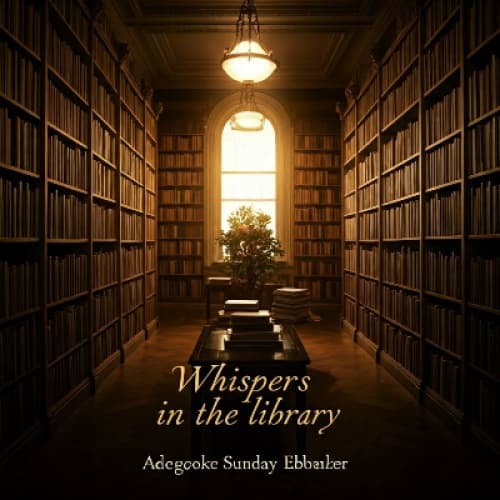
The story unfolds in the heart of Lagos, Nigeria, within a quaint, historic library called "The Wisdom Vault." This library, an imposing colonial-era structure, stands as a relic of a bygone era, nestled in the quieter part of Yaba, away from the cacophony of the bustling city. The building itself is a character, with its high arched windows that let in beams of sunlight, casting golden hues on the dusty bookshelves. The air is thick with the scent of aging paper and polished wood, and the echoes of footsteps on the creaky floorboards add to its mystique.
Despite the digital age, The Wisdom Vault remains a sanctuary for a small but devoted group of patrons. Students, academics, and curious minds frequent this space, drawn by the tranquility and the vast collection of books, many of which are rare editions passed down through generations. The library, however, has seen better days. Its once-pristine walls are now faded, and the roof occasionally leaks during the heavy rains. Yet, it remains a haven for those who seek knowledge, solace, or simply a place to escape the harsh realities of life in Lagos.
Main Character:
Amara Okonkwo, the librarian, is a woman deeply connected to the library. In her late thirties, she is known for her quiet demeanor, sharp intellect, and an uncanny ability to find the perfect book for any reader. Amara's life is intricately woven with the library; she grew up among its shelves, as her father was the previous librarian. When he passed away, Amara inherited not just his position but also his passion for preserving the stories within the library's walls.
Amara's life outside the library is solitary. She lives in a modest apartment in Surulere, a short bus ride away from the library. Her apartment is sparsely decorated, with the exception of the books that line the walls, reflecting her love for literature. She spends her evenings reading, often with a cup of tea by her side, lost in the worlds that each book offers. Amara is unmarried, having lost the love of her life, Emeka, to a tragic accident years ago. Since then, she has poured all her affection and energy into the library, finding comfort in the companionship of books.
Plot:
Introduction:
Amara has always believed that books possess a life of their own. She often talks to them, not expecting a response but feeling a sense of connection. This habit, passed down from her father, becomes more profound one fateful evening. As she is closing the library, she hears a faint whisper. At first, she dismisses it, attributing it to the wind rustling through the pages of an open book. But as the days go by, the whispers become more distinct, more purposeful.
These whispers seem to emanate from specific books, particularly when they are returned by certain patrons. Amara, who has always been sensitive to the emotions of others, begins to notice a pattern. The books are not just telling stories; they are recounting the lives, the secrets, and the innermost thoughts of the readers who borrow them.
The First Whisper:
The first book that speaks to Amara is a copy of Wole Soyinka's "The Man Died." It is a well-worn book, its pages yellowed with age, yet it remains one of the most borrowed books in the library. The whispers from this book are faint, almost indiscernible at first, but Amara begins to hear them more clearly as she concentrates.
One evening, after the last patron has left, Amara sits with the book, listening. The whispers reveal the story of a man who borrows the book regularly. He is an elderly professor, retired from the University of Lagos, who now spends his days in solitude, haunted by memories of the Nigerian Civil War. The book reveals his inner torment, his guilt over the things he witnessed and the things he failed to prevent. The professor is a man who has lived a life filled with intellectual achievements, but his heart is burdened by the weight of the past. The book whispers his regrets, his fears, and his unspoken longing for redemption.
Amara is moved by the story, but she is also troubled. How can she help this man? She realizes that the books are not just speaking to her; they are calling out for help. The professor, like many others, carries his pain in silence, but the book has become his confessor, his only outlet for the emotions he keeps buried deep within.
The Girl and the Folktales:
As Amara becomes more attuned to the whispers, she begins to seek out the stories hidden within the books. Another book that catches her attention is a collection of Nigerian folktales. This book has been borrowed by a young girl named Adanna, who comes to the library every week after school. Adanna is a quiet, shy girl, about ten years old, who always seems to be lost in her thoughts. She rarely speaks, but her eyes light up whenever she is handed a new book.
When Adanna returns the folktales book, Amara hears the whispers immediately. The book speaks of a little girl who lives with her grandmother in a crowded apartment. Her parents have passed away, and her grandmother is the only family she has left. The whispers reveal that Adanna's grandmother is strict and old-fashioned, often scolding the girl for being too imaginative. Adanna retreats into the world of stories as a way to escape the harsh realities of her life.
The book also reveals a deeper secret. Adanna is being bullied at school, but she is too afraid to tell anyone, not even her grandmother. The folktales, with their stories of brave heroes and heroines, give her the strength to endure the torment she faces daily. The whispers express Adanna's longing for a friend, someone who understands her and the world she escapes to in her mind.
Amara is deeply moved by the young girl's plight. She decides to reach out to Adanna, gently encouraging her to talk about her life. Amara recommends books that she hopes will empower the girl, giving her the courage to stand up for herself. Over time, Adanna opens up to Amara, finding in her a confidante and a mentor. The library becomes a safe haven for the girl, a place where she can be herself without fear of judgment.
Unraveling the Mysteries:
As the weeks pass, Amara begins to hear more whispers from other books. One particularly poignant story comes from a biography of Fela Kuti, the legendary Nigerian musician and activist. The book was borrowed by a young man named Tunde, who visits the library sporadically. Tunde is in his early twenties, a struggling musician who dreams of making it big in the Lagos music scene. However, his life is far from glamorous. He lives in a cramped apartment with his mother and three younger siblings, barely making ends meet with the little money he earns from playing at local bars.
The whispers from Fela's biography reveal Tunde's frustrations and his fears of never achieving his dreams. The book speaks of his late-night practice sessions, his arguments with his mother, who wants him to find a "real job," and his internal struggle between pursuing his passion and fulfilling his family's expectations. Tunde is torn between his love for music and the harsh reality of his circumstances. The whispers also reveal his admiration for Fela Kuti, whom he sees as a symbol of resistance and self-expression in a society that often stifles creativity.
Amara feels a deep connection to Tunde's story. She sees in him the same passion that drove her father to dedicate his life to the library, despite the challenges he faced. Amara decides to support Tunde in her own way, recommending books on music theory, African history, and the lives of other great musicians. She also introduces him to other young musicians who frequent the library, helping him build a network that could support his dreams.
The Turning Point:
The story reaches its climax when Amara encounters a book on African mythology borrowed by a teenage girl named Chiamaka. Unlike the other patrons, Chiamaka is new to the library. She is a bright but introverted girl, always dressed in oversized clothes, her face hidden behind large glasses. She borrows books on a wide range of topics, from science to history, but it is the book on mythology that captures Amara's attention.
The whispers from this book are different鈥攎ore urgent, filled with fear and desperation. As Amara listens, she learns that Chiamaka is living in a dangerous situation. The book reveals that the girl is being abused by a family member, but she is too afraid to speak out. The whispers describe the fear that grips Chiamaka every time she returns home, the nights she spends crying herself to sleep, and her silent prayers for a way out.
Amara is shaken to the core. This is no longer just a story; it is a cry for help. She knows she cannot stand by and do nothing. But how can she intervene without making things worse for Chiamaka? Amara wrestles with this dilemma, torn between her desire to help and the fear of overstepping her boundaries.
After much contemplation, Amara decides to take action. She reaches out to a local NGO that specializes in helping children in abusive situations. She explains the situation, careful not to reveal too much, but enough to convey the urgency of Chiamaka's plight. The NGO agrees to send a counselor to the library under the guise of offering free tutoring services.
Amara arranges for Chiamaka to meet with the counselor, hoping that the girl will feel safe enough to share her story.
The plan works. Chiamaka slowly opens up to the counselor, who helps her find a safe place to stay while the authorities investigate her situation. Amara feels a deep sense of relief, knowing that she has helped save a life.
Resolution:
The story concludes with Amara reflecting on the events of the past few months. The whispers in the library have changed her life in ways she could never have imagined. She has become more attuned to the needs of the patrons, finding ways to support them beyond just providing books. The library, once a place of quiet solitude, has become a hub of silent conversations, a place where stories come alive and where the pain, joy, and hopes of its visitors are laid bare.
Amara realizes that the library is more than just a repository of books; it is a living entity, a witness to the lives of those who pass through its doors. She feels a renewed sense of purpose, determined to continue her father's legacy of caring for the library and the community it serves.
The story ends with a scene of Amara walking through the library, listening to the gentle whispers of the books. She smiles, knowing that she is not alone in this journey. The library, with its hidden stories and secrets, is a place of endless possibilities, where every book has a voice, and every voice deserves to be heard