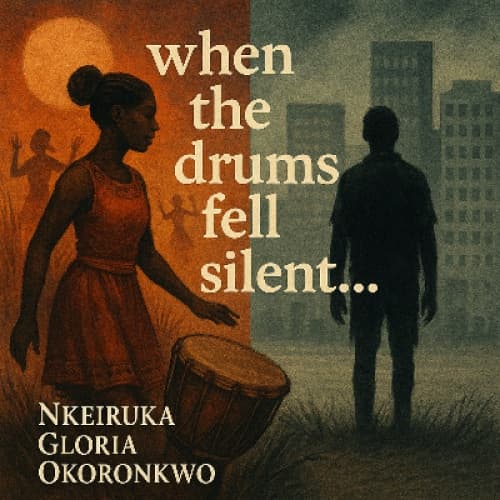
"I write this not because I have hope. I write because memory is all we have left."
My name is Anele, born of the red hills of Uruzi, daughter of soil and smoke, of music and mourning. They say we are one country now — Zalengwa, they call it — a name that means nothing in my mother’s tongue. But I remember what my grandmother told me, when the moon was a drum in the sky and the wind still smelled like millet and rain.
Before the strangers came, there were four lands: Uruzi, Makira, Senoba, and Ighatu. We were not perfect, no. But we were whole. We had our gods and our seasons, our harvest dances, our burial chants. We did not write things down — we remembered with our mouths and our feet. Every elder was a library, every child a blank page.
Then came the Ahloma — that’s what we called the strangers. Ahloma, meaning “those whose tongues twist like snakes.” They spoke a language none of us knew — a sharp, cold sound like clanging stones. At first, they brought shiny tools and colorful cloths. We traded yams for mirrors, palm oil for bottles that turned men into ghosts.
But what they truly came for was our land, and our gold, and our silence.
The Ahloma knew they could not conquer us with spears. So they used something worse — division.
They whispered into the ears of Makira that Senoba was hoarding the rivers. They told Ighatu that Uruzi thought itself better. They traded salt for secrets, gold for grudges. Soon, our drums no longer danced — they warned. Our fires no longer warmed — they burned.
Then one day, the Ahloma stood before us with a map they had drawn — a crooked thing with straight lines where rivers used to curve.
“You are now one,” they said. “One people. One nation. One flag.”
But how can four mothers share one name?
They called it Zalengwa, which meant stitched skin in their tongue. But the stitching never healed. The gods of Ighatu clashed with the sky-serpents of Senoba. Makira refused to share its dance grounds. Uruzi — my home — tried to keep its language alive, but slowly, our children forgot the songs.
I am seventeen now. I live in the city of Zimbele, where the roads shine but the eyes of the people do not.
Our sky is choked with drones, our markets echo with plastic voices. In school, they teach us the language of the Ahloma. They say our tongue is “uncivilized.” At night, my brother watches their shows, where women wear no wrappers and elders are mocked for their wisdom.
My grandmother still speaks in the old way, under her breath. When she thinks I’m asleep, she sings the Uruzi dirge — the one they used to sing for the dying. But now she sings it for the living, for those who have forgotten who they are.
Sometimes I wonder: what does it mean to belong to a people who no longer remember themselves?
I walk past mirrored buildings and see my face — brown, sharp, proud — and I think of the stories carved in our old drums. The ones they burned when they brought their churches, their factories, their screens.
We gained lights. We lost stars.
We gained roads. We lost paths.
We gained order. But we lost soul.
Last night, I dreamt of the old drums.
They stood in the center of Uruzi, tall and patient, their skins dark with time. I saw my grandmother dancing around them, her feet speaking the language of the earth. And for a moment, I believed the world was still ours.
But when I woke, the drums were gone.
Only the hum of machines filled the air, the hollow chatter of screens.
Even my own tongue felt strange in my mouth — like a song half-forgotten.
Maybe this is how a people die — not with war, but with forgetting.
The Ahloma never needed to break our bodies; they only needed to break our stories. And they did. Piece by piece. Until we could no longer remember what it meant to be us.
But I am Anele, daughter of Uruzi, granddaughter of the drums.
And I refuse to forget.
Tomorrow, I will sit with Grandmother.
I will ask her to tell me every story she knows — the names of our rivers, the colors of our old festivals, the songs they sang when the moon was full. I will write them all down.
I will learn our language again, even if I must learn it alone.
And maybe — just maybe — if I whisper them to my children one day, the drums will not be silent forever.
For a story never truly dies…
…as long as someone remembers to tell it.