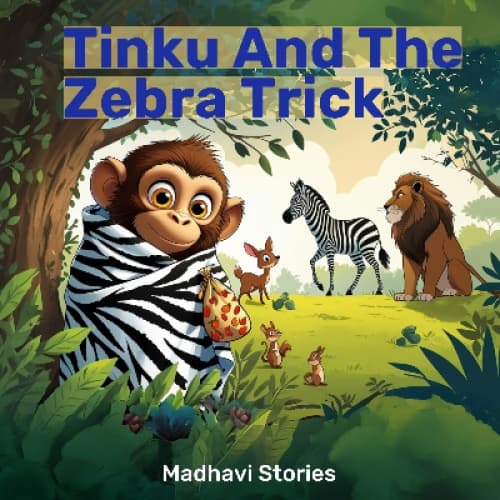
This story is about a monkey named Tinku who lived in a deep forest.
One night, Tinku couldn’t sleep properly. So, he went to his grandmother and said,
“Grandma, please tell me a story. I’ll listen to it and fall asleep.”
His grandmother began telling him a story. But within a minute, Tinku said,
“Grandma, you’ve already told me this story. Tell me a new one!”
She started another story. Again, Tinku interrupted,
“No, this story is too boring. Tell me something new!”
Every time she started, he stopped her and insisted on something fresh and exciting.
Tinku kept troubling her, saying,
“New story, new story!”
So, Grandma thought for a moment and looked up at the sky. She looked at the moon and the stars. She said,
“Nature is very mysterious, Tinku. We can never predict what might happen. I’m going to share something real that happened.”
Tinku became very curious and started listening intently.
“When I was a little girl,” she began,
“it rained continuously for several days in this forest. The whole forest was flooded. We couldn’t go anywhere for food. We had no drinking water. No food. We starved. Couldn’t sleep either. We were just waiting for the day the forest would return to normal so we could survive.”
“Is that really true?” Tinku asked.
“Yes,” Grandma said. “And I’ll tell you something completely opposite. Listen.”
“There was also a time of drought in the forest. During the drought, not a single drop of water was available. We had to walk very far to find water. All the rivers and ponds here dried up. Even the trees and plants suffered. So, we didn’t have proper food either. Again, we lived in hunger.
Once there was so much water, we couldn’t drink it. Another time, there was no water at all. That’s why I’m telling you — nature is mysterious. We can never predict what might happen. So, we must always be prepared,” said Grandma.
Hearing this, Tinku was amazed. That night, he couldn’t sleep. He kept thinking about what Grandma had said.
“What if the forest floods again? Or if there’s another drought? Will we have to starve for days?” Tinku wondered.
Then he got an idea:
“From now on, I should store food!”
So, the next day, whenever Tinku found food, he ate only a little and stored the rest. He continued this for many days. As a result, fruits and vegetables began to rot in the area he lived in, and a foul smell started spreading.
Other monkeys started scolding him.
“Why are you wasting good food by storing it? Now it’s rotten and stinks!”
Tinku replied proudly,
“Grandma said one day this forest may face a flood or drought. We’ll have no food. We’ll starve. That’s why I’m storing food.”
Some monkeys laughed,
“You're thinking about a flood or drought that may or may not come? Look there — a lion! What if it eats you now? How will your stored food help you then?”
They all laughed loudly.
This mockery shocked Tinku.
“Does a lion eat monkeys?” he asked.
“If it’s hungry, it will eat anyone — even elephants,” said one monkey.
Tinku wasn’t upset by their teasing. He was only thinking:
“If the lion comes, how do I protect myself?”
So, he began observing the lion.
How does it hunt? How can I avoid being hunted?
He noticed the lion hunted deer easily — it even went after elephants. Tinku became frightened.
One day, he saw the lion target a lone zebra. The lion crept up and began chasing it. The zebra noticed and ran toward its herd. As soon as the lion chased, all the zebras ran together. The lion got confused and couldn’t identify the exact zebra.
The black-and-white stripes confused the lion. It couldn’t hunt that day and walked away.
Tinku was thrilled.
“Among all the animals, the zebra is the smartest. But how did it really escape?” he wondered.
Tinku wanted to know the secret. He began watching the lion closely.
Days later, the lion again targeted a zebra. Tinku followed. The zebra ran into its herd. The lion chased, and Tinku followed.
Though Tinku knew which zebra was being targeted, even he got confused.
That’s when it clicked:
“It’s the black-and-white stripes! If I had stripes like that, I could escape too!”
But where would he get those stripes?
One day, a wildlife photographer came to the forest. He clicked pictures of all the animals — even the lion.
Tinku noticed the lion never attacked the man.
“Why?” he thought.
Later, when the photographer left for another area, Tinku sneaked into the tent. He found a piece of cloth with black-and-white zebra-like stripes.
“This is it!” he thought. “This cloth protected the man.”
Tinku took the cloth and never let go. He wrapped it around himself.
Other monkeys laughed.
“What? Are you a zebra now?”
But Tinku didn’t care.
“I’ll do anything to stay safe,” he said.
One day, while collecting fruits, Tinku heard the footsteps of the lion. He turned around and saw the lion staring directly at him.
Tinku panicked, dropped all the fruits, tightened the cloth around him, and ran!
The lion chased him. Tinku ran as fast as he could. But he tripped on a rock and fell into a puddle. The cloth got soaked and heavy.
The lion, meanwhile, had actually targeted a deer — not Tinku — so it continued chasing the deer and didn’t even notice Tinku in the puddle.
After a while, the lion stopped and wondered why Tinku had been running. So, it turned around and came back to find him.
Meanwhile, Tinku was overjoyed, thinking he had been saved because of the zebra-striped cloth.
But suddenly, he felt a hot breath behind him — and froze.
“Why were you running?” the lion asked.
Tinku replied, “You were chasing me to hunt me! That’s why I ran — to protect myself from you. This cloth saved me!”
He then proudly explained how he had been watching the lion closely and had learned that the zebra’s stripes confused it during a chase.
The lion was surprised.
“This cloth saved you?”
“Yes,” Tinku replied. “Just like zebra stripes confuse you, I thought this would do the same.”
The lion was impressed.
“I’ll make a deal,” the lion said.
“If you can prove this cloth saves you, I’ll never hunt you for the rest of your life.”
“Not just me,” said Tinku. “Don’t hunt any monkey from my tribe.”
“Agreed,” said the lion.
“Go stand among the zebras. I’ll roar and chase. If I can’t catch you, then the cloth really works — and I’ll keep my promise.”
Tinku was excited. He wore the cloth and joined the zebras.
The lion roared. The zebras ran. Tinku ran too. But the wet cloth slowed him down.
Tinku realized the lion was closing in.
“Even if I get caught, let my tribe be safe,” he thought.
He threw away the cloth, ran fast, and climbed a tree.
The lion couldn’t catch him.
“You won,” said the lion. “But you removed the cloth.”
Tinku explained,
“The cloth slowed me down. It got heavy when wet. But I only wanted to save my tribe. That’s why I dropped it.”
The lion was moved.
“I’ll still keep my word,” it said.
“You have something special — the ability to think fast. That’s your uniqueness.”
The lion continued,
“Each creature has a unique skill. Zebras have stripes. Monkeys can leap between trees. You have sharp thinking. That saved you.”
Tinku bowed his head.
“Forgive me. I thought I needed zebra skin to survive. I was scared because my friends asked what I’d do if the lion hunted me.”
The lion said,
“Your idea was right, but the way you used it was wrong.”
“Where did all this fear come from?” the lion asked.
Tinku replied,
“From my grandmother’s story. She told me about the flood and the drought — how they suffered without food or sleep. That’s why I started storing food.”
The lion said,
“You heard only half the story. The rest was told by my father.”
He explained how during the flood and drought, all animals in the forest shared their food and shelter and stayed united.
“No matter what disaster comes, we’ll face it together. What you started — storing food — is a smart idea. We’ll all follow that.”
All animals cheered and praised Tinku.
Tinku asked,
“But what about water?”
The lion replied,
“Good question! In my cave, there’s a spring that never dries. It was formed by lightning. Since sunlight doesn’t reach there, it won’t evaporate.”
“We’ll continue your idea,” said the lion.
The monkeys asked,
“But fruits and vegetables spoil. What should we do?”
The lion answered,
“We’ll eat overripe ones first and replace old food daily. That way, we’ll always be ready.”
Everyone was happy. The lion praised Tinku again,
“No one thought of this before. You did. You started a great idea!”
Moral:
Natural disasters can strike anytime, anywhere — flood, storm, tsunami, earthquake, drought.
We can’t always be completely prepared for everything, but we should at least be partially ready.
The idea of storing food is a good one. If we store it properly and wisely, it can be a great help during times of disaster.
In fact, some foreign countries still follow this practice. Whether it’s areas frequently hit by tornadoes, or regions that often face earthquakes or tsunamis, people there store food in advance and make sure they have a safe shelter arranged.
In our country, this habit is very rare. It’s only when there’s a sudden announcement like heavy rains, or if it rains continuously for a week, that we rush to the shops. Suddenly, stores get fully crowded. We try to buy everything and stock up — only at that moment do we think about it.
But the sad part is — in that rush, we forget that others, including children, also need food. Our concern for others reduces in such situations.
So instead of panic-buying during a disaster, it's better to slowly and mindfully collect and store food in advance.
Even ants do this! During monsoon season, ants don’t come out. Why? Because they store all the food they’ll need during the sunny days before the rain starts.
We should do the same.
But that doesn't mean we should live in fear of a danger that hasn’t even come yet. Just like the lion said — when a threat actually comes, our body and our intelligence will naturally work together to protect us.
That’s a natural instinct, not just in animals, but in humans too.
We must recognize that — and live mindfully.
Instead of living in fear like Tinku did — worrying “what if this happens, what if that happens” — we should enjoy the present happily.
The fear of the future can destroy the joy of the present.
So always stay happy.
Let your fears lead to clarity and ideas, not become obstacles.
Let ideas blossom from fear, not foolishness.