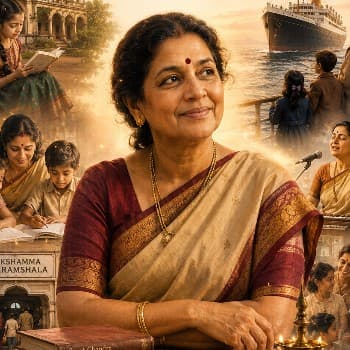

Lakshamma was the sixth of the many siblings born into the illustrious Reddy Zamindar family of Pallikonda, in the erstwhile Andhra Pradesh. The year was 1932, a time when their family stood unrivalled in wealth, land, and influence. Their ancestral home, more a small kingdom than a residence, overflowed with life. Uncles and aunties, mamas and mamis, cousins of every age, all lived under one sprawling roof. Counting only blood relatives, the household numbered forty‑two, not including the servants who moved silently through its long corridors.
At the heart of this mansion lay its most striking feature: a sixty‑foot corridor stretching from the inner courtyard to the grand main door. Suspended in the very centre of the Darbar hall was a majestic wooden swing, reserved exclusively for the family patriarch, Sreerammurthy. It was his throne. Except for his bath, meals, and a brief afternoon siesta, he spent nearly every waking hour on that swing, listening, observing, and commanding.
From this seat, he received updates on the vast fields the family had owned for generations, fifty‑one katas of fertile land, abundant enough to grow every edible imaginable. The estate produced more than the family could ever consume, supporting not just their household but a thriving agricultural business of storage and trade. In truth, no one in the family ever needed to work. Many didn’t. Studies were optional, discipline was not.
For in this zamindari household, hierarchy was absolute. Every decision, big or small, flowed from one man. Sreerammurthy’s word was final. Period.
Sreerammurthy was qualified lawyer and had then a degree B.A.B.L. During British India, law was taught as a three‑year professional degree after a B.A., and many universities (Madras, Bombay, Calcutta, Allahabad) offered the B.A.B.L. integrated route. Thereby he was eligible to practice as a lawyer. In the entire house then he had the highest degree and the entire neighbourhood revered for his qualification. When he used to get into his Morris Minor, people used stand as a sign of respect when the car passed by and was heading to the court. One fine day he stopped practicing to everyone’s surprise. Later it is said he quit when he lost a case on unethical grounds which hurt him deeply.
Lakshamma was her grandfather’s cherished granddaughter, the one who held a special corner of his heart. He admired her for her all‑round abilities, her athletic spirit, her melodious singing, her steady performance in studies, a rare blend of grace and grit that set her apart from the rest.
One morning, before Lakshamma could even finish her schooling, her mother quietly told her that her grandfather had chosen a groom for her and that the marriage would take place soon. Her mother was overjoyed, but Lakshamma felt the ground slip beneath her feet. How could she be married off before completing her studies, before even finishing school?
Lakshamma was the only one in the family who dared to debate with her grandfather. Their conversations often began as healthy discussions and sometimes escalated into loud arguments, but in the end, his word was law. She would eventually yield, though never without telling him, boldly, “Grandpa, you lost this argument.” And deep inside, he knew she was right, but he never admitted it.
That day too, she walked straight into the main Darbar hall, where her grandfather sat surrounded by senior men of the family, and confronted him without hesitation. “Grandpa, I want to study more. I want to stand on my own feet. I don’t want to live like a parasite. Why are you doing this to me? I am not getting married. Not at any cost.”
Before her words could settle in the room, her father, Subbaiah, sprang up and slapped her across the face.
“How dare you question your grandfather’s decision, something even we wouldn’t dream of doing?” he thundered. Turning to her mother, he ordered, “Padma, take her away. Teach her how to speak to elders. People in her future home shouldn’t point fingers at our upbringing. Half of Andhra knows our name. Make sure she learns her manners.”
Padma pulled a resisting, heartbroken Lakshamma out of the Darbar hall, her protests echoing behind her.
That night, Lakshamma slipped quietly into her grandfather’s room. He lay awake, staring at the motionless fan above him. . Her mother had already told her he hadn’t eaten a morsel all day. She sat beside him gently, her fingers moving through his hair like a calming comb, the same gesture she used whenever she “lost” an argument with him, which in truth was usually a victory he never admitted.
“Grandpa,” she whispered, “why are girls treated like a burden? Why is everyone in such a hurry to get rid of her?”
His eyes softened instantly. Tears gathered, slipped from the corners, and traced slow lines down his cheeks. He didn’t speak, perhaps he couldn’t.
Laksh’s voice trembled as she continued, “I can never hurt you, Grandpa. If you want me to marry, I will. Whoever you choose… I will agree.” Her words broke into sobs.
She rose to leave, but he caught her hand, pulled her close, and held her tightly. The man who never bent before anyone broke down in her arms, crying without restraint.
“I’m sorry, my child… forgive me,” he whispered, his voice shaking.
In that moment, Lakshamma felt something inside her shift. For the first time, she saw her grandfather not as the unshakeable patriarch, but as a man crushed under society’s rigid expectations. And with that realisation came a quiet ache, a small piece of the respect she had always held for him slipped away.
Lakshamma was never the same again in the Reddy household. The girl whose presence once filled the home with laughter, mischief, and an effortless flamboyance seemed to dim overnight. She had been the spark that even made the elders loosen up, even when her grandfather was around. But now, all of that, her brightness, her ease, her infectious energy, vanished like a flash of light snuffed out too soon.
On the day of her marriage, Lakshamma saw the groom for the very first time, a young, strikingly handsome man. For a moment, she felt undeserving, painfully aware of her own plainness. All she could do was pray silently to her favourite God, hoping he would be a kind man who would take care of her.
When the time came for her departure, she surprised everyone, she did not shed a single tear. The rest of the household, however, was inconsolable. There wasn’t a soul who wasn’t crying: her siblings, her parents, and even her grandfather, the man who had always been the family’s pillar.
She took blessings from all the elders, one by one. Finally, she approached her grandfather. As she bent down to touch his feet, he gently stopped her hands, guided them away, and pulled her into a tight embrace. That was the moment Lakshamma broke, the tears she had held back all morning finally spilled.
Deep within, she understood why he hadn’t allowed her to touch his feet. It was his silent way of admitting the mistake he could never voice aloud.
Lakshamma had actually moved to another state, a place where the local language sounded foreign to her ears and made her feel like an outsider in her own country. For someone who blended effortlessly with people, this sudden linguistic barrier felt unsettling. Thankfully, her husband’s family spoke the same dialect she did, and that small familiarity softened the transition.
To her relief, the household resembled her own: a joint family, warm, affectionate, and welcoming, though far smaller in number. From the very first day, she felt their kindness. Yet, just as in her childhood home, the final authority rested with the head of the family, whose decisions were unquestionable. Lakshamma sensed that this could one day create friction, but she told herself she would deal with it when the moment arrived.
Before she left, her parents and grandfather had repeatedly warned her not to be stubborn or argumentative the way she often was at home. But deep within, Lakshamma knew her own nature, if something felt illogical or unjust, she believed it deserved to be spoken aloud. And she would voice it, no matter whose house she lived in.
From childhood, Lakshamma had been a voracious reader, devouring books across genres, all in her mother tongue. Through those pages she grew familiar with the great Bengali minds: Sarat Chandra, Bankim Chandra, even the teachings of Ramakrishna Paramahamsa. Back in her ancestral home, their spiritual guide had been Haranath Banerjee of Sonamukhi in Bankura district, West Bengal. Looking back, it almost felt as if destiny had been quietly preparing her all along, shaping her through stories, through philosophy, through unseen threads, so that one day she would find herself married and living in the very land where those voices were born, the erstwhile Calcutta.
Lakshamma’s curiosity and eagerness to belong were unmistakable. From the moment she arrived, she threw herself into learning Bengali, determined not to remain an outsider. She picked up the language with surprising fluency, enough to join the neighbourhood women in their conversations and laughter. Much later, she told her son how she would write Bengali words in her own mother tongue and practise them again and again until they flowed naturally from her tongue. That was her way, she would rather work hard to be included than quietly accept being excluded.
Her devotion to music deepened this journey. A Meera Bhakt at heart, she often sang Hindi bhajans, painstakingly writing each word in her mother tongue so she could memorise them perfectly. Music was the one realm where she never hesitated to stretch herself, whether the song was in Bengali, Hindi, Telugu, or Tamil, if it carried melody, especially with a classical soul, she embraced it wholeheartedly.
Slowly, her voice became her identity in this new land. Her singing drew people to her, opened doors, and softened distances. She began gaining quiet popularity, the kind that grows from sincerity and talent. True to her steadfast ‘Goat’ nature, she became a familiar presence at Chaitanya Math and at auspicious gatherings in the homes of friends who had come to love her voice and her spirit.
In the 1940s and 50s, postcards and inland letters were the only lifeline between families. Lakshamma’s parents wrote to her regularly, asking about her wellbeing, though, more often than not, their real focus was on her behaviour, which they considered more important than anything else.
But it was her grandfather’s letters that truly delighted her. His messages were never about discipline or conduct; instead, they opened windows into the world. He wrote to her about spirituality, recommended novels, shared his thoughts on authors whose works both of them had read, and even suggested songs she might have missed. Every letter carried something to learn, something to reflect upon.
Lakshamma treasured those letters. She preserved them carefully, reading them again and again, for they came every two or three months like a gentle reminder of the bond they shared. Her grandfather never once questioned her behaviour, such was his confidence in her and she cherished him all the more for it.
One day, a telegram arrived with just three devastating words: “Grandpa has expired.” In those days, telegrams were sent only when sorrow had to be conveyed urgently, and receiving one felt like being struck by a bullet. Lakshamma stood frozen at the doorstep where the postman had handed it over, unable to believe what her eyes were reading.
Her sister‑in‑law, sensing something terribly wrong, rushed toward her. The moment Lakshamma saw her, she collapsed into her arms, crying uncontrollably. Telegrams carried a weight that pierced straight through the heart, families were close‑knit then, and when a marriage took place, it wasn’t just two individuals who united, but two entire families.
So, the news of her grandfather’s passing didn’t shake only her parental home; it rippled through her in‑laws’ household as well. Such was the depth of the bond he had created, the respect he commanded, and the affection he had earned on both sides.
As per custom, the elder brother‑in‑law, the one who oversaw all major decisions in the household, decided that both Lakshamma and her husband, Ram, should fly home to attend the funeral. At first, Lakshamma resisted; the thought of seeing her grandfather in that condition was unbearable. But the entire family insisted. They reminded her that it would not look appropriate if she didn’t go, given societal expectations, and more importantly, that she had been his favourite, his soul would find peace if she were present.
Lakshamma finally surrendered to their insistence and agreed to travel, though her heart was heavy. Deep inside, she wished she could remember her grandfather as he had been, strong, affectionate, unbroken, not as a body lying still. Yet she knew she had no choice but to go.
The flight felt endless. It was Lakshamma’s first time on an airplane, yet she never once felt the thrill of flying. She didn’t look out of the window even for a moment. She could hear children squealing with excitement, women pointing at clouds and commenting on the view, but for her, this journey had no wonder, only weight. She sat in complete silence, fingers tightly gripping the end of her saree, eyes closed, her mind refusing to accept the words written on the telegram. Ram sat beside her, calm and steady, knowing that nothing he said could soften the storm raging inside her.
When they finally reached her parental home, the familiar gate, once a symbol of childhood laughter and warmth, looked strangely distant, as if it belonged to another lifetime. Relatives stood gathered in the courtyard, their faces swollen from crying. The moment they saw her, a hush fell over the space. Someone whispered, “Laksh has come,” and the crowd parted instinctively, creating a path for her.
Her mother rushed forward first, breaking into fresh sobs as she held Lakshamma tightly. Her siblings followed, each touch, each cry, making the reality heavier. But Lakshamma’s eyes searched for only one thing, the room where her grandfather lay.
Her feet moved on their own, slow, and trembling. The house that once echoed with his voice now felt unbearably still. As she approached the inner room, the smell of incense and ghee lamps filled the air. A few elderly men sat chanting softly. The white cloth, the flowers, the silence, everything blurred before her.
And then she saw him.
Her grandfather lay there, serene, his face calm, almost as if he were in a deep, peaceful sleep. But the stillness, the absolute stillness, shattered her. Lakshamma froze at the doorway, her breath caught in her throat. For a moment, she couldn’t move. She couldn’t cry. She couldn’t even think.
Then something inside her broke.
She fell to her knees beside him, her hands trembling as she touched his feet, the very feet he had once stopped her from touching out of love and guilt. Now, there was no hand to lift hers away, no gentle voice to tease her, no wise eyes to reassure her.
Her wail rose from a place so deep that the entire house felt it. Women rushed to her, trying to hold her, but she clung to the edge of the bier, sobbing as if her heart had been torn open.
All the memories, his letters, his advice, his affection, his unwavering faith in her, came flooding back in a single, unbearable wave.
Her grandfather, the man who had shaped her mind, her values, her love for literature and music, was gone.
And in that moment, Lakshamma felt a part of herself go with him.
Once the rituals were over and the day arrived for Lakshamma and Ram to return, her Chinna Tataiah, her grandfather’s younger brother, asked everyone to gather. Since Lakshamma was the only one who lived away from the hometown while all others had settled nearby, the moment carried a certain significance.
He announced that their lawyer would read out the will left behind by their beloved elder brother. As expected, the room grew tense. Eyes shifted, expectations rose, everyone wondered what share of the substantial property might come their way. Everyone except Lakshamma.
The lawyer took nearly thirty minutes to read the long, detailed will. When he finally finished, all eyes turned toward Lakshamma, she had received the lion’s share. It wasn’t a surprise; most had anticipated it.
But while the room watched her, Lakshamma looked only at her husband. After fifteen years of marriage, their understanding was so deep that a single glance conveyed everything. She rose and addressed the gathering.
She requested that her entire inheritance be used to build a Dharamshala near their temple, a place capable of accommodating at least a thousand devotees, offering free food and free stay during the three sacred days when lakhs of pilgrims arrived to offer prayers, a tradition that had endured for over a century.
She added that for the rest of the year, the Dharamshala could be used for cultural events, marriages, and community gatherings. The revenue earned from these activities would help sustain the facility and fund future benevolent initiatives. “I want my grandpa’s name to be remembered in every good moment,” she said softly.
She requested the lawyer to transfer the funds to her father, who would oversee the construction, while her Chinna Tataiah would guide the family in other responsibilities now that the elder pillar was gone.
A deep silence filled the room. Her husband smiled with quiet pride. Her parents and Chinna Tataiah nodded, moved by the maturity and vision of her decision. In that moment, they realised how much Lakshamma had grown, thinking not of herself, but of legacy, community, and the values her grandfather had instilled in her.
Lakshamma’s respect for her husband grew many times over. Though his income as a government servant was modest in those days, he never once spoke of financial strain, nor did he ever ask her for help. His quiet dignity, his refusal to burden her, and his innate magnanimity made her feel deeply proud to be his life partner, his true soulmate.
Lakshamma was the mother of two children, a daughter, Vasuda, and a son, Surya. She raised them with a mix of softness and strictness; in those days, strictness often meant physical discipline, and she was no exception. She ensured her daughter learnt Bharatanatyam, one of India’s oldest and most revered classical dance forms from the temples of Tamil Nadu. Her son, to her relief, turned out to be naturally good at studies, and as a result, escaped many of the scoldings and whacks his sister endured.
Though Lakshamma was a well‑read woman, when it came to parenting, she leaned more towards firmness than gentleness. Perhaps it was the unhealed ache of not completing her own education, or the constant pressure that middle‑class families carried, the belief that only good education could secure a dignified life. In trying to ensure her children never faced the limitations she did, she sometimes pushed too hard. At times, Vasuda openly rebelled, and Surya too, though quieter, carried his own unspoken feelings.
One fine day, Ram came home and mentioned to his elder brother that his office had offered him a deputation posting in London. The news struck Lakshamma like a bolt of lightning. After finally settling into a new state and city, she now had to uproot herself once more, this time to an entirely new country. It felt as though life had pushed her back to the starting line again. The cycle of learning and unlearning, adjusting, and readjusting, was about to begin all over.
Ram and his family were allotted passage by ship, a journey that typically took about twenty‑one days along the classic sea route from India to London via the Suez Canal. They departed from erstwhile Bombay, sailing northwest across the Arabian Sea, then entering the Gulf of Aden, the narrow stretch between Yemen and the Horn of Africa. From there, the ship travelled the entire length of the Red Sea before passing through the Suez Canal, that crucial link between Asia and Europe which saved weeks of travel by avoiding the long loop around the Cape of Good Hope.
After exiting Port Said, the ship crossed the Mediterranean, slipped through the Strait of Gibraltar between Spain and Morocco, and then moved into the Atlantic. From there, it sailed north along the European coastline, finally entering the English Channel and arriving at Tilbury Docks in London.
For Lakshamma and her children, it was an unforgettable experience, crossing seas, oceans, and the borders of many countries. But the journey was far from easy. When the ship rolled in rough waters, luggage slid from one end of the cabin to the other. Almost all passengers suffered bouts of nausea, barely able to eat for days when the rolling was at its worst. It was a test of endurance, but also an adventure they would remember for a lifetime.
In London, Lakshamma had to adapt quickly to the English way of living. Slowly, she gathered the courage to step out on her own, shop in the malls, and navigate a lifestyle completely different from what she had known. A great relief came from her neighbours, a Bengali family, whose warmth, and familiarity made her feel less alone. Even her children, who attended school in London, helped her adjust in small but meaningful ways.
During their stay, Lakshamma gave birth to a baby boy, Varun. For Vasuda and Surya, he became the centre of their world, their favourite companion the moment they returned from school.
But London also brought sorrow. News arrived that her mother had passed away after a prolonged illness. Lakshamma had no choice but to mourn from afar, unable to be by her mother’s side. Soon after, she received another blow, her beloved Chinna Tataiah too had left this world. Two losses in a single year.
Yet, before their passing, her father had completed the Dharamshala, a project that had become his full‑time responsibility. Managing bookings, finances, logistics, and ensuring the satisfaction of the countless devotees who visited had become his life’s mission. He had even involved a few of Lakshamma’s cousins to support him. Knowing that her grandfather’s money was being used for such a noble purpose brought Lakshamma immense comfort.
Then came a sudden crisis. Lakshamma was diagnosed with tuberculosis, a dreaded disease in those days and doctors insisted she needed immediate surgery. Her chances of survival were said to be less than ten percent. Without the operation, they gave her no more than six months to live.
Ram did not hesitate. He decided she must undergo the surgery and arranged the money by borrowing from friends and using his savings. Against all odds, Lakshamma survived. During her long recovery, Ram and the children took charge of everything, caring for the newborn, managing the house, cooking, handling school routines, and supporting her through every difficult moment.
It was as if the children suddenly grew up overnight, becoming responsible beyond their years. And Ram, juggling office, hospital visits, home, and a new baby, displayed a strength that words can barely capture. In a foreign land, without extended family, he held every thread together. Sometimes, it feels impossible to explain how the Almighty grants certain individuals the energy, determination, and grace to face such storms.
Truly, hats off to Ram.
Just when life in London seemed to be settling into a rhythm, little Varun began developing asthma. The doctors advised, wisely or unwisely, that a tropical climate would be better for him. Around the same time, Ram’s five‑year deputation was also coming to an end.
Like many Indians of that era, Ram could have resigned from his government job and taken up work in London itself. Opportunities were there, and the temptation was real. But Ram was a man of quiet principles. He did not want to live in a foreign land feeling like a second‑class citizen, nor did he want Varun’s health to deteriorate in the cold climate. With clarity and conviction, he decided the family would return to India.
Ram and Lakshamma returned to India with the comforting belief that coming back to their own country, their own people, would be the best decision for the family. But once they arrived, they slowly realised that the expectations waiting for them were vastly different from what they had imagined. Their relatives welcomed them warmly, yes, but beneath the warmth lay unspoken hopes, especially from Ram’s elder brother.
In those days, and even now, many Indians who went abroad were expected to return with substantial savings, enough to build a dream home, enjoy a more comfortable life, and often support extended family members through their financial struggles. Others were expected to settle permanently overseas, take up citizenship, and gradually bring relatives abroad to help them build new careers.
But none of this was possible for Ram. Every rupee he had saved during his years in London had been spent on Lakshamma’s treatment and recovery from tuberculosis. There was no surplus, no foreign wealth, no cushion to meet the expectations that awaited them.
They had returned with hope, but reality, shaped by circumstances beyond their control, was far more complex.
While Ram went to work each day, it was Lakshamma who had to bear the brunt of the household’s frustrations, most of which eventually circled back to finances. To the rest of the family, it felt as though they too were being forced to shoulder the burden, and the arrival of another baby boy only added to the expenses. Slowly, the pressure began to mount.
Lakshamma reached a point where she could no longer tolerate the constant snide remarks. She told Ram firmly that they needed to move out and live separately. She assured him that even if his income was modest, she would manage, but they had to escape the negativity that was eroding their peace.
Ram, too, had been silently absorbing the daily potshots aimed at Lakshamma. He understood her pain, and he knew the environment was becoming unhealthy. Realising that dignity mattered more than convenience, he agreed.
Lakshamma gathered all her courage to convey the decision, with Ram standing quietly beside her. There may have been an attempt to dissuade her, but she was in no state to listen to sermons or persuasion. And so, the first real split in the joint family took place.
Lakshamma made one thing noticeably clear to Ram: she would never stop him from visiting his family whenever he wished. But she herself would not step into that house again until she could prove to them and to herself that she could run her own home solely on her husband’s earnings.
Once again, it was a new place with new challenges. Interestingly, they became the first South Indian family ever to move into that locality. Although they managed to secure a good 2BHK flat, there was another reality they had to accept, just a short distance behind their building lay one of the largest slum clusters in Asia at the time. It added a layer of unease to their fresh start, making the transition even more demanding.
Laksh early in her life realized she is destined to a big struggle in her life, and she was prepared to face it mentally and physically.
One day, Lakshamma’s father called to say his health was failing and it was time to hand over the responsibility of the Dharamshala to someone in the family. She agreed immediately, the burden had become too heavy for him. She also knew that the cousins who had been helping him had not studied much and had limited opportunities. So, she gently told her father, “You pass the baton to them. I will come and complete all the legal formalities.” In her heart, she hoped the Dharamshala would become a source of livelihood for them, a way to support their families with dignity.
During the summer vacation, she travelled with her children to her hometown. The cousins were moved to tears when she completed the legal transfer, entrusting the Dharamshala to them and asking only one thing, that they run it well, so her grandfather’s soul would remain at peace.
It was as if her father had been waiting just to see his daughter. Soon, he passed away quietly in his sleep. Lakshamma sat beside him in silence, thanking God for taking him gently to a better place.
Her father had often told her how her brothers and sisters were constantly fighting, wanting to divide the large ancestral house and live separately. Some were even envious of Lakshamma, believing that after her father’s time, they too would receive a share of the Dharamshala, which did not happen. The two cousins she legally empowered were the same unfortunate boys who had lost both parents in a road accident when they were young.
After completing everything, Lakshamma left with her children without any bitterness. She knew, deep within, that her home would never feel the same again if she ever returned.
Lakshamma took up a job in a school. She believed that instead of complaining, it was better to contribute. For six to seven years, she worked diligently and even conducted tuitions at home to supplement the family income. She was never the kind of woman who surrendered to destiny. If anything, she believed in challenging it, in finding ways to reshape her circumstances rather than accept them passively.
Ironically, the very house where Ram’s elder brother and younger brother lived also ended up shifting to the same locality where Ram and Lakshamma had moved. Their landlord had issued a notice to vacate, as his elder son was returning from abroad permanently and needed the house.
With time, all the old hurts began to heal. And although the families now lived in separate homes, they came together for almost every occasion, birthdays, festivals, auspicious days, lazy Sundays, or even simple evening gatherings. The distance between the houses did not create distance in the relationships; in fact, every get‑together slowly stitched the family back into a circle of warmth and belonging.
Lakshamma gradually came to play a pivotal role in the family, to the point where decisions often stopped with her. It marked a significant shift from the earlier tradition, where the seniormost male member had the final say. Instead, choices now gravitated toward the person who was more rational (though not always), more trusted, and more capable of bringing everyone onto the same page. That person happened to be Lakshamma.
The rigid hierarchy of a single male head approving every decision slowly began to soften. What emerged instead was a more inclusive way of taking decisions, a sign that the family was opening up, evolving, and learning to value collective wisdom over inherited authority.
Lakshamma, having seen her sons and daughter got married, was well prepared for taking care of her Grandsons and Granddaughters. Her energy levels were at the peak when she got the opportunity to nurture them. Perhaps more than her physical strength the mental strength and sheer love for the next generation to be cared made her tick. Undoubtedly all grandsons and daughters who called her “Avva” was their go to person. Another immense quality where she could easily get into the shoes of 1 year to 100 years person with ease. Such was her communication skills and flexibility and there were so many topics she could talk on / debate being a well-read person. She used to contribute to the Telugu magazine released every month on behalf of their Gurudev Harnath Baba.
Lakshamma slowly began to notice that Ram’s health was slipping. The spasms caused by his weakening lungs were becoming more frequent, slowing him down in ways she had never seen before. This was not the Ram she knew, the man who was always active, who stepped out every single day, whether to the club to meet friends, to the market, the bank, to file IT papers, or simply for the joy of going out. Now, even a few steps triggered breathlessness.
One evening, during what was meant to be a routine check‑up, Ram collapsed. In that moment, the quiet assumption Lakshamma had carried all her life, that her husband would always be there, shattered. The man who had been her unconditional support for decades was suddenly not beside her. The one who absorbed her frustrations, the one she confided in, the one whose advice she sought for every small and big matter was gone. A void opened inside her, one she had never imagined would arrive so soon.
Yet, there was one small consolation: he did not suffer for long. God took him away gently.
Ram’s life had been marked by a rare calmness. He never fought with anyone, not even with Lakshamma’s family members. His composure was his signature. And he carried himself with a quiet dignity: always smartly dressed, always clean, always looking fresh, no matter the circumstances. That was Ram, simple, steady, graceful, and deeply loved.
It took Lakshamma sometime before she could step out in public again after losing her husband. But the woman of grit that she was, practical, steady, and inwardly strong, slowly began to rebuild a new rhythm for herself. In time, she embraced a fresh lease of life. She witnessed the weddings of all her grandsons and her granddaughter and even welcomed with same love and ecstasy her great‑grandsons and great‑granddaughters into the world. Her life, continued to expand with new joys and new generations.
Lakshamma divided her time between the homes of her elder and younger sons, and her daughters‑in‑law cared for her with the affection and tenderness one reserves for a mother. With age, Lakshamma began facing her share of health challenges. Yet, in one remarkable instance, she recovered from a serious condition, a recovery that even surprised the medical fraternity.
One evening, just a day before Christmas, her thoughts were entirely with her favourite granddaughter, who had been unwell. She kept checking on her repeatedly, each time receiving the same gentle reassurance that she was feeling better. Later that night, after watching a movie, one of the many small interests that kept her engaged, she decided to retire for the day. She said softly, “Good night, children,” and went to sleep.
That night became her last in this world. Lakshamma slipped away quietly, leaving behind a lifetime of love, strength, and memories. Once again, she moved to a new place, but this time, it was God’s own home, where peace would surely embrace her.
Lakshamma’s journey was not merely long, it was full. Full of storms she faced head‑on, full of responsibilities she carried without complaint, full of people she held together with nothing more than her love, her grit, and that unmistakable spark in her eyes. She had a maturity far beyond her years, the kind that made even elders pause and listen. And yet, she carried that wisdom with a lightness that made people laugh. Her humour being one liner, it was the kind that slipped in quietly, like a breeze, and suddenly the whole room felt lighter.
People often wondered how one woman could be so practical and yet so full of mischief. But that was Lakshamma, a rare blend of sense and glitter.
Her affection was legendary. She loved with a largeness that left no one out, siblings, cousins, in‑laws, neighbours, and especially her grandchildren, who adored her with a reverence usually reserved for special individuals. To them, she was not just a grandmother; she was a universe of stories, songs, warmth, and that special brand of humour that only she possessed.
Of course, she made mistakes, who doesn’t? To err is human, and she was beautifully human. But when weighed against the decades of service she gave her family, the sacrifices she made silently, the dignity she upheld through every hardship, and the love she poured into every relationship, those errors can be ignored.
What is worth remembering is the woman she was.
A woman who stood tall even when life tried to bend her. A woman who left behind not wealth, but something far greater — legacy.
When she said “Good night, children” on that final evening, she didn’t just end a day. She closed a chapter of grace, courage, humour, and boundless affection. And somewhere, one feels she must have walked into God’s home with the same quiet confidence with which she walked into every new place in her life, ready to learn, ready to love, ready to belong.
Lakshamma will be remembered not for the years she lived, but for the life she filled into those years. Not for the hardships she faced, but for the dignity with which she rose above them. Not for the mistakes she made, but for the countless hearts she healed, held, and shaped.
She will be remembered forever, with love, with laughter, and with the deepest affection.