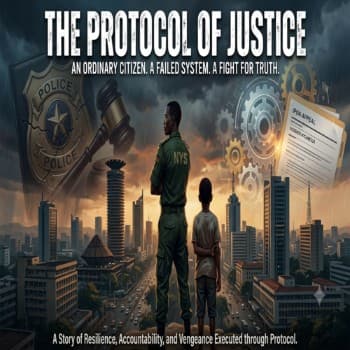

Act I: The Arrival
The bus from the village hissed to a halt at the chaotic Machakos Station in Nairobi. I stepped out into the exhaust fumes and the deafening roar of hawkers, clutching my small bag. My name is Geophrey, a mere citizen who had recently completed my rigorous National Youth Service (NYS) training. Back home, getting a job wasn't just a daily hustle; it was a distant, untouchable dream.
Seeing my struggle, my sister Winnie, who worked tirelessly as a teacher at a local private school, had called me a week prior. “Geophrey, come up to the city,” she had urged over the phone. “Come taste the town, at least you can network and find some connections here.”
When I arrived at her modest house, the welcome was warm. Winnie met me at the door, her face lined with the exhaustion of a school teacher but bright with relief.
"You made it safely, Geophrey," Winnie said, taking my bag. "Nairobi is fast, but there is always a way for someone with discipline."
"Thank you, siz," I replied, sitting down. "The village was stretching me. I am ready to look for any opening."
Suddenly, an energetic eleven-year-old boy burst into the sitting room, a wide grin on his face. This was Junior, Winnie’s son. He was incredibly charming and absolutely loved visitors, especially his uncles.
"Uncle Geophrey!" Junior shouted, running up to give me a high-five. "You are finally here! Tomorrow I am going to tour you around the town. I know all the shortcuts."
Winnie laughed, shaking her head. "Junior, let your uncle rest first. And remember what I told you about the estate—watch the company you keep. Some of those boys by the field are toxic."
"Ah, Mom, they are just my football friends," Junior insisted, brushing it off with a smile.
Act II: The Playground Clash
The next evening, the air was cool as Junior led me through the estate. True to his word, he was a proud tour guide, pointing out the shops and introducing me to neighbours. Soon, we neared an open dirt field where a group of boys were playing football.
Junior’s eyes lit up. "Uncle, they are playing! Can I join them for a few minutes?"
"Go ahead, Junior," I said, leaning against a wooden post on the sidelines. "I'll watch from here."
He eagerly ran onto the pitch. For the first twenty minutes, it was a normal game. But then, the atmosphere shifted. I could see the boys clustering together, voices rising. An argument had broken out, though from where I stood, I couldn't hear the words.
Suddenly, the shouting stopped, replaced by a terrifying explosion of violence. Boom.
Before I could even comprehend what was happening, three bigger boys set upon Junior, viciously beating him to the ground. My heart hammered violently against my ribs. Adrenaline surged through my veins, and my NYS training immediately took over. I sprinted across the dust of the field.
When I reached him, the attackers tried to scatter. Using tactical restraint and sheer speed, I managed to corner and physically secure the main boys who had initiated the attack. But when I looked down at Junior, my blood ran cold. He wasn't just bruised; he was lying there, gasping, beaten almost to death.
Act III: The Shocking News
With the boys restrained by the gathering crowd, I lifted Junior’s fragile body and rushed him to the nearest hospital. My hands were trembling as I dialled Winnie's number.
"Winnie, get to the hospital near the estate right now," I breathed into the phone, trying to control my panic. "Junior has been badly assaulted."
Because it was the weekend, Winnie dropped everything and arrived within minutes. She burst into the casualty ward, her eyes wide with terror, only to find her vibrant son lying on a metal bed, restless, sweating, and writhing in agony.
"What happened to my baby?!" Winnie cried, sobbing as she held his hand. "Junior, look at me!"
A doctor stepped between us, his expression grim. "Please, step outside into the waiting area. We need to perform an immediate, thorough examination."
The wait felt like an eternity. Finally, the doctor emerged, holding a clipboard, his face pale. He looked at Winnie, then at me.
"Are you his mother?" the doctor asked quietly.
"Yes, please tell me he's going to be okay," Winnie pleaded.
"Madam... this wasn't just a beating," the doctor said, dropping his voice. "Our examination reveals a shocking truth. Your son has been shot. There is a bullet lodged inside him, and his internal organs are at severe risk. We need to operate immediately."
Winnie collapsed into a chair, crying out in disbelief. A gunshot? From an eleven-year-old’s football match? The nightmare had officially begun.
Act IV: The Protocol
The next morning, while Junior was in surgery, we found out the truth about the boys I had captured. They came from an incredibly wealthy, influential family. The boy who pulled the trigger was the son of a high-ranking police officer; the child had taken his father's real service weapon, mistaking it for a toy gun during the argument. Winnie was just a private school teacher. Going against people with deep pockets and government badges was going to be pure hell.
But we had to follow the criteria. We went straight to the local police station to file the official report and obtain a P3 form.
Inside the cold, stark station, the desk officer listened indifferently as I explained the shooting.
"Do you know these boys?" the officer asked, tapping his pen. "You can't just make wild accusations about firearms."
"I have proof," I said firmly. I pulled out my phone and pulled up the photographs I had taken of the boys on the field.
The officer leaned over the desk to look at the screen. Instantly, his pen stopped. The colour drained from his face, and his demeanour turned completely rigid. He looked around nervously, then leaned in close, whispering in a tense, warning tone.
"Young man... do you know whose children these are? Are you sure you know what you are dealing with here? Drop this matter if you love your family."
I did not flinch. Drawing myself up to my full height, I replied in a dark, deep, unyielding voice:
"We are just following the criteria, Officer. We write the statement here. The court will nullify the rest."
Realising my discipline wouldn't break, the officer reluctantly began typing the report, his hands stiff with anxiety. As we gathered our copies and turned to leave the station, I caught the officer picking up his landline phone. I paused near the door, hearing his frantic, hushed words pierce the quiet corridor:
"Sir... your son did it again. Yes, the teacher's family. What are we going to do?"
The system was actively protecting a repeat offender.
Act V: The Rigged Court and The Scar
The weeks that followed were filled with terror. Members of the officer's family cornered Winnie outside her school, delivering blunt threats: “Withdraw the case, or we will wipe your entire family off the map.” But we pushed forward, refusing to be silenced, until we finally stood in the courtroom.
The session was a messy, heartbreaking circus. The wealthy family’s expensive lawyers twisted the facts effortlessly. They bought off witnesses, manipulated the evidence, and painted Junior as a reckless, aggressive delinquent who had caused the incident himself.
The judge banged his gavel, delivering a ruling that felt like a dagger to our hearts: Case dismissed due to lack of standard evidence. Furthermore, the court ordered us to pay damages to the officer's family for defamation and legal costs.
When we got back to the hospital, Junior had finally been cleared to go home. He survived, but the physical side effects and the deep, jagged entry scar on his torso would be a permanent reminder of the day the law betrayed him.
Winnie was weeping silently at the foot of the bed. Junior looked up at me, his eyes losing their childhood charm, replaced by a cold, heavy sadness.
"Uncle Geophrey," he whispered, pulling me close. "They lied. The police lied, the judge lied. I only want one favour from you. Give me revenge for justice."
I looked at my nephew's scar, then thought of my NYS oath to protect and uphold order. If I used violence, the system would gladly lock me away and leave Winnie completely vulnerable. I had to risk everything, but I had to fight them using a strategy they couldn't bribe or shoot their way out of.
Act VI: The Audit
I bypassed the local precinct and the corrupt municipal court entirely. Using the rigorous, methodical record-keeping I was taught in the service, I compiled an airtight, ironclad dossier. I included Junior’s unalterable medical bullet reports, the certified timeline of the station visit, and a hidden audio recording of the desk officer’s panicked phone call admitting “Your son did it again.”
Instead of going back to the local authorities, I escalated the entire file to the national headquarters, launching a formal appeal directly through the Independent Policing Oversight Authority (IPOA) and national internal affairs divisions. I laid out the case like a tactical operation, bypassing their regional network completely.
Two weeks later, high-level federal investigators descended on the local station without warning. Faced with an unbribable federal audit and the raw audio recording, the desk officer cracked under interrogation, confessing to the entire cover-up.
The web collapsed with terrifying speed. The local judge was placed under an immediate corruption investigation, and the high-ranking police officer was officially suspended, stripped of his badge, and indicted on criminal charges of gross negligence, official misconduct, and illegal firearm concealment. Their wealthy allies vanished into thin air the moment the national spotlight grew too hot.
On the day the officer’s dishonourable dismissal was made public, I stood outside the regional police headquarters. I watched as the man walked out of the gates, civilian clothes hanging loosely on him, completely stripped of the uniform that once made him a god.
He noticed me standing there, tall and disciplined. He stopped, his face hollowed by defeat.
"You thought your rank and your pockets made you untouchable," I told him, my voice steady, cutting through the afternoon noise. "But discipline, protocol, and the truth are things you can never buy. Now, go home, and finally teach your child how to be a citizen."
He couldn't even look me in the eye. He just walked away into the crowd.
I returned to our house that evening and sat on the edge of Junior’s bed, showing him the official oversight directive. The system had failed us at the bottom, but unwavering discipline had executed justice from the top.
"Your favour is paid, Junior," I said softly. "Justice wasn't given to us. It was executed."