Amir hadn’t prayed in years.
It wasn’t rebellion. Just routine. Success, pressure, and a hundred little distractions. As a corporate consultant in central London, every minute of his day was accounted for — except the ones meant for his soul.
Thursday began like any other. Coffee, calendar, calls.
Then the power cut happened.
The building blacked out. Meetings were canceled. Elevators stuck. Phones lost signal. It was almost comical.
With nothing else to do, Amir stepped outside into the gray chill of afternoon. His phone buzzed to life but offered no signal.
That’s when he saw it — something odd.
Across the street, squeezed between a boarded-up laundromat and a grimy barber shop, was a narrow building he’d never noticed before. No windows. Just a wooden sign with weathered gold paint:
“Community Prayer Room — All Welcome.”
He blinked.
This wasn’t on Google Maps. Not even in the city register. He would’ve known — he’d been on this street a hundred times.
Drawn by curiosity more than faith, Amir crossed the road and entered.
The inside felt... strange. Not eerie, but still. Timeless.
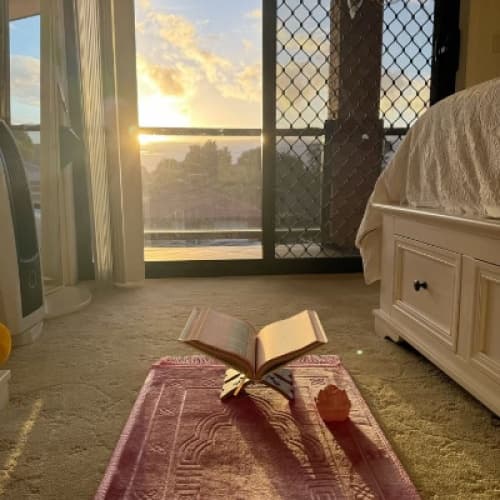
There were no fluorescent lights, no loud carpets or donation boxes. Just simple white walls, a worn prayer rug, and a bookshelf with a few old Qur’ans. One Arabic, one with English translation, and one... hand-written in ink.
In the far corner sat a man in his sixties. Pale beard, eyes closed, back straight.
He opened his eyes the moment Amir stepped in.
"You're welcome," he said, as if he had been expecting him.
Amir hesitated. "Is this... a mosque?"
The man smiled. "No. Not quite. Just a room for those who remember... or want to."
Before Amir could respond, the man stood up slowly and walked out, saying only:
“It’s not about where you are. It’s about where you stop pretending.”
Alone, Amir sat down on the carpet. He hadn’t come to pray. He didn’t even have wudu. But something about the silence here was different. It wasn’t empty. It was full — of questions he had avoided for years.
He looked at the bookshelf again. The hand-written Qur’an caught his eye.
He picked it up.
Inside the front cover was a note, in faded Urdu:
"For the one who runs the fastest, thinking he’ll outrun emptiness — this book is yours now. If you’re reading this, it means you’re already being pulled back."
He closed the book, his throat dry.
In that moment, he remembered something: this street used to be where his grandfather brought him as a boy. They’d buy bread from a bakery nearby. He hadn’t thought of that in twenty years.
Was this the same block?
Suddenly, the wooden floor creaked behind him. Another visitor?
No. No one there.
He stood, unsettled. Perhaps the place was playing tricks on him.
Before he left, he saw a second sign — tucked in a corner behind a prayer mat, dusty and half-covered:
“Not every door stays open forever. But mercy does.”
That night, Amir went home, still unsure what had happened. But for the first time in over a decade, he made wudu. Slowly. Like a man cleaning not just limbs, but layers.
He stood for prayer.
His voice cracked when he said Allahu Akbar. He barely finished two rakats before tears spilled over.
He didn’t know if he was crying from shame, memory, or something deeper — relief.
The next day, the power in the building was back.
Out of habit, he went across the street.
The laundromat was still there.
The barber shop too.
But the Prayer Room?
Gone.
In its place was a shuttered door with broken bricks. As if it had never existed.
Confused, he asked the barber, “Wasn’t there a prayer room here yesterday?”
The man raised a brow. “That place? It’s been closed since I was a kid. Some say it used to be a Sufi zawiya decades ago. No one's used it in years.”
Amir didn’t answer. He simply nodded and walked away, heartbeat loud in his ears.