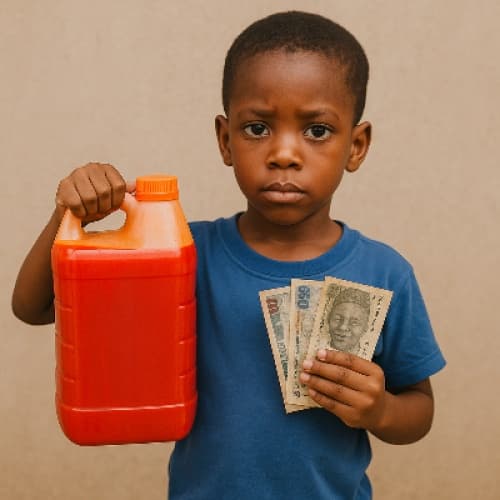
It was an unfortunate afternoon in Lagos—well, unfortunate for me, not for the whole of Lagos. I was in Primary 3 or 4, sometime in the early 2000s. Before you call me mumu, remember, I was just a little boy.
That morning, I woke up full of energy, happy, and ready for the day—unaware it was about to run faster than me. Before going to school, my daddy left ₦150 on the shelf for me to buy 5 liters of palm oil. I might have been small, but I wasn’t lazy. I could fetch water, go to Bariga Market (Odo Eran) to buy meat, and handle plenty of house chores. Sometimes, I even left school during break time to get beef because my daddy loved it.
Spaghetti was the first meal I learned to cook. My dad often gave us money for lunch, and we’d decide what to buy—beans and bread, or garri with sugar and groundnut, sometimes kulikuli. I remember another day when I sent my junior brother to buy groundnut. Poor boy got knocked by a bike. Till today, the mark is still on the back of his hand. I still feel guilty about that. I thought my life would end once my daddy heard.
But this story is about another day entirely—the real unfortunate one.
It was a Friday. I came back from school after Jumu’at prayers. The palm oil shop was only two blocks away. There were two ways to get there, but I always preferred the less busy route—not quiet, but no cars.
Along the way was a sloped road—probably still there today. After the slope, it was less than 50 meters to turn right toward our street. That’s where a woman stopped me. She had a child on her back (I assumed it was hers, though in Lagos you can’t be sure). She greeted me warmly, asked about my mum, and then said, “Have you forgotten me?”
I looked confused. She smiled and said, “Your mum used to send you to my house.” She asked where I was going, and I told her my daddy sent me to buy palm oil.
Then she asked me to hand her the money and gallon. She gave me three ₦5 notes to buy her akara and pointed toward a route I knew well. Strange thing was—no one sold akara there, morning or afternoon.
Still, I ran off with the ₦15. After ten minutes, it hit me—nobody sells akara on that road, and I didn’t even know this woman. I rushed back, but she was gone. I found the gallon hidden under a parked car, but the ₦150 had vanished.
My heart dropped. I wandered the streets, hoping to see her. At home, people had started searching for me. I saw our landlady’s son, Bro Tobi, asking if anyone had seen me. I hid. I even went to the mosque to pray for a miracle—but Allah seemed to close His ears that day.
By the time I gave up, it was nearly 7 p.m. I had to go home and face my death squad.
My daddy wasn’t back yet; he was at Sawih (a Muslim Friday gathering). Auntie Bunmi, who lived with us, listened to my story but had no money to cover me. I went to the sitting room to check on the cane—its usual spot. My daddy was a teacher, so having canes in the house was like having extra plates in the kitchen. Sometimes, there were three of them—ready.
When my daddy came home, Auntie Bunmi told me to wait at the backyard while she explained. Then she called me in for my verdict.
Instead of the beating of my life, my daddy gave me another ₦150 for the palm oil—but with a condition: until that palm oil finished, I wouldn’t taste any food made with it. If the meal needed palm oil, I would have to eat mine with just water and salt—starting that night.
At first, I was relieved. No beating? Perfect. But I soon regretted it.
My daddy would make me sit in front of him, eating amala with water. Same for eba. Same for semo. After the first week, Auntie Bunmi started giving me smaller portions. I would finish my “water version” and sneak into the kitchen to find ewedu and delicious stews waiting for the rest of the family. That went on for another two weeks before my palm oil ban was lifted.
It was a crazy experience—but it was discipline, and it made me wiser. Since that day, I’ve never been scammed again.
These days, parents don’t discipline their children, and the result is clear—rotting attitudes that poison society