The workday was coming to an end, yet my packed calendar—filled with endless Google Meet calls—refused to let me go home for even a minute. Then again, these days the very concept of “going home from work” has changed dramatically.
Now, instead of fighting through endless traffic jams on the way from the office, all it takes is a few steps from the room hastily turned into a workspace to the other side of the apartment—closer to your family—and you’re home. Humanity’s dream of teleportation has come true. We now live in a world of instant movement between locations: in less than a second we can appear in a client’s office on the other side of Moscow or drop into a colleague’s home office in Chicago.
I took five steps into the kitchen, bringing a long working day to a close. My wife was preparing dinner, and my little daughter was mastering the art of horseback riding on an inflatable donkey.
With a familiar, well-practiced motion, I inserted a capsule into the coffee machine, placed a cup underneath, and fragrant coffee made from 100% Arabica began to flow into the glass, topped with a thick layer of foam.
At that moment my phone rang. It was Misha—my friend and former colleague, a senior manager at a well-known consulting firm. He was driving past my building and suggested meeting briefly to discuss the latest news and simply chat about life. It was something we had all been missing throughout the pandemic.
I grabbed my mask and sanitizer and rushed downstairs.
The last time I had seen Misha was about a year earlier—the day I crossed the street to join a competitor, leaving our once-successful company behind. By then it was rapidly losing employees like a patient in intensive care suffering from unstoppable blood loss and facing an increasingly grim prognosis of cardiac arrest.
Misha greeted me in good spirits, though his eyes betrayed the truth—the day had clearly not been easy. Most likely he had once again performed the usual consulting heroics, fixing presentations prepared by careless junior colleagues.
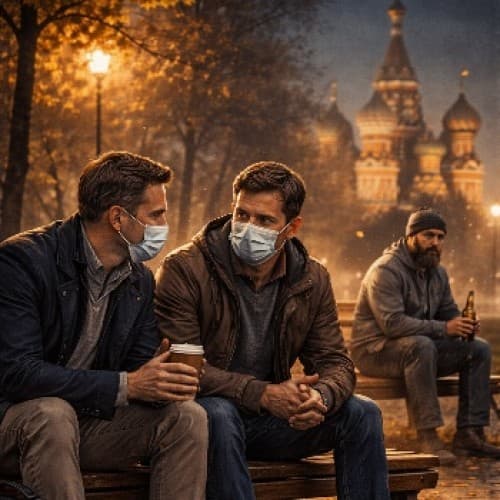
We nodded in greeting, almost simultaneously put on our masks, and started walking, discussing recent news and reminiscing about old times.
The weather was wonderful. Despite the late autumn evening, the sun seemed reluctant to leave Moscow, gently warming the freshly laid asphalt and touching the masked faces of people hurrying home.
We sat down on a bench in a small park and kept talking without pause—about everyday matters, a recently finished vacation, the exhausting reality of remote work, and the consulting profession that seemed to be shrinking year by year.
Right in front of us, near the neighboring bench, a laborer in gray sweatpants stopped. In his hand he held the inevitable accessory of a tired proletarian—a well-deserved bottle of cold beer.
Before sitting down, he wiped the bench, balancing the bottle with the elegance of Johnny Depp in Pirates of the Caribbean. Then he perched on the edge and casually crossed one leg over the other.
For a while he sat there, observing the world around him, periodically taking slow sips of his cooling beer with the steady rhythm of an oil pumpjack.
Suddenly his gaze settled on us.
He slowly lifted himself from the bench and, swaying slightly, walked toward us, clearly intending to deliver something important—something that, in his mind, could not be postponed.
“Guys!” he addressed us, rounding his words and swallowing the endings under the influence of a fast-acting carbonated beverage.
“I was just thinking—why are we all so scared of this damn Covid? There’s so much noise about it! Everyone talks about it all the time, wearing masks, washing their hands. I’ve decided I’ve had enough. I’m going to live normally—walk around, meet friends, throw parties, go to the bathhouse! The main thing is not to be afraid to take risks! If we don’t take risks, we don’t feel life. It just passes us by!”
All this time Misha studied the beer philosopher with the focus of a leopard preparing to pounce on an antelope, letting him finish pouring out his philosophy onto two brains that were not quite prepared for such profound evening reflections.
When the speech was over, Misha paused for a second and politely wrapped up the conversation.
“That’s wonderful,” he said calmly, turning back to our discussion.
The worker didn’t need a long explanation. He must have sensed the quiet authority in the sharp, decisive tone of an experienced senior manager. He quickly returned to his bench.
We talked a little longer about random topics and soon said goodbye, each of us hurrying back to our families.
That night I couldn’t fall asleep for a long time. I kept thinking about the words of the worker-philosopher and about the balance between freedom of movement and the safety of one’s family, about the lockdown of the first wave and the new reality unfolding outside our windows.
After all, human society cannot exist without personal interaction. Virtual meetings will never replace the energy of a real conversation or the power of eye contact. And every person has a limit to social isolation—beyond which fear disappears.
Toward morning, drifting into sleep, I kept repeating to myself:
“The main thing is not to be afraid to take risks… not to be afraid…”
But another thought would not let me go:
“Family comes first.”
The social limit had not yet been reached. Not yet.
Everything was still ahead.
And ahead was the second wave.