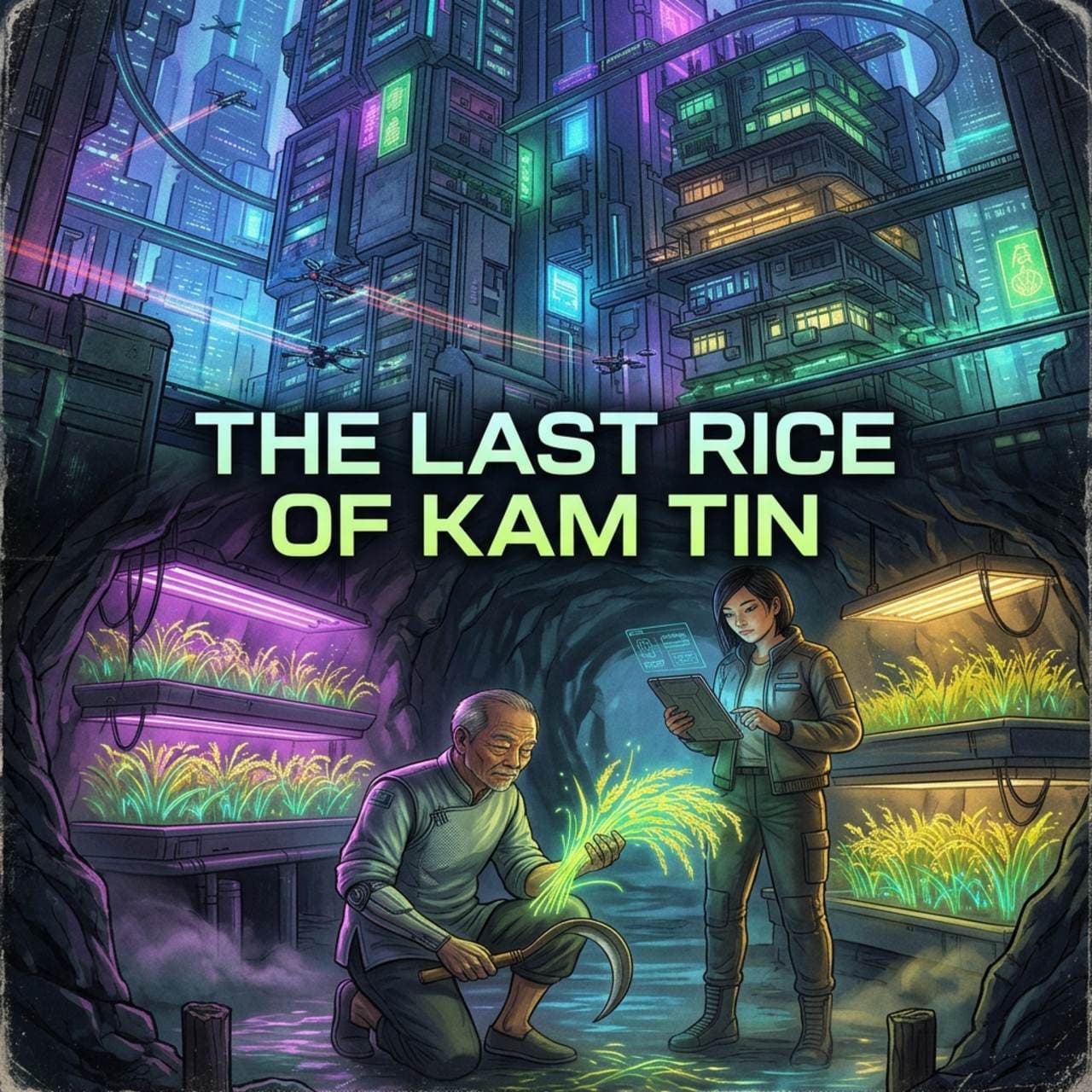

The neon of Kowloon had long since dissolved into the grey, smog-tinted mists of the New Territories, replaced by the amber hum of atmospheric regulators and the cold, pulsing blue of subterranean nutrient pipes.
For forty years, Uncle Ho had lived beneath the concrete canopy of Yuen Long, tending to the stubborn ghosts of a forgotten agriculture. Above them, the SAR megastructure—a sprawling, multi-tiered hive of vertical habitats, mag-lev arterial loops, and drone-lanes—pulsed with the frantic heartbeat of nine million souls. But down here, in the subterranean silt-vats carved out of the old Kam Tin floodplains, time moved to the slow drip of reclaimed condensation and the rhythmic thrum of geothermal harvesters.
Ho adjusted the polarized visor of his pressure-weave tunic, wiping a bead of sweat from his brow. At seventy-eight, his cybernetic left elbow clicked softly—a relic from the reclamation wars when he’d helped lay the foundational cooling grid for the district’s lower sectors.
"Uncle Ho," a sharp voice chimed from the comm-link embedded in his collar. "Sector Seven's atmospheric pressure is dipping by two millibars. Are you pushing the nitrogen flush too early?"
It was Mei, his grand-niece. She was a junior bio-engineer for the District Housing Authority, her mind perpetually wired into the civic grid, tethered to high-speed data streams that Ho couldn't even begin to fathom. Unlike her peers, who grew up on synthetic algae paste and nutrient-infused gelatin squares from the automated stalls of Mong Kok, Mei spent her weekends down in the mud with him. She was one of the few who still understood the strange, intoxicating scent of wet earth mixed with organic compost.
"Let it dip, Mei-mei," Ho muttered back into his mic, his voice rasped by decades of breathing filtered underground air. "The Fa Lok variety needs a touch of stress before the final spike. If you coddle them too much, the starch turns to water. A good harvest needs a little hardship, just like the old days in the walled villages."
"The old days are gone, Uncle," Mei’s voice sighed through the static. "The Climate Council approved the rezoning for Block 12 yesterday. Next quarter, they’re pouring the foundation pilings right through the middle of Sector Six. This is our last run."
Ho didn't answer immediately. He knelt, pressing his bare, weathered fingertips into the warm, nutrient-rich slurry of Bio-Plot 4. Beneath the surface, bathed in the synthetic violet glow of quantum-LED grow lamps, thousands of slender jade shoots swayed gently in the artificial current. These weren't normal rice plants. They were genetically reinforced descendants of the heirloom Wun Yiu strains, spliced with deep-sea kelp DNA to withstand the high-saline water table and the erratic radiation leaks from the old nuclear fusion substations.
They were the stubborn heartbeat of Yuen Long’s farming heritage—a heritage that had survived British colonial expansion, the great sea-wall flood of 2058, and the relentless, suffocating sprawl of the vertical city.
Hong Kong had always been a city of transitions. For centuries, the fertile plains of Yuen Long had fed the bustling fishing and trading ports of the Pearl River Delta. When the rising oceans swallowed the coastlines in the late 21st century, the colonial-era farmlands had been paved over, stacked high with steel and smart-glass. Yet, hidden beneath the foundations, a secret society of cultivators—men and women who remembered the taste of real jasmine rice and the aroma of sun-dried Mandarin oranges—had kept the embers alive. They became subterranean agrarians, trading black-market organic yields to high-ranking bureaucrats in exchange for water rights and power allocations.
Ho stood up, his joints popping, and walked over to the observation deck overlooking the sprawling vat-farms. Stretching as far as the eye could see were tiers of glowing hydroponic terraces, humming with the quiet industry of pollination drones shaped like mechanical dragonflies.
Ten minutes later, the heavy airlock door at the end of the tunnel hissed open. Mei stepped inside, shedding her sleek corporate utility jacket to reveal a plain linen shirt underneath. She carried a steaming thermos of herbal tea and a datapad flashing with real-time seismic diagnostics.
"They’re moving up the timeline," Mei said, handing him a cup of chrysanthemum tea. "The District Council wants to clear the sub-levels for a new mag-lev freight bypass. If we don't harvest by tomorrow night, the automatic demolition drones will flush the whole sector with liquid concrete."
Ho took a slow sip of the bitter, soothing tea. He looked out over the sea of violet light. "Let them try. A farmer doesn't harvest because the calendar says so, Mei. He harvests when the grain bows its head."
"Uncle, this isn't poetry, this is engineering," Mei argued, though there was no heat in her voice, only a deep, resonant sadness. "We’ve got maybe thirty percent yield readiness. The grains are still milky."
"Then we use the overdrive," Ho said quietly.
Mei stared at him, her eyes widening behind her augmented reality lenses. "The overdrive? Uncle, pumping that much synthetic solar-flux into the root system will cook the stems. It’ll force a lifetime of maturation into twenty-four hours. The yield will be volatile—it might even trigger a localized nutrient surge that trips the district alarms."
"Let it ring," Ho smiled, a rare, crinkling grin breaking across his leathery face. "For forty years, they’ve bought our silence with ration cards and sublevel permits. Let’s give them a smell they won't forget. Let Yuen Long remember what real rice smells like before they bury us in ferroconcrete."
For the next eighteen hours, the underground farm became a crucible of controlled chaos.
Mei hacked the regional power grid, rerouting surplus plasma-conduit energy from the idle manufacturing districts above straight into the subterranean heating coils of Bio-Plots 1 through 5. The temperature in the cavern soared, the air thickening with humidity until it felt like a mid-summer monsoon in the old New Territories.
Ho moved among the vines like a conductor before an orchestra. With an antique analog refractometer—a brass-and-glass instrument saved from his grandfather’s shop in Shap Pat Heung—he tested the sugar content of the swelling grains.
Tick. Tick. Hum.
Above them, through the thick basalt ceiling, they could hear the faint, low-frequency rumble of heavy excavation machinery. The city was waking up, its millions of citizens commuting through the neon canyons, completely unaware that miles beneath their feet, an illicit, prehistoric ritual was reaching its climax.
"Sugar levels are at twenty-eight percent," Mei called out, her fingers flying across her wrist-console as she monitored the thermal core. "The stems are turning gold, Uncle! The DNA splicing is holding... barely. But the pressure valves are screaming."
"Let them scream," Ho said. He unhooked a traditional wooden sickle from the wall—a tool with a worn oak handle polished by decades of calloused palms. Though harvesting machines could reap an acre in seconds, Ho insisted on doing the first cut by hand. It was a matter of respect. You didn't slaughter a crop with a machine; you reaped it with a gesture of gratitude.
At midnight, the warning sirens finally began to wail.
A-WOO. A-WOO.
Amber emergency lights flashed across the concrete pillars. The central civic computer had detected an unauthorized power drain and an anomalous organic heat signature radiating from Sector Six.
"They’re sending an inspection drone down the access shaft," Mei panicked, her datapad flashing a crimson warning. "We have three minutes before security locks the blast doors!"
"Help me with the basket, Mei," Ho commanded, his voice steady and immovable as a mountain.
Together, they hauled a large, woven bamboo basket—another antique, preserved through generations—into the center of the terrace.
Around them, the Kam Tin rice fields were transformed. Bathed in the final, blinding surge of the overdrive light, the stalks stood tall and heavy-headed, glowing with a rich, amber-gold luminescence. The air was no longer thick with the smell of ozone and recycled coolant; it was heavy, sweet, and intoxicatingly earthy—the rich, nutty aroma of freshly roasted grain and wet paddy soil, a scent that hadn't naturally existed in this district for half a century.
Ho stepped into the warm slurry, lifted the wooden sickle, and swept it in a smooth, practiced arc.
Swish.
A bundle of golden stalks fell cleanly into his palm, heavy with plump, glowing grains. He lifted them to his face, breathing in the rich fragrance of the earth, before laying them gently into the bamboo basket.
"Uncle! They’re cutting the primary power feed!" Mei shouted as the overhead quantum-LEDs flickered and died, plunging the cavern into sudden, dramatic shadow, illuminated only by the natural bioluminescence of the golden rice itself.
Heavy footsteps echoed from the reinforced maintenance tunnel behind them. Security enforcers in sleek, matte-black riot gear, their visors glowing with digital designations, burst into the sector, weapons raised.
"Halt! This is a restricted municipal zone under Article 42—" the lead enforcer's voice cut off abruptly as he stepped into the clearing.
The enforcer stopped dead in his tracks. The weapon lowered slightly from his grip. Beneath the dark tactical visor, the young man—no older than twenty-five—seemed to lose his breath. He lowered his weapon completely, sniffing the air with a look of utter bewilderment.
In a megacity where every sensation was synthesized, pre-packaged, or digitally simulated, the raw, visceral aroma of real, living earth and ripening grain hit the enforcer's senses like a physical blow. It was a genetic memory he didn't even know he possessed—an echo of ancient valleys, ancestral village feasts, and open skies that his grandparents had left behind.
Ho stood tall beside the glowing basket of golden rice, the wooden sickle resting casually against his shoulder. He looked at the young enforcer, then at Mei, who stood defiantly with her hands linked behind her back.
"Tell the council," Ho said, his voice ringing clear and strong through the silent cavern, "that the harvest is done. You can pour your concrete now."
The enforcer looked from Ho to the glowing basket, then back to the endless rows of golden stubble fading softly in the dark. Slowly, deliberately, the young man tapped a command into his wrist-unit, overriding the automated demolition sequence for Sector Six by twenty-four hours.
"Harvest's good this year, old man," the enforcer muttered quietly, turning his squad around and marching them back up the tunnel, leaving the farmers alone in the warm, fragrant glow of the underground earth.