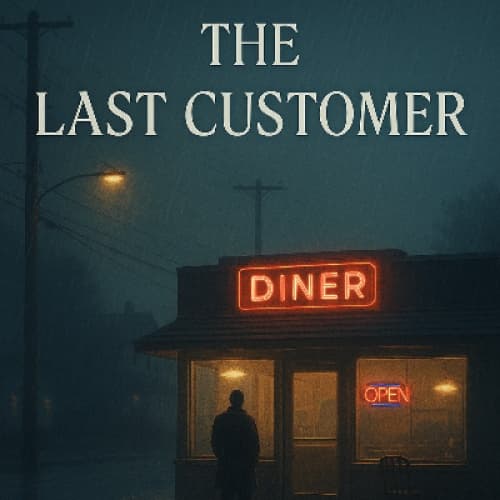

Darla’s Diner closed at eleven on weeknights, midnight on Fridays and Saturdays, and “whenever the last plate’s clean” on Sundays because Darla believed in God, rest, and the kind of mercy you show with coffee refills. The Thursday of the storm, the neon sign stuttered like a skipping heart and the rain came in mean slants that turned Harbor Road into a black ribbon. The ferry had been called early on account of wind; the seagulls were asleep someplace only gulls know.
Ruth wiped the long counter in slow ovals and watched the windows fog from their own breath. The bell above the door had gone quiet for an hour, then two. In the kitchen, Ricky the cook sang low to himself and stacked pies into the chilled glass case: apple, cherry, Darla’s famous marionberry that stained your mouth like a secret you could not untell.
“Clock it,” Ricky called through the pass. “We’re dead.”
“We wait on locals,” Ruth said, out of habit. “And the ferry stragglers.”
“Ferry stragglers already drowned,” Ricky said, cheerful in the way of men who thought catastrophe was a story.
At 10:47, the bell over the door shivered and a man stepped in with the storm. He shook rain from a charcoal coat and stood a moment just inside, as if asking the diner permission. The neon washed his face a soft pink. Not handsome, not plain. Brown hair damp at the edges. Age hard to name, anywhere between forty and sixty—one of those faces that had practiced decency long enough to look like it. He didn’t stamp his feet or remove his coat. He only chose a two-top by the window and placed both hands on the table, the way children do when they have something to say and have promised themselves they won’t forget.
Ruth brought menus and two coffees out of habit. He smiled at the second cup like she’d guessed something right.
“What can I get you?” she asked. “Kitchen’s still up.”
“Coffee’s fine,” he said. “It’ll help me stay a person.”
“Long night?”
He looked past her to the storm. “Long town.”
Ruth had lived in Ash Harbor all her life and never heard anyone say it exactly like that. She set down the coffee and the second cup for the empty chair. The man cupped the heat with both hands and didn’t drink.
“You waiting on someone?” she asked.
“Not anymore.”
Ruth tucked a stray curl behind her ear. “I’ll give you a minute with the menu anyway. Growling stomachs have a way of changing their minds.”
He lifted the menu, glanced, lowered it. “You’ve got the marionberry left.”
“Always do.”
“Good.” He nodded as if that answered something. “I like knowing we’re still predictable.”
He didn’t order pie, though. He didn’t order anything. He just sat and watched the rain bead on the window and run in threads, and then he said, “Your daughter sleeps with the light on but tells you she doesn’t. She thinks she’s protecting you from worry.”
Ruth stilled, the way you do when a glass slides off a counter and you haven’t heard it break yet. “Excuse me?”
He sipped the coffee finally, as if that allowed him to be forgiven. “She leaves it on low, just enough to catch the edge of her dresser. You can see it from the street if you’re walking the long way home.”
“Do I know you?” Ruth asked. Her voice came out more polite than she felt.
“Names aren’t much good at this hour,” the man said. “People are tender with them. They bruise.”
Ruth looked down the counter, like help might be hiding under the napkin holder. Ricky had the radio on in the kitchen, some old soul song about missing the train. The door had fogged its own little halo around the man’s silhouette, a watery frame. He wasn’t threatening. He wasn’t even particularly interested in being right. He stated the detail and let it sit there between the sugar packets and the pie case, the way true things prefer to live, unwatched.
“What’s her name?” he asked, almost gently.
“Evie,” Ruth said, before she decided not to.
“Evie,” he repeated, like a pastor saying amen to someone else’s prayer. “She’s eleven. She hums when she brushes her hair.”
Ruth pictured the blue brush with missing bristles, the film of glitter on the bathroom counter that never came off, not even with lemon cleaner. “Listen,” she said, not unkindly, “I don’t know what kind of joke this is, but—”
“It isn’t,” he said. “It’s a visit.”
He reached into his coat, and for a breath Ruth felt the old fear—the one that lived in the sheen of every night shift, the one women learn early and carry like a second set of keys. But he only took out a folded piece of paper and placed it on the table.
“Open it,” he said.
She did not. Instead she took one step back, then another. “Ricky?” she called, light as she could make it. When Ricky pushed out through the swinging door, wiping his hands on a towel, the man lifted his free hand slightly, palm out, as if warding off a dog.
“I’m not here to scare anyone,” he said. “I’m here to give someone a head start.”
“On what?” Ricky asked, taking in the man, the second coffee, Ruth’s face.
“On grief,” the man said, like it was a word he delivered often.
Ricky had shoulders big enough to turn situations back into nothing. He hovered behind the counter and didn’t move closer. “You need me to call Chief Holt?”
The man’s smile was small, rueful. “The chief is busy with the ferry radios tonight. Static makes men feel useful.”
Ruth had the suspicion the man was trying hard to be kind. It was a terrible feeling, to be afraid of someone’s kindness. She slid into the chair opposite him—the empty one, the one with the spare cup—and heard herself ask, “What is this?”
“Insurance,” he said. “If you take it.”
He tapped the folded paper. Ruth touched it with her fingertips and felt nothing but the soft dry rasp of paper. She unfolded it. Inside was a map torn from one of those free tourism guides—the kind with cartoon salmon and a smiling lighthouse. He’d drawn a thick ink line from Darla’s Diner to a house on Hargreaves, Esme Pike’s old place that Evie liked because the front porch had a swing. Near the corner—Ash Harbor Middle on one side, a cul-de-sac on the other—he’d drawn a sharp black X.
“Tomorrow,” the man said softly. “7:56 a.m. The crossing guard calls in sick. The new volunteer stands on the wrong corner and waves. A gray truck with a cracked windshield is late, a coffee spills, a foot slips. There are three inches of rain already in the street. The tires skip. Your daughter is wearing the yellow boots with the frog eyes. She’s thinking about the test. She steps where she always steps.”
Ruth stared at the X until it blurred. She forced herself to breathe. The sound of it made her throat feel like it had learned a new shape. “People don’t know things like that.”
“Most don’t want to,” he said. “It makes the day feel rigged. But some people trade ignorance for time.”
Ricky took a half-step closer. “This a threat, man? You telling a mother you’re gonna—”
“No,” the man said, and this time there was something like anger under the word, some low private current. “I don’t do the taking. I witness. I sit with people before. I sit with people after. I make sure there’s pie left if they decide to stay a little longer.”
Ruth touched the map again. The paper looked like a second mouth on the table. “Why me?”
“Because you always wait for the last customer.”
He said it without triumph, as if it were just another weather report. On the radio, a caller told the weatherman that Devil’s Bluff was swallowing fog like it meant something. Ruth folded the map in half, then in fourths, each fold a worse sound than the last.
“What happens if I keep her home?” she asked.
“Then tomorrow has to find another way to become itself. It will. It always does. But maybe not with her.”
Ruth thought of Evie’s lamp set on low, the soft wedge of light on the dresser, the way the glow reached only far enough to name the next thing. She thought of the coat hooks in the hallway, the careful row of wet boots and the one boot always on its side because it liked knowing the floor was still there. She thought of the porch swing at Esme Pike’s old place and how it cried like a puppy when the wind changed.
“What if I do nothing?”
“Then tomorrow is a story someone else tells you.”
The man turned his coffee cup once on the saucer, a habit that felt ancient in a way Ruth couldn’t explain. He didn’t drink. The steam had died.
“What’s your name?” she asked again, and this time she didn’t mean it like a ledger. She meant it like a mercy.
He looked at her for a long, quiet moment, then at the pie case, then at the rain that had soothed itself into a steadier fall. “Some towns call me the Last Customer,” he said, almost embarrassed. “I prefer not to be called at all.”
“That isn’t an answer.”
“It’s the only one I can carry.” He nudged the map back toward her. “Keep this. Or burn it. Either way, make the morning yours.”
Ricky leaned on the counter, elbows wide. “You gonna pay for that coffee?”
The man smiled without offense. He slid a ten under the cup and stood, the coat falling around him like he had learned it from someone else. “Tell Darla thank you for never switching brands,” he said to no one and to everyone. “People don’t realize how much relief comes from something tasting exactly like it always has.”
He reached for the door. The bell shook. The rain opened like beaded curtains. He paused, just before he went out, and turned back with the expression of someone trying to pick the right words from an unhelpful shelf.
“She shouldn’t wear the frog boots tomorrow,” he said. “They make her brave.”
Then he was gone into the coastal dark, a man-shaped absence moving down Harbor Road like it knew where to end.
Ricky exhaled and swore in a reverent way. “You okay?”
“No,” Ruth said, and realized she meant it, and realized “okay” was a thing that had to be decided, not felt. She took the map. She put it in the pocket of her apron. She poured out the cold coffee and washed the cups like she could undo something in herself with hot water.
At home, the porch light made everything look better than it was. She peeked into Evie’s room, expecting the lie of darkness. But the lamp was on low, a neat wedge of light over the dresser, as promised. Evie lay on her side with the arm of her stuffed bear over her eyes, the way she always did when she wanted to wake to the world she had chosen. On the floor were the frog boots, one turned onto its side like it had fainted thoughtfully.
Ruth sat on the edge of the bed and watched her daughter breathe. She could feel the storm pressing its fingers against the windows, testing each latch. She put her hand on Evie’s calf and felt the warm, ordinary life of it and wanted to weep—at the storm, at the boots, at the fact that love made time both a thief and a gift.
In the morning she made pancakes because pancakes were a way to make a new day agree to be kinder. Evie hummed while brushing her hair because girls who want to be brave tell themselves they already are. Ruth made a point of saying, “Blue rain boots today,” and when Evie started to protest—“But the frog eyes—” Ruth said, “Humor me,” and kissed her daughter’s forehead and let the argument die the way smart arguments do, by being loved to death.
At 7:40, Ruth texted the diner to say she’d be late. At 7:45, she held Evie’s hand at the corner where the crossing guard usually stood and today did not. At 7:56, a gray truck with a cracked windshield slid twenty feet past the stop, the driver’s coffee performing a brown comet in the cab. He slammed both feet on brake and swore his way back into a life he wouldn’t understand later. Ruth felt the tug in her shoulder where Evie’s hand had jerked and thought, This is what a miracle feels like in a town where nobody claps.
They waited for the volunteer who’d been sent to the wrong corner. They crossed when it made sense. Ruth walked Evie all the way to the steps of the school. She didn’t say be careful because sometimes words put ideas in the air that didn’t need the help.
On the way back, she took the long way, past Esme Pike’s old porch swing. It was crying like a puppy. Ruth tucked her chin into her collar and breathed the long wet morning. She stopped by Redeemer Church and lit a candle for anyone whose morning had not been delivered, for anyone who’d needed the Last Customer and got some other visitor instead.
At the diner, Darla was slicing lemons and telling Larissa from Dispatch that the radios had eaten two of her calls. “Static makes men feel useful,” Larissa said, surprised it had come out of her mouth.
Ruth pinned her apron and slipped the folded tourist map into the top drawer where the straws lived. The ten-dollar bill the man had left sat on the counter under the sugar shaker, dry as a leaf. She picked it up and turned it over. On the back, in the blank space where some people wrote grocery lists or phone numbers, someone had written a date in tidy block letters—October 13, 1989—and beneath it: Thank you for not closing early.
She would find the rest of it later, because stories make you wait: the old Polaroid in the bulletin board cork behind the register, yellowed at the edges, dated 10/13/89 in ballpoint. In it, the diner looked the same as ever because the diner refused to change even when people did. A younger Darla beamed between two men in ferry jackets and a third in a charcoal coat with damp hair at the edges, the kind of face you couldn’t put an age to if you tried. A second coffee sat on the table in front of the empty chair beside him. On the counter: a folded tourist map, a black X, a note she couldn’t read beneath the glare.
But that would be the later part of the story. The now part was pies in their case and the rain doing what rain had always done and a mother who’d decided to alter the morning by small degrees rather than wait for the day to choose her. At 10:12, an older couple came in for the marionberry and said they’d split it because they were being good. At 12:03, three high school kids tried to order fries as their entire lunch and Darla said yes because mercy is a better teacher than rules. At 1:14, the door bell shook and a man in a charcoal coat stepped inside with the mist and stood a moment as if asking the diner permission.
Ruth put two cups on a saucer without thinking and poured the coffee.
When he reached the two-top by the window, she set one cup in front of him and one in the empty chair. “We have the marionberry,” she said, because some lines deserved to be said the same way every time.
He rested his hands on the table. “Good,” he said. “I like knowing we’re still predictable.”
She didn’t ask his name. She didn’t need to. She only placed a fork and a napkin and waited for the thing in him that needed to be spoken. When it came, it wouldn’t sound like a threat. It would sound like weather. And she would listen, because some towns learned long ago that the cost of staying open late is also the reason people survive the morning.