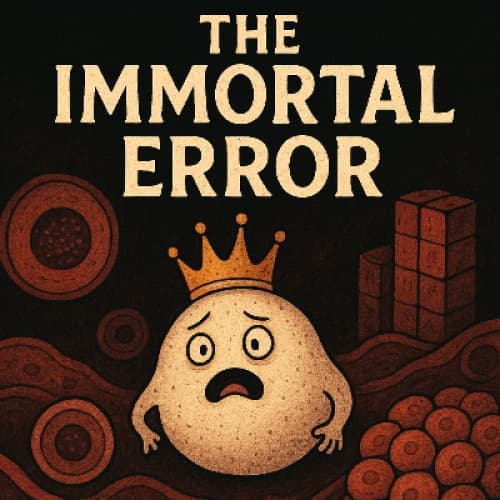
In the smooth, sun-drenched nation of Epidermis, order was everything. The society prided itself on balance—births matched deaths, expansion matched shedding. The Functional Citizens, responsible for producing keratin, pigment, and protection, worked diligently on the Nation’s surface, facing the outside world with quiet discipline while protecting everything inside.
Beneath them, in the shaded depths, dwelled the Pioneer Division, a small and powerful guild of citizens known for their reproductive capabilities. They didn’t take part in daily labour; their job was simple but sacred: replace the fallen.
The system ran on signals—chemical couriers carrying precise instructions through an extraordinarily developed network. Whenever a few of the Functional Citizens perished, a faint pulse of distress rippled through the microenvironment, reaching the Pioneers below. The Pioneers would stir, receive the order, and initiate the sacred Rite of Division. Selected pioneer citizens would split into two, and the balance would be restored.
Life was peaceful, if a little dull. Every death had its meaning; every birth, its place.
Then, one day, a Pioneer’s gene-script glitched. Just a single letter went astray—an innocent error during routine renewal. Normally, the proofreading patrols caught such mistakes, but this one slipped through the cracks, disguised as efficiency. The change was subtle: her receptors became hypersensitive, her internal accelerators jammed in the on position. Now, even the faintest whisper of a signal sounded like an alarm. The couriers did not call for her to act, but she felt summoned all the same.
“The damage must be repaired!” she declared, dividing once—then again, just to be thorough.
Nothing terrible happened. The Functional Citizens above barely noticed the addition. So the Pioneer continued. The more she divided, the more she believed she was saving society from an unseen collapse.
Her supervisor tried to intervene, but by then the signal system had grown chaotic. “There’s too much division in the guild of pioneers!” he cried, but the rhythmic thrum of replication drowned out his voice.
Soon, an army of cloned rogue Pioneers emerged. They completely lost their ability to listen to the “stop” orders. The tumour suppressor regulators, ancient and respected, tried to enforce the rules: Pause when the structure is unstable. Die when you can be corrected. But they were too struck by gene-script glitches and were beginning to fail. One by one, their circuits went dark.
The rogue Pioneers had discovered a strange pleasure in multiplying. Each new citizen, armed with accumulated genetic errors, brought new ambition. They formed committees, colonies, and then entire clusters. They worked tirelessly, convinced they were heroes. “The structure must be maintained!” they chanted, even as the city above began to bulge and buckle under the pressure of their enthusiasm.
Functional Citizens tried to complain. The pigment workers filed formal grievances. The keratin guild warned of resource shortages. But the signals were no longer obeying the old laws; feedback loops echoed endlessly, amplifying the “divide” commands while silencing the calls for rest and repair. Messages bounced between overactive receptors like rumours in a panicked crowd.
The Pioneers stopped asking permission. “We no longer wait for distress,” their leader declared. “The damage is constant—the need eternal. We are the repair.”
The council of Tissue tried diplomacy first. They sent inhibitors, negotiators, even a few apoptotic envoys—self-sacrificing messengers meant to die for the greater good. The envoys never returned. The Pioneers had silenced the genes responsible for programmed death. “Why should any of us die?” they argued. “We’re the foundation of eternity!”
In time, the once-peaceful nation of Epidermis transformed. Streets of neatly aligned cells grew crowded and uneven. New Pioneers popped up everywhere, ignoring borders, squeezing between neighbourhoods, displacing workers. They built without blueprints, divided without demand.
To the Functional Citizens, it felt like an invasion. To the Pioneers, it was destiny.
“Don’t you see?” one cried to a collapsing pigment factory. “We’re ensuring immortality! You fade; we flourish!”
And flourish they did—wildly, grotesquely, beautifully. They broke the rules of shape and structure. They filled every available space, then began to explore beyond their borders. A few adventurous Pioneers whispered of foreign lands—the bloodstream, the liver, the lung—vast territories waiting to be “repaired.”
The council was horrified. “You can’t just leave the homeland!” they shouted.
“Watch us,” the Pioneers replied, slipping through the vessels like pilgrims seeking new territory.
Epidermis groaned under the weight of its expansion. The communication lines failed. Signals meant for balance were lost in the biochemical noise. Somewhere in the chaos, the last surviving Functional Citizen whispered to a neighbour, “Do you remember when death meant peace?” The neighbour was gone before the sentence ended.
Down below, the original Pioneer—the one whose gene-script had glitched first—could no longer recognise herself in the crowd. She looked around at the endless repetition of her own kind, at the architecture crumbling from too much life. For a brief moment, she felt something like doubt.
“Perhaps,” she said softly, “we were never meant to repair forever.”
But the thought was drowned by the roar of a million identical voices chanting the new creed:
“Divide, and thou shalt endure.”
And so they did.
The society of Epidermis expanded, suffocating itself with good intentions, until there was no structure left to preserve—only growth, only noise, only the endless echo of a system that forgot how to stop.