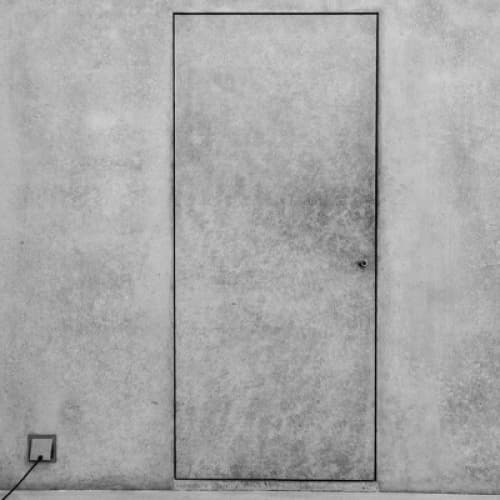
Nobody noticed the new door except Mira. It appeared between the copy room and the stairwell sometime after lunch on a Tuesday, the way a headache appears: quietly, and then all at once. The corridor had always been a featureless sweep of beige. Now there was a door the color of wet ash, without a handle, with a keyhole too small for any normal key.
Mira asked Leo from IT if he’d seen Facilities install anything. He shrugged and said, “We don’t put doors in. We just tell you the Wi-Fi is fine.” He went back to microwaving fish, which felt like its own kind of haunting.
That afternoon, a draft rippled through the hallway. The gray door inhaled. The hair on Mira’s wrists rose. She stared at the keyhole and thought, absurdly, of an eye. It looked back.
She told herself it was just poorly finished metal reflecting her own face. Still, she placed a sticky note at the top of the doorframe: “When did this appear?” She dated it. She signed her name.
In the morning, the sticky note was gone.
So were two emails from her Sent folder—the ones she’d written late, asking for a deadline extension from a client named Protea Systems, explaining that half her team was out with the flu. Those emails had been polite, perfectly composed. They had taken time. Now their absence made a small, mean crater in her day. She stared at the empty space in Outlook until the white felt loud.
The gray door breathed again.
Mira carried on because carrying on was the only office ritual everyone obeyed. She made a spreadsheet on lost productivity and reframed the project plan. She ate an apple that tasted of copy paper. She walked past the gray door five times without looking and once with her eyes locked on the keyhole until her pulse stumbled.
That night, long after most of the office lights went out, she stayed late. The door stayed, too.
“Okay,” she whispered. Talking to inanimate objects was a known symptom of burnout. “What do you want?”
Something shifted behind the door. Not footsteps. More like the sound of furniture remembering it used to be trees.
The keyhole widened—not physically, but in the way a shadow becomes a room if you think about it too long. Mira felt the answer rather than heard it:
Come see.
Her chest got small. The elevator dinged somewhere far away; the final cleaners dragging trash bags like failed parachutes. She stepped forward.
Up close, the gray paint was not paint. It had depth, like looking into a rain cloud. Mira lifted a finger. The surface was cold—not winter-cold, hospital-cold. She pressed lightly, and the door gave under her fingertip the way skin does.
She yanked her hand back.
At home, she dreamed she was late for a meeting. Everyone watched her arrive; everyone had the head of her boss and the hands of her mother. The only empty seat was inside the gray door. She woke with the taste of dust in her teeth.
On Wednesday, six people forgot Mira’s name. They knew her. They worked with her. But they smiled apologetically and said, “Sorry—Mina?” and “Maria?” and “We met last week, right?” It would have been funny, if not for the way each of them blinked too slowly, irises filmed with a sad gray.
At noon, Protea Systems called and asked why she hadn’t replied. Mira promised a revised proposal by Friday. She hung up, checked her Sent folder, and watched as the new email she’d just sent buckled into static and vanished.
She went to Facilities.
“There is no door,” said the woman at the desk, without looking up from her screen.
Mira swallowed. “Do you want to come see it?”
“I don’t leave the desk,” the woman said, as if reciting from a manual. “Nothing leaves its place until it’s time.”
“What time?”
“Closing,” said the woman, and smiled with exactly the wrong number of teeth.
Mira bought a cheap metal key from a hardware kiosk. It wasn’t meant to fit; she was only testing the story she was telling herself: if she had a key, she had control. She wrapped the key in blue painter’s tape and drew a cartoon eye on it with a Sharpie, because humor was supposed to make fear smaller.
At dusk she stood in the corridor. The office hummed with the mausoleum buzz of after hours. She raised the key. The keyhole looked, very briefly, relieved.
It didn’t fit.
She pressed anyway. The key warped in her hand, bending toward the hole like a plant toward a window. Mira let go. The key rotated by itself and slid in with a sound like a breath being held too long.
Her heart stuttered. “Don’t,” she whispered, to whatever part of herself wanted this. “Don’t do this.”
She turned the key.
The gray door opened onto her office. Not the real one; a perfect copy. Same thrift-store plant on the filing cabinet. Same chipped mug. Same sticky note on the monitor reminding her to “drink water, you desk-lich.” The air smelled faintly of her citrus hand cream.
And there she was, sitting at her desk, typing.
Mira did not breathe. The other Mira didn’t look up. The clock on the wall ticked toward 6:12. The clock on her wrist said 5:03.
She stepped in.
The carpet felt deeper; she sank a little. She circled the desk. The other Mira’s face was softer by degrees—a cheekbone smoothed, the eyes a shade more rested, the mouth turned less toward apology. On the monitor, words appeared, one after another: “Dear Protea Systems, attached please find…” The emails existed here.
“Excuse me,” Mira said.
Other Mira stopped typing. She looked up with the expression Mira used for interns and fire alarms: patient, distant, already resuming the task in a private corridor of her mind. She focused, and recognition swam in. Her gaze sharpened and then—this was the worst part—she looked relieved. “Oh. You found it.”
“What is this?” Mira asked, throat tight. “What—who are you?”
“I’m the one who stayed late,” her double said, as if that explained everything. “I’m the one who keeps things from falling apart.”
“By stealing my emails?”
Other Mira’s smile was kind and unfathomably tired. “Nothing is stolen. It’s stored. You lose some things so others can be safe. Isn’t that how you’ve lived?”
Mira wanted to argue. She also wanted to apologize for something it hurt to name. “How long has this been happening?”
Other Mira’s hands hovered above the keyboard. “Since the first time you wished for a place to put all the tasks, all the fear, all the deadlines you agreed to because saying no felt like a failure. You make a door and then forget you made it. That’s the point.”
Mira glanced back at the threshold. The gray door looked very far away now, the hall beyond it drained of color like newsprint left in the sun.
“Close it,” she said.
Other Mira tilted her head. “If I do, you’ll remember everything again. All the things you put here will come back. The late nights. The mistakes you saved by editing quietly. The meeting where you swallowed your anger so a louder person could take credit. It hurts to be the only one who keeps track.”
Mira thought of the people who couldn’t say her name today. She thought of the email thawing and reforming like pond ice, her words turning into mist in someone else’s server. She thought of waking and not quite recognizing her own life.
“I want my name,” she said. “I want the parts of me I left in here. Even if it hurts.”
Other Mira looked genuinely surprised. Then she looked proud. She stood. The chair rolled back and hit the desk with a soft complaint. She reached toward the monitor, not touching, fingers hovering as if over an injured animal.
“Take a breath,” she said.
Mira did.
Other Mira put her hand on Mira’s shoulder. Her palm was cool, steady. She leaned close and whispered into Mira’s ear a list of things Mira had been trying very hard not to remember: the voice of an old friend she never called back; the exact phrase her boss used in the review that made her smaller for a whole year; the soft, insistent wish she’d had as a child to go outside instead of finishing worksheets. Each memory settled in Mira’s chest like a coin dropped in a well, ringing home, rings fading.
It hurt. But the hurt was accurate, like pressure on a bruise that proves the body knows where it ends.
“Close it,” Mira said again, and this time Other Mira nodded.
They walked to the threshold together. The door pulsed. On the other side, the corridor had brightened. The sticky note was back at the top of the frame. It said, in her handwriting, “Don’t forget me.”
“Some things will still slip,” Other Mira said softly. “That’s what doors do. But you can lock it.”
“How?”
“Name what you’re keeping,” Other Mira said. “Every day. Even the small things.”
Mira turned the key. The gray door shivered as if cold. The air tightened. For a moment she felt herself doubling, like a ghost stepping into her skin—but then it was only her again, the single hurt, the single heartbeat.
The door latched.
Mira pulled the key free. It had straightened. The cartoon eye she’d drawn was gone.
In the morning, people said her name correctly. Protea Systems apologized for the confusion and thanked her for the immaculate proposal she had apparently sent at 6:12 p.m. last night. The Sent folder held every email in neat rows, their subject lines like tiny doors you could open and close without fear.
At lunch, Mira walked the corridor. The gray door was still there.
She took the sticky note down and wrote a new one. “I know you,” she wrote. “But not today.”
She pressed it above the frame.
That night it was still there, the glue holding, the note unvanished. But as she turned to leave, she felt a draft tug at the hem of her coat, and the door took a thin, polite breath.
Mira exhaled, too.
“Goodnight,” she said.
Behind the door, something that loved her in a hard, practical way listened—then slowly, carefully, went quiet.