


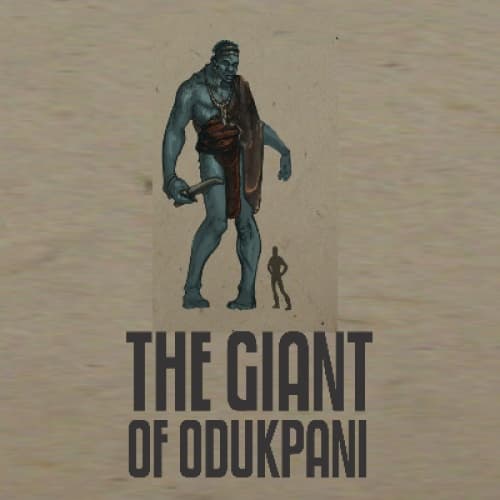
In the dense rainforests of Odukpani, where the trees whispered secrets and the rivers sang lullabies, there lived a giant named Obuma. Towering at twenty feet, with skin like polished ebony and eyes that glowed like fireflies in the dark, Obuma was no ordinary creature. He was born of thunder and baobab roots, a guardian of the land long before men carved borders into maps.
Obuma wasn’t feared—he was revered. Villagers left offerings of yam and palm wine at the edge of the forest, hoping for his protection during harvest and storms. Children told tales of how he could uproot a tree with a single breath or summon rain with a stomp of his foot.
But Obuma had a secret.
Each night, he shrank.
As the moon rose, his massive form would curl into itself, bones folding like origami, until he was no taller than a boy. In this form, he wandered the village unseen, listening to stories, watching dances, and learning the ways of humans. He loved their laughter, their songs, and the way they dreamed even when the world was cruel.
One night, a drought gripped the land. Crops withered, rivers dried, and the villagers began to despair. They pleaded with Obuma, but he did not answer. He had grown weary—not of the people, but of their growing greed. They had begun to take more than they gave, cutting trees without thanks, poisoning rivers with waste.
So Obuma made a choice.
He appeared at dawn, larger than ever, his voice echoing like drums across the hills. “I will bring the rain,” he said, “but only if you remember the old ways. Respect the earth. Honor the spirits. Share your bounty.”
The villagers, humbled, agreed.
Obuma raised his arms, and the sky cracked open. Rain poured for seven days and seven nights. The land drank deeply, and life returned. From that day on, the people of Odukpani lived in harmony with nature, and Obuma watched from the shadows—sometimes as a giant, sometimes as a boy—always guarding, always listening.