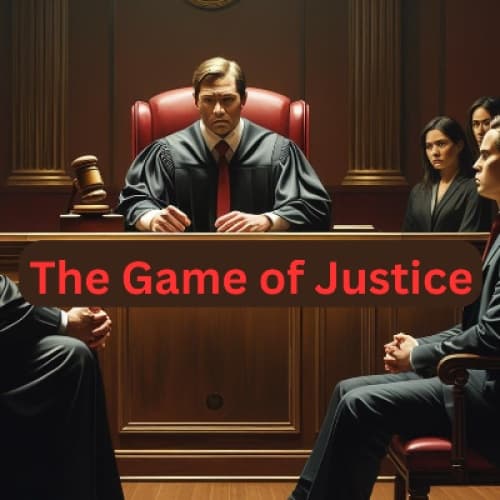
Patna was glowing that evening. The grand hall of the Bar Association was filled with people - lawyers, journalists, old colleagues, and admirers - all gathered to bid farewell to one of the most respected judges of Bihar, Justice D.C. Tripathi. At sixty-five, he had retired after four decades on the bench, carrying with him a reputation of being fair, fearless, and uncompromising.
Applause echoed through the hall as the President of the Bar stood on stage.
"Justice Tripathi," he announced, "you have not only delivered justice, but you have given dignity to the very idea of justice. Tonight, this hall is honoured to celebrate your service."
Thunderous claps filled the room. Tripathi walked to the microphone with a calm smile. His voice carried the weight of his years.
"Delivering justice," he said slowly, "is never easy. Many times, it is a battle between the heart and the law. But in the end, one must always hold the scales of the Constitution, even when the heart bleeds."
The crowd nodded in admiration. But among them, one man did not clap. He stood silently, his eyes burning with quiet rage, though his lips curled into a faint smile. He whispered to himself, words meant only for the shadows to hear:
"And when an innocent is hanged… who takes the blame then?"
Tripathi froze for a brief second, as if his conscience had been pricked. His eyes searched the crowd but found nothing unusual. He adjusted his glasses and continued:
"I am proud to say that every decision I made was guided by the law… and by the voice of my conscience."
At that moment, his phone buzzed in his pocket. He pulled it out discreetly. A message flashed on the screen:
"Your son is next, Honourable Judge."
His heart skipped a beat. The applause thundered on, but his face turned pale. His mind swirled with questions. Was this a threat? A prank? Or the return of a shadow from his past?
That night, after the ceremony, the grand old man returned home. His house was silent, the ticking of the clock loud against the emptiness. He loosened his tie, his mind still unsettled by the anonymous message.
He opened the old wooden cabinet in his study. As he did, an ancient file slipped out and fell to the floor. The name on it froze him in place:
"State vs. Rizwan Sheikh (2005)."
Tripathi's hand trembled. He had tried to bury that case in the deepest corners of his memory, but fate had other plans. He picked up the file - and with it, the weight of a decision he had once made.
Flashback - 2005, Courtroom
The case was one of the most sensational of its time. The daughter of a prominent lawyer, a 17-year-old girl, had been kidnapped and later found dead in an abandoned warehouse. The prime accused: Rizwan Sheikh, a junior clerk in the same law firm where her father worked.
The evidence was circumstantial - CCTV footage placing him near the warehouse, some voice messages, and documents found in his bag. But there was no direct proof. Rizwan had pleaded desperately in court:
"Sir, I didn't kill her! She was my friend… I only helped her hide. Someone else… someone else killed her!"
The prosecution thundered back:
"Your Honour, the evidence speaks for itself. His phone records, his movements, his possessions - all point to his guilt."
The media howled outside the courthouse. "Justice delayed is justice denied," they cried. Under immense public pressure, the government had appointed a special fast-track court. And the man presiding over it was none other than Justice D.C. Tripathi.
After weeks of trial, Tripathi delivered his verdict. His words echoed in the silent courtroom:
"On the basis of the circumstantial evidence before this court, the accused Rizwan Sheikh is found guilty. Punishment - death by hanging."
Gasps filled the room. Rizwan screamed, "I am innocent!" but his voice was drowned in the noise. A woman in the gallery wailed:
"You have killed an innocent man, Judge!"
Back in the present, Tripathi woke up drenched in sweat. The file still lay in his hand. His phone buzzed again. Another message:
"One more innocent has been silenced. Who will be next, Judge?"
The next morning, the newspapers carried a shocking headline:
"20-Year-Old Murder Case Reopens - Convict Found Dead Under Mysterious Circumstances."
Tripathi's eyes darkened. He muttered to himself:
"Passing a death sentence is never easy. But when the past starts haunting you… the weight becomes unbearable."
That night, he walked into his old garage, long locked away. Dust covered everything. As he opened a rusted steel box, his breath stopped. Inside were photographs, a blood-stained scarf, and a tape recorder.
He pressed play. Rizwan's trembling voice filled the room:
"…She was scared… someone else saw her that night… a third man… I was framed…"
Tripathi whispered, horrified:
"The third man? Who was he? Did I… did I kill the wrong person?"
Before he could think further, his phone rang again. A deep, cold voice said:
"Your son Aditya is safe… for now. But remember, every justice has its price, Judge."
The line went dead.
Tripathi rushed to his son's room. It was in disarray. On the desk lay a half-written note:
"Father, you never told me the truth about the Rizwan case. Was he really guilty?"
Beside it was a pendrive labelled: "Truth.zip."
Trembling, Tripathi inserted it into his laptop. Three files appeared:
CourtRecordings
Rizwan_LastVoice.mp3
MissingEvidence_2005.pdf
He clicked the audio. Rizwan's voice came alive:
"If I die, Judge, will you carry the burden of my death? I was innocent… you should have listened…"
Tripathi's hands shook. His face turned pale.
"Did I condemn an innocent man?" he whispered.
Meanwhile, Inspector Neelima Chauhan, a sharp and fearless officer, was assigned to investigate the mysterious deaths. She asked Tripathi directly:
"Sir, is this connected to any of your old cases? Some vendetta?"
Tripathi replied bitterly:
"Those who were punished, were punished by the law… not by me. But perhaps… the law itself was blind."
Days later, a parcel arrived at his house. Inside was a crude court sketch… and an old tape recording. A chilling voice spoke from the cassette:
"I was innocent. Now it's your turn, Judge."
Tripathi sat alone in his study, staring at the wall lined with fifty old case files. Shadows danced in the room. His voice was barely a whisper:
"It seems… someone is judging me now. With my own methods."
The camera of fate zoomed out on him, a man once feared and respected, now trapped in his own game of justice.