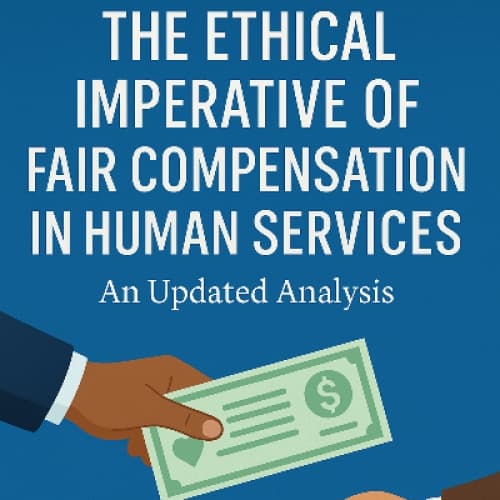

An Updated Analysis
By Leprinthinya Wilkins
Chapter One: The Moral Core of Human Services
At the heart of human services lies an unwavering dedication to people — individuals, families, and communities facing hardship or seeking growth. This field is not driven by profit margins, but by purpose. Yet, despite its moral roots, a troubling paradox persists: those who care for society’s most vulnerable are often underpaid, overworked, and overlooked.
As the demand for human services grows, so too does the burden on its workers. In 2020 and beyond, new data reveals the deepening cracks in the foundation of this essential workforce. This book examines one critical question: How can we ethically justify a system that leans on compassion but pays in crumbs?
Chapter Two: The Loyalty Link — Compensation and Commitment
Back in 1998, Jeffrey Pfeffer argued that fair compensation is key to cultivating loyalty, reducing turnover, and ensuring organizational success. More than two decades later, his insights echo louder than ever.
Recent studies affirm this truth: when employees are paid well, they stay. But loyalty isn’t just about money. It’s about respect — shown through health benefits, professional development, a manageable workload, and a culture that values emotional well-being.
Think of the case manager at Already Autism Institute. Their day is a marathon: juggling client care, meetings, documentation, and school coordination. Much of their work goes unpaid, undocumented — yet without it, the client suffers. This highlights a dangerous truth: when only billable hours are valued, everything else becomes invisible.
Chapter Three: The Price of Invisible Labor
Janet Finn (2011) emphasized an often-ignored reality: workers must be compensated for the full scope of their responsibilities, not just what’s billable.
Too often, professionals are expected to attend staff meetings, plan services, or complete paperwork "on their own time." This practice doesn’t just ignore labor; it exploits it. Worse, it silently penalizes those who go above and beyond, leading to burnout and disillusionment.
Some progressive organizations, particularly in behavioral analysis, are beginning to adapt — including non-billable hours in salaried positions. But the field as a whole has a long way to go.
Without change, we risk driving away the very people we rely on to heal, teach, support, and protect.
Chapter Four: Emotional Labor and the Silent Burnout
Arlie Hochschild (2012) defined emotional labor as the act of managing feelings to meet job expectations. In human services, this is not a side task — it’s the job.
Surface acting, where workers must smile through trauma, grief, or anger, is widespread. Over time, this emotional suppression chips away at mental health, creating emotional exhaustion, depersonalization, and burnout.
Workers at Already Autism Institute routinely face emotionally charged situations: children in crisis, families navigating grief, heartbreaking diagnoses. Without proper support — like mental health days, counseling access, and wellness benefits — even the most passionate professionals will eventually collapse under the weight.
Chapter Five: The Reality of Wage Disparities
Despite the moral importance of their work, many in human services live paycheck to paycheck. In 2023, social and human service assistants earned a median wage of \$41,410. Social workers made about \$58,380 — barely enough to meet rising costs of living, especially when student loan debt is considered.
These numbers are not just statistics — they represent real barriers to recruitment and retention.
Worse still, the gender and racial wage gap persists in this sector. Women and people of color, who make up a large portion of the workforce, are especially impacted. The 2023 data showed that women returning to fields like social work after the pandemic often found themselves locked into low-wage positions.
We cannot claim to value diversity, equity, and inclusion while underpaying the very people embodying those values.
Chapter Six: The Cost of Turnover
Turnover is not just an HR issue — it's an ethical one. Every departure represents a disruption in client care, a broken bond, a trust lost. And the financial costs — recruitment, training, onboarding — are staggering.
Research from nonprofit organizations in Illinois paints a bleak picture: compensation directly impacts whether workers stay. Vacancies in 2023 skyrocketed in agencies unable to offer competitive pay. Qualified professionals simply could not afford to stay.
The implications are dire: without staff, programs shut down. Children go without therapy. Families lose support. Communities suffer.
Chapter Seven: Best Practices for a Fair Future
There is a path forward — one paved with dignity, strategy, and ethical responsibility.
Nonprofits and agencies must adopt a **“total rewards” approach**, combining:
* Competitive salaries
* Strong health insurance
* Paid leave
* Retirement benefits
* Mental health resources
* Professional development opportunities
Transparency is key. Publishing salary ranges, explaining compensation structures, and regularly benchmarking against industry standards build trust and accountability.
Bonus structures and wellness stipends can also play a role, particularly in tight budgets. What matters most is the message: **We see you. We value you. We’re investing in you. **
Chapter Eight: The Ethical Mandate
This book is more than an analysis — it's a call to action.
Fair compensation is not just good practice — it’s a **moral obligation**. Every hour worked, every emotion managed, every non-billable task completed contributes to the mission. To ignore this is to betray the very values that define human services.
Organizations must lead with integrity. Funders must shift their priorities. Policymakers must push for change. And as a community, we must uplift those who uplift others.
Closing Reflections
The future of human services depends on how we treat those at its heart. If we want compassion to last, we must make it sustainable. If we want services to thrive, we must pay people what they’re worth.
It is time for the ethical talk to match the payroll.
About the Author
**Leprinthinya Wilkins** is a passionate advocate, professional in the behavioral health field, and dedicated thought leader on ethics in human services. Through her experience, research, and frontline dedication, she brings attention to overlooked injustices within caregiving industries and calls for real, systemic change.
All rights reserved. No part of this book may be reproduced, stored in a retrieval system, or transmitted by any means — electronic, mechanical, photocopying, recording, or otherwise — without prior written permission from the author.
Official Logo: Leprinthinya Wilkins™