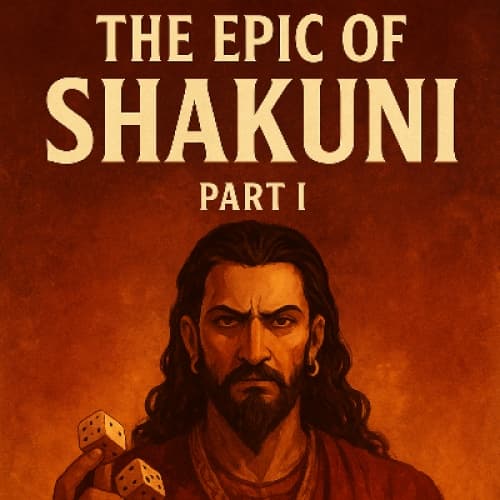
"'A tale of power, vengeance, and destiny - told through the eyes of one of Mahabharata’s most enigmatic players.”
INDEX
CHAPTER 1 – The Prince of gandhara
CHAPTER 2 – The Serpent in the Kuru Court
CHAPTER 3 – The Rise in Hastinapur & The Game of Dice
CHAPTER 4 – Shadows Before the Storm
CHAPTER 5 – The Gathering Storm
CHAPTER - 1
The Prince of Gandhara
The kingdom of Gandhara lay like a jewel on the northwestern frontier of Bharat, its valleys carved by the silver threads of mountain rivers, its hills whispering with the winds of centuries. Traders from far-off lands brought silks, spices, and precious stones, while bards sang of Gandhara’s learning and warriors. It was here, in the royal palace of stone and cedar, that a boy named Shakuni was born — the youngest son of King Subala and Queen Sudharma.
Shakuni’s birth was not accompanied by omens of fire or prophecy. Instead, the day was gentle, the monsoon clouds drifting lazily across the sky. Yet those who met the boy in his first years noticed an uncommon sharpness in his eyes — deep, calculating, and aware in a way that seemed far older than his years. He absorbed everything: the strategies discussed in the royal court, the movements of guards, the games played by ministers to gain favor. While his brothers wrestled in the courtyards, Shakuni preferred the quieter company of the palace library, where dusty scrolls spoke of forgotten wars and ancient diplomacy.
He loved the game of dice — not for its promise of wealth, but for the dance of chance and calculation it offered. The way a single throw could change the course of the game fascinated him. His uncle, an old Gandharan minister, once told him, “The board is the world, the dice are fate, but the hand that throws them… that is where skill lies.” These words would lodge deep in Shakuni’s mind, becoming a seed that would later bear poisonous fruit.
Yet life in Gandhara was not all games and learning. The political landscape of Bharat was a web of alliances and rivalries, and Gandhara — though wealthy — was often overshadowed by the vast power of Hastinapur. King Subala knew well that maintaining peace with the Kuru empire required delicate diplomacy. It was this awareness that led him to agree, years later, to the marriage of his beloved daughter Gandhari to the blind prince Dhritarashtra of Hastinapur — a union that would forever change Shakuni’s life.
When the news of the alliance was first announced, the palace erupted in debate. Some hailed it as a masterstroke — the sister of Gandhara’s princes becoming queen of the mighty Kurus. Others muttered in private that marrying Gandhari to a blind man was an insult. Shakuni, still a youth but already shrewd, hid his emotions behind a calm mask. But inside, a flicker of resentment began to grow — not toward his sister, but toward the court that had arranged her fate without regard for her own wishes.
The marriage itself was lavish, with processions of elephants, the sound of conch shells, and rivers of gold and silk exchanged as gifts. Yet behind the grandeur, there was unease. Gandhari, bound by duty, accepted her fate with the quiet dignity that would define her, even choosing to blindfold herself so that she might share her husband’s darkness. To the world, it was an act of devotion. To Shakuni, it was a silent cry — a sacrifice that deserved retribution.
The years that followed brought calamity. Under mysterious circumstances, King Subala and his sons — Shakuni among them — were invited to Hastinapur, only to be imprisoned. It is said that Bhishma, wary of Gandhara’s influence, feared that the large number of Gandharan princes could one day pose a threat to the Kuru throne. One by one, the brothers starved, the prison walls swallowing their laughter, their voices, their very lives.
But Shakuni survived. According to some tellings, his father, seeing no escape, decreed that Shakuni should be given the family’s last scraps of food so that at least one son might live to avenge them. Each day, Shakuni would divide the meager grain, taking the smallest portion for himself, yet still weakening until his bones seemed carved from shadow. By the time he was released, his gait had become uneven, a limp that would mark him forever.
The prison years hardened Shakuni. The boy who had once loved the play of strategy now carried the weight of blood-oaths and vendettas. When he emerged from Hastinapur’s dungeons, he was not simply the youngest prince of Gandhara — he was the sole surviving son of a slaughtered house, his mind sharpened into a weapon by grief and hunger.
Yet he was clever enough to hide that weapon beneath a sheath of charm. He smiled in court, spoke softly, and played the role of the devoted maternal uncle when Gandhari’s sons — the Kauravas — were born. In truth, each one of those boys became another piece on the great board in Shakuni’s mind, a game he had already begun to play.
He watched Duryodhana, the eldest Kaurava, with particular interest. The boy was ambitious, proud, and easily swayed by flattery. Shakuni began to whisper in his ear, feeding him visions of a Hastinapur ruled by Kauravas alone, free from the shadow of the Pandavas. Slowly, the bond between uncle and nephew deepened into something far more dangerous: a partnership founded on shared ambition and resentment.
But Shakuni’s vengeance was not to be rushed. The strategist in him knew that a single strike might bring temporary satisfaction, but a slow, calculated campaign could destroy his enemies entirely. He would bide his time, weaving himself into the very heart of Hastinapur’s politics until no one could remove him without unraveling the kingdom itself.
Thus, the stage was set. Shakuni, survivor of Gandhara’s fall, would become the quiet architect of one of the greatest tragedies in Bharat’s history — a man who played with kingdoms as other men played with dice.
CHAPTER - 2
The Serpent in the Kuru Court
The journey from Gandhara to Hastinapur was not merely a passage across rivers and forests; it was the crossing of a threshold into an entirely different world. Shakuni had travelled with a small retinue—officially to “visit” his sister Gandhari and her new family, but in truth, he carried the ghost of Gandhara’s dungeon in his heart, each step forward tightening the knot of purpose within him.
When the chariots rolled through the massive gates of Hastinapur, the city greeted him with a tapestry of power. Here, the very air seemed thick with ambition and protocol. High white walls gleamed in the sunlight, guards stood like carved stone, and the palace itself sprawled with the confidence of a kingdom that had never tasted real defeat. Shakuni’s dark eyes drank it in—the architecture, the bustling courtyards, the measured steps of ministers and soldiers. Everything was a clue, and every clue would be useful.
Bhishma was the first to receive him formally. The grandsire stood in his white robes, as unbending as the bow of the gods, his face carved with duty. Shakuni bowed low, letting the moment stretch. When their eyes met, it was not hostility that passed between them, but a kind of measured caution—two men who understood that the other was not to be underestimated.
Vidura was next. Unlike Bhishma, Vidura’s welcome was warm, almost too warm. But Shakuni could sense the steel beneath it. This was a man of justice, unbribable, who valued truth above politics—a dangerous quality in a court where lies often walked freely. Dhritarashtra, blind but towering, offered words of courtesy, and Shakuni replied with deliberate humility. In that first meeting, Shakuni marked them all—not with judgment, but with the cold detachment of a chess player assigning pieces to a board.
The young princes, however, were another matter. Pandu’s sons—the Pandavas—stood together, their bodies honed by training, their eyes bright with confidence. In them, Shakuni saw unity, discipline, and the dangerous allure of rightful claim. By contrast, Duryodhana, eldest of Dhritarashtra’s sons, stood slightly apart, his chin lifted in defiance, his eyes restless. That restlessness was Shakuni’s first opening.
Over the next weeks, the palace revealed itself to him. He learned who spoke to whom, who lingered in whose chambers, which ministers bowed too deeply to Bhishma, and which servants whispered to Vidura. Shakuni never asked directly; he simply listened. A careless word from a soldier, a muttered complaint from a minister, a servant’s nervous glance—all were stored in his mind like precious jewels.
It was during an afternoon of courtly games that Shakuni first spoke at length with Duryodhana. The young prince had been bested in a friendly wrestling match by Bhima and sat apart, glowering. Shakuni sat beside him, not with sympathy, but with a quiet observation.
“Strength wins the day,” Shakuni murmured, “but not always the war.”
Duryodhana turned sharply. “And what wins the war, uncle?”
“Patience,” Shakuni replied, his voice low, “and knowing which piece to move… and when.”
From that day forward, Duryodhana began seeking him out—not openly, but in the shadowed corners of gardens, or while walking the quieter palace halls. Shakuni never fed him outright malice; instead, he offered questions that planted roots.
Why must the sons of Pandu be treated as equal heirs? Why must Bhima mock your strength? Why does Bhishma speak more warmly to them than to you?
The questions worked slowly, like a serpent’s venom. Duryodhana’s pride, already raw, began to harden into resentment. And Shakuni fed that resentment with stories—not lies, but carefully chosen truths about Gandhara’s own losses, the cruelty of fate, the injustice of being overshadowed.
When the time came to consider the coronation of Yudhishthira as heir apparent, Shakuni was ready. He knew that Dhritarashtra’s heart was torn, that Bhishma’s will leaned toward the Pandavas, and that Vidura’s counsel would follow dharma even if it wounded his king. Shakuni’s counsel to Duryodhana was simple:
“If you allow them to rise above you now, you will spend your life bowing to them. But if you act before they are crowned, you decide the game.”
The Lakshagraha plot—the house of lac—was born in these whispering sessions. Shakuni never appeared in its planning; that would have been foolish. Instead, he spoke of opportunities and let Duryodhana and Karna execute the plan. When the Pandavas miraculously escaped, Shakuni neither gloated nor despaired. A failed move was simply a chance to prepare the next.
In the years that followed, his influence deepened. He taught Duryodhana the language of subtle power: controlling allies through obligation, sowing distrust between rivals, and—most importantly—letting others believe they acted on their own free will. Shakuni never shouted commands; he offered quiet nudges. And soon, the Kuru court moved not just to the will of its king, but to the rhythm of an unseen hand from Gandhara.
CHAPTER - 3
The Rise in Hastinapur & The Game of Dice
Hastinapur smelled of incense, iron, and old ambitions. For a man made of measures and motives, it was intoxicating. Shakuni arrived at court a foreigner with a limp and the quiet manners of a bereaved prince; he left every day with a little more of Hastinapur’s rhythm inside him. He watched its ceremonies and its silences, learned the cadences of praise and the pauses of accusation, and began to fit his thoughts to the court as if learning to play on a new, larger board.
He built his influence the way a mason builds a wall: one stone at a time. He cultivated small mercies — a well-placed compliment to a minister, a discreet lending of coin to a steward whose ledger balanced on the edge of disaster — and he repaid slights with an even subtler architecture of humiliation. The world of the palace was a lattice of favors and favors returned; Shakuni learned which threads, if loosened, would pull down more than a single robe.
Many mistook his constant presence at Gandhari’s side for devotion; in truth, the loyalty was real but it was braided with purpose. Gandhari’s blindfolded grace sheltered him. To the court he was the uncle whose grief had nobility. To Duryodhana, he was a confidant. To Vidura and a few others, he was merely a man they had seen suffer and thus hesitated to suspect.
Duryodhana mattered most to Shakuni because Duryodhana mattered to Hastinapur. Where Dhritarashtra’s blindness made him dependent, Bhishma’s honor made him inflexible, and Vidura’s conscience made him inconvenient at times, Duryodhana was a fulcrum. He was young, hungry for power, and quick to bristle when the world failed to bend toward him. Shakuni recognized the edges of the boy — pride, jealousy, a dangerously fertile resentment — and he began, patiently, to sharpen them.
“Strength wins contests,” Shakuni told him once beneath a pergola, where the city’s sound fell away into a private hush. “But strength is an instrument. It can chop wood or it can be swayed like a reed when the wind is caught right.”
Duryodhana’s mouth twitched. “And who teaches a prince to catch the wind?”
Shakuni’s smile was slow. “A friend who has seen what happens when wind is ignored.”
Their conversations were not direct lessons in treason; they were counsel wrapped in commonplace aphorisms and tales from Gandhara. He told stories of kings who trusted too much and fell, of generals who were loved but empty of will. He pointed to the Pandavas with an economy of words that made jealousy seem inevitable: “They laugh together in the training ground,” he said once, “as if fortunes were already divided among them. The people look at such laughter and think lineage is destiny.” He did not say you should stop it; he showed why it should be stopped, then left the rest to Duryodhana’s pride.
Shakuni also knew the court’s weak points intimately. He observed how Bhishma’s respect for ritual made counsel predictable, how Vidura’s devotion to dharma made him morally inflexible, and how Dhritarashtra’s love for his son often overruled his judgment. So he tailored each whisper. To Bhishma, a story of duty; to Vidura, a hypothetical about justice; to Dhritarashtra, a brotherly warning wrapped in filial reluctance. The harmony of the palace slowly became discordant, with Shakuni plucking the loose notes.
When opportunity presented itself, he did not hesitate to use it. The first such strike that left a visible mark on the court was deceptively small: a parcel of sweets, a carefully timed compliment, a momentary show of hospitality that turned into fear. Bhima, known for appetite and appetite’s laughter, was the intended recipient of a token presented at a feast — a small gift pressed into his hand as he stood near the lion throne. In the months that followed, Bhima fell sick after dining; it was not fatal, only a scare — an alarm bell rung in the ears of a household that believed itself invulnerable.
The episode passed through the court like a gust of cold air. Gandhari’s gloved fingers tightened on her veil when she thought of the sickened cousin; Dhritarashtra fretted and paced; Vidura muttered about fate. No one accused Shakuni aloud — for what accusation could be made against a man who had been broken and quietly restored, who wore grief like a badge no courtier dared to mock? But the seeds of dread had been sown. Bhima recovered, leaving behind a subtle but lasting awareness that the palace had enemies inside it — and that safety in Hastinapur was no longer an article of faith.
Shakuni’s true craft lay in turning that fear into leverage. He did not gloat over the poisoning; he allowed its suggestion to hang like fog. He talked to Duryodhana about risk and reward while their conversation seemed merely a pleasant interchange. He introduced the concept that true sovereignty was not simply the crown but the ability to decide who would sit beneath it. He taught Duryodhana to dislike the idea of sharing power, not because it was immoral, but because it was antithetical to the principle of rulership as command.
To many of the Kauravas, Shakuni became an interpreter of the court — the man who made the world’s ambiguities simple. To the Pandavas, he remained a curious figure: foreign, polite, and oddly persistent. But Shakuni’s design required more than whispered resentments and a poisoned cake; it required a public demonstration of vulnerability and honor that could be exploited. That demonstration arrived in the form of a game.
In Hastinapur, the game of dice was no mere diversion. It was ritual, method, and an accepted instrument of settling disputes and wagers. The board was polished by centuries of play, the dice were tokens that men believed could carry fate. For Shakuni, the game offered theater and a mechanism with which to weaponize the court’s faith in luck and duty.
He began to teach Duryodhana not only to gamble but to believe in the ritual’s absoluteness: that a king who won would be divinely validated, that a king who lost had invited his destiny. He showed the prince how to play with a certain bravado — how to bait an opponent into trusting their own honor, only to watch the opponent stake more than they could afford to lose.
The first move was subtle: a friendly match with Yudhishthira under the pretext of mending fences, which gradually escalated each time into higher stakes. Shakuni suggested wagers carefully — small at first, then larger — until the pattern made the players comfortable with jeopardy. He made sure the dice would be seen and handled by those who would feel their pull; he made sure rumors of luck and curse would intermingle in the hallways. Each suggestion was framed as a test of character, a way to show who deserved the praise of Hastinapur. It was, to many, merely sport. To Shakuni, it was the perfect engine.
Who would throw the dice in the critical game? Shakuni prepared an answer for that, too. The bone dice he kept hidden in the fold of his robe were not merely souvenirs of his father; they were instruments of the only kind of justice he believed in: a justice meted out by providence when aided by human hands. He polished them, carried them like a talisman, and let tales of their reliability float through the corridors like the scent of incense.
Even Gandhari, who carried blindness as both penance and solidarity, grew uneasy with the slow eddies of enmity. Once, she caught Shakuni alone in the corridor and looked at him without the veil. The court, seeing only her blindfold, misread the exchange as private family counsel; Shakuni read it as accusation.
“Brother,” she said softly, “you promised me you would guard our name.”
He met her eyes and did not flinch. “I guard it,” he replied. “In ways you cannot yet understand.”
She believed him — or chose to — and folded her veil more tightly. Her faith wrapped around him like a banner; his resolution tightened like a bowstring.
As the months unfurled, the court’s undercurrents swelled toward a visible current. Invitations to an official game were drafted as if by accident, rumors were allowed to drift into the ears of nobles who loved spectacle, and subtle commentaries on honor and destiny multiplied in the halls. Shakuni’s hand moved invisibly, deft as any player keeping count of pips.
When at last the formal challenge was issued — a public game with high stakes and witnesses — Shakuni stood at the center he had chosen for himself: the architect of the match, the mentor who had planted impatience in Duryodhana’s chest, and the man who held, in his palm, the bones that had become his family’s last testament.
The pieces were set. The board shined. The bone dice lay wrapped and waiting. Hastinapur, in its confidence, prepared to watch a game; Shakuni prepared to decide a fate.
CHAPTER - 4
Shadows Before the Storm
Shakuni watched the Pandavas leave Hastinapur in silence, their heads bowed in humiliation, Draupadi’s unbound hair trailing like a banner of wrath. The great hall that had echoed with laughter during the game of dice now seemed hollow, haunted by the memory of her curse and the tension in the air. For most, the matter was over—the Pandavas had been defeated and exiled, their fate sealed for thirteen long years. But for Shakuni, it was merely the beginning of the next act. Victory in a single game was not enough; he wanted the very roots of the Pandavas’ strength to wither until they could never rise again.
In the days following their departure, the court of Hastinapur buzzed with unease. Wise men whispered that Duryodhana’s triumph had gone too far, that the humiliation of noble kin would one day bear bitter fruit. Yet Shakuni moved among the murmurs with calm assurance, like a shadow weaving itself through the corridors. He knew the Pandavas were resilient, that exile in the forests would only sharpen their resolve. So he worked quietly to poison the channels of peace before they could ever reopen.
Whenever Bhishma or Vidura attempted to speak of reconciliation, Shakuni was ready with a dozen reasons to delay, to doubt, to inflame Duryodhana’s pride. He would remind his nephew of the insult of Draupadi’s laughter when she mocked him in the palace of illusions. He would speak of how the Pandavas’ exile was a divine justice, and that their return would only bring instability to the throne. His words dripped like venom into the ear of a willing listener, for Duryodhana’s heart already burned with the need to hold what he had taken.
Years passed. In the forests, the Pandavas endured hardship with the patience of warriors, but their name still carried weight among kings. Shakuni saw to it that Hastinapur’s envoys painted them as fallen princes, unfit to rule, wanderers sustained only by pity. Yet beneath the surface, he knew they were gathering strength—Arjuna’s journey to win celestial weapons, Bhima’s relentless training, Yudhishthira’s unbroken dignity. These were threats no wall could keep out, so Shakuni turned to diplomacy’s darker arts.
One by one, he tightened Hastinapur’s grip on neighboring kingdoms. Where friendship with the Pandavas lingered, he sowed suspicion. Where neutrality stood, he offered alliances sealed with gifts and flattery. If a king wavered, he whispered doubts about the Pandavas’ survival through their long exile. He orchestrated marriages that bound doubtful rulers to Duryodhana’s cause, and forged treaties that promised mutual defense in the event of “Pandava aggression.” Each move was a stone in the fortress he built around Hastinapur’s power.
When the thirteenth year drew near and whispers arose that the Pandavas had returned in disguise, Shakuni’s vigilance doubled. He urged Duryodhana to send spies, to test every rumor, to prepare for their inevitable demand for Indraprastha’s return. And when the truth could no longer be denied—that the Pandavas had fulfilled the terms of exile—Shakuni stood in the court and spoke of danger, not justice.
“They have returned,” he told Duryodhana, his voice low but sharp enough to cut through the council’s debates. “They come not as humble petitioners, but as men who believe the gods themselves have restored their right. If you yield now, you hand them the throne. And if you fight later, you will face them at the height of their power.”
Thus began the final unraveling of diplomacy. Even as Krishna himself came to mediate, offering peace in exchange for merely five villages, Shakuni advised refusal. To him, any concession was weakness, and weakness was the first crack in a dam. He fanned Duryodhana’s arrogance until the offer was rejected with insult, sealing the fate of all present.
In the final days before war, Shakuni moved like a general before a battle, arranging allies, confirming pledges, and ensuring that when the Kurukshetra field was chosen, Hastinapur would stand ringed by loyal kings. Yet in the dark corners of his mind, he knew the risk. The Pandavas were not foes to be taken lightly. But Shakuni’s hatred ran deeper than caution. For him, the war was not merely Duryodhana’s fight—it was the culmination of years of vengeance, the settling of an ancient score born in Gandhara’s ashes.
And so the road to Kurukshetra was paved—not by the march of armies alone, but by the whispers, schemes, and relentless counsel of one man who had turned the wheel of fate until it could no longer be stopped. The day was fast approaching when the world would tremble under the clash of kin, and Shakuni, ever the shadow at the throne, awaited it with the patience of a serpent coiled for the final strike.
CHAPTER - 5
The Gathering Storm
The days following the final insult to the Pandavas were unlike any Hastinapur had known before. The city seemed cloaked in an unshakable heaviness. Messengers came and went with news from distant kingdoms. Armies began to move. Metal rang in the forges as armor was beaten into shape. Banners were dyed in the colors of rival houses, and the sound of drums echoed across the land.
In the marble corridors of the palace, Shakuni moved like a shadow — silent, watchful, always calculating. To the courtiers he was merely the ever-present maternal uncle of Duryodhana, but to those who truly knew the pulse of power, he was the invisible hand guiding events toward a collision from which there could be no turning back.
The Pandavas, now returned from exile and determined to reclaim their rightful share of the kingdom, had sent word to Hastinapur: they sought peace, but peace with justice. Shakuni had listened to Duryodhana’s first angry reaction, then placed a firm hand on his nephew’s arm.
“Peace, dear nephew,” he had said, his voice calm, his eyes cold. “Peace is the language of the weak. They seek half the kingdom? Give them nothing. Not even the space to place a single pin. Force their hand. If war is to come, let it come on your terms.”
Duryodhana’s jaw had tightened. The seed Shakuni had planted years ago — the belief that Hastinapur belonged to him alone — had now grown into an unshakable tree.
Meanwhile, preparations for war gathered momentum. Chariots gleamed under the sun as artisans and smiths worked day and night. Elephants, their tusks capped in iron, were painted with bright symbols of victory. Horses were fed and trained for the march.
And beyond Hastinapur, the alliances were forged. The Kauravas had the support of mighty Bhishma, the venerable commander, though his heart was torn. Drona, the revered teacher, had pledged his loyalty to the throne. Karna, fierce as the sun, stood like an unmovable mountain beside Duryodhana. And at the center of it all, whispering, weaving, calculating, was Shakuni.
But even the most cunning plans cannot ignore the will of fate.
Krishna himself arrived in Hastinapur as the envoy of peace, draped in simple yellow robes, his eyes holding the calm of the ocean and the fire of the sun. In the royal court, he spoke not as a warrior, but as a guardian of dharma.
“Return to them what is theirs,” he urged. “Let not this land drown in the blood of brothers. Rule with justice, not with greed. This is your final chance.”
The court fell silent. All eyes turned to Duryodhana.
But the prince, proud and unyielding, rose from his throne and laughed — a laugh as sharp as steel. “Krishna,” he said, “you speak as though I am to beg from them. I will not. If they want land, let them take it — if they can. My resolve is firm. I will not give them land enough to drive a needle into.”
Krishna’s gaze hardened, yet he did not raise his voice. “So be it,” he said, turning away. “You have chosen war. Remember — war will choose its price.”
The die was cast.
From that moment, the roads of Aryavarta trembled under the weight of marching armies. From the northwest came the fierce Gandharan warriors, answering Shakuni’s call. From the east, allies loyal to Karna. From every corner of the land, chieftains and kings brought their spears, their shields, their dreams of victory — or plunder.
The Pandavas, too, gathered their allies. The mighty Drupada of Panchala, the warriors of Matsya, the brave Chedis, the Yadavas led by Satyaki, and countless others took up arms. Krishna, now no longer an envoy but the charioteer of Arjuna, prepared himself for the inevitable.
On the plains of Kurukshetra, tents rose like a city of war. The ground was marked for chariot lanes, supply camps, and command posts. Drums thundered in the evenings, horns called the warriors at dawn. And in the quiet moments between, men sharpened their swords and whispered prayers to gods who might or might not be listening.
Shakuni’s tent was always lit deep into the night. There, he poured over maps and scrolls, discussed formations with Duryodhana, and whispered strategies that reached far beyond the battlefield. He knew that war was not only fought with weapons, but with the mind — with misdirection, with careful manipulation of pride, fear, and anger.
On the eve of battle, the air was heavy with dust and anticipation. Bhishma stood at the head of the Kaurava army, his banner of the golden palmyra fluttering in the wind. Across the field, Arjuna’s chariot shone beneath the morning light, the emblem of Hanuman on its flag.
Duryodhana came to Shakuni one last time before the first conch was to sound. “Mama,” he said quietly, “is there any path left now but war?”
Shakuni placed a hand on his nephew’s shoulder. “No, my prince. We have walked too far to turn back. The wheel has been set in motion. All that remains is to guide it to our victory.”
Far in the distance, a breeze stirred the dust over Kurukshetra. Warriors tightened their armor. Charioteers gripped their reins. Drummers raised their sticks.
And then, as the first rays of the sun touched the field, a single conch was lifted to the lips of a warrior.
The sound did not come yet — for the world seemed to hold its breath.
The story of Shakuni, Duryodhana, and the fate of two great houses would now move to the rhythm of war.
To be continued in the next book…
Synopsis
The Epic of Shakuni: The Prince of Gandhara unveils the untold saga of one of the Mahabharata’s most fascinating and misunderstood figures. Born as the youngest prince of the wealthy kingdom of Gandhara, Shakuni grows up amidst courtly intrigue, ancient rivalries, and the looming shadow of the Kuru empire.
What begins as a life of quiet learning and strategy turns into a journey of vengeance when fate delivers a crushing blow to his family. Imprisonment, loss, and betrayal sharpen his mind into a weapon — one he will wield not with the sword, but with whispers, schemes, and the roll of dice.
From his first subtle influence over the young and ambitious Duryodhana, to the infamous game of dice that sends the Pandavas into exile, Shakuni becomes the silent architect of a conflict that will engulf kingdoms. Yet, beneath the plotting lies a man shaped by loyalty to his sister, pride in his fallen homeland, and an unyielding desire to rewrite destiny.
As alliances form, envoys fail, and the drums of war echo across Aryavarta, Shakuni’s hand guides events toward the inevitable battlefield of Kurukshetra. This is not merely a retelling of war — it is the story of the mind that set it in motion.
This is Part I of a larger saga, ending on the eve of the Great War, and leaving readers at the brink of history’s most legendary clash.