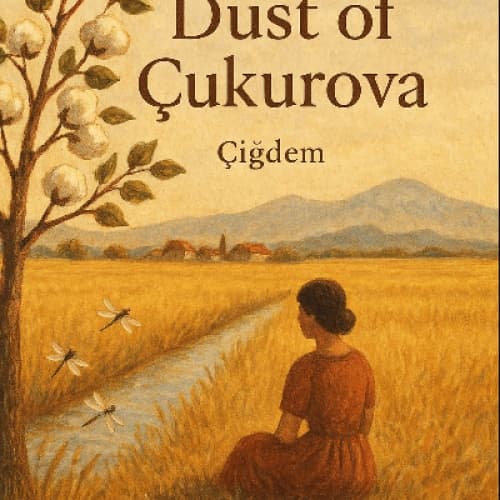
As the late summer light faded, Cigdem sat beneath the cotton tree, its trembling leaves murmuring secrets to the breeze. The plains of Cukurova stretched endlessly before her, golden and dry, like pages of a forgotten book. She had returned after twenty years, not to reclaim anything, but to remember.
The village had changed. The old coffee house or kahve in local language where her grandfather used to play backgammon with friends had been swallowed by a new road. Yet the scent of the soil - earthy, sunburnt, and stubborn - remained the same.
Cigdem had once believed that leaving Cukurova would free her from its slow sadness. In Istanbul, she had tried to become someone else: an artist, a scientist, a woman of ideas. But melancholy followed her like a shadow stitched to his heels. It was not the kind that came from heartbreak or failure, but from the weight of time, and the beauty of things lost.
She stepped to the edge of the irrigation canal, where dragonflies hovered like fleeting thoughts - too delicate to hold. The water shimmered, mirroring the sky's quiet indifference. Her grandfather's voice echoed in her memory, telling tales of his youth in Tarsus - of sweet roots that could be eaten, of friendships long faded but never forgotten.
She remembered falling from the bike while riding alongside her brother. The scar from that fall still lingered - a quiet reminder of a time when the hospital was miles away and their parents too preoccupied to notice. She used to play in the mud with the village children, shaping vases and filling them with tiny summer flowers. They turned a simple glass plate with playful ridges into a game, sipping soda from its edges like a shared secret.
She recalled how her brother once reminded her of the time they celebrated his birthday by making an omelette together. Though she had no memory of it, she could see how much it meant to him - so she smiled and played along.
In the quiet of evening, Cigdem sat alone in the apartment built where her childhood home once stood. The walls, once bright white, had faded to a tired yellow. She opened a drawer and found a photograph: her father, smiling faintly, holding a microphone in one hand and a bouquet in the other. She gazed at it for a long time, as if waiting for the image to speak.
Outside, the wind carried the scent of cotton and dust. Cukurova was still here, vast and patient. And Cigdem, like the characters in novels, understood that melancholy was not something to escape, but something to live with - like the silence between verses, or the shadow beneath a tree.