
The ghost town simmered under curfew. The authorities had sealed off the streets in response to yet another violent protest. Word was that the army had shot a boy in the face near the city’s iconic clock tower during the usual Friday unrest.
Asmat was livid. Trapped indoors, she raged silently—not just at the army or the government, but at the militants, the protesters, and even the boy who had chosen the wrong day to die. She couldn’t stop thinking about Sheeba. About their last meeting in the botanical garden. About that kiss—soft, urgent, electric. Nothing in her life had felt so certain before.
She didn't know if Sheeba felt the same. But Asmat loved her, unconditionally, recklessly. That had to be enough. With desperation and longing curling inside her like smoke, she stepped onto the balcony and called Sheeba. Whispering urgently, she begged her to find a way to come. Somehow. Anyhow. A strange unease crept over her — a cold, nameless fear — as if the air itself had become too heavy to breathe.
After much pleading, Sheeba agreed to convince her father to drop her off in his official police car. Asmat’s heart soared. She would finally tell Sheeba everything — lay it all bare. For a moment, despite the smoke and sirens, the sky felt lit with invisible rainbows.
In her nervous excitement, Asmat accidentally knocked over a flowerpot. It fell from the balcony and landed with a loud clang on the tin sheet covering the pavement below. The sound echoed like a gunshot through the silent street.
The soldier stationed nearby, jittery and primed for conflict, panicked. Seeing movement on the balcony, he raised his rifle and fired. Asmat instinctively ducked, hands over her ears, still clutching the phone. On the other end, Sheeba was speaking louder, straining to hear. She never heard the shots.
Two bullets tore through her lungs. One pierced her throat.
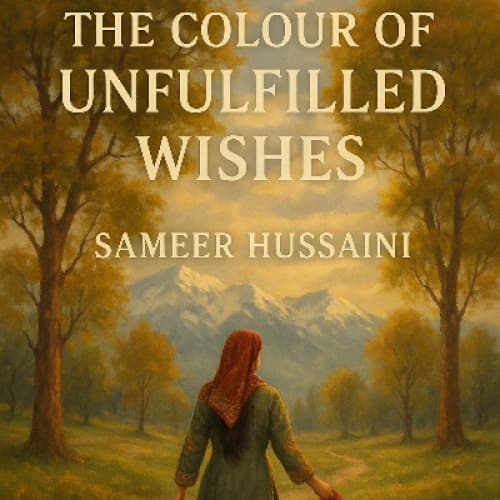
Asmat died believing she'd hold Sheeba again. The balcony was drenched in blood—the colour of unfulfilled wishes, of a love that never had the chance to become real.
In her final moments, her thoughts were not of pain, but of all the words she never got to say. She saw Sheeba’s face — the way she smiled when nervous, the softness in her eyes when they last kissed in the garden. Asmat had imagined telling her everything, imagined a future with quiet mornings, secret notes, maybe even a life far from this chaos. All of it now dissipated like smoke in the stormy air.
She regretted not saying “I love you” aloud. Not once. She had waited for the perfect time, a perfect moment that would never arrive. The world had stolen not just their future, but the confession that might have made the present more bearable.
Even as her vision dimmed, she hoped Sheeba would somehow understand — would know that her love had been fearless and complete, even if it was never spoken clearly enough to echo back.
And somewhere, deep in the fading rhythm of her heart, she prayed for a different world. One where two girls could love each other without fear, without curfews, without bullets mistaking flowerpots for war.