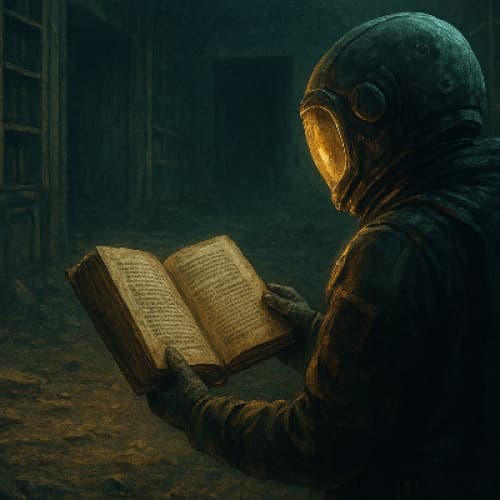
The ruins of Mars Station Nine lay under a patient shroud of red dust.
It wasn’t the coarse grit of the open plains, but a finer powder—older than any living forest on Earth, so ancient it seemed to remember the shape of the winds that had carried it a billion years before humanity even breathed.
It swirled lazily through the air as Kael Asher stepped inside, weightless in the station’s failing gravity. His helmet lights carved pale cones into the darkness, catching the slow tumble of frozen debris.
The silence here was not the quiet of peace—it was the suffocating stillness of something long dead.
Kael’s boots sank into the dust like snow. The metallic groan of his own steps echoed against the hollow corridors. He passed rusted bulkheads warped from thermal collapse, panels hanging like broken ribs from the skeletal frame of the station.
There had been thousands of people here once, their laughter and chatter flowing through these halls like warm air. Now, there was only his own breathing in the helmet, steady and loud, a sound that seemed almost obscene in the stillness.
Officially, no one was allowed here. The Winter Collapse—a chain reaction of failed life-support systems—had flash-frozen the station in a single night, killing everyone in their sleep. Rescue ships had arrived too late, and by the time the Core authorities came to investigate, the structure had been deemed too unstable to enter again.
But archivists like Kael did not follow such decrees.
The dead could not protect their secrets.
He entered the Central Archive Chamber, expecting more of the same—bare walls, the shattered husks of ancient holo-crystals, gutted racks where memory cores had once glowed. The NeuroNet had made such things obsolete centuries ago; the galaxy’s entire knowledge now pulsed invisibly through the collective mind.
And yet—
Something in the farthest corner of the chamber caught his eye.
Half-buried under a slab of collapsed ceiling plating was a rectangular object.
Kael’s pulse stuttered.
Objects with such sharp, clean geometry didn’t belong here.
He knelt, brushing centuries of dust aside with a gloved hand, until his fingers met a texture unlike the cold, unfeeling steel of the station. It was… organic.
He pulled it free.
It was heavier than expected.
A book.
Not a holo-slate. Not a crystal drive.
Paper.
Its cover was bound in worn, dark leather, the edges softened by age. The moment it touched his hands, the air in his helmet felt different—sharp, almost metallic, as though the object carried an electrical charge.
Across its surface, faintly embossed in gold, was a date:
2025.
Kael’s breath misted the inside of his visor. This was impossible.
Paper books had vanished over a thousand years ago; the oldest known fragment sat sealed in the Core Museum under deep stasis. This one… it looked as if it had been printed yesterday.
He opened it. The first page was blank—except for a single handwritten line in a language his neural implants refused to translate.
And yet, without knowing why, he understood it perfectly:
“This record will not be found until it is too late.”
He turned to the next page—and froze.
It was not a story. It was a log.
It described, with impossible precision, events that would happen tomorrow:
The NeuroNet’s global pulse skipping. The blackout in the Andromeda Ring. The flicker of every lightscreen from Sol to Vega.
And the exact moment when Kael Asher would stand in the ruins of Mars Station Nine, holding a book that should not exist.
The final line on the page made his chest go cold.
“And after reading this, Kael Asher looked up and saw the shadow in the doorway.”
Kael’s helmet lights caught movement.
Someone—or something—was standing there.