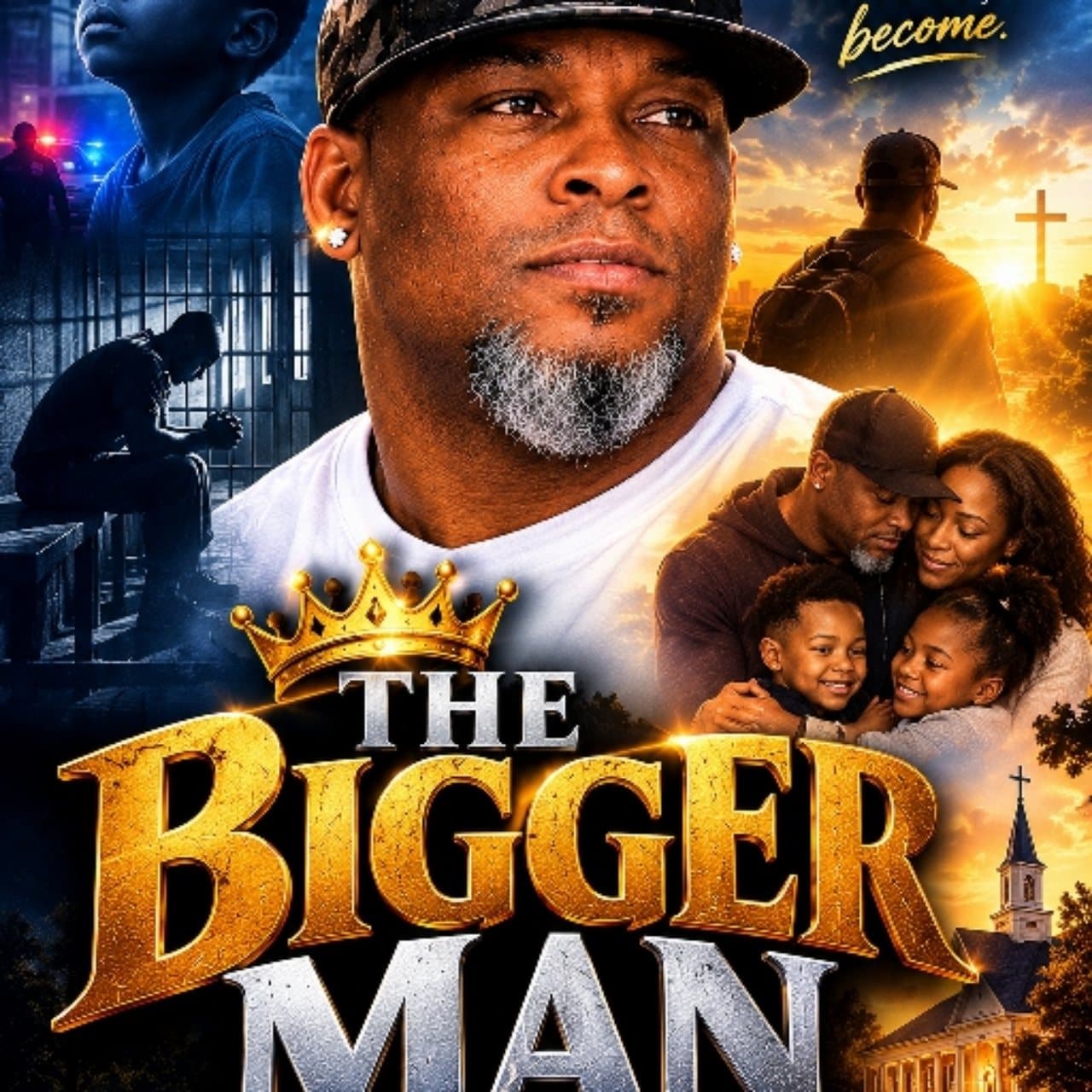

From Troubled to Peaceful
By Terrance J. Fields
The blue lights flashed across the front porch, painting the walls in shades of red and blue.
Four-year-old James McGuire stood near the doorway, watching strangers prepare to take him away from the only home he knew. Neighbors stood outside, whispering. His mother was nowhere to be seen.
“They’re just going to help your mama,” someone told him.
ames didn't understand what that meant. He only understood that Mama wasn't coming with him.
That night, he entered a world where children learned to live out of plastic bags, where beds were temporary, promises were fragile, and love often came with an expiration date.
He was too young to understand addiction. Too young to understand why his mother couldn't get better. But he was old enough to feel abandoned.
By the time he was eight, his mother was gone for good.
He watched as adults moved around the house, speaking in hushed voices. When the body bag passed, James didn't cry. He simply wondered whether his mother had finally found the peace that life had never given her.
After that, the foster homes blurred together.
Some families showed kindness. Others treated him like another responsibility they had been paid to accept. James learned to smile when people watched and hide his feelings when they didn't.
Adults called him difficult.
James called it surviving.
He didn't know it then, but every disappointment was building a wall around his heart. And behind that wall, a little boy was waiting for somebody to prove that he mattered.
Nobody seemed to notice.
Or perhaps they noticed and didn't know how to reach him.
Either way, James was learning the wrong lesson: if nobody was going to protect him, he would have to become somebody people feared.
And fear, he would discover, could be mistaken for strength.
THE HOUSE THAT CHANGED HIM
At nine, James was placed in a white house with red shutters on Maple Street.
His new foster mother, Mrs. Threadwell, kept the house spotless. The air smelled of lavender and coffee, and her husband seemed quiet and dependable.
For a little while, James allowed himself to imagine that he might finally belong somewhere.
He spent hours outside playing basketball with a battered ball and a cracked rim. It wasn't much, but the backyard offered something he rarely experienced: a little quiet.
Then the questions started.
The looks changed. Adults whispered. An investigation followed, and before James could understand what was happening, he was being moved again.
Another house.
Another bed.
Another beginning that wasn't really a beginning at all.
Something inside him broke on Maple Street. It wasn't only his trust in that family. It was his belief that grown-ups could keep him safe.
He stopped asking questions. He stopped expecting explanations. He learned to disappear while standing right in front of people.
The anger came slowly at first.
Then it grew.
By thirteen, James was stealing, fighting, and making choices that seemed to confirm what people already believed about him. His first arrest came after he stole a bicycle.
As the officer placed handcuffs around his wrists, he said, “Guess we finally caught up with you, kid.”
The words followed James into juvenile detention.
Caught up with me?
He had been running his entire life. Running from grief, rejection, disappointment, and the constant fear that nobody would ever choose him.
But nobody in that courtroom wanted to hear that story.
They saw a boy who had broken the law.
James saw a boy who had never learned how to stop hurting.
Juvenile detention became a familiar place. Fights and theft followed him, and every return made it easier to accept the identity people had given him.
One therapist asked what made him so angry.
“Breathing,” James answered.
She wrote something down.
He wasn't trying to be clever. He was tired of living inside a world that seemed determined to remind him he wasn't wanted.
By seventeen, people had stopped calling him troubled.
Now they called him dangerous.
James began to believe them.
BEHIND THE WALLS
Prison didn't surprise him.
When the cell door slammed shut, James felt as if the world had finally stopped pretending there was a place for him in it.
The days became a routine of metal doors, hard surfaces, loud voices, and long stretches of silence. He had spent his childhood moving from place to place, but prison was the first place where he knew exactly where he would wake up every morning.
That certainty came at a price.
At first, he fought to establish himself. He believed that if people feared him, they couldn't hurt him. But bruises didn't heal the emptiness inside him, and winning a fight never made him feel like a winner.
After a period in solitary confinement, he began to understand something he had never considered before.
Maybe he was exhausted from trying to prove he couldn't be broken.
He started listening to the older men around him. He listened to prisoners who had spent years behind bars. He listened to the preachers who visited on Sundays.
One older man gave him a piece of advice that James initially dismissed.
“Forgiveness ain't for them,” the man told him. “It's for you.”
James almost laughed.
Forgive the people who had failed him? Forgive the world that had taken so much from him? Forgive himself for all the damage he had done?
He wasn't ready.
But the words stayed with him.
For three years, he watched the sunrise through the same prison bars. And somewhere between the endless days and the quiet nights, James began to recognize the one person he had never held accountable for his future.
Himself.
He couldn't change what happened to him as a child. He couldn't bring his mother back. He couldn't undo the pain that had followed him into adulthood.
But he could decide what happened next.
That decision didn't arrive with thunder or a miracle. It came quietly, almost unnoticed.
One day, James simply decided he was tired of being angry.
He didn't know how to become a better man yet. He only knew he didn't want to remain the man who had entered that prison.
When his release finally came, he walked through the gates with little money, no clear plan, and a promise.
I won't die the same man who came in here.
For the first time, the future belonged to him.
He just had to figure out what to do with it.
THE MAN WHO SAW MORE
Freedom was harder than James expected.
He had imagined that leaving prison would feel like opening a door to a new life. Instead, he found himself broke, uncertain, and sleeping in a shelter that seemed filled with other people who had run out of chances.
He needed work.
More than that, he needed somebody to believe he could do something worthwhile.
One afternoon, a man named Patrick Wells approached him.
Patrick wore a pressed suit and carried himself with the quiet confidence of someone who didn't need to prove anything.
“Looking for help, son?” he asked.
“I'm looking for work,” James replied.
“Then you found both.”
Patrick owned a small cleaning business. He knew James had a criminal record, but he didn't treat him as if that record were the only thing worth knowing about him.
He cared about whether James showed up, whether he worked honestly, and whether he was willing to learn.
James got his chance.
His first paycheck wasn't much, but it meant something. Patrick even taught him to set aside ten percent for giving. James didn't understand the lesson at first, but he was beginning to discover that Patrick saw life differently.
Patrick didn't simply talk about responsibility. He demonstrated it.
He worked alongside his employees. He treated people with respect. He prayed for his business and showed gratitude for the opportunities he had.
He taught James to budget instead of spending every dollar, to breathe before responding in anger, and to solve problems without turning every disagreement into a battle.
One evening, after a long day, Patrick looked at him and said, “James, you've been fighting life your whole life. Maybe it's time to start living it.”
James didn't answer.
But the words reached a place that years of punishment had never touched.
Patrick began taking him to church. James sat in the back the first time, arms crossed, prepared to leave if anybody made him feel unwelcome.
Nobody did.
The music filled the room. People prayed. For once, James wasn't being introduced by his mistakes.
Patrick never forced his faith on him. He simply lived it in front of him.
And slowly, James began to believe that perhaps God hadn't abandoned him after all.
“You don't have to be the man your past says you are,” Patrick told him one day. “You can be the man your future needs you to be.”
For the first time, James considered the possibility that his past was a part of his story, not the ending.
He was learning to work without resentment, listen without preparing an argument, and accept correction without treating it as an attack.
He still had rough days. Anger didn't disappear simply because he wanted a different life.
But now, he had someone reminding him that change was possible.
Then came the test.
THE CHOICE
It happened on a Tuesday evening.
James was locking up the shop when a familiar car pulled alongside the building. Behind the wheel sat Tyrone, an old friend from the neighborhood and a reminder of everything James had left behind.
“Jay!” Tyrone called. “Come here a minute.”
James approached cautiously.
“I hear you're working for some cleaning company now,” Tyrone said with a grin. “I got something better. Real money. Quick money.”
For a moment, James felt the old pull.
He remembered the excitement of easy money, the thrill of taking what he wanted, and the old belief that the fastest way forward was to take a shortcut.
His bills weren't going to pay themselves. His future wasn't guaranteed. And Tyrone was offering an opportunity that required no patience.
Just one decision.
James could feel the old version of himself reaching for the steering wheel.
“What you say, Jay?” Tyrone asked. “You coming or what?”
James thought about Patrick. He thought about the prison bars, the shelter, and the promise he had made when he walked out of prison.
He thought about how hard he had worked to become somebody different.
“I can't go back there, man,” he said.
Tyrone laughed.
“Man, you've gotten soft.”
Maybe James had.
Maybe he was finally learning that strength didn't require him to prove himself to everybody who questioned him.
“Call it what you want,” James replied. “I'm good.”
He turned and walked away.
His hands shook the entire time.
The decision had taken only seconds, but those seconds carried the weight of his entire life. He had never been so afraid of making the wrong choice because, for the first time, he had something worth protecting.
When James arrived home, Patrick was sitting on the porch.
The older man looked at him, studied his face, and smiled.
“You passed it, didn't you?”
James sat beside him.
“I almost didn't.”
“But you did.”
James looked down at his hands.
Patrick leaned back in his chair. “Temptation doesn't always come when you're weak, son. Sometimes it comes when you're finally getting strong.”
That night, James prayed.
He didn't ask for wealth or an easy life. He asked for the strength to keep becoming the man he wanted to be.
It was a small prayer.
But it was the beginning of a different kind of life.
SOMETHING WORTH BUILDING
James met Michelle at a little diner on Fifth and Maple.
He came in after work, wearing his cleaning uniform, tired from the day and carrying the usual weight of someone trying to rebuild his life.
Michelle was a waitress with a tired smile and an uncommon ability to make people feel seen.
“Rough day?” she asked as she poured his coffee.
“You could say that.”
She smiled. “Then let me fix that cup right. On the house.”
It was a small gesture, but James understood the power of small gestures. His life had been changed by people who offered him something without demanding that he earn their kindness first.
He returned to the diner.
They talked.
Michelle told him about her dream of going to nursing school and the two jobs she worked to keep moving forward. She had her own struggles, but she hadn't allowed them to steal her belief in tomorrow.
“Everybody's fighting something,” she told him once. “But not everybody keeps swinging.”
James knew he had found somebody who understood that life could hurt without having to destroy you.
A year later, they were married.
When their twins, Micah and Malia, arrived, James held them and cried harder than he ever had in his life.
He looked at their tiny faces and thought about the little boy who had spent his childhood wondering why nobody wanted him.
Now, two children depended on him.
He would never be able to give them a perfect world. He couldn't promise they would never experience disappointment or pain.
But he could give them something he had desperately needed himself.
He could be there.
He could keep his promises. He could listen when they were afraid. He could show them that love didn't have to disappear when life became difficult.
He could be their father.
Patrick stood beside him through the wedding and watched as James began building a family of his own.
“Second chances don't come easy,” Patrick told him, “but they sure come worth it.”
James carried those words with him.
He eventually built a cleaning crew of his own. Five men, one van, and a dream.
He had gone from a boy nobody seemed able to keep to a man responsible for other people's livelihoods.
For the first time, he wasn't merely surviving.
He was building something that could outlive him.
Life became peaceful in a way James had never experienced.
Then Patrick got sick.
THE LAST LESSON
At first, Patrick brushed off his illness.
“Just a bug,” he said.
But the days passed, and he grew weaker. The man who had once filled every room with his voice began speaking in whispers.
One evening, James and Michelle brought him dinner. Patrick smiled when they entered, trying to summon the strength to appear as though nothing had changed.
“Look at you two,” he said. “Y'all turned out all right.”
Later, Patrick asked James to sit with him privately.
The room was quiet.
Patrick reached for his hand.
“James, I need you to do something for me.”
“Anything.”
“Don't stop teaching. Don't stop giving chances. Somebody gave one to you. Be that for somebody else.”
James tried to joke that Patrick would be around to keep him straight.
Patrick shook his head.
“Son, I'm tired. But I'm not scared. God's been good.”
Two weeks later, Patrick died.
The church was packed for the funeral. People came from every corner of town, including people who had struggled, people who had been overlooked, and people whose lives Patrick had touched without ever asking for recognition.
James stood behind the pulpit, staring at the photograph of the man who had helped him find his way.
He had imagined losing Patrick many times during those final weeks, but imagining it hadn't prepared him for the silence that followed.
The man who had given him a chance was gone.
For a moment, James felt like that frightened little boy again, watching another important person disappear from his life.
But then he remembered Patrick's last request.
Don't stop giving chances.
James put aside the speech he had prepared.
“Patrick Wells taught me what being a man really means,” he told the congregation. “He showed me how to rise without stepping on other people. He taught me how to forgive, how to work honestly, and how to love without conditions.”
His voice trembled.
“He saw something in me when I couldn't see it in myself. And because he gave me a chance, I got to become a husband, a father, and a man who can look in the mirror without being ashamed of the person looking back.”
James paused, wiping his eyes.
“I can't repay him for what he did for me. But I can make sure somebody else gets the same chance.”
That was his goodbye.
And it was also a promise.
THE BIGGER MAN
Ten years later, James stood outside the same church where he had said goodbye to Patrick.
Only this time, the sign above the entrance read:
NEW HOPE MINISTRIES
PASTOR JAMES McGUIRE
He looked at the sign and smiled.
The name that had once carried shame now carried purpose.
Inside, the church was alive with conversation. His twins, Micah and Malia, were nine years old and dressed for Sunday service. Michelle stood near the steps, watching them with the same warmth that had first drawn him toward her.
James walked into his office before the service began.
On the desk sat a framed photograph of him and Patrick from years earlier. Both men were covered in paint after a job had gone wrong, and Patrick was laughing so hard that James could almost hear him.
Beneath the photograph were the words James had written years ago:
Don't stop giving chances.
That was the foundation of New Hope Ministries.
The church welcomed people who had been rejected elsewhere: former prisoners, struggling parents, people fighting addiction, and men and women who had begun to believe their mistakes were all they would ever be.
James understood them.
He knew what it felt like to walk into a room and wonder whether anybody could see beyond your past.
He knew what it meant to be judged before you had a chance to speak.
And he knew that sometimes the difference between a person giving up and a person trying again was one human being willing to say, “I believe you can do better.”
Every Sunday, James reminded his congregation that a person's worst decision didn't have to become the definition of their entire life.
“You can't rewrite your past,” he would tell them, “but you can start a new chapter today.”
After the service that morning, a young man approached him.
The man had tattoos running down his arms, nervous eyes, and the posture of somebody expecting rejection before it arrived.
“Pastor,” he said quietly, “I don't think God could ever forgive me.”
James studied him for a moment.
He saw the fear beneath the man's words. He recognized the shame, the guarded expression, and the belief that the world had already decided what kind of person he was.
James had worn that same expression once.
He stepped closer.
“Son, you can spend the rest of your life believing your past is too big for God,” he said. “Or you can start believing that grace is bigger than your mistakes.”
The young man looked down.
James gently lifted his chin.
“And you've got some work to do, too. You have to stop punishing yourself for the rest of your life. Take responsibility. Make things right wherever you can. Learn from what you've done. But don't confuse accountability with giving up on yourself.”
The young man's eyes filled with tears.
“Where do I start?”
James smiled.
“Right here. Right now. One honest decision at a time.”
As the young man walked away, James stood quietly in the sanctuary.
He thought about the boy who had lost his mother, the teenager who had been swallowed by anger, the prisoner who had stared through bars at a world he thought had forgotten him.
He thought about Patrick.
For years, James had believed that being a man meant never showing weakness, never backing down, and never letting anyone see how deeply life had hurt him.
He had been wrong.
The biggest man in the room wasn't necessarily the strongest, the loudest, or the one everybody feared.
Sometimes, the bigger man was the one who admitted he needed help.
The one who walked away from a fight he could have won.
The one who chose honesty when dishonesty promised an easier life.
The one who forgave without pretending the hurt had never happened.
And sometimes, the bigger man was the one who reached back for somebody else after finally finding his own way forward.
That evening, after the church had emptied, James locked the front doors.
The sun was fading, casting a warm glow across the parking lot.
He looked toward the sky and thought about the man who had changed his life.
“Thank you, Patrick,” he whispered. “I made it.”
For the first time, those words meant more than survival.
They meant he had become the man that little boy had needed all along.
And tomorrow, somebody else would walk through those church doors carrying a burden they believed was too heavy to bear.
James would be there.
Not because he had lived a perfect life.
But because somebody had once looked at a broken young man and seen more than his brokenness.
And now it was his turn.
THE END
The bigger man isn't the one who wins every fight. He's the one who learns when not to swing—and finds the courage to become somebody worth following.