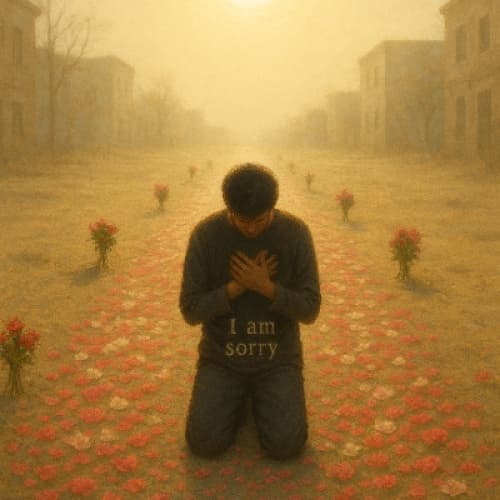

I emerged from the abyss into a world so bright it felt unreal. At first I thought the power had failed at home, but when I stepped into the light I realized this was not my street. It was deserted — no familiar faces, no open windows, only an empty silence that swallowed sound. The sun hung high, merciless and white; the world beneath it seemed to burn. Oddly, my skin felt numb to the heat, as if my body belonged to another time.
I began to follow a carpet of petals. They were laid out like a delicate road — petals strewn with quiet intent, small bouquets standing at intervals like trembling bookmarks of memory. Hope stirred in me: perhaps my loved ones had prepared a surprise, a hush of celebration meant to welcome me home. I walked on, heart full of a fragile, foolish expectation.
Then the truth came like a chill. It dawned on me — with a slow, sinking weight — that I had to go home. But my feet would not obey me. My steps refused to move forward. I stopped. I sank to my knees and wept, the sound raw and small beneath the unblinking sun. I could not bear the thought of returning because I could not face my parents’ shattered faces; I could not be the reason for their tears.
The darkness I had woken from folded itself into understanding: the blackness had been my coffin. This bright field was not a celebration but a graveyard. The carpet of petals was not a welcome but a procession. I had died, though the moment of it had been stolen from me , the how and when a blank I could not find. All that remained was the weight of what I had left unsaid.
Pressing my hands to my chest, I whispered into that cruel, indifferent light: “I am sorry. Forgive me for leaving you.” My parents and my loved one. It was a small, fragile apology, but it was the only thing I could give. In that moment, surrounded by petals and silence, I understood the endless ache of absence — and the desperate hope that those I loved might one day find peace with what I could not say while I was alive.