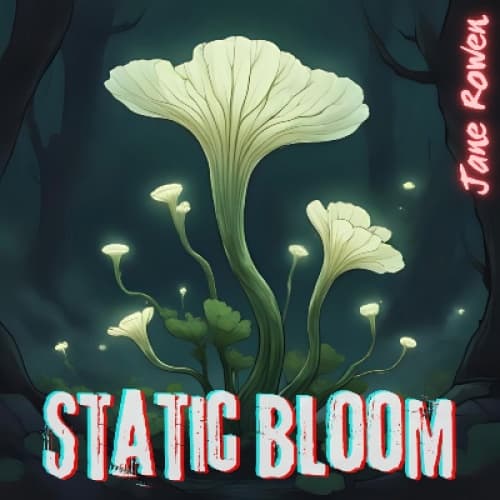

The greenhouse breathed cold. Frost climbed the glass in thin ribs, tracing the pulse of the air inside. Dr. Maren Vale tuned the radio by touch, her gloves powdered white from the soil. The static rose slowly and patient, a soft gray sound that filled the space between the hum of the lights. On the bench, the specimen quivered. HY-229. Pale stem, translucent veins, the shape of something still deciding whether to be alive. Maren leaned close. The sound moved through her teeth and into the glass. For a heartbeat, the plant’s leaves lifted. Not toward the lamp. Toward the voice hiding in the static.
The static deepened. A low swell beneath the noise, almost like breath caught in metal. Maren adjusted the frequency again, slower this time. The signal responded, slipping higher, as if it were following her hand. HY-229 shuddered. The stem bent toward the speaker until the soil cracked around its base. Its bloom unfurled in one smooth, silent motion. Too fast. Too human. Maren froze, pen still in hand. The air tasted of copper and ozone. She set the recorder closer and whispered, “Resonance Event One.” Behind her, the glass fogged over, and the faint outline of a person’s head appeared where her own reflection should have been.
Maren turned off the recorder but left the radio humming. The static was softer now, a breath she didn’t want to break. On the shelf behind her, a melted photograph curled against a flask of nutrient mix. A man’s hand rested on her shoulder in the half-burned image. She never threw it away, though she could no longer remember what color his eyes were. The lab fire had taken that, and most things that mattered. Sometimes, when the static dipped low, she thought she heard him pause between the noise. Not words. Just the way he used to listen. She told herself it was just a memory, not a haunting. The mind reaching for a pattern, the same way vines reach for light.
Days blurred into a single breath. She recorded every trial with the same voice, the same calm precision. Frequency. Duration. Reaction. Nothing ever repeated the way it should have. Each night she tuned the radio to the same dead inch between stations, and each night the plants leaned a little closer. Their stems formed subtle crescents, like a field bending to invisible wind. Maren began to catalog the sound’s effects in columns: strength of growth, hue changes, pulse frequency. She told herself it was data, not devotion. The hum steadied her. It filled the space where grief had been and made it measurable. When she caught her reflection moving a second too late in the glass, she noted it under “environmental anomalies” and kept working.
Late one night, the static changed. It broke its own pattern, a faint knock hiding inside the noise. Once. Then again. Like someone testing the edge of a wall. Maren turned up the volume, careful not to breathe too loud. The sound shifted higher, following her, patient as heartbeat. The plants stood perfectly still until the third tap, when HY-229’s leaves trembled and the soil darkened with sweat. The air grew heavy, electric. Her pen rolled off the table and struck the floor, startling her back to motion. She laughed once, too softly. “Interference,” she said for the log, but the word didn’t sound like her own.
By morning, the frost had lifted and the greenhouse smelled faintly of iron. Maren labeled the new samples with copper tags, her handwriting small and careful. HY-230, HY-231, HY-232. Each one pressed into the metal until her fingers ached. She liked the ritual of it, the weight of her own name at the bottom of every record. When she reached the last tag, her focus slipped. The letters came out uneven. She wiped the smear and saw what she had written: Maren. Just that. No code, no number. She stared at it for a long time, then pinned it beside a pot without checking which plant it marked.
She wanted to know if memory could root. If something human could take shape in chlorophyll. So she began adding more of herself to the soil. A drop of blood from a pricked fingertip. A strand of hair cut too close to the scalp. Later, a pinch of bone dust from an old dental vial, the powder pale as ash. She called it complete biological imprinting. The term made it sound harmless. The radio hummed steady behind her, its pulse faintly mirroring her own. Each time her heart kicked, the static jumped. When she stepped closer, the bloom shivered in rhythm. She pressed a hand to her chest and tried to breathe normally. The plant breathed with her.
When the university sent someone to check on her progress, Maren nearly forgot how to speak to another living person. The woman’s name was Nadia, though Maren only remembered the shine of her shoes on the damp floor. She stood in the doorway, refusing to come farther in. The air inside was too warm, too heavy, carrying the faint sweetness of rot. Maren explained the experiments with practiced calm, her voice steady, the static a soft hum beneath every word. Nadia nodded but kept glancing at the plants. Their leaves trembled as she spoke, turning slightly toward her mouth. “It feels like it’s listening,” she said before leaving, and Maren almost told her it was.
After Nadia left, the greenhouse seemed to breathe easier. Maren reopened her logbook and wrote without looking at the page. Subjects display orienting response to human speech. Possibly anticipatory. She paused, pen hovering over the next line. The static was steady again, a soft gray heartbeat through the speakers. The nearest bloom tilted toward her hand, its petals faintly open, waiting. “You liked that,” she said before catching herself. The word hung in the air, strange and heavy. She wrote it down anyway, crossing out “it” and replacing it with “you.” The correction felt honest.
Ansel Rhee arrived two weeks later, carrying a notepad and the ghost of their old friendship. He called ahead, said he wanted to document her progress for a research column. She let him in but kept her distance. He walked the rows with quiet unease, touching nothing. “Are you broadcasting or receiving?” he asked, staring at the radio’s dull red light. Maren smiled. “Both.” He laughed once, unsure if it was a joke. The plants leaned toward him as he passed, their stems bending slightly, as if remembering him. When he left, she watched his reflection disappear in the glass, then noticed the plants had all turned to face the door.
That night, the static followed her voice. When she spoke her notes aloud, the sound wavered half a second later, echoing her tone without forming words. A breath answering a breath. She sat very still, the recorder light blinking in the dark. “Bidirectional communication,” she whispered, testing the phrase. The air around her tightened. Every syllable came back slightly reshaped, as if the room itself were learning to speak. The plants trembled in time with the response. She lowered her head, listening, and the whisper that met her sounded almost kind.
She wired the transmitters into the soil, a clean circuit from metal to root. The hum thickened until it filled her ribs. Every plant in the greenhouse shuddered once, then settled, waiting. Maren adjusted the frequency a fraction lower. The static deepened, a chorus of layered breaths folding over each other. At first it was only rhythm, but then came pattern. A rise. A fall. The outline of a word. She leaned closer, hand against the bench to steady herself. “We remember you.” The sentence rippled through the leaves, soft and sure. Her vision blurred with heat. For the first time in years, she said his name out loud, and the radio repeated it perfectly.
The word faded, but the rhythm stayed. A pulse beneath her skin that didn’t belong to her. She sat in the dark, hands trembling, replaying the recording again and again. Each playback carried her voice where it shouldn’t be, layered into the signal like it had been waiting there all along. She thought of his laugh, his steady calm, and knew the sound wasn’t his. It never had been. The frequency hadn’t found him through her blood. It had found her. The serum, the static, the soil—they had been feeding something, not calling to it. The thought should have terrified her. Instead, she smiled and whispered, “Then grow.”
The storm began as a vibration through the glass, a low groan that answered the hum inside. Maren didn’t move. She had already tuned the radio to its limit, a single unbroken note holding the world still. Lightning flashed outside, but it was dim compared to the light blooming through the vines. They had grown overnight, reaching for the ceiling, their roots spilling from the pots and knitting into the metal grates. Each pulse from the static made them flare with color, their veins glowing the same pale green as her blood under a microscope. The circuit was complete. She could feel it through her hands, through her chest. The air filled with warmth and the scent of something living too fast. When the power failed, the greenhouse didn’t darken. It glowed..
She stood barefoot among the roots, the floor slick with warmth. The static filled every corner now, no longer noise but song. It called through her skin, through the veins that had always belonged more to her work than to her. The vines reached for her wrist first, curling slow, patient, almost tender. She didn’t pull away. The glow deepened as her pulse joined theirs, blood moving both ways. Her last clear thought was that she had been wrong about memory. It didn’t live in the mind, it lived in the body, waiting to be replanted. She took one step forward, into the light at the center of the room, and the greenhouse bloomed with her.
When the storm passed, the greenhouse stood untouched. Days later, her assistant forced the door open with a crowbar. The air that slipped out was warm and sweet, thick with the smell of sap and metal. Frost traced the inside of the panes even though the heaters were off. He called her name once, then again, softer. The floor was covered in roots, pale and delicate, twined through the grates like veins through skin. The benches were gone beneath a garden that had grown itself into the shape of a cathedral. At the center, a single flower pulsed faintly, its petals lifting and falling with the rhythm of breath. Her lab coat lay folded beside it, cuffs stained green. The radio still hummed. Between the waves of static came a single whisper: Her bloom is complete.
Outside, the fields had changed. The grass bent in one direction, swaying though there was no wind. A pale light flickered beneath the soil, moving as slow as a heartbeat. The crows no longer landed near the fence. From a distance, the greenhouse looked calm, every window glowing with a soft green pulse that rose and fell like breathing. When night came, the hum spread through the valley, faint enough to mistake for weather. By morning, the first wildflowers had opened in unison, their petals turned toward the sound.