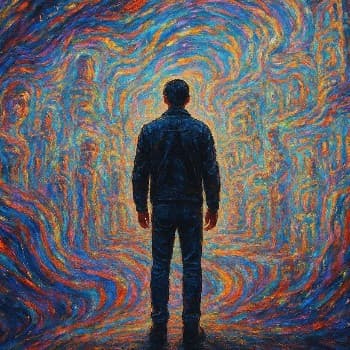
Chapter One: The Breach
The landscape outside the train window had flattened into the kind of monotony that made time feel negotiable. Dr. Marcus Reid watched Idaho scroll past—sagebrush, basalt outcroppings, the occasional farmhouse set back from the tracks like a period at the end of a long, dusty sentence. He'd made this trip dozens of times over the years, enough that his body knew the rhythm of the rails, the particular sway and clatter that meant he was two hours from Boise.
He had a stack of midterm exams in his lap, blue-book essays on quantum entanglement that his students had labored over with varying degrees of comprehension. Marcus had graded three of them, his red pen moving with the practiced efficiency of someone who'd seen every possible misunderstanding of Bell's theorem. The fourth exam sat open before him, but he'd been staring at the same paragraph for five minutes, his attention drifting to the window, to the approaching visit, to the vague guilt that always accompanied these trips home.
It had been eight months since he'd last seen his parents. Too long. His mother had said as much on the phone last week, her voice carrying that particular blend of affection and reproach that only mothers could perfect. We're not getting any younger, Marcus. His father had been quieter on the extension, just a gruff "Good to hear from you, son" before letting Elizabeth do most of the talking.
Marcus rubbed his eyes and returned his attention to the exam. The train car was half-empty—a Thursday afternoon in late October wasn't prime travel time. An elderly woman sat three rows ahead, knitting something purple. Across the aisle, a businessman typed furiously on a laptop, his fingers attacking the keys with urgent precision. Behind Marcus, someone was listening to music through headphones, the tinny percussion just audible over the train's ambient noise.
Normal. Everything was perfectly, unremarkably normal.
Then the air changed.
It happened so gradually that Marcus didn't register it at first—just a subtle shift in pressure, like the moment before a thunderstorm when the atmosphere grows dense and expectant. He looked up from the exam, frowning. The sensation intensified. The air in the train car became heavy, pressing against his chest, his throat, making each breath require conscious effort.
Marcus's hand went to his collar, loosening his tie. Was the ventilation system malfunctioning? But no one else seemed to notice. The businessman kept typing. The elderly woman's needles continued their rhythmic clicking.
The heaviness increased. Marcus felt it settling on his shoulders like a physical weight, pushing down, compressing. His lungs worked harder, pulling in air that felt thick, substantial, wrong. He gripped the armrest, his knuckles whitening.
And then he saw it.
The air itself was moving—not flowing like a breeze, but undulating, rippling like heat shimmer off summer pavement. Waves of distortion rolled through the train car, bending light, warping the edges of objects. The businessman's laptop seemed to stretch and compress. The window beside Marcus showed the landscape outside wavering as if viewed through water.
His heart hammered against his ribs. This wasn't possible. Air didn't behave this way. Physics didn't allow for this. He was hallucinating—had to be. Low blood sugar? Carbon monoxide? Some kind of neurological event?
But it felt real. The pressure on his chest was real. The difficulty breathing was real. The visual distortions were real.
Marcus looked around wildly, seeking confirmation, seeking someone else who saw what he was seeing. The elderly woman pulled a loop of yarn through a stitch. The businessman paused his typing to sip from a coffee cup. Behind him, the music listener shifted in their seat with a soft rustle of fabric.
No one reacted. No one noticed.
The waves intensified, the air growing so thick Marcus thought he might suffocate. He tried to stand, but the weight held him down. His vision blurred at the edges. The train car seemed to telescope, distances becoming elastic and uncertain. He couldn't tell if the businessman was ten feet away or a hundred.
This isn't happening, he thought desperately. This can't be happening.
Time stretched. Seconds felt like minutes. Marcus counted his heartbeats—one, two, three—trying to anchor himself to something measurable, something rational. His training screamed at him: observe, document, analyze. But his body was in full panic mode, adrenaline flooding his system, primitive instincts overriding his physicist's mind.
And then, as suddenly as it had begun, it stopped.
The pressure released. The air cleared. Marcus gasped, pulling in a deep, shuddering breath that filled his lungs with blessed normalcy. The visual distortions vanished. The train car snapped back into sharp, ordinary focus.
He sat frozen, his hands trembling, his shirt damp with sweat. The exam had fallen from his lap to the floor. He bent to retrieve it, his movements slow and uncertain, half-expecting the phenomenon to return.
It didn't.
The businessman closed his laptop and stood, stretching. The elderly woman tucked her knitting into a canvas bag. The train's PA system crackled to life: "Next stop, Boise. Arriving in approximately fifteen minutes."
Marcus pressed his palm against the window. The glass was cool and solid. Outside, the landscape continued its unremarkable procession. Inside, everything was exactly as it had been.
Except it wasn't. Something had happened. Something impossible.
He took another breath, then another, forcing his pulse to slow. There had to be an explanation. A rational, scientific explanation. Pressure changes in the train car. An optical illusion caused by... by what? Fatigue? Stress?
But even as he constructed these explanations, he knew they were inadequate. What he'd experienced had been too visceral, too specific. The air had been wrong in a way that defied casual dismissal.
Marcus gathered the scattered exams, stacking them with hands that still shook slightly. He'd mention it to his father—Robert had been an engineer before retirement, a practical man who might offer some prosaic explanation that would make this whole episode feel less unsettling.
The train began to slow, the rhythm of the rails changing as they approached the outskirts of Boise. Marcus stared out the window at the familiar approaching cityscape, trying to shake the lingering sense of wrongness that clung to him like smoke.
He told himself it was nothing. A strange moment, already fading.
He was wrong.
Chapter Two: Homecoming
The taxi pulled away from the curb, its taillights disappearing around the corner of Sycamore Street, leaving Marcus standing on the sidewalk with his overnight bag and the peculiar sensation that he'd gotten out at the wrong address.
Except this was the right address. 2847 Sycamore. He'd lived here from age six until he left for college. He knew this house the way he knew his own reflection—intimately, automatically, without conscious thought.
So why did it feel wrong?
Marcus stood motionless, his bag hanging from his shoulder, his eyes moving across the familiar-unfamiliar facade. The house was a two-story craftsman, sage green with white trim. Or it had been. Now it was a muted blue-gray, the color of storm clouds, with trim in a cream that was almost yellow in the late afternoon light.
They repainted, he thought. That's all. People repaint their houses.
But the color felt wrong in a way he couldn't articulate. Not ugly, not inappropriate for the architecture—just wrong, like a word mispronounced by someone who'd only ever read it on a page.
He forced himself to walk up the driveway. The concrete was the same—cracked in that familiar diagonal line near the garage, stained with decades of oil drips from his father's various vehicles. But the driveway curved slightly to the left now, didn't it? Marcus stopped, frowning. Had it always curved? He tried to summon the memory of walking this path as a teenager, coming home from school, but the image in his mind showed a straight shot from street to garage.
You're misremembering, he told himself. It's been years. Memory isn't perfect.
He knew this professionally. He'd read enough about the malleability of memory, the way the brain reconstructed rather than replayed. But knowing it intellectually didn't ease the crawling sensation at the base of his skull.
The landscaping was wrong too.
There should have been a row of boxwood hedges along the front of the house—his mother's pride, meticulously trimmed into perfect rectangles. Instead, there were ornamental grasses, tall and feathery, swaying in the October breeze. And the maple tree in the front yard—it was on the right side of the walkway, not the left. Wasn't it? Marcus closed his eyes, trying to visualize the view from his childhood bedroom window. The maple had been visible from that window, he was certain. On the left side. He could remember watching its leaves turn crimson every fall, could remember the way its branches scraped against the gutter during windstorms.
But there it stood, fifteen feet to the right of where it should be.
Trees don't move, his rational mind insisted. You're confused. Disoriented from the trip.
From the thing on the train.
The thought arrived unbidden, and Marcus pushed it away. Whatever had happened on the train—the heavy air, the visual distortions—had nothing to do with this. Couldn't have anything to do with this. That had been some kind of neurological episode, a migraine aura perhaps, or a panic attack. This was just... this was just his memory being unreliable.
He walked closer to the house, his analytical mind cataloging discrepancies like a scientist documenting experimental anomalies:
The porch light fixture was different—a modern brushed-nickel lantern instead of the brass coach lamp he remembered.
The house numbers beside the door were in a different font, sleeker, more contemporary.
The front door itself was the same dark wood, but the small decorative window at the top was rectangular now, not the oval he could have sworn had been there.
The welcome mat said "HOME" in simple block letters. His mother's mat had been more ornate, hadn't it? Something with flowers?
Marcus set his bag down on the porch and pressed his palms against his temples. His head was beginning to ache, a dull pressure behind his eyes. Stress. Fatigue. The lingering effects of whatever had happened on the train. That was all this was.
But the wrongness persisted, accumulating with each detail. Individually, each discrepancy was minor, easily explained. Collectively, they formed a pattern that his physicist's brain recognized as significant. Too many variables deviating from expected values. Too many anomalies clustering in one location.
He pulled out his phone, thinking he might call his father, give him a heads-up that he'd arrived. But what would he say? Hey Dad, the house looks weird. Did you move the maple tree?
Marcus pocketed the phone and picked up his bag again. He was being ridiculous. His parents had made some changes to the house over the years—so what? He'd been a distracted, self-absorbed academic, visiting infrequently, probably not paying attention to home improvement projects his mother had mentioned on phone calls he'd only half-listened to while grading papers or preparing lectures.
The guilt of that realization settled over him, familiar and heavy. He'd been a bad son. Inattentive. Too wrapped up in his own life, his research, his students. His mother had probably told him about repainting the house, about replacing the hedges with grasses, about the new porch light. And he'd said "That's nice, Mom" without really hearing her, without really caring.
We're not getting any younger, Marcus.
He could hear her voice so clearly, the gentle reproach, the love underneath it. He'd see her in a moment, and he'd apologize for being away so long, for being so absorbed in his own world that he'd failed to notice the changes in theirs.
Marcus reached for the doorbell, then hesitated. Should he ring, or just walk in? He'd always just walked in before, calling out "I'm home!" as he dropped his keys in the bowl on the hall table. But something about the wrongness of the house made him uncertain, made him feel like a visitor rather than a returning son.
He compromised, turning the doorknob—unlocked, as it had always been—and pushing the door open while simultaneously calling out, "Dad? It's Marcus. I'm here."
His voice sounded strange in his own ears, too loud, too forced.
The interior of the house exhaled familiar scents—coffee, old wood, the faint mustiness of a house that had stood for decades. But underneath those familiar notes was something else, something he couldn't quite identify. Not unpleasant, just... different.
Marcus stepped across the threshold, his heart beating faster than it should, his analytical mind screaming that something was fundamentally, inexplicably wrong, even as his rational mind insisted that everything was fine, that he was simply tired and disoriented and letting his imagination run away with him.
He set his bag down in the entryway and waited, listening to the house settle around him, wondering why coming home had never felt quite this much like entering foreign territory.
"Dad?" he called again, his voice echoing slightly in the hallway.
Footsteps approached from deeper in the house, and Marcus steeled himself, forcing a smile, preparing to see his father and pretend that everything was perfectly, completely normal.
Chapter Three: The Dead Mother
Robert Reid appeared in the hallway, wiping his hands on a dish towel, and Marcus felt the wrongness intensify.
His father looked the same—the same silver-gray hair, the same weathered face with its deep-set lines, the same reading glasses hanging from a cord around his neck. But something in his posture was different. Stiffer. More guarded. He stopped several feet away, not moving in for the usual awkward hug, not even extending a hand.
"Marcus," Robert said, and even his voice carried that strange quality of familiar-but-wrong. The tone was flat, careful, like someone addressing a stranger they weren't entirely sure they could trust.
"Hey, Dad." Marcus forced brightness into his voice, trying to bridge the odd distance between them. "Good to see you. Sorry I couldn't get away sooner—midterms, you know how it is."
Robert nodded slowly, his eyes never leaving Marcus's face. The scrutiny felt clinical, assessing. "Yes. Midterms."
An uncomfortable silence stretched between them. Marcus shifted his weight, suddenly aware of how he was standing, how he was holding his hands. His father had never made him feel self-conscious before, but now he felt like a specimen under observation.
"How was the trip?" Robert asked finally, the question perfunctory.
"Fine. Long. You know how trains are." Marcus gestured vaguely. "The house looks... different. Did you repaint?"
"Three years ago." Robert's expression didn't change. "You said you liked the color when we told you about it."
Had they told him? Marcus couldn't remember. Another gap in his attention, another failure of memory. "Right. Yeah. It looks good."
More silence. Robert remained motionless in the hallway, the dish towel still in his hands, his eyes still fixed on Marcus with that unsettling intensity.
"So," Marcus said, trying to inject normalcy into the increasingly surreal conversation, "where's Mom? Is she out? I was hoping to see her."
The change in Robert's expression was immediate and profound. His face went pale, then flushed, his jaw tightening. The dish towel slipped from his fingers and fell to the floor, forgotten.
"What did you just say?" Robert's voice was barely above a whisper.
Marcus felt ice slide down his spine. "I... I asked where Mom was. Is she—"
"Marcus." Robert took a step forward, and there was something almost frightening in his eyes now—confusion, yes, but also a dawning horror. "Your mother has been dead for five years."
The words hit Marcus like a physical blow. The hallway seemed to tilt, the walls pressing in. His mouth opened, but no sound came out. His brain refused to process what he'd just heard, rejected it as fundamentally impossible.
"What?" The word came out strangled, barely recognizable as his own voice.
"Elizabeth died five years ago." Robert's voice was shaking now, his hands clenched into fists at his sides. "Marcus, what the hell is going on? Is this some kind of—I don't understand what you're trying to—"
"No." Marcus shook his head violently, backing up until his shoulders hit the wall. "No, that's not—that's not possible. I would know. I would remember. You would have called me, I would have come home, there would have been a funeral—"
"There was a funeral!" Robert's voice rose, cracking with emotion. "You were there! You gave the eulogy, for God's sake! You stood up in front of everyone and talked about how she used to help you with your science fair projects, how she always believed you'd do great things—"
"Stop." Marcus pressed his palms against his temples, his head suddenly pounding. "Stop, that never happened. I never—Mom isn't dead. She can't be dead. I talked to her—when did I last talk to her?"
He tried to summon the memory, but it slipped away like smoke. When had he last talked to his mother? Last month? Last year? The timeline in his head was suddenly fuzzy, indistinct, like trying to remember a dream upon waking.
"The cancer," Robert said, and his voice had gone quiet again, but now it carried a note of fear. "The pancreatic cancer. She fought it for eight months. You came home twice during her treatment—once in March, once in July. You were here when she died, Marcus. You held her hand. You were there."
"I wasn't!" The words burst out of Marcus, desperate, pleading. "I don't remember any of that! There was no cancer, no treatment, no—"
He stopped, his breath coming in short gasps. His father was staring at him with an expression Marcus had never seen before—a mixture of grief and terror and something else. Something that looked almost like he was seeing a ghost.
"Marcus." Robert's voice was very careful now, the way you might speak to someone standing on a ledge. "Are you... are you feeling all right? Have you been under a lot of stress? Have you been sleeping?"
"I'm not crazy!" Marcus pushed away from the wall, his hands shaking. "I'm not having a breakdown or a psychotic episode or whatever you're thinking. I'm telling you the truth—I have no memory of Mom dying. None. That didn't happen in my—"
He stopped himself before he said it. In my reality. The thought was absurd, impossible, the stuff of science fiction. But it sat in his mind like a stone, heavy and undeniable.
Robert took another step forward, his hand outstretched as if approaching a frightened animal. "Maybe you should sit down. I'm going to call Dr. Morrison, okay? He can come over, just talk to you for a bit—"
"I don't need a doctor." But Marcus's voice lacked conviction. His legs felt weak, his vision swimming at the edges. The hallway seemed to be breathing around him, expanding and contracting like the air on the train.
"You're scaring me, son." Robert's voice cracked on the last word. "I don't know what's happening, but you're scaring me. You show up here acting like—like you don't remember the worst thing that ever happened to this family. Like the last five years just didn't exist for you."
Five years. Marcus tried to account for the last five years of his life. Teaching. Research. Publications. Conferences. The memories were there, solid and real. But nowhere in them was his mother's illness. Nowhere was her death. Nowhere was the grief that should have colored everything.
"The funeral was at St. Mark's," Robert continued, his voice taking on a desperate quality, as if by providing details he could force Marcus to remember. "It was raining. You wore your gray suit. Your mother's sister came from Portland—you hadn't seen Aunt Carol in years, and you barely recognized her. The church was packed. Everyone from her book club, her garden society, the neighbors—"
"Stop," Marcus whispered. "Please stop."
But Robert couldn't stop, the words pouring out of him now like a dam had broken. "We buried her at Riverside Cemetery, next to her parents. You picked out the headstone—simple granite with her name and dates and that quote from Whitman she always loved. You visit every year on her birthday. You were just there in April—"
"I wasn't!" Marcus's shout echoed through the hallway. "I don't remember any of that because it didn't happen! Not to me. Not in my—"
He stopped again, his heart hammering. His father was looking at him with naked fear now, backing away slowly, his hand moving toward his pocket where Marcus knew he kept his phone.
"I think you should leave," Robert said quietly. "I think you should go back to wherever you came from, and I think you should see someone. A doctor. A therapist. Someone who can help you with... whatever this is."
"Dad—"
"Don't." Robert held up a hand, his voice breaking. "I don't know what kind of game this is, or if you're having some kind of episode, but I can't—I can't do this. I can't relive losing her. Not again. Not like this."
Marcus stood frozen in the entryway of his childhood home, watching his father retreat down the hallway, watching the distance between them grow into a chasm he had no idea how to cross. Every instinct screamed at him to follow, to explain, to make his father understand.
But understand what? That Marcus had somehow slipped into a world where his mother was dead? That reality itself had become unmoored?
The rational part of his brain—the physicist, the scientist—knew how insane that sounded. But the evidence was mounting, undeniable and terrifying. The house. The landscaping. And now this—the most impossible discrepancy of all.
Robert disappeared around the corner, and Marcus heard a door close. Lock.
He stood alone in the hallway, his bag still by the door, his father's words echoing in his head. Five years. Cancer. Funeral. You were there.
But he hadn't been. He was certain of it.
Wasn't he?
Chapter Four: Something Wrong with Him
Marcus didn't know how long he stood there, his back against the wall, his breath coming in shallow gasps. Minutes, maybe. Long enough for the adrenaline to fade, leaving behind a hollow exhaustion that made his limbs feel like lead.
He should leave. Get back in a taxi, find a hotel, put distance between himself and this nightmare. But his legs wouldn't move. Some part of him—the part that still believed in logic, in cause and effect, in a universe that made sense—refused to accept what was happening.
The sound of a door unlocking made him look up. Robert emerged from what Marcus knew was the study, his face pale and drawn. He'd aged a decade in the last twenty minutes.
"I called Dr. Morrison," Robert said, his voice carefully neutral. "He can see you tomorrow morning. Nine o'clock."
"I don't need a psychiatrist, Dad."
"He's not a psychiatrist. He's our family doctor. Your family doctor." Robert's emphasis on the word your carried weight. "He's known you since you were twelve. Maybe he can help figure out what's going on."
Marcus pushed away from the wall, forcing himself to stand straight despite the tremor in his legs. "What's going on is that I'm telling you the truth. Mom isn't—" He stopped, corrected himself. "Mom wasn't dead when I got on that train this morning. I would know if she died. I would remember."
Robert's jaw tightened. He moved into the living room, gesturing for Marcus to follow. After a moment's hesitation, Marcus did.
The living room was another assault of familiar-but-wrong. The couch was the same, but positioned differently. The bookshelf held the same volumes, but in a different order. And on the mantle, where Marcus remembered a collection of his mother's ceramic birds, there were two framed photographs.
In one, Elizabeth Reid smiled out from the frame, her arm around a younger version of Marcus. And in the other, Marcus was looking grim and standing alone in front of a church.
"That's from the funeral," Robert said quietly, watching Marcus's face. "Your Aunt Carol took it. You didn't want any photos taken, but she insisted. Said we'd want them later."
Marcus approached the mantle slowly, his eyes fixed on the photograph. The Marcus in the picture looked hollow, grief-stricken. His eyes were red-rimmed, his face gaunt. Marcus had no memory of that moment, that suit, that church. But the evidence was there, undeniable, staring back at him.
"I don't remember this," he whispered.
"You gave the eulogy right after this was taken." Robert's voice was strained, like he was reciting facts to keep himself grounded. "You talked about the summer she taught you to identify constellations. You said she was the first person who made you believe you could be a scientist."
The words should have triggered something—a flash of memory, a sense of recognition. But there was nothing. Just a vast, terrifying blankness where those memories should have been.
"The diagnosis came in January," Robert continued, and Marcus realized his father needed to say these things, needed to make them real again. "Pancreatic cancer, stage four. They gave her six months. She made it eight." His voice cracked. "She was so determined to see your spring semester end, to know you'd finished another year of teaching. She held on until May."
"Stop," Marcus said, but there was no force behind it.
"You came home in March when she started chemotherapy. You stayed for a week. You sat with her during her treatments, read to her when she was too tired to hold a book herself. You read her The Martian Chronicles—she always loved Bradbury."
Marcus's hands were shaking. He shoved them into his pockets. "That didn't happen."
"You came back in July when the doctors said there was nothing more they could do. You took a leave from the university. You were here for the last three weeks." Robert's eyes were wet now, his voice thick. "You slept in the chair next to her bed. You held her hand when she died at 3:47 in the morning on July twenty-third."
"No." The word came out strangled. "I was teaching summer session in July. I was in Seattle. I gave a lecture on quantum entanglement at a conference. I remember that. I remember the hotel, the other physicists, the—"
"You weren't at any conference." Robert took a step closer, and there was something desperate in his eyes now. "Marcus, you were here. You were with your mother when she died. How can you not remember that?"
"Because it didn't happen!" Marcus's voice rose, echoing off the walls. "Not to me. Not in my—"
He stopped himself again, but Robert had heard enough.
"Not in your what?" Robert's voice dropped to barely above a whisper. "What were you going to say?"
Marcus met his father's eyes and saw the fear there, raw and undisguised. Robert was terrified—not just of Marcus's apparent delusion, but of something else. Something he didn't want to name.
"You think I'm crazy," Marcus said.
"I think something is very wrong." Robert's hands were clenched at his sides. "I think my son is standing in front of me claiming he doesn't remember the worst thing that ever happened to our family. I think—" He stopped, swallowed hard. "I think I don't know what to think."
Marcus pulled out his phone, his hands still trembling. "I can prove it. I can show you my calendar, my emails. I can call the university, they'll confirm I was teaching in July five years ago. I can—"
But even as he said it, doubt crept in. What if he checked his calendar and it showed something different? What if his emails told a story he didn't remember living? What if everyone he called confirmed his father's version of events?
The phone felt heavy in his hand, the screen dark and reflective. He could see his own face in it, distorted and strange.
"You're afraid to look," Robert said, and it wasn't a question.
Marcus's thumb hovered over the power button. "If I look and it says what you're saying... if there's evidence I was here, that I lived through all of this..."
"Then you'll know you need help."
"Or I'll know something else is happening. Something impossible."
The words hung between them, absurd and terrifying. Robert stared at him, and for a moment, Marcus saw something flicker across his father's face—not disbelief, but something worse. A terrible, dawning consideration.
"What are you saying?" Robert's voice was barely audible.
"I don't know." Marcus lowered the phone without turning it on. "I don't know what I'm saying. But Dad, I swear to you—on everything I am, everything I believe in—I have no memory of Mom being sick. No memory of her dying. When I got on that train this morning, she was alive. I was planning to see her this weekend. I was going to tell her about a paper I'm publishing, about a breakthrough in my research. I had a whole conversation planned in my head."
Robert's face had gone very pale. "What paper?"
"On quantum decoherence and—" Marcus stopped, seeing his father's expression. "What?"
"You published that paper three years ago." Robert's voice was shaking now. "I have a copy of it. You sent it to me. You dedicated it to your mother's memory."
The floor seemed to tilt beneath Marcus's feet. "No. I'm still working on it. I haven't even submitted it yet. I was going to—"
"I'll show you." Robert moved toward the study, then stopped, turning back. "Unless you think I'm lying. Unless you think I'm part of whatever delusion you're experiencing."
"You're not lying." Marcus's voice was hollow. "That's what makes this so terrifying."
They stood facing each other across the living room, father and son, separated by an impossible gulf. The photograph on the mantle seemed to watch them, that grief-stricken Marcus forever frozen in a moment this Marcus couldn't remember.
"I want to believe you," Robert said finally, and the admission seemed to cost him something. "God help me, part of me wants to believe that you're telling the truth, that you really don't remember. Because the alternative—that you're having some kind of psychotic break, that I'm losing you too—"
His voice broke, and Marcus saw tears on his father's face. The sight of it cracked something in his chest.
"I'm not crazy," Marcus said, but his voice lacked conviction. How could he be sure? How could anyone be sure of their own sanity when reality itself seemed to be lying?
"Then what's happening?" Robert's question was a plea. "Help me understand, Marcus. Make this make sense."
But Marcus had no answer. The physicist in him wanted to construct a hypothesis, to gather data, to apply the scientific method to this impossible situation. But the son in him—the terrified, disoriented son—just wanted his mother to walk through the door and prove that none of this was real.
"I don't know," he whispered. "I don't know what's happening."
Robert wiped his eyes with the back of his hand, a gesture so familiar it made Marcus's throat tighten. For a moment, he looked like he might cross the room, might embrace Marcus the way he used to when Marcus was young and frightened. But the moment passed, and the distance between them remained.
"You should stay here tonight," Robert said finally. "Your room is... it's the same. Mostly. We can talk more in the morning, after you've rested. After we've both had time to think."
Marcus nodded, not trusting his voice. The idea of sleeping in his childhood bedroom—a room that was probably subtly wrong in ways he couldn't yet articulate—filled him with dread. But where else could he go?
"I'm not crazy," he said again, needing to hear it out loud.
Robert looked at him for a long moment, his expression unreadable. "I know you believe that," he said finally, and the careful phrasing—you believe that, not I believe you—opened another chasm between them.
Marcus watched his father retreat down the hallway again, heard the study door close. Not locked this time, but closed. A boundary drawn, a distance maintained.
He stood alone in the living room, surrounded by furniture that was almost right, photographs that showed a life he didn't remember living, and the crushing weight of a grief he'd never experienced.
His phone was still in his hand. He could turn it on. He could check his calendar, his emails, his published papers. He could call colleagues, friends, anyone who might confirm which version of reality was true.
But he was terrified of what he might find.
Outside, the sun was setting over Boise, painting the sky in shades of orange and red. Through the window, Marcus could see the maple tree in the wrong place, the ornamental grasses that shouldn't exist, the driveway that curved differently than he remembered.
Everything was wrong. Or everything was right, and he was the thing that didn't belong.
Marcus sank onto the couch—the familiar couch in the wrong position—and buried his face in his hands. His father thought he was delusional. Maybe he was. Maybe this was what losing your mind felt like: the absolute certainty that you were right, even as all evidence pointed to the opposite.
Or maybe—and this thought was somehow more terrifying—maybe he was right. Maybe something impossible had happened on that train. Maybe the heavy air, the wavy distortion, had been more than just a strange moment.
Maybe he'd fallen through a crack in reality itself.
The thought should have been absurd. But sitting in this almost-right house, mourning a mother he remembered as alive, talking to a father who looked at him like a stranger, Marcus couldn't dismiss it.
Something was wrong. With him, with the world, with the fundamental nature of reality.
And he had no idea how to fix it.
Chapter Five: The Woman Who Doesn't Remember
Marcus couldn't stay in that house another minute. The walls felt like they were closing in, the familiar-but-wrong furniture pressing against his peripheral vision, his father's careful distance a physical weight on his chest.
He left without telling Robert where he was going. Just grabbed his jacket and walked out into the cooling evening air, letting the door close softly behind him. If his father heard him leave, he didn't come to ask questions.
The neighborhood streets were exactly as he remembered them—or were they? Marcus walked slowly down Sycamore Drive, his eyes cataloging every detail with the desperate precision of someone trying to prove their own sanity. The Hendersons' house was still pale yellow, but hadn't it been cream-colored? The fire hydrant on the corner was red, but he could have sworn it used to be yellow. Or was that just his memory playing tricks?
How could you trust your own mind when reality itself seemed negotiable?
The evening air smelled of cut grass and barbecue smoke, sounds of family dinners drifting from open windows. Normal sounds. A normal neighborhood. Except Marcus felt like a ghost walking through it, untethered from the world around him.
He turned onto Maple Street—at least that name was right—and nearly collided with a woman coming out of her car at the corner house. She was carrying a bag of groceries, fumbling with her keys.
"Sorry, I—" Marcus started, then stopped.
He knew her.
Sarah Brennan. She'd been two years behind him in school, lived three houses down from his parents. They'd been on the same swim team one summer, had carpooled to meets together. She'd had braces and a nervous laugh, had been terrified of diving off the high board until Marcus had talked her through it one afternoon in July.
She looked up at him, and Marcus felt a surge of relief so powerful it made him dizzy. Here was someone who would remember him, who could confirm that he wasn't crazy, that his memories were real.
"Sarah!" The name came out too loud, too eager. "Sarah Brennan, right? It's Marcus. Marcus Reid."
She looked at him blankly, her keys frozen halfway to the lock. "I'm sorry, do I know you?"
The words hit him like a physical blow. "What? Yes, we—we were on swim team together. The summer of... God, it must have been 2006? You lived down the street from my parents. We carpooled to meets with your mom driving."
Sarah's expression shifted from blank confusion to polite wariness. "I think you have me confused with someone else. I've never been on a swim team."
"Yes, you were. Coach Patterson. The Boise Aquatics Center. You were terrified of the high dive until—" He stopped, seeing her take a small step backward. He was scaring her. He forced himself to lower his voice, to smile. "I'm sorry, I just... you really don't remember me?"
"I've lived in this neighborhood my whole life," she said carefully, "and I've never seen you before."
"But I grew up here. My parents are Robert and Elizabeth Reid. Three houses down." He pointed, even though the angle was wrong from where they stood. "You used to come over sometimes. You and your brother would—"
"I don't have a brother."
Marcus felt the ground shift beneath him. "Yes, you do. Tyler. He was a year older than you. He played baseball, had that ridiculous collection of vintage comic books."
"I'm an only child." Sarah's voice had gone flat, her body language screaming discomfort. "Look, I don't know what this is about, but—"
"Wait, please." Marcus held up his hands, trying to appear non-threatening even as panic clawed at his throat. "Just... humor me for a second. You're Sarah Brennan, right? You work at the library downtown?"
"I'm a dental hygienist." She shifted the grocery bag to her other hip. "And I really need to get inside."
"No, you—" Marcus stopped himself. In his memory, Sarah had always talked about becoming a librarian, had spent every free moment reading. But here she was, telling him something completely different. "Okay. Okay, but you went to Boise High, right? Graduated in 2008?"
"2007." A flicker of something crossed her face—confusion, maybe, or the first hint of recognition. "Wait, did you go to Boise High?"
"Yes! Yes, I graduated in 2006. We overlapped for a year. You must remember—"
"I might have seen you around." She was studying his face now, her wariness giving way to puzzlement. "You do look kind of familiar. But I definitely don't remember being on swim team with you. I was in drama club. We did Our Town my senior year."
"No." The word came out harder than Marcus intended. "No, you were on swim team. I remember it clearly. You had this ritual before every meet where you'd tap the starting block three times. You said it was for luck."
Sarah's face had gone pale. "I do that," she said slowly. "Before dental procedures. I tap the tray three times. I've done it since I was a kid, but I don't know why. It's just... a thing I do."
Marcus felt something crack open in his chest—hope, or maybe terror. "Because you did it on swim team. Because I was there. Because we—"
"I was never on swim team." But her voice had lost its certainty. She was looking at him differently now, like he'd said something that resonated in a way she couldn't explain. "But I... I have this weird memory. Of being afraid of heights. Of standing on something high and someone talking me down. But it wasn't a diving board. It was... I don't know. A tree house, maybe?"
"No, it was the high dive. At the pool. I was there."
"That's not how I remember it." Sarah's hand had gone to her throat, a nervous gesture. "And I don't remember you at all. I'm sorry, but I don't."
They stood facing each other on the sidewalk, the evening shadows lengthening around them. Marcus could see the truth in her eyes—she wasn't lying, wasn't playing some cruel joke. She genuinely didn't remember him. But there was something else there too, a flicker of uncertainty, as if his words had disturbed something buried deep in her memory.
"I should go," Sarah said finally. "My husband's waiting for dinner."
"You're married?" The question slipped out before Marcus could stop it.
"Five years." She held up her left hand, showing a simple gold band. "To James Kowalski. We met at the dental office where I work."
In Marcus's memory, Sarah had been dating someone named Derek in high school, had talked about going to college in Seattle. But here she was, married to someone Marcus had never heard of, working a job she'd never mentioned wanting.
"Right," Marcus said hollowly. "Of course. I'm sorry for bothering you."
Sarah hesitated, her keys still in her hand. "Are you okay? You seem... I don't know. Lost."
The kindness in her voice nearly broke him. "I'm fine. Just... confused. I thought I knew you, but I guess I was wrong."
"Maybe you're thinking of someone else. Someone who looked like me."
"Maybe." But he wasn't. He knew her face, knew the way she tucked her hair behind her left ear when she was nervous, knew the small scar on her chin from when she'd fallen off her bike in middle school. Except when he looked now, there was no scar. Just smooth, unblemished skin.
"Take care of yourself," Sarah said, and there was genuine concern in her eyes. She unlocked her door and slipped inside, leaving Marcus standing alone on the sidewalk.
He stood there for a long time, watching the light come on in her living room, seeing her shadow move past the window. A normal woman, living a normal life, with no memory of him at all.
But she'd remembered the tapping. The ritual. She just remembered it wrong, attached it to a different context, a different history.
Marcus turned and walked back toward his parents' house, his legs moving automatically while his mind raced. This wasn't just his father. This wasn't just his own fractured memories. Sarah Brennan—someone who should have known him, who should have shared his past—had no recollection of him at all. Her entire life had unfolded differently. She had no brother. She'd never been on swim team. She'd married someone else, chosen a different career.
The problem wasn't with him.
The problem was with reality itself.
And Marcus had no idea how many other people had been rewritten, how many other lives had been altered, how many other memories had been erased or replaced or twisted into something unrecognizable.
He stopped walking, standing in the middle of the sidewalk as the streetlights flickered on around him. The neighborhood looked peaceful in the gathering dusk, windows glowing with warm light, the distant sound of a dog barking.
Everything looked normal.
Everything was wrong.
And Marcus was utterly, terrifyingly alone.
Chapter Six: David's Fractured Memories
Marcus didn't return to his father's house that night. He couldn't face those walls again, couldn't bear the weight of Robert's fearful stares or the ghost of his mother's absence. Instead, he checked into a Holiday Inn on the edge of town and spent the night staring at the ceiling, his mind churning through impossible scenarios.
By morning, he'd made a decision. If reality had shifted around him, if his memories no longer matched the world he'd fallen into, then he needed to find someone—anyone—who could anchor him. Someone whose connection to him ran deep enough that it couldn't be completely erased.
David Chen.
They'd been inseparable from third grade through high school. Best friends in the truest sense—the kind of friendship forged in childhood and tempered by shared experience. If anyone would remember him, it would be David.
Marcus found him at the coffee shop where David had always said he'd end up working if his engineering career didn't pan out. Except when Marcus walked through the door of The Daily Grind on Fifth Street, David wasn't behind the counter serving lattes. He was sitting at a corner table, laptop open, wearing a suit that suggested he'd done just fine with that engineering career.
"David?" Marcus approached slowly, bracing himself for another blank stare, another "Do I know you?"
But David looked up and smiled—a genuine, warm smile of recognition that made Marcus's knees weak with relief.
"Marcus Reid! Holy shit, man, how long has it been?" David stood, extending his hand, then pulling Marcus into a brief hug. "What are you doing in Boise? I thought you were teaching in Seattle."
"I am. I'm just... visiting my dad." Marcus sat down across from David, his heart still hammering. "You remember me."
"Of course I remember you. We grew up together." David's smile faltered slightly. "Are you okay? You look like you've seen a ghost."
"I'm fine. Just... it's been a weird couple of days." Marcus tried to match David's casual tone, tried to act like this was a normal reunion between old friends. "So you're still in Boise? I thought you were going to move to California after college."
"I did, for a while. Worked for a tech company in San Jose for five years. But I moved back about three years ago when my mom got sick." David's expression sobered. "She's doing better now, but it was touch and go for a while."
Marcus nodded, filing away the information. In his memory, David's mother had always been healthy, had still been working as a nurse the last time they'd talked. But that had been... when? He couldn't quite pin down the timeline.
"I'm sorry to hear that," Marcus said. "But I'm glad she's okay now."
"Yeah, me too." David took a sip of his coffee. "So what brings you to town? Just a visit, or is there something going on?"
"Just a visit. Thought I'd see my dad, catch up with some old friends." Marcus paused, then took a risk. "Actually, I was hoping to talk to you about something. Do you have a few minutes?"
"Sure, I've got time. I'm just working on some project proposals, nothing urgent." David closed his laptop and gave Marcus his full attention. "What's up?"
Marcus took a breath, trying to figure out how to phrase this without sounding insane. "Do you ever feel like... like your memories don't quite match up with reality? Like you remember something one way, but everyone else remembers it differently?"
David's expression shifted, something flickering behind his eyes. "That's a weird question. Why do you ask?"
"Just curious. It's been happening to me lately. Small things, mostly. Like I could have sworn we had Mr. Henderson for physics in high school, but my dad mentioned Mr. Kowalski, and now I'm not sure."
"It was Henderson," David said immediately. Then he frowned. "Wait, no. It was Kowalski. Mr. Kowalski for physics. Mrs. Henderson taught English."
"Are you sure?"
"Yeah, I'm... I think I'm sure." But David didn't sound sure. He looked troubled, his brow furrowed. "Actually, now that you mention it, I've been having that same feeling lately. Like things are slightly off, but I can't put my finger on what."
Marcus leaned forward, his pulse quickening. "What kind of things?"
"Just... little stuff. Like I could have sworn the coffee shop on Main Street was called The Roasted Bean, but it's actually called Bean There. And I have this memory of us going camping at Redfish Lake the summer after sophomore year, but when I mentioned it to my brother last month, he said we never went there. Said we went to Payette Lake instead."
"But you remember Redfish Lake."
"I do. I remember it clearly. The hike up to the alpine lakes, the way the water was so cold it made your teeth hurt. But my brother insists it never happened." David rubbed his temples. "I've been chalking it up to stress, or maybe just getting older. Memory's not perfect, right?"
"Right," Marcus said, but his mind was racing. David felt it too. The wrongness. The sense that reality had shifted in subtle but undeniable ways.
"Why are you asking about this?" David's eyes were sharp now, studying Marcus's face. "Is something going on?"
Marcus made a decision. If he couldn't trust David—his oldest friend, the person who'd just confirmed that he wasn't alone in sensing the wrongness—then he couldn't trust anyone.
"Something happened to me," Marcus said quietly. "Something impossible. And I need to know if I'm crazy, or if something genuinely wrong is happening."
David set down his coffee cup. "I'm listening."
So Marcus told him. Not everything—not yet—but enough. The strange phenomenon on the train. Arriving at his parents' house to find everything subtly wrong. His father's insistence that his mother had died five years ago, an event Marcus had no memory of. The encounter with Sarah Brennan, who didn't remember him at all.
David listened without interrupting, his expression growing more serious with each detail. When Marcus finished, there was a long silence.
"That's..." David started, then stopped. "Marcus, that's insane. You know that, right?"
"I know how it sounds."
"Your dad thinks you're having some kind of breakdown."
"I know."
"And maybe he's right. Maybe you are." But David's voice lacked conviction. He was looking at Marcus with something that wasn't quite belief, but wasn't quite disbelief either. "But that thing you said about the train. The heavy air, the visual distortions. That's... that's really specific. That's not the kind of thing someone just makes up."
"I'm not making it up."
"I believe you're not making it up. I believe you experienced something." David leaned back in his chair, his engineer's mind clearly working through the problem. "But there has to be a rational explanation. A medical explanation. Maybe you had a seizure, or a stroke, or—"
"Then how do you explain the memories?" Marcus interrupted. "How do you explain that you remember Redfish Lake, but your brother doesn't? How do you explain that I remember my mother being alive, but my father has photographs of her funeral?"
"False memories. Confabulation. The brain does weird things sometimes."
"Both of us? At the same time? Remembering things that never happened, forgetting things that did?" Marcus shook his head. "That's not a medical condition. That's something else."
David was quiet for a long moment, his fingers drumming on the table. "What are you suggesting?"
"I don't know. I'm a physicist, not a neurologist. But I know that what I'm experiencing isn't normal. And I know that you're experiencing something similar, even if it's not as extreme." Marcus met David's eyes. "I need your help. I need someone who believes me, or at least someone who's willing to consider that I might not be crazy."
"I don't think you're crazy," David said slowly. "But I also don't know what to think. What you're describing—it's not possible. Reality doesn't just shift. People don't just slip into alternate timelines or whatever you're implying."
"I'm not implying anything. I'm just trying to understand what's happening to me."
David studied him for another long moment, then sighed. "Okay. Okay, I'll help you. But on one condition."
"What?"
"If we investigate this and find nothing—if all the evidence points to you having some kind of medical or psychological issue—you promise me you'll see a doctor. A real doctor, not just your dad's family physician."
Marcus nodded. "Deal."
"Alright then." David reopened his laptop. "Let's start with the basics. You said your dad has photographs of your mother's funeral. Can you get copies of those? And any other documentation—death certificate, obituary, medical records if possible."
"I can try."
"Good. And I want you to check your own records. Your calendar, your emails, your published papers. See if there's any evidence that contradicts your memories." David's fingers were already flying over the keyboard. "I'll do some research on my end. Memory disorders, neurological conditions, anything that might explain what you're experiencing."
"You think it's medical."
"I think it's the most likely explanation. But I'm willing to be proven wrong." David looked up from his laptop. "And Marcus? If this is real—if something genuinely impossible is happening—we need to be careful. We need to document everything, gather evidence, approach this scientifically. Because if you're right, if reality really has shifted somehow, then we're dealing with something that could change everything we understand about the universe."
Marcus felt a surge of gratitude so powerful it made his throat tight. "Thank you. For believing me. Or at least for not immediately assuming I'm delusional."
"You're my oldest friend. And honestly?" David's expression was troubled. "Those memory discrepancies I mentioned? They've been bothering me more than I wanted to admit. Maybe there is something going on. Maybe we're both experiencing it. Or maybe we're both crazy." He smiled, but it didn't reach his eyes. "Either way, we'll figure it out together."
They spent the next hour making plans, dividing up tasks, establishing a methodology for their investigation. By the time Marcus left the coffee shop, he felt something he hadn't felt since stepping off that train: hope.
He wasn't alone anymore. He had an ally. And together, maybe they could figure out what had happened to him.
Or prove that he really was losing his mind.
Either way, at least he'd know.
Chapter Seven: Gathering Evidence
They met again the next morning at David's apartment, a modest two-bedroom in a converted warehouse downtown. The living room had been transformed into a makeshift command center—David's laptop on the coffee table, surrounded by notebooks, printouts, and two large whiteboards he'd borrowed from his office.
"I couldn't sleep," David admitted as he let Marcus in. "Kept thinking about what you said. About the train, about your mother, about all of it." He gestured to the whiteboards. "So I started organizing what we know."
Marcus studied the boards. David had divided them into categories: MARCUS'S MEMORIES, CURRENT REALITY, DISCREPANCIES, TIMELINE, and THEORIES. Under MARCUS'S MEMORIES, he'd listed everything Marcus had told him. Under CURRENT REALITY, he'd started documenting the contradictions.
"This is good," Marcus said. "This is exactly what we need. A systematic approach."
"That's what I thought." David handed him a cup of coffee. "So let's start with the hard evidence. Did you bring the photos?"
Marcus pulled out his phone. "I took pictures of the photograph on my dad's mantle. The one from the funeral." He pulled up the image and handed the phone to David.
David studied it, his expression unreadable. "That's definitely you. And that's definitely a church. And your mother..." He trailed off, then looked up at Marcus. "You really don't remember this?"
"I've never seen that photograph before yesterday. I've never worn that suit. I've never been to a funeral for my mother because my mother isn't—" Marcus stopped, corrected himself. "Because in my memory, my mother is alive."
"Okay." David set the phone down and made notes on his laptop. "What about your own records? Did you check your calendar?"
Marcus pulled out his laptop and opened it. "I was afraid to look last night. But I checked this morning." He navigated to his university email and calendar. "Here. Look at this."
David leaned over to see the screen. Marcus pulled up his calendar from five years ago, July specifically. The dates were blocked out: PERSONAL LEAVE. FAMILY EMERGENCY. And in his email, there were messages—dozens of them—from colleagues expressing condolences, from students asking about makeup exams, from the department chair approving his leave of absence.
"I don't remember any of this," Marcus said, his voice hollow. "I remember teaching summer session that year. I remember giving a lecture at a conference in Seattle. But according to this, I was in Boise. I was with my mother when she died."
David scrolled through the emails, his frown deepening. "These are detailed. Specific. They reference conversations, events, things that would be hard to fabricate."
"I'm not fabricating them. They're real. They're just not... mine." Marcus pulled up another window. "And look at this. My publication record."
He navigated to his university profile page, to the list of his published papers. There, three years ago, was the paper he'd told his father about—the one on quantum decoherence. The one he remembered still working on.
"'Quantum Decoherence in Multi-Particle Systems,'" David read aloud. "Published in Physical Review Letters. Dedicated to the memory of Elizabeth Reid." He looked at Marcus. "You really don't remember writing this?"
"I remember working on it. I remember the research, the experiments, the data analysis. But I never finished it. I never submitted it. It's still sitting in my drafts folder." Marcus opened another window, showing a document titled "Decoherence_Draft_v7.docx" with a modification date from two weeks ago. "Except apparently I did finish it. Three years ago. And dedicated it to my dead mother."
David sat back, running his hands through his hair. "This is... this is really strange, Marcus. I mean, the evidence is right here. Your calendar, your emails, your published work—they all support your father's version of events. They all say you were here when your mother died."
"I know."
"But you have no memory of it."
"None."
"And you have this draft of the same paper, dated recently, as if you're still working on it."
"Yes."
David was quiet for a moment, staring at the screens. "Okay. Okay, let's approach this scientifically. What are the possible explanations?"
"One: I'm delusional. I've had some kind of psychotic break and I'm experiencing false memories."
"Possible, but unlikely. You're too coherent, too rational. And your false memories are too consistent, too detailed."
"Two: I have some kind of neurological condition. A brain tumor, maybe, or early-onset dementia."
"Also possible. But again, you're showing no other symptoms. Your cognitive function seems fine. You're not confused about who you are or where you are—just about specific events in your past."
"Three: Something impossible happened. I somehow slipped from one reality into another."
David didn't immediately dismiss it. Instead, he stood and walked to the whiteboard, picking up a marker. "Let's explore that. If we assume, just for the sake of argument, that you did somehow cross from one reality to another, what would we expect to see?"
"Discrepancies," Marcus said. "Things that are different between the two realities. And not just in my memories—in the physical world."
"Like the house being painted a different color."
"Exactly. Or the landscaping being different. Or Sarah Brennan having a different career, a different life history."
David wrote PHYSICAL DISCREPANCIES on the board. "What else?"
"Timeline inconsistencies. If the realities diverged at some point, we should be able to identify when. A moment where things split off in different directions."
"And you think that moment was five years ago. When your mother died in this reality but not in yours."
"It fits. All the major discrepancies seem to cluster around that time period."
David added DIVERGENCE POINT: 5 YEARS AGO to the board. "Okay. So if this is real, if you really did cross realities, how did it happen?"
Marcus thought about the train, about that moment of heavy air and visual distortion. "The phenomenon on the train. It has to be connected. Something happened in that moment. Some kind of... breach."
"A breach in what?"
"In the barrier between realities. Between parallel universes." Marcus stood and joined David at the whiteboard. "Look, quantum mechanics suggests that every quantum event creates a branching point. A moment where reality splits into multiple possibilities. Usually, those branches are completely separate. We can't access them, can't even detect them. But what if something disrupted that separation? What if there was a moment where the barrier between branches became thin enough to cross?"
"You're talking about the many-worlds interpretation."
"Yes. Hugh Everett's theory. Every quantum measurement causes the universe to split into multiple branches, each representing a different outcome. In one branch, Schrödinger's cat is alive. In another, it's dead. Both are equally real."
"But we can't access those other branches. They're causally disconnected from ours."
"Usually, yes. But what if there was a localized instability? A quantum fluctuation that temporarily weakened the barrier?" Marcus was getting excited now, his physicist's mind engaging with the problem. "Think about it. The train was moving at high speed. There could have been some kind of electromagnetic interference, or a localized gravitational anomaly, or—"
"Or you're grasping at straws," David interrupted gently. "Marcus, I want to believe you. I really do. But what you're describing is pure speculation. There's no evidence that parallel universes exist, let alone that someone could cross between them."
"The evidence is me. I'm the evidence."
"Or you're a man with a medical condition that's causing false memories and confabulation."
Marcus felt frustration rising in his chest. "Then explain the draft paper. Explain why I have a document on my computer, dated two weeks ago, for a paper I supposedly published three years ago."
"Maybe you're working on a follow-up. Maybe you opened the old file and forgot you'd already published it."
"I didn't forget. I remember working on it continuously for the past three years. I remember every iteration, every revision. I remember the experiments I ran last month to test a new hypothesis." Marcus pulled up the document and scrolled through it. "Look at the data. Look at the references. Some of these papers were published within the last year. How could I have cited them in a paper I published three years ago?"
David leaned in, studying the document. His expression changed. "That's... that's a good point. These references are recent. Too recent."
"Because I'm still working on this paper. In my reality, I never finished it. But in this reality, I did. Three years ago. Except the version on my computer is the one from my reality, not this one."
"So you're saying you brought it with you. When you crossed over."
"I must have. My laptop, my phone, my memories—they all came with me. They're artifacts from my original reality, existing in this one."
David sat down heavily, his mind clearly racing. "If that's true... if you really did bring physical objects with you... then we should be able to find other discrepancies. Other things that don't match."
"Like what?"
"Like your published papers. If you published that decoherence paper three years ago in this reality, there should be a copy of it somewhere. In a journal, in a database. And it should be different from the version on your computer."
Marcus felt a surge of hope. "You're right. We can compare them. If they're different, if the published version doesn't match my draft, that would be evidence that I'm not just confused or delusional."
"It would be evidence of something," David agreed. "Let's find out what."
They spent the next two hours tracking down the published paper. David had access to academic databases through his company, and he pulled up the Physical Review Letters article from three years ago. They read it side by side with Marcus's draft, comparing every section, every equation, every reference.
The differences were subtle but undeniable. The published version cited papers that didn't exist in Marcus's draft. It used slightly different methodology in places. The conclusions were similar but not identical. And most tellingly, the acknowledgments section thanked people Marcus had never worked with, referenced grants he'd never received.
"This is impossible," David said, staring at the two versions. "These are clearly related papers—the core research is the same—but they're not the same paper. It's like... like two different people wrote them. Two versions of you."
"One from each reality," Marcus said quietly.
David looked up at him, and for the first time, Marcus saw belief in his friend's eyes. Not certainty, but genuine consideration. "I don't know how this is possible. I don't know how to explain it. But Marcus... I think you might be right. I think something really did happen to you."
Marcus felt something loosen in his chest—relief, validation, terror all mixed together. "So what do we do now?"
"We keep gathering evidence. We document everything. We try to understand the mechanism—how this happened, why it happened, whether it could happen again." David turned back to the whiteboard and added a new category: EVIDENCE OF REALITY SHIFT. "And we figure out if there's any way to reverse it. Any way to get you back to your original reality."
"Do you think that's possible?"
"I have no idea. But if you crossed over once, maybe you can cross back." David met his eyes. "The question is: do you want to?"
Marcus thought about his mother, alive in his original reality. He thought about his father here, grieving and confused. He thought about the life he'd built in Seattle, the research he was doing, the students he was teaching. And he thought about the version of himself that had lived in this reality, that had been here when his mother died, that had published that paper and dedicated it to her memory.
"I don't know," he said honestly. "I don't know if I can get back. I don't know if I should even try. But I need to understand what happened. I need to know the truth."
"Then we'll find it," David said. "Together."
They worked late into the night, building their case, documenting the evidence, constructing a framework for understanding the impossible. And for the first time since stepping off that train, Marcus felt like he wasn't alone in the darkness.
He had an ally. He had evidence. He had hope.
And maybe, just maybe, he had a way forward.
Chapter Eight: The Parallel Dimension
The drive back to his father's house felt longer than it should have. Marcus sat in the passenger seat of David's car, the folder of printed evidence on his lap, his mind racing through the explanation he would have to give. How do you tell your father that you're not the son he thinks you are? That you've slipped through a crack in the universe and landed in a world that looks like home but isn't?
"You want me to come in with you?" David asked as they pulled up to the curb.
Marcus looked at the house—the wrong shade of blue, the relocated maple tree, the boxwood hedges that shouldn't exist. "No. This is something I need to do alone."
"Call me if you need anything. I mean it."
Marcus nodded and climbed out of the car, clutching the folder like a lifeline. The evening air was cool, carrying the scent of cut grass and distant barbecue smoke. Normal suburban sounds. A normal suburban evening. Except nothing was normal anymore.
He found Robert in the living room, sitting in the armchair by the window with a glass of whiskey in his hand. The older man looked up as Marcus entered, his expression guarded.
"I didn't think you'd come back," Robert said quietly.
"I need to show you something." Marcus set the folder on the coffee table and sat down on the couch across from his father. "I need you to listen to me. Really listen. And I need you to look at the evidence before you decide I'm crazy."
Robert's jaw tightened, but he nodded. "All right."
Marcus opened the folder and pulled out the first document—a printout of his university CV from this dimension. "This is my curriculum vitae from the university website. Look at my dissertation title."
Robert leaned forward, squinting at the page. "'Quantum Entanglement and Non-Local Correlations in Multi-Particle Systems.'"
"That's not what I wrote my dissertation on. I wrote about topological phases in condensed matter systems. I spent four years on that research. I defended it in front of a committee. I remember every word of that defense." Marcus pulled out another document. "And look at these publications. Papers I supposedly wrote about superconducting qubits. I've never worked with superconducting qubits. I've never even been in a lab that had that equipment."
"Marcus—"
"Just look at them. Please." Marcus spread more papers across the table. "Here's an email I supposedly sent six months ago, discussing research I have no memory of conducting. Here's a conference presentation from Munich in 2018—except I was in Prague that year, not Munich. Here's a teaching award for a course I never taught."
Robert picked up one of the papers, his brow furrowed. "These have your name on them. Your email address. Your signature."
"I know. Because in this world, I wrote them. But I'm not from this world." Marcus pulled out his phone and opened his photo library. "Look at this. Thanksgiving, three years ago. Do you see what's missing?"
Robert stared at the photo of himself standing alone by the turkey, and something in his expression cracked. "Elizabeth."
"She should be in this photo. I remember her standing next to you. I remember her laughing because you almost dropped the carving knife. But she's not there. She's not in any of the photos after five years ago." Marcus's voice was shaking now. "Because that's when she died. In this world. But not in mine."
"Marcus, grief can do strange things to memory—"
"This isn't grief. This is physics." Marcus leaned forward, his hands clasped together. "Dad, something happened on the train. Right before we arrived in Boise. The air became heavy, suffocating. Everything went wavy, like heat distortion. It only lasted a few seconds, but I felt it. Something fundamental shifted."
Robert was very still, his eyes fixed on Marcus's face.
"I think it was a dimensional breach," Marcus continued. "A thin spot between parallel universes. And somehow, I slipped through. I fell from my reality into this one. A world where Mom died five years ago. Where my research took a different direction. Where small details are just slightly wrong." He gestured at the evidence spread across the table. "I know how it sounds. I know it's impossible. But the evidence is right here."
"Parallel universes," Robert said slowly. "You're telling me you believe in parallel universes."
"I'm a physicist. The mathematics of quantum mechanics suggests they exist. Every quantum event creates a branching point, a new timeline. Usually, those timelines are completely separate. But if something disrupted the barrier—a quantum fluctuation, a localized instability in spacetime—it could create a window. A moment where someone could slip from one reality to another."
Robert set down his whiskey glass with a trembling hand. "And you think that's what happened to you."
"I don't think it. I know it." Marcus's voice broke. "Dad, I saw Mom six months ago. We had lunch in Seattle. She told me about the garden she was planning for spring. She was alive and healthy and happy. And now I'm here, and you're telling me she's been dead for five years, and I have no memory of her funeral, no memory of her being sick, because in my world, it never happened."
The silence that followed was suffocating. Robert stared at the papers, at the photos, at his son's desperate face. When he finally spoke, his voice was barely a whisper.
"The day of her funeral," he said, "you gave a eulogy. You talked about how she used to make you hot chocolate after school, with the little marshmallows you liked. You talked about the time she drove three hours to bring you your physics textbook when you forgot it during your first year of college. You cried. I'd never seen you cry like that."
"I don't remember any of that."
"I know." Robert's eyes were wet. "I could see it in your face yesterday. The confusion. The genuine shock. I thought maybe you'd blocked it out, some kind of trauma response. But the way you looked at me when I mentioned her death—it wasn't the look of someone who'd forgotten. It was the look of someone hearing it for the first time."
Marcus felt something loosen in his chest. "You believe me."
"I don't know what I believe. But I know my son. And you're not lying." Robert picked up the photo from Thanksgiving, studying the empty space where his wife should have been. "Five years ago. That's when you said this happened?"
"The timeline matches. All the major divergences cluster around that point."
"Five years ago, Elizabeth was diagnosed with pancreatic cancer. Stage four. The doctors gave her six months." Robert's voice was steady, but his hands shook. "She lasted eight. She was so strong, Marcus. Even at the end, she was making jokes, trying to keep everyone's spirits up. She made me promise not to let you put your life on hold for her. She wanted you to keep teaching, keep researching. She was so proud of you."
Marcus closed his eyes, grief washing over him for a woman who was alive in his world but dead in this one. "I'm sorry. I'm so sorry I wasn't here."
"You were here. You came home every weekend. You sat with her, read to her, held her hand." Robert's voice cracked. "But that wasn't you, was it? That was... the version of you from this world. My Marcus."
"I don't know how it works. Maybe when I slipped through, I displaced him. Maybe we switched places. Maybe he's in my world right now, confused and terrified, trying to understand why his mother is suddenly alive." Marcus opened his eyes. "Or maybe there's no other version. Maybe I just... overwrote him. Took his place without anyone noticing."
The implications of that hung in the air between them. If Marcus had displaced another version of himself, what had happened to that person? Had he simply ceased to exist? Or was he trapped somewhere, screaming into a void that no one could hear?
"What are you going to do?" Robert asked.
"I don't know." Marcus looked at the evidence scattered across the table, at the life he'd never lived documented in papers and photos. "The breach on the train—it was brief. A few seconds at most. If that was the window between dimensions, it's closed now. I don't know if I can find another one. I don't know if I can get back."
"Do you want to get back?"
The question hit Marcus like a physical blow. Did he want to go back? Back to a world where his mother was alive, where his research made sense, where his memories matched reality? Of course he did. But what would that mean for this world? For this version of his father, who had already lost his wife and might lose his son again?
"I don't know," Marcus said honestly. "Part of me wants to find a way back more than anything. But part of me..." He looked at his father, at the grief and confusion and desperate hope in the older man's eyes. "Part of me thinks maybe I'm here for a reason. Maybe I'm supposed to be here."
"Or maybe it was just a random quantum event with no meaning at all," Robert said. "The universe doesn't care about reasons."
"No. It doesn't." Marcus gathered the papers back into the folder, his movements slow and deliberate. "But we do. We have to find meaning in it, or we'll go crazy."
Robert stood and walked to the window, looking out at the street where Marcus had grown up. "She would have wanted you to be happy. Wherever you are. Whatever world you're in. That's what she would have said."
"I know." Marcus's throat was tight. "I just wish I could have said goodbye."
"You did. In this world, you did." Robert turned back to face him. "Maybe that's enough. Maybe that has to be enough."
They stood there in the fading light, father and son, separated by an impossible gulf of divergent realities but connected by grief and love and the stubborn human need to make sense of the senseless. Outside, the neighborhood settled into evening routines—dogs barking, children being called in for dinner, the distant sound of a lawnmower making one last pass.
Normal life, continuing on, indifferent to the fact that the fundamental nature of reality had been torn open and stitched back together wrong.
Marcus thought about the train, about that moment of heavy air and wavering light. He thought about the countless quantum events happening every second, each one potentially creating a new branch, a new timeline, a new world. He thought about his mother, alive in one universe and dead in another, and how both versions were equally real, equally true.
He thought about the profound loneliness of being the only person who knew the truth.
"I'm going to stay," Marcus said finally. "At least for now. I'm going to try to build a life here. Try to be the son you remember, even if I don't remember being him."
Robert's eyes glistened. "You don't have to—"
"I know. But I want to." Marcus managed a weak smile. "Besides, someone needs to make sure you're eating properly. Mom would never forgive me if I let you live on frozen dinners and whiskey."
It was a small joke, a tiny gesture toward normalcy, but Robert laughed—a broken, grateful sound. "She really wouldn't."
They stood together in the gathering darkness, two men trying to navigate an impossible situation with nothing but love and stubbornness to guide them. Marcus knew the road ahead would be difficult. He would have to learn to live in a world that didn't quite fit, to mourn a mother who was both alive and dead, to accept that he might never find his way home.
But for now, in this moment, he had his father. He had evidence that he wasn't crazy. He had the beginning of understanding.
And maybe, just maybe, that would be enough.