
In the quiet English countryside, a young boy named Isaac Newton wasn't like the other children. While they played boisterous games, Isaac was often found lost in thought, sketching inventions, or meticulously observing the world around him. Born in a small village, his early life was marked by challenges, but his mind, a universe of its own, was always seeking answers.
His greatest "Aha!" moment, the one that legend has etched into history, occurred during a period of forced solitude. A terrible plague, the Great Plague of London, had swept through England, forcing people to quarantine. Young Newton, then a student at Cambridge University, returned to his family home in Woolsthorpe Manor. It was here, in the tranquility of his mother's orchard, that a simple event sparked a revolution in human understanding.
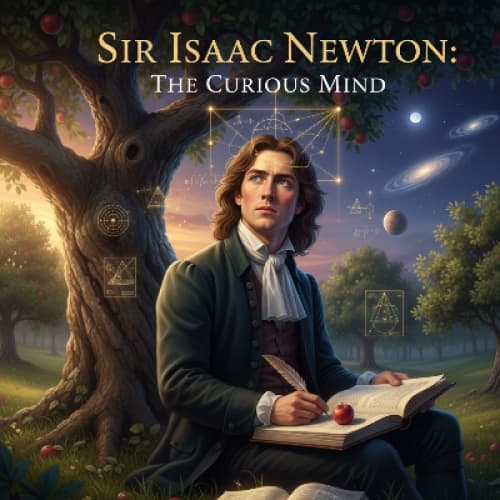
One afternoon, as Isaac sat beneath an apple tree, pondering the mysteries of the universe, an apple detached from its branch and fell to the ground. For anyone else, it would have been just an apple falling. But for Newton, it was a question. *Why did it fall straight down? Why didn't it fly sideways or upwards?* This seemingly trivial observation ignited a profound chain of thought.
He began to consider that the same force that pulled the apple to the Earth might also be the force that kept the Moon in orbit around the Earth, and the planets in orbit around the Sun. This simple, yet revolutionary idea, led him to formulate his theory of **Universal Gravitation**. He realized that every particle of matter in the universe attracts every other particle with a force directly proportional to the product of their masses and inversely proportional to the square of the distance between their centers.
Newton didn't just stop at gravity. His years of intense study and experimentation led to groundbreaking discoveries in optics, where he demonstrated that white light is composed of a spectrum of colors. He invented calculus, a new branch of mathematics essential for understanding change and motion. His "Philosophiæ Naturalis Principia Mathematica" (Mathematical Principles of Natural Philosophy), published in 1687, laid the foundations for classical mechanics, defining his three laws of motion that govern how objects move.
Newton's story is a testament to the power of curiosity, observation, and relentless inquiry. From a single falling apple, he unlocked secrets of the cosmos, forever changing how humanity understood the universe and its workings. His brilliance shone not just in grand theories, but in the simple act of asking "why?" when everyone else saw only "what."
---