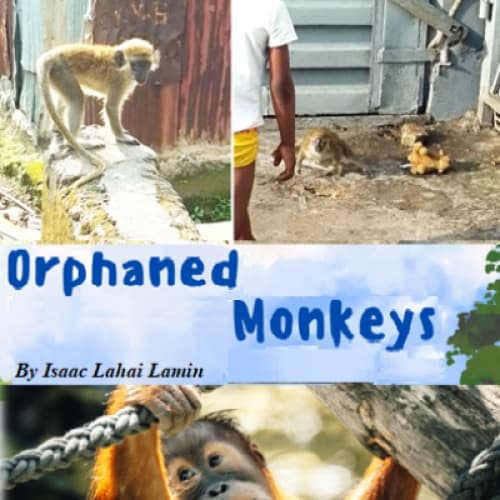

On the far end of the city of Freetown in the Tengbeh Town community, Old Railway Line, a monkey whined in distress. It raved on the cement-laden floor in front of a young boy who swooped for its catch, his clenched puffy fist sweeping in the dense cloggy air. The monkey sprinted away wriggling and whining, escaping another terror that may have ended its little life; for monkeys are expert dodgers, quick responders to stimuli. "It's a nice dam miss!", Michael giggled at the boy's naughty endeavour. "Look where the monkey has sprung to", he atoned spitting a slug of saliva in the clogged drainage. The rusty zinc house sung at the foot of the modern concrete building, providing perfect contradiction.
The monkey stood on a raised block work on the side of the zinc building, kicking in the charred vacuum, its eyes fixed on the boy, sensing an aura of unusual omen. The frosty eyes of the monkey scanned the boy cap � pe, with precision more than a modern scanning machine, its head cocked to the right shoulder. Along the compound margin, huge number of strange women and men were already drawn into the commotion, heating up the tension. The monkey survived the scourge, and the crowd rescinded in the balcony.
Two weeks earlier, I discovered another orphaned monkey in a two-storey building that houses an engineering firm at 7A Hannah Benka Coker Street. The building stands opposite the FREETOWN SECONDARY SCHOOL FOR GIRLS, about two hundred meters from the famous Siaka Stevens National Stadium. I plodded behind the gatekeeper in the backyard of the compound, my eyes following an orphaned monkey suspended on a string attached to a tree trunk leaning on the sidewall of the building; a usual playground for homegrown wild animals in Sierra Leone.
The monkey horribly flicked onto the sidewalk of the first floor, its hand clenched to a guardrail. It peered cautiously through the muddy showers of rain in the late morning hours of Wednesday as we marched oddly across the compound space. Our presence fired the flickered move of the monkey, rocking back-and-forth on the building pavement. I drew a phone from my pocket and took snapshots. The monkey weighed 12 pounds, medium-sized, with silvery green parchment dripping beneath its chin and outer belly. It was the African Green Monkey; the similitude of the monkeys trapped in the Mount Aureol forest in the western rural district. Monkeys have cohabited with humans at homes in Sierra Leone for long before the Civil War erupted in 1991. Mr. Musa Kamara, a 52-year-old man, explains why they domesticate monkeys in Sierra Leone. "The reasons for rearing monkeys at home are varied", he spoke in low tone, his eyes calm and twinkling. Mr. Musa is one of the few Sierra Leoneans with a wealth of knowledge about wild animals, having lived in the countryside for two decades. "Some people keep monkeys at home for mere fun while some do so out of necessity", he recollects. His explanation aligns with the usual views of most Sierra Leoneans.
A New Perspective
While monkeys are found in the midst of humans at homes, the essence of their domestication attracts diverse explanations. For some, having monkeys at home fires up their day, driven by the oddity of humans-monkey cohabitation. Mr. Dauda Kamara, a resident in the Western Area of Freetown, recalled how monkeys slipped into human dwellings. "Monkeys are captured and kept at homes", Mr. Kamara narrates, his eyes fixed on the gaze of my fulmination for answers. "In the homes", he continues, "monkeys provide moments of amusement for children as they hop and wriggle around, climbing up-and-down objects, while echoing rhythmic screechy sounds". Monkeys are trusted social service providers, offering temporary breeding space for onlookers and children. Monkeys, however, become victims of behind-the-scene business transactions, purchased and petted at homes as orphaned animals. Others, such as Mr. Saio Turay, see the interaction differently. Mr. Turay has seen many sunrises, now in his early 70s, with vast knowledge about monkeys. His response added rigor to the story: "Monkeys are not good for human beings, and not good for rearing at home", he cautioned, slightly giggling on the side of his lips. The opportunity in discussing the subject lighted his face with a flashing concoction of hope and despair. He had not spoken about monkeys for nearly twenty years. Back home in the northern province, Mr. Turay recalled his encounter with indigenes consuming monkeys on countless times. "For most people in that part of the country", Mr. Turay chuckles, sniffing out the words through his tightly clenched teeth, "monkeys provide the best delicacy of living memory, similar with pussy cats or dogs, or other wild animals". The mass consumption of monkeys and the hundreds of Sierra Leone Leones involved in their commercialization provide recurring impulse for the trade - ignoring monkeys' imminent extinction.
The Paradox of Humans-Monkeys Cohabitation. The Truth In-between.
In 2023, Moses N. Saigne and his colleague writers identified monkeys as having high risk of zoonotic diseases, including Mpox. The risk is espoused in the context of the population's high propensity towards consuming wild meats. Mpox first broke out in Sierra Leone on December 9, 1970, nearly three months after Liberia experienced its first Mpox case on September 17, 1970. After 21 years, in 2025, there is a resurgence of Mpox disease in Sierra Leone, claiming more than five thousand lives, and disfiguring thousands in a sweep. Despite few instances of official restrictions around wide meats consumption in the past, during Ebola and Covid 19 outbreaks, the practice is still thriving among Sierra Leoneans.
Unfortunately, there has not been any restriction on wild animal domestication in Sierra Leone, particularly monkeys, even with the outbreak of the current Mpox disease. The monkeys trapped in the home of the engineer at Hannah Benka Coker Street and the Old Railway Line in Tengbeh Town, may be deprived of their jungle lives. They are instances of many monkeys domesticated in homes, sometimes killed and consumed, or sold off in the illegal trade network.
While monkeys at homes resemble trusted partners, they are kept in an assembly line of the wild animal trade cartel growing in volume in the West Africa region. The Mano River Union States, comprising Sierra Leone, Guinea, and Liberia, exemplify a natural beauty of dense forestation with variety of wild animal species. Yet, significant number of these species is threatened as underground traders voraciously unleash the illegal trade in wild animals. Mr. Musa is one of those who believe that the trade in monkeys is pursued moderately in some areas of the northern province of Sierra Leone. "The trade in monkeys was alive before the war broke out in Sierra Leone. The practice goes on at low scale in places such as Tambaka on to Kabala Forest reserve", Mr. Musa narrated, his voice trembling. Kabala is located in the northern region of Sierra Leone with preserved forests and typical jungle lifestyle. This unbeatable forest reserve with stunning natural touristic sites makes the region an enviable spot for visitors far and wide. Here, the monkey business is now the preoccupation of the big men, unlike in the past. "Before, youths were the cardinal drivers of monkey capture, consumption and trade in the Kabala axis", Mr. Musa recalls. "Most of the young people who engaged in the practice of hunting, killing and trading monkeys and other wild animals have left for the city or travelled abroad".
In the western area where Freetown is located, one of Africa's oldest cities, monkey trade goes on in isolated communities. Mr. Dauda, a middle-aged photographer with vast experience, who hailed from the western area peninsula, testifies: "The women take off slaughtered monkeys, wholesome, place them over a fire to rip off their outer hairs, dry and bag them for sale". This method of trade in monkeys was mainly carried out by traders who travelled with them to neighboring countries, in cross-border trade. Most times, procession of truckloads of monkeys headed towards the Liberian border, passing through checkpoints manned by security personnel. About five-percent of moneys accrued from the trade fell into the pockets of Police Officers who gave free passage to those annoying entrepreneurs. Trade in monkeys has always been a mega business in this exclusive interlocking West African regional block.
Gendered perspective of wild meat consumption
Investigations show that women consume wild meats more than men in the Mano River Union countries. Evidence also shows their mass involvement in the trade than men. In the western area, more women transact monkey trade domestically, hidden away from the public purview. Due to these practices, monkeys' presence in the western area rural district has dwindled, and even disappeared in some notable locations. The western rural peninsula is one spot where the African monkeys are scared away by human settlement creation, consumption of wild animals, and trade run by organised transnational criminal network. Mr. Dauda is well familiar with the schism surrounding trade in wild animals in the Peninsula area: "When we were kids, monkeys used to come into our compounds and the villages at Gloucester, Regent, and Kent", he smoldered under his breath as he watched the busy crowd disappeared slowly around us. The time was maturing deep into the night. "But there are no monkeys close to those settlements anymore. They have been driven off". Mr. Dauda said these last words as his voice collapsed into the noisy crowd. Part of the problem monkeys have faced emanates from the systemic depletion of the forest cover which was once about c. 51,800 ha. While few monkeys cohabit with humans in the backyards of some residents, others often run out of luck.
Where has the Monkey population gone?
As monkeys attract the eyes of humans, they become victims of the scourge of wild animal demand, leading to drastic reduction in their population. Within the urban towns and cities, the scarce presence of monkeys is visibly alarming; yet days pass by in silence without mentioning the need for legislations about wild animals, especially in the thick of the dwindling monkey population. Since the end of the civil war in 2002, the track of monkey presence has dimmed inexorably due to the frivolous attention given to them. The vendetta does not stop at orphaned monkeys captured and restricted at homes; the entire population has been a target. Actual figures about the monkey population are scarce, exemplifying the historical injustice that has proliferated the monkey kingdom and all wild animals in the Mano River Union countries. Pioneers of past national censuses ignored monkeys or other wild animal species. Law makers have equally ignored this life-threatening issue in Parliament: "No regulation for monkey consumption exists in Sierra Leone!!", a man (preferred to be anonymous) working at the Ministry of Environment hummed in animosity. Part of the problem also lies in societal and cultural belief, considering wild meats as perfect delicacies and status respectability. Moses N. Saigne and colleagues particularly hold this belief: "The choice for wild meat consumption is determined solely by the taste and status symbol among Sierra Leoneans". In this mad preference for wild meat consumption in the Sierra Leone society, threat level against monkeys in the western area and the provinces is mounting, despite efforts to strengthen and scale up habitat protection through inter-agency collaboration and law enforcement.
Systemic Neglect: Monkeys at Crossroads
The silence of law enforcement for monkeys has defined the fight to protect wildlife against illegal trade network. Among the existing wildlife species in Sierra Leone, Chimpanzees are the only animals that are increasingly protected against illegal poaching and targeted trafficking hotspots. This bias is due mainly to the similitude in the biological formation of chimps and humans than monkeys. The preference for chimps remains the cornerstone of government's approach in protecting wild animals in Sierra Leone: "Chimps are one endangered species that has captured our hearts, because of their intelligence, closeness to human DNA, and their playfulness", a government officer spoke gently. Monkeys fall outside of this evolving strategy, in the midst of increased victimization. Ironically, monkeys are the only wild animals which are relatively attached to humans, domesticated at homes without posing major danger to human security. "You can't try that with chimps", Mr. Dauda fires. In the year 2014, Bruno, one of the chimps which escaped from the Tacugama Sanctuary, killed a man along the highway leading to Morgegba community in the western rural district. The incidence sent shockwaves across the western area causing panic and fear.
New Obligations
The burden to protect monkeys and other wild animal species is ignored amidst frightening possibility of the monkey species extinction. Urgent actions must be taken to correct the missing link in the wider biodiversity protection drive. As the country braces to conduct its next census in early 2026, it is imperative to consider quantifying the monkey population and their diverse strata, and to map out hotspots of their presence. Homes where monkeys are kept as pets must be identified and measures taken to get them back into their natural habitat with maximum protection, or ensure that they are not harmed or fall victim of human consumption within the broader wild animal trade network. Legal frameworks regulating the interaction between monkeys and humans must be prioritized with penal codes. Monkeys must feel safe in Sierra Leone so that the next generation will experience their presence far and wide.
References
M. N. Sainge et al. 2023. Published by Cambridge University Press on behalf of Fauna & Flora International doi:10.1017/S0030605322000990 https://doi.org/10.1017/S0030605322000990 Published online by Cambridge University Press.
Millar, J.D. 1971. SPECIAL REPORT Fcbruary RAM. Human Infection with Monkeypox Virus: Liberia and Sierra Leone. CENTER FOR DISEASE CONTROL. SMALL POX ERRADICATION PROGRAM. VOLUME V, NUMBER 1.