
Dilshan was, by any usual criteria, a success. Still only thirty five, he was the conductor and director of a highly praised orchestra that he had himself helped to establish. This is not something he could have imagined when, thirty years before, he’d asked his father – a schoolteacher in Belihuloya - to buy him a simple wooden flute. When the family moved, sometime later, to Kandy, the flute of course went with him.
Certainly he had come a long way since the day when a distinguished English musician, holidaying in Sri Lanka, heard the fifteen year-old boy playing the flute in the garden of a luxury hotel in Kandy. The Englishman had been so impressed by Dilshan’s playing that, after discussion with the boy’s father, he arranged for him to have lessons from a flautist in the Symphony Orchestra of Sri Lanka. On a subsequent visit to Sri Lanka, the Englishman was so convinced of Dilshan’s talent that he helped to secure him a scholarship at the Royal Academy of Music in London.
When Dilshan left the Academy, he was immediately offered a position in a chamber orchestra in the north of England. Although he enjoyed playing – especially flute concertos by Mozart and C.P.E. Bach – he was increasingly attracted to the idea of conducting. On several occasions he stood in for the regular conductor of the chamber orchestra and was also invited to conduct other concerts in the region. Within a couple of years, he developed a reputation as an imaginative and energetic young conductor.
It was then that he received an offer to return to Sri Lanka and help to establish a new orchestra. A group of wealthy businessmen had decided that the country should surely have more than one classical orchestra and were willing to invest in a new one. The orchestra would be located in Galle. Concerts, they believed, would be attended not only by local people but by many visiting tourists, especially during the period around the annual literary festival.
Dilshan had no hesitation in accepting the offer. Despite the rewards and satisfaction of his career in England, he badly missed being away from his home country. Within a month of returning, he was busy assembling a brand new orchestra – the Galle Sinfonia. Its thirty players were a mixture of young Sri Lankans at the beginning of their careers and a small number of musicians from Australia and Europe. Dilshan was especially pleased to welcome Sven, a fifty year-old and well-known Swedish trumpeter, who’d decided that the remainder of his playing days would be spent in a warmer climate than Stockholm’s.
The Galle Sinfonia, located in a converted old Dutch building in the Fort, was instantly successful. The investors had been right: visitors from around the world who were staying in Galle’s many hotels were keen to attend the concerts and enjoy the champagne suppers that followed. Dilshan was free to conduct whatever music he wanted and happy to find himself leading a group of enthusiastic musicians with a sense of mission – to promote in Sri Lanka a love of Western classical music. He was happy, too, at developing a relationship with a young cellist, Devika, only recently graduated from a music academy in Australia.
Three years later, now thirty five, Dilshan found it hard to explain, even to himself, why he left the orchestra, abandoned his career, and returned to place of his childhood. The process of disillusion and dissatisfaction had been gradual. What sparked it, he recalled, was reading some remarks by two composers he greatly admired – Debussy and Takemitsu. Both men expressed nostalgia for times when music had been close to nature and the hope that, in their own compositions, they might inspire in people a sense of unity with nature. Dilshan then learnt from other books and websites that there still exist tribal societies whose music interacts with the sounds of nature – of birds, animals, running water, wind in the trees and raindrops striking the ground. Theirs is a music that honours the origins of music as something that resonates with the sounds of natural environments. Certainly, in his own case, it had been the songs of the birds in the forest near his childhood home that had been his inspiration to take up the flute. He wanted to be able to join in with this singing.
Dilshan became sure that what he needed was to become part of a great orchestra of nature, not the orchestra of men and women that he now conducted. There was one concert in particular that confirmed for him this need. Cocooned inside an air-conditioned concert hall and insulated from the sound of the sea and the wind, he conducted a programme of music by Haydn and Mozart – sophisticated music belonging to a century very different from the present. Dilshan was sure that only a fraction of the audience, dressed in their evening finery, could properly appreciate the music. After the concert was over, he mingled – as he was obliged to do - with the champagne drinking men and women who, when not on their mobile phones, were chatting and laughing. They had, it seemed, already forgotten the music they’d just heard.
Dilshan was struck by the artificiality of it all. The music he conducted, week after week, had been sucked into a modern, technological age – an age of artifice and fashion. Much of what he conducted, Dilshan knew, was great music, but he could no longer abide the kind of world into which it had been absorbed. He would seek out, he decided, a very different, more natural world, and play a music that belonged to it and not to a world of concert halls, recording studios, air-conditioning and smartphones.
The following day he handed in his resignation to the trustees of the Galle Sinfonia. There was nothing any longer to keep him in Galle. His relationship with Devika had ended a couple of months earlier when he discovered that, while he was guest conducting in India, she had spent two weekends in a hotel with Sven, the trumpeter. Dilshan felt no animosity towards either of them, and indeed experienced a sense of relief. He would no longer have to explain to Devika why he would be leaving Galle.
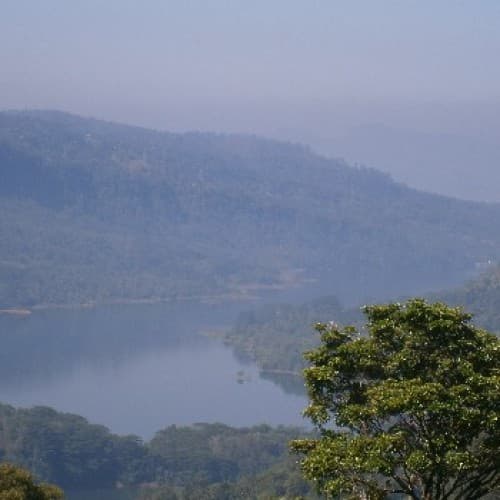
Dilshan knew precisely where he would begin his new musical life – in a hilly forest close to his childhood home a few kilometres from Belihuloya. He spent three days, while staying at the local Rest House, looking for a suitable home to rent. He chose a small bungalow reached by a long, steep narrow track that snaked down a hillside. As he stood on the terrace at the back of the bungalow he could see, to his left, a paddy field beyond a scattering of frangipani and oleander bushes. From the bushes, a stony path led own to a small river beyond which another hill rose up. Directly in front of the terrace was the forest, and such was the steepness of the terrain as it dropped towards the river, that the tops of some trees were almost at eye level. As he watched and listened to the many birds that flitted among the trees and bushes, Dilshan knew that here was the place he would now live.
Early in the morning after the day on which he moved into the bungalow, as the sun rose above the paddy field, Dilshan took his flute – the one his father had bought for him thirty years earlier – onto the terrace. Already the birds were busy – flycatchers and bee-eaters twittering as they hunted, sparrows tweeting as they flew in and out of their nests under the eaves of the bungalow, a flock of babblers chattering as they scurried about on the ground, coucals and myna birds calling from among the trees. When Dilshan began to play a traditional tune on his flute, the birds – puzzled by this new sound = fell silent, as he had predicted. He knew that it would be days, weeks perhaps, before they accepted the sound and began to adjust to it.
Over the following days, more and more birds began to lose their fear, recover their voices and not only accept the sound of the flute but respond to it – just as Dilshan’s playing responded, in turn, to the sounds of the birds. After a month,he had in front of, around and above him a whole avian orchestra. Like the instruments in a symphony orchestra, the voices of the birds were at many different pitches. In the highest register were the trills and tweets of the smallest birds, including the flycatchers, bee-eaters and sparrows. Tuned to a lower pitch were sounds made by larger birds, like the koels and coucals. Deeper still was the cooing of spotted doves and woodpigeons.
Dilshan was delighted, not just by the range of pitches, but by the variety of timbres. The shrieking of the parakeets, the cawing of the crows, the whistling scream of a serpent-eagle, and the chuntering of the babblers were just a few of the distinct sounds he could hear. There was a wealth of difference, too, in the structure – the dynamics – of the sounds. At one end of the scale was the single note constantly repeated by the sparrows. In between were the steeply rising call of the myna birds and the ascending-then-descending call of the black-hooded orioles. At the far end of the scale were the tunes of the virtuoso songsmiths, the magpie-robins and white-rumped shamas – songs that, it seemed to Dilshan, these birds could vary and improvise upon at will, just as he could on his flute.
Each morning, unless there was heavy rain, Dilshan would start the concert at 6.30 by playing a simple melody. At first a few birds would join in, but within minutes, the whole avian orchestra was cooing, whistling, squawking or singing in response to the sounds he made – just as the notes he then played were in response to the sounds of the birds. The forest, the paddy field and the river banks were, for a whole hour, alive with song. The concert over, the birds would return to their daily routines of feeding, squabbling, nesting, mating and sleeping.
Dilshan was delighted and moved by the music he was directing, but there were, he felt, some important elements missing. Lacking, for instance, was a percussion section. A solitary woodpecker hammered away at the trunk of a cashew tree, but the sound wasn’t loud enough, and anyway the bird’s attendance was sporadic. Again, there were no bass voices to lend depth and richness to the orchestral sound.
The problem, of course, was that the music was confined to the sounds of birds. Some other animals, it is true, reacted to the music by making various noises, but not in a way that integrated with the avian music. For example, the macaques that swung each morning from branch to branch in the forest would grunt or squeal, but – Dilshan felt – more out of annoyance at the noise than a desire to join the orchestra. The cause of the problem, he realised, was that the sounds of his flute, while perfectly suited to inspire the birds, were not right for attracting other animals.
After a long telephone conversation with a music shop in Kandy that specialised in traditional instruments, Dilshan drove, a few days later, to collect what he had ordered from the shop. While in Kandy, he had dinner with his parents and tried, unsuccessfully, to explain to them why he had resigned from his position with the Galle Sinfonia in order to lead an orchestra of birds and animals.
Dilshan returned from Kandy with a small double-handed drum, a conch-shell, a three-stringed violin made of bamboo and coconut, and a double-reed oboe-like horanawa. To add to this collection, Dilshan selected a gourd and made notches on its surface: when a stick was run over the notches, it made a percussive rasping noise. The following morning, he took these new instruments, along with his flute, onto the terrace. Once the chorus of birds was in full voice, Dilshan experimented with the drum and the gourd. At first, as with the birds earlier on, the rhythm made by these instruments had little effect. But within a week, it had changed. Bullfrogs, crickets and geckos were croaking, chirping or clicking in perfect time with Dilshan and with one another. He now had his percussion section.
The following week, with the birds and the percussive animals already sounding out, Dilshan played a tune on the horanawa. As he predicted, its abrasive, shrieking sound was ideal for prompting the macaques to screech and bark in reply. As an unexpected bonus, the sound of the instrument also prompted the muntjac deer that lived across the river to respond with their high-pitched barks.
The week after that, it was the turn of the three-stringed violin. This had the right timbre, Dilshan hoped, to resonate with the many squirrels that lived high in the trees. He was right: within a few days the vibrating squeaks of the instrument were being echoed by those of the squirrels – the higher pitch of the palm squirrels harmonising nicely with the lower pitch of the giant squirrels.
Finally, Dilshan brought the conch-shell onto the terrace and blew into it as powerfully as he could. For a while there was no response, but then, from the hill on the far side of the river, came the howling of jackals, a mournful sound perfectly attuned to that of the conch-shell. But the best was yet to come. A few minutes later, Dilshan heard the trumpeting of two elephants, coming from the northern tip of the Uda Walawe National Park that lay just a few kilometres below the bungalow. Perhaps they were beasts who had, when younger, walked in peraheras and were accustomed, therefore, to the blasts of the conch-shell.
Dilshan’s orchestra of nature was now complete. Each morning he would go onto the terrace with his collection of instruments. He would blow his flute, conch-shell and horanawa, scrape at his violin and notched gourd, and thump his drum. In return he was greeted by a great wall of sound. Above, below and all around him were the sounds of the animal world, of hundreds of birds and of creatures of every size, from crickets to elephants. Here was an experience of sound that dwarfed even the most memorable moments Dilshan had known in his career as a conductor. Orchestras three times the size of the Galle Sinfonia could do nothing to match the richness of this great animal orchestra, with its combination of tweets and twitters, squeaks and squeals, rattles and rasps, bellows and barks, howls and hoots.
Then something happened that, for Dilshan, was truly wonderful. He had spent the day in Kandy, visiting his still uncomprehending parents, and arrived back home late at night. Because of this, he overslept. What awakened him was not, as normally, the rays of the sun through the shutters of his bedroom window, but the sound outside. He quickly tied on a sarong and hurried out onto the terrace. The birds, squirrels, deer, bullfrogs, jackals – all of the creatures – were in full song. And the beautiful thing was that they had not needed Dilshan to start and conduct them. Instead they had come together in a spontaneous chorus of sound, in a joyous epiphany of nature. Dilshan did not need to play his instruments: instead he sang … and sang and sang, his song rising and falling, speeding up and slowing down, loud then soft then loud again, in harmony with the song of the great chorus around him.
A year after Dilshan had left Galle, Devika and Sven, now married, were holidaying near Belihuloya and decided to visit him. They knew he lived in the area and, when they inquired at the Rest House, were told how to find his bungalow. They drove down the narrow track to the bungalow, but there was no response when they knocked on the door. In fact, the place looked as if it was closed up. When they spotted an old man chopping some wood by the edge of the paddy field, they approached him and asked if he knew where Dilshan was. The man said nothing, but shook his head and pointed in the direction of the forest.
Devika and Sven took the path down towards the river but could see nothing of Dilshan. But if they had looked upwards and been able to peer through the dense foliage of the trees, they would have seen Dilshan. He was now, as he was every day, sitting astride a branch, naked and with his flute hanging from a cord around his neck. To his left sat a giant squirrel and to his right a pair of crows. Had Devika and Sven been there an hour earlier, they would have heard coming from the branch music that blended into a great festival of sound that filled the forest and rose to the sky.