


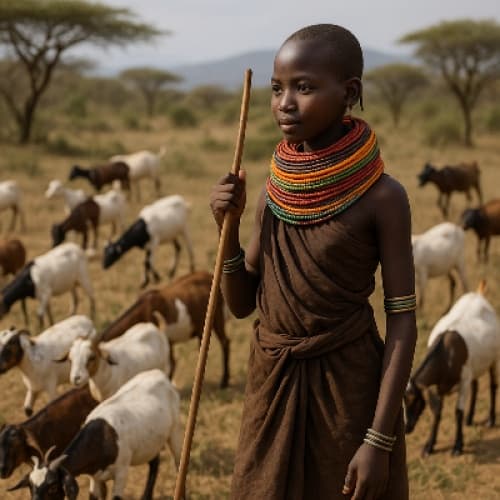
Nayece of Silale
In the dusty stretch of Silale village in Turkana North, where the sun painted the earth in gold and red, Nayece was born under the wide, open sky. Her father, Lokwawi, was a respected elder — stern, proud, and deeply loyal to the traditions of the Turkana people. Her mother, Akiru, was gentle but equally firm in upholding the ways passed down through generations. Education, especially for girls, was seen not just as foreign but dangerous. “White man's knowledge will teach girls to forget their culture,” Lokwawi would say. “A girl must learn the ways of our people, not the ways of strangers.”
Nayece, the third child and only daughter, grew up herding goats with her older brother, Ekal, and listening to stories by firelight. Her life was predictable, bounded by unspoken rules: respect your elders, stay within the village, and never, ever think of school. But curiosity has its rhythm. Nayece sometimes will pretend that she is the teacher and the goats are her students. She will keep repeating words that she heard from a classroom in the nearby school to the goats and answering back.
Every market day, when traders passed through Silale, Nayece would listen from behind a makeshift stall as children from nearby towns chattered about school. Pencils. Notebooks. Reading. Writing. Laws. Rights.
One day, a government officer stopped in the village to distribute relief food. Nayece overheard a conversation about scholarships for pastoralist girls. Her heart beat faster. That night, she asked Akiru, “Mama, what is a lawyer?”
Akiru looked away. “Someone who speaks in court. Someone who lives far, in Nairobi. Not for us.”
But the seed had been planted.
Over the next months, Nayece found a way. She secretly learned to read from torn books left behind by aid workers. When herding goats, she scratched letters in the dust. Eventually, with the help of a community health worker who noticed her sharp mind, she applied for a bursary without her father’s knowledge. At thirteen, she left for Lodwar with nothing but a second-hand dress and a notebook tied with a string.
Her father didn’t speak to her for two years.
But Nayece pressed on. Secondary school. Then she joined a university in Eldoret to study a diploma in law. And finally, a law degree at the University of Nairobi. She studied at night, worked odd jobs, and never let go of her mission.
At 25, she returned to Silale, not as a girl with questions, but as Advocate Nayece Lokwawi. Her first case? Helping her family win back land they had lost to a corrupt deal. Her second? Defending a girl from forced marriage and winning.
Today, Nayece runs a legal aid clinic in Turkana North, helping dozens of girls access education every year. Her father, now older and quieter, sits beside her during community meetings, proud but still puzzled.
“I wanted to protect you,” he once told her.
“You did,” Nayece smiled. “You just didn’t know it yet.”