Well, Gentle Reader, here we are. I’m new here, so please forgive me if I’m awkward as I explore this space. After four decades of writing planning reports with such exciting titles as “A Benefit/Cost Analysis of the Potential for Development of a Tourist Railroad Between Smithton and Jones City,” I’m having fun in my retirement using my skills to write fiction. Here’s a sample of my style.
I have always envisioned this story as the opening of a book and, indeed, as the opening of a series of books. With that beautiful number of the beast available, it’s not like I’ll ever run out of places to explore. So, I make this naked plea. If you like this chapter and would like to see how Blaine, Madge, and the crew fare, let me know. Otherwise, I’ll explore other story ideas.
Thanks in advance,
Dave
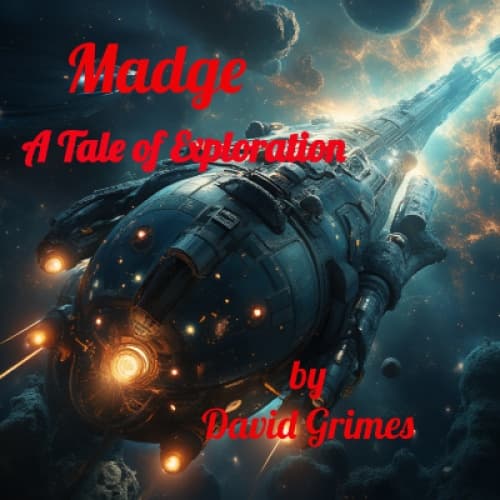
MADGE: A Tale of Exploration
“Once you postulate infinity, not only can anything you can imagine happen, anything you can imagine must happen.”
Anonymous
Chapter One
“Nobody can hear you scream in the vacuum of space,” or so they say.
I suppose that’s true, at least in the most technical way. Hearing, after all, is a well-understood biological process. Rapid changes in air pressure cause tiny vibrations in the eardrum, the tympanic membrane. A bunch of stuff happens then, tiny bones vibrate and amplify the microscopic pressure waves, the ossicles if you care about the nomenclature of such things, and then to the fluid-filled inner ear, the cochlea, with tiny hairs, they’re called cilia, and they stimulate nerve endings. Then that computer between your ears gets to work and translates all of that into sound. Of course, if there’s no air, there is no pressure change to start the process.
So, on balance, yeah – nobody can hear you scream in the vacuum of space.
It’s odd, the way your mind works when you’re waking after a transition. You think about things like that. Nobody really understands why it happens, but it does. Something to do with thinking. The way you go about it can be biological or electronic. It doesn’t bother non-thinking systems. Motors work fine after transition. Switches switch, valves open and close, computers still operate. It doesn’t bother recording devices. Everything shows normal except that tiny jump in the record when the transition occurs. But thinking, sentience, cognition, reasoning, pick your label, gets scrambled and it takes a few minutes to recover if you’re biological. If you’re an AI, you’re in for a long, complicated rebuild and you may never be quite the same if you transition while awake.
But as long as you’re sleeping when the transition occurs you wake, feel a little weird for a while, and you’re back to normal. Maybe someday somebody smarter than me will figure out why it happens. For me, I don’t care. It works and therefore, as far as I’m concerned anyway, it’s right.
Not that it mattered. We were in space, dimension ὧ287,394 according to the Universal Burroughs Log, but not in a vacuum. The hull integrity was secure. At least Madge wasn’t yelling about an emergency.
“Madeline,” I said, waking her, “post-jump status check.”
She yawned, noisily, the sentient AI’s way of filling time while she fully booted up.
I waited.
This was one of the unanticipated consequences of the Burroughs Drive, the way it tended to scramble artificial intelligence circuits if they were awake during the transition. It was one of those painful lessons learned during those first explorations, including the first four explorers who were never heard from at all after they left.
Before any pilot is checked out on Burroughs Drive operations there is a required course on the history of its development. I don’t know why, and I was bored out of my skull during those classes, but it was required, and so I took it. I had learned of Jake Burroughs's n-dimensional theories that had culminated in that wonderful Number of the Beast, (6^6)^6 which writes out to 10,314,424,798,490,535,546,171,949,056. Call it ten gazillion and you’re close enough. Not infinity, but one hell of a big number, each of which represents a separate universe with its unique history and cosmology. Big enough that I'd be happy to cover a bet that we would, eventually, run across that universe where a zillion monkeys working on a zillion word processors eventually produce a letter-perfect volume of the complete works of Shakespeare (whoever that might have been - it's an expression, not history).
The Burroughs Factor was an interesting mathematical concept, nothing more, for decades. Some of the brains tried to link it to string theory and quantum physics, but it took the development of Rearden Metal and the Galt Motor before any practical applications were found. Remember, this was ancient Earth, you know, that “home planet” of folklore. They were still operating on nuclear power or, if you can believe this, burning fossil fuels to make steam. No, I’m not kidding here.
Anyway, that’s what the tales I heard said.
They really had no idea what they had. It was like a bunch of monkeys had stumbled onto electricity before they managed to handle fire. They didn’t understand how Rearden Metal locked interstices at the quantum level or that the Galt Motor pulled energy directly from the quantum foam. But they were great experimenters and fearless tinkerers. They managed to make it work.
Well, except those first four who never came back. The fifth ship had a computer expert on board who managed to nurse the third-generation AI, a barely sentient moron, back to life and get back. So here I was, waiting, as Madge, the 157th generation of AI from those poor idiots back then, was waking up.
“Yes Blaine,” she said, indicating she was fully awake.
“Post-jump status check,” I said again.
There was a fractional pause while she ran about ten million tests.
“Electronic systems 99.7 percent effective, three-tenths of one percent down for maintenance.
Drive system nominal. Two percent down for maintenance.
Hull integrity 99.8 percent.”
“Gotcha,” I said, relaxing. I was always a little tense after a transition.
“Ummmmm, Blaine, honey,” she said, and I knew there was a request coming.
“Yes, Madge?” I replied, keeping things relatively formal. I know she prefers "Honey" or "Sweet Cheeks," but she was going to ask for something, so I used her name, albeit the shortened, familiar version.
“Please fix that leak at the number four antenna aperture. It gives me an itch.”
I chuckled and said, “Will do. Remind me after I get the others up.”
The Burroughs transition bothers biological minds just like it does AI, so we all sleep through it. I made the rounds. Sal, the toughest human being I ever knew, not to mention being a wizard around anything electronic or mechanical was stirring. Kra’al, the Sendorian, was curled, tail wrapped around protectively. I gave the bunk a gentle nudge with my foot, dancing away as soon as I did, making sure I was clear when that powerful tail snapped out in a reflex.
Madge sent a scratching sound over the speakers, her way of reminding me she had an itch.
While the others were starting to shake off the transition haze, I touched the right spot and the opening to the cabinet dematerialized. I got out the leak kit.
Some things never change, and this was one. I could picture those early pioneers using a similar kit as I pressed the smoke pack and spotted the pinhole in the antenna seal that was making Madge itch. The seal itself wasn't a part of the ship's body so Madge couldn't just materialize a fix. Instead, it needed the old-fashioned approach. I squeezed a little drop of the leak sealer, basically some glue, where the smoke spiraled up and out. A little spritz from the activator and it was done.
“Thank you, Blaine,” Madge said.
“You’re welcome, Sweet Cheeks,” I replied.
I set water to heating for coffee for me and Sal and some of that green stuff Kra’al drinks, his planet’s equivalent of coffee.
“Well, Madge,” I asked, “what’s the word here in good old ὧ287,394?”
“Scanning, Blaine,” she replied.
“Preliminary analysis - standard universe. Hydrogen elements everywhere. Stars dispersed into definable galaxies. The nearest star is a little over five light-years distant. Boy, that was close. Scanning all spectrums for signs of communications.”
That’s the thing about being the first into a new universe. You literally never know what you’ll find. There were some in the record that had nothing in them. Truly nothing. Not even some loose hydrogen. Those who think about such things thought these were universes, and there weren’t many of them, where the Big Bang never, well, went BANG! Some were the opposite, nothing but random hydrogen. Maybe in the chaos following the Big Bang in them, nothing had coalesced. That’s the thing about chaos. It’s, well, chaotic and pretty much anything that can happen, especially when you’re talking about ten gazillion possibilities, will happen.
Most were like what Madge was reporting. There would be stars and galaxies and hydrogen everywhere. Where there were stars there would be planets and where there were planets there would be life. Well, where there were planets in that sweet spot that had liquid water there would be life. If it was a planet with a moon and tides, life would have found its way onto land after a bazillion or so times when all of the sea creatures stranded in tidal pools had died. Eventually one would make it. Evolution may be a harsh bitch, but life always finds a way around her.
Even on planets not in the sweet zone, there might be life. One universe, I forget which one, has silicone-based life that had formed on an airless moon – the science guys are still trying to figure that one out. One universe had life that was nothing but electrical charges floating in a huge charged ball. Infinity, or anyway the ten gazillion chances we know of so far, means there are lots of surprises.
This was our job. We jump in using the Burroughs Drive, wander around using the Alcubierre Drive and sample a few dozen stars, look around for stuff that might be useful, and move on. If we found life, we would drop down and look. We hadn’t hit the jackpot yet. Once in a while, an explorer would. The pill that cured every form of cancer came from a common weed over on an obscure planet in universe Σ78,338. Now THAT discovery had made that explorer fabulously rich. I mean FABULOUSLY rich. I read somewhere he bought an entire planet. We were doing okay though. We had found a half dozen planets with the potential for colonization and the bonuses kept us comfortable if not rich. When the race is on the upward swing of the Malthusian chart, new planets are valuable.
“Thanks, Dear,” I said, always aware that she liked to be stroked a little, “keep us posted while your crew gets it together.”
“You know,” she said, “if you’d get me that body you keep promising me, I could take care…”
“What?” I asked. She never stops in mid-sentence.
“Well now, this is interesting,” she said.
Chapter Two
“Madge?” I asked. In my 22 years with her since I bought the ship she had never, not once, stopped in mid-sentence.
No response.
“Madeline 1213,” I said, using her full name, well, the full ship registration name, “report.”
“Blaine, I’m being bombarded on every…” and she broke off.
I had no idea what was happening so I invoked a never-before-used emergency protocol.
“MADELINE! BLAINE SAYS THREE TIMES! SCRAM! SCRAM! SCRAM!”
This was a preprogrammed response that had her transition us to our last universe.
My head exploded. Well, okay, it didn’t really explode or I wouldn’t be able to write this, now would I? But that’s damn sure what it felt like.
I woke up….
No, let me start that again.
I came to in the fetal position. My cheek was in a pool of vomit and the smell told me that wasn’t the only way my body had reacted to being awake during transition. I got up onto all fours, my head hanging, and struggled to breathe.
I could almost feel my brain rebooting.
“Blaine,” yeah, that was my name. Okay, there was something to hang onto.
I swiveled my head on my neck, looking around.
A woman, flat on her back, arms out. Obviously unconscious, she was breathing, well, snoring in a deep bubbly way.
And a lizard. But not a lizard. But green. With pebbled skin and a thick tail. It looked dead, its
tongue lolling to the floor the way it was laying there.
Space. Yeah, that was it. I was in space, in a ship.
I went out again.
Well, folks, have I piqued your interest? Let me know if you would like to see just what happened to Blaine and his crew. And what about Madge? Can she be recovered? Repaired? Rebooted?